What Is Halal Investing? The Complete Beginner's Guide (2026)
By Akinda · 2026-05-05
Table of Contents
- 1. What Is Halal Investing?
- 2. Why Does It Matter? The Numbers Behind Islamic Finance
- 3. The Two Core Prohibitions: Riba and Gharar
- 4. What Industries Are Non-Compliant to Invest In?
- 5. The AAOIFI Financial Screening Ratios Explained
- 6. What Is Dividend Purification?
- 7. Common Myths About Halal Investing
1. What Is Halal Investing?
Halal investing is the practice of building wealth through financial instruments - stocks, funds, bonds, or other assets - that comply with Islamic law (Shariah). The word halal (حلال) simply means "permissible" in Arabic, and in the context of investing, it describes any financial activity that avoids what Islam prohibits: interest (riba), excessive uncertainty (gharar), and industries considered harmful or immoral.
At its core, halal investing is not a niche workaround or a compromise. It is a complete, principled framework for building long-term wealth - one that has been practiced for over 1,400 years and that today governs trillions of dollars in global assets.
A halal investment must satisfy two tests simultaneously:
- • Business screen: The business itself must operate in a permissible industry.
- • Financial screen: The company's financial structure must fall within defined ratios for debt, interest income, and cash.
Halal investing = permissible industry + compliant financial ratios. Both conditions must be met. A company making 100% halal products but financed entirely through interest-bearing debt would still fail the screen.
2. Why Does It Matter? The Numbers Behind Islamic Finance
Many first-time Muslim investors assume halal investing means sacrificing returns or limiting options. The data says otherwise.
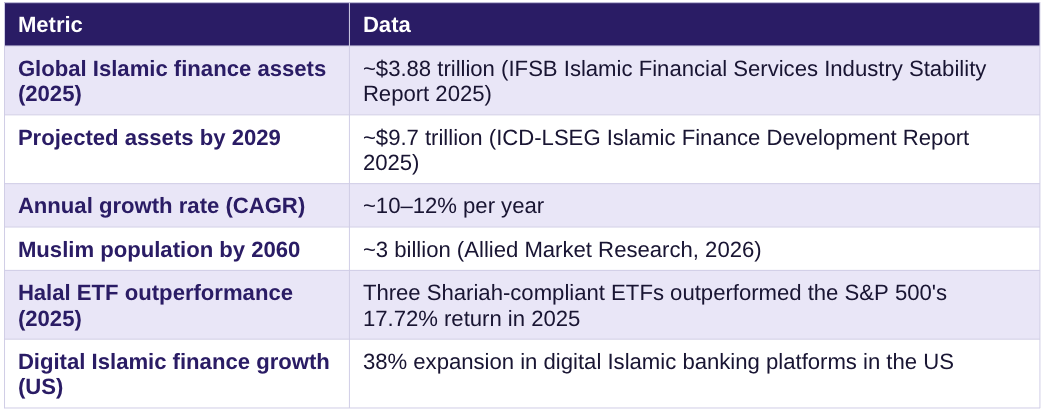
These figures reveal a structural shift: halal investing has moved from a niche religious practice to a mainstream, multi-trillion-dollar global asset class. For Muslim investors, this is both a validation and an opportunity. The infrastructure - screeners, funds, platforms - is more accessible today than at any point in history.
3. The Two Core Prohibitions: Riba and Gharar
Riba (ربا) - The Prohibition on Interest
Riba is the Arabic term for any predetermined, guaranteed return on a loan or financial instrument, which we commonly call interest. In Islam, riba is strictly prohibited, because it creates unfair advantage and leads to injustice in financial dealings. Islam only allows profit when it is tied to real economic activity and shared risk.
In the context of investing, riba matters in two ways:
- • A company that borrows money at interest (debt financing) introduces riba into its capital structure.
- • A company that earns interest income - through bank deposits, bonds, or lending - generates haram revenue.
This is why halal stock screening examines not just what a company does, but how it is financed. A perfectly halal business, a technology company with no problematic products, can still fail a halal screen if it carries too much interest-bearing debt.
Gharar (غرر) - The Prohibition on Excessive Uncertainty
Gharar refers to transactions involving excessive ambiguity, uncertainty, or speculation. It is the principle that makes options contracts, futures, and most forms of derivative trading impermissible in Islamic finance - you cannot sell something you do not own, and you cannot profit from a contract whose outcome is fundamentally unknowable.
Gharar is why day trading and speculative short-selling occupy contested territory in Islamic finance, while long-term equity ownership in compliant companies is broadly permitted. When you own a share, you own a real proportional stake in a real business, which is genuine economic participation, not speculation.
Islam does not prohibit profit or wealth creation - it prohibits exploitation, uncertainty, and profit without risk. Equity investing, done correctly, is perfectly aligned with Islamic values: you share in a company's real economic risk and reward.
4. What Industries Are Non-Compliant to Invest In?
The first gate in any halal stock screen is the business activity screen. No financial ratio can "fix" a company whose core business is prohibited. The following industries are categorically excluded:
- •Conventional banking and insurance (interest-based financial services)
- •Alcohol production, distribution, or retail
- •Tobacco and tobacco products
- •Pork and pork-derived products
- •Gambling, casinos, and gaming platforms with real-money betting
- •Adult entertainment and pornography
- •Weapons manufacturing for civilian harm (controversial defense contracts)
- •Cannabis (recreational; medical cannabis is permitted by many scholarly bodies)
Companies whose primary business is in the above sectors are excluded entirely, regardless of their financial ratios. A beer company with zero debt is still haram.
Many large companies operate in multiple sectors, which creates gray areas. A technology company that earns 2% of its revenue from a conventional banking subsidiary is treated differently from a bank. This is where the financial screening ratios - specifically the 5% impure income threshold - come in.
5. The AAOIFI Financial Screening Ratios Explained
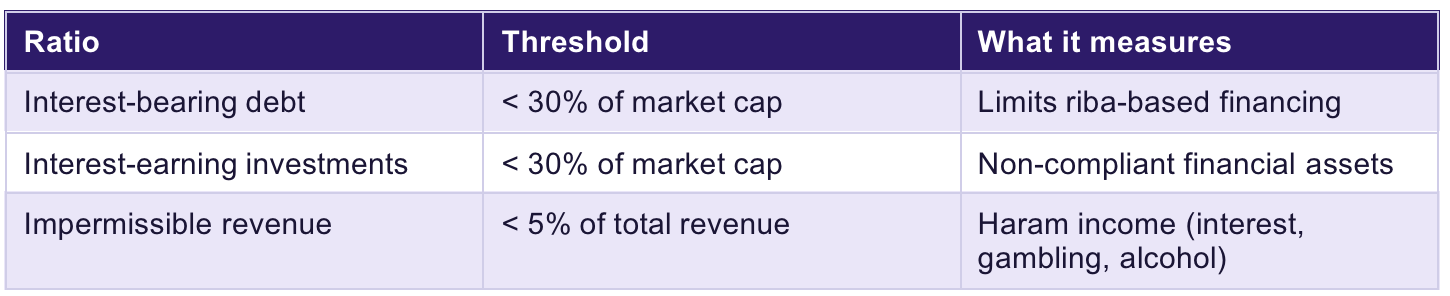
Once a company passes the business activity screen, it must pass a second layer: financial ratio screening. The most widely adopted global standard comes from the Accounting and Auditing Organization for Islamic Financial Institutions (AAOIFI), which issued Shariah Standard No. 21 in May 2004.
AAOIFI applies three key financial ratios:
Why 30% and 5%? The Historical Context
These thresholds were not arbitrary. In the 1990s, senior Shariah scholars, including Mufti Muhammad Taqi Usmani, grappled with a practical reality: almost no publicly listed company in the modern economy is completely free of any connection to interest-based systems. Banks, for example, are unavoidable counterparties in commercial transactions.
The 30% threshold (derived from the Islamic legal principle of one-third as a maximum) represents the tolerable level of indirect, unavoidable exposure - not an endorsement of interest. Scholars noted that exceeding this threshold would mean the company is fundamentally dependent on riba-based financing, which crosses from indirect exposure into structural reliance.
The 5% impure income threshold recognises that a technology company earning 2% of its revenue from interest on cash deposits is fundamentally different from a bank. The 5% limit requires the investor to purify that small, incidental portion through charitable donation.
Important Note
AAOIFI uses market capitalisation as the denominator for debt ratios. Some other standards (FTSE, MSCI) use total assets instead. This matters: the same company can pass one standard and fail another. Always check which standard your screener uses. Akinda uses AAOIFI standards - the most widely recognised globally.
Compliance Changes Quarterly
A stock's halal status is not permanent. A company's debt levels, revenue mix, and cash position change every quarter with earnings reports. A stock that is halal in Q1 2026 may fail the screen in Q3 2026 if the company takes on significant interest-bearing debt for an acquisition. This is why active monitoring - not one-time screening - is essential for serious halal investors.
6. What Is Dividend Purification?
Even after passing all screening criteria, some halal investments generate a small percentage of impure income — interest earned on cash deposits, for example. Shariah scholars permit holding these investments, but require the investor to "purify" the proportional haram income by donating it to charity.
The purification formula under AAOIFI methodology:

Example: A technology company earns $100 million in total revenue, with $3 million (3%) coming from interest income on cash deposits. You own 1,000 shares. The purification amount per share is calculated from the $3 million impure income portion. This amount, typically a few cents per share, is donated to a charity of your choosing. The rest of your return is clean.
Purification is not a punishment - it is a mechanism that allows Muslim investors to participate in the real economy while maintaining moral accountability for incidental impurity.
7. Common Myths About Halal Investing
Myth #1: Halal stocks always underperform.
The data does not support this. Several Shariah-compliant ETFs outperformed the S&P 500 in 2025. The natural exclusion of highly leveraged financial companies and tobacco stocks has historically been a performance advantage during market downturns, not a drag.
Myth #2: There are not enough halal stocks to build a diversified portfolio.
False. Of the 120,000+ stocks globally, a substantial portion pass AAOIFI screening - particularly in technology, healthcare, consumer goods, and industrial sectors. The major indices contain hundreds of Shariah-compliant names.
Myth #3: You need a fatwa for every investment.
No individual fatwa is required. The screening methodology established by AAOIFI and endorsed by senior Shariah scholars is a collective framework. Using a screener that applies these standards - transparently and consistently - is sufficient for the vast majority of Muslim investors.
Myth #4: Halal investing is only for Muslim-majority countries.
Completely false. The United States, United Kingdom, and Australia all have growing halal investing ecosystems. The London Stock Exchange is a major sukuk listing venue. Shariah-compliant ETFs trade on the NYSE. Digital platforms make halal investing accessible from anywhere.
Ready to start your halal investing journey the right way? Check out our step-by-step guide here.