
- Halal investing for beginners
10 Halal Dividend Stocks to Know in 2026 (Shariah-Screened)
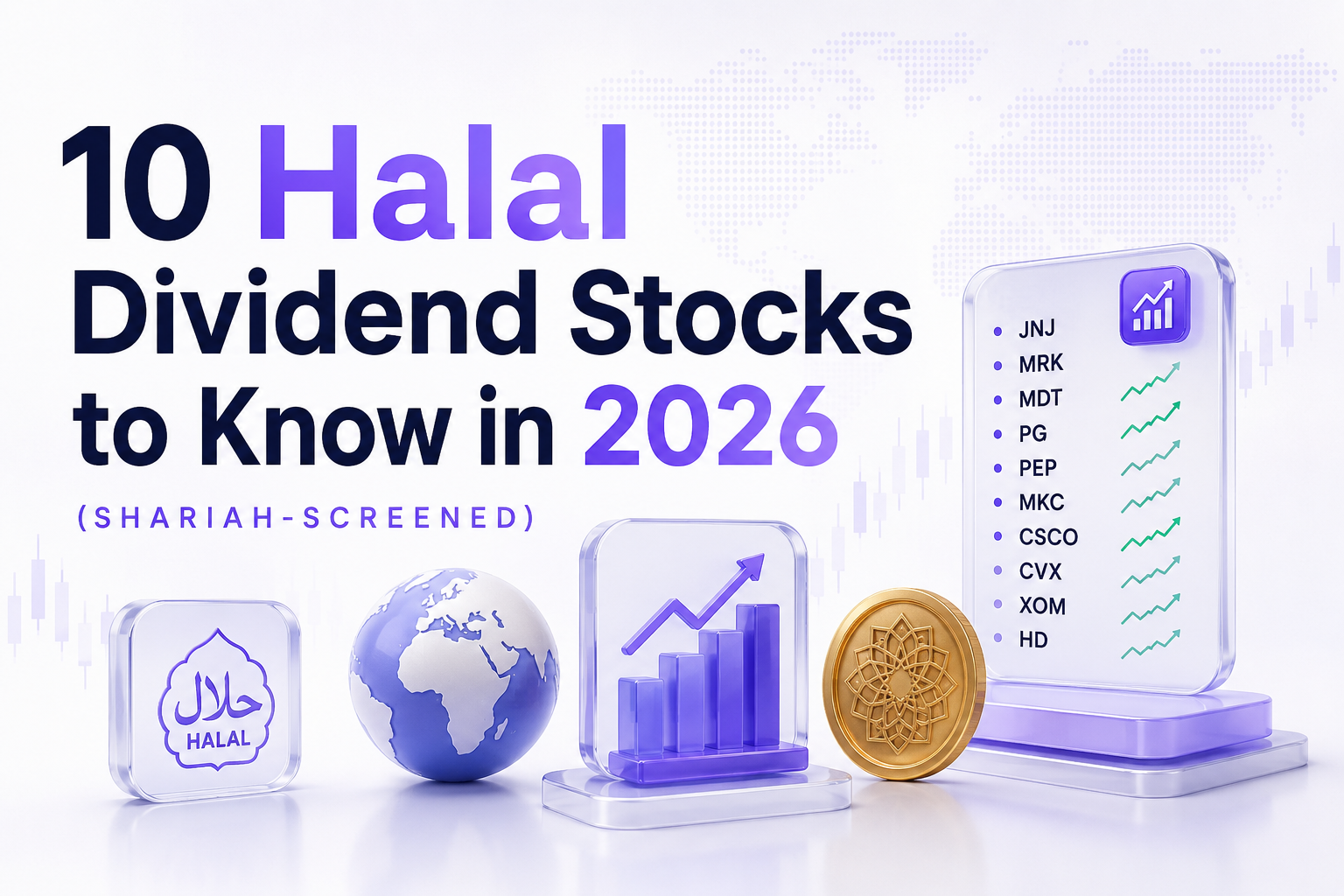
10 Halal Dividend Stocks to Know in 2026 (Shariah-Screened)
Most people assume halal investing and dividend income don't mix. There's a reason for that: Shariah screening throws out conventional banks and insurers, and those are exactly the names that fill traditional high-yield lists. So where does that leave a Muslim investor who wants regular income? In better shape than you'd think. Plenty of profitable companies in healthcare, consumer staples, technology and energy pay real dividends and still pass AAOIFI screening. This guide walks through 10 halal dividend stocks screened as compliant in early 2026, how the screening works, and what you owe by way of purification.
Quick Answer Halal dividend stocks are shares of Shariah-compliant companies that pay out part of their profit to shareholders. A stock qualifies when its core business is permissible, its interest-bearing debt stays under 30% of market cap, and its non-permissible income stays under 5% of revenue (AAOIFI Standard 21). Dividends are treated as profit-sharing, not interest, so they're generally halal, though any small slice of impure income should be purified by giving it to charity. |
Table of Contents
What are halal dividend stocks?
Are dividends halal in Islam?
How are stocks screened for Shariah compliance?
10 halal dividend stocks to know in 2026
Do you have to purify halal dividends?
How do you build a halal dividend portfolio?
What are halal dividend stocks?
A halal dividend stock is a share in a Shariah-compliant company that distributes part of its earnings to shareholders as a dividend. Two things have to line up. The company's business has to be permissible, and its balance sheet has to stay within the interest limits set by Islamic finance. Get both right and the dividend is simply your cut of a real, profitable business.
That second test is where a lot of familiar income stocks fall out. Conventional banks, insurers and heavily leveraged utilities earn or rely on interest, so they fail regardless of how steady their payout looks. What's left skews toward sectors that tend to run clean balance sheets: healthcare, consumer staples, parts of technology, and energy. If you want to test any ticker yourself, Akinda's free halal stock screener runs the AAOIFI screen and shows the business activity and financial ratios behind each verdict.
Are dividends halal in Islam?
Yes, in most cases. A dividend is a share of a company's actual profit, tied to how the business performs. That makes it a form of profit-sharing, which is permissible, and it's a different thing entirely from riba (interest), which is a fixed return promised on money regardless of any underlying enterprise.
The distinction matters. Interest is guaranteed and detached from risk. A dividend can be cut, paused or raised depending on how the company does, and you carry the ownership risk that comes with holding the stock. The one condition is that the underlying company has to pass Shariah screening. If it does, the dividend is halal income, minus any purification owed on a small share of impure earnings.
How are stocks screened for Shariah compliance?
Akinda screens equities against AAOIFI Shari'ah Standard No. 21 (Financial Paper – Shares and Bonds), the benchmark most scholars treat as the strictest rulebook in use. AAOIFI is the Bahrain-based body founded in 1991, and its criteria underpin major Islamic indices such as the S&P and Dow Jones Islamic Market indices. The screen runs in two stages, often summarised as the 30/30/5 rule.
1. Business activity screen
The company's core business must be permissible. That rules out anything whose primary activity is interest-based finance (conventional banks and insurers), alcohol, pork, gambling, tobacco, adult content or weapons. A company that fails here can't be rescued by good financials.
2. Financial ratio screen
A permissible business still fails if its balance sheet leans too hard on interest. Under Standard 21:
- Interest-bearing debt must not exceed 30% of market capitalisation.
- Interest-earning or non-compliant investments must not exceed 30% of market capitalisation.
- Non-permissible income must not exceed 5% of total revenue.
Breach any one of these and the stock fails. Worth knowing: AAOIFI sets the debt and asset limits at 30%, while the Dow Jones and S&P Shariah indices use 33%. That three-point gap is real, and it's why a stock can read as compliant on one screen and non-compliant on another in the same quarter. Apple, for instance, regularly bumps against the stricter AAOIFI asset limit even though looser screens pass it. The thresholds here are verified against AAOIFI's Standard 21 page. You can see the full breakdown for any company on its Akinda page, for example the Shariah report for Johnson & Johnson.
Compliance isn't permanent A stock that's halal today can turn non-compliant next quarter if its debt climbs or its interest income rises. Screening has to be based on the latest audited figures and checked regularly, not set once and forgotten. Treat every name below as "compliant as of early 2026, verify before you buy." |
10 halal dividend stocks to know in 2026
The names below were screened as compliant on AAOIFI-based methodology in early 2026, pay a real, recurring dividend, and sit in sectors that tend to pass the financial screens. They're spread across healthcare, consumer staples, technology, energy and retail so you're not concentrated in one corner of the market. Yields move daily, so treat the figures as rough markers, not live quotes. Each ticker links to its full Shariah report on Akinda.
| Ticker | Company | Sector | Dividend character |
|---|---|---|---|
| JNJ | Johnson & Johnson | Healthcare | Dividend King, ~3% yield |
| MRK | Merck & Co. | Pharmaceuticals | Steady payer, growing |
| MDT | Medtronic | Medical devices | Dividend Aristocrat |
| PG | Procter & Gamble | Consumer staples | Dividend King, ~2.4% |
| PEP | PepsiCo | Consumer staples | Dividend King, ~3–4% |
| MKC | McCormick & Co. | Consumer staples | Long dividend history |
| CSCO | Cisco Systems | Technology | Low debt, ~2.5% yield |
| CVX | Chevron | Energy | Dividend Aristocrat, higher yield |
| XOM | Exxon Mobil | Energy | 40+ yrs of increases |
| HD | The Home Depot | Retail | Reliable grower |
Healthcare and pharma
Healthcare is one of the most naturally Shariah-friendly sectors, and it's rich in long-term dividend payers. Johnson & Johnson (JNJ) is a Dividend King with decades of consecutive increases and one of the few AAA-rated balance sheets in the market. Merck (MRK) pairs a solid, growing payout with a deep drug pipeline led by its oncology franchise. Medtronic (MDT), a medical-device maker, is a Dividend Aristocrat with a long record of raises. All three run the kind of permissible business and manageable leverage that tends to clear AAOIFI's screens.
Consumer staples
Staples are the classic income sector because people keep buying the products in any economy. Procter & Gamble (PG) and PepsiCo (PEP) are both Dividend Kings, with PepsiCo usually carrying the higher yield of the two. McCormick (MKC), the spices and flavourings business, has paid dividends for decades. None of these touch prohibited lines, and their debt generally stays inside the limits, though PepsiCo and McCormick carry more acquisition debt than P&G, so they're worth a fresh check.
Technology
Tech isn't known for big yields, but a few mature names pay steadily. Cisco Systems (CSCO) builds the networking hardware and software that runs much of the internet, keeps debt low, and pays a dividend around 2.5%. It's a rare tech name that reads as clean on the financial screen without much drama.
Energy and retail
Chevron (CVX) and Exxon Mobil (XOM) are the income anchors here. Oil and gas extraction is a permissible, asset-based business, and both are long-standing dividend growers that usually offer the highest yields on this list. One honest note: some investors exclude fossil fuels on ethical or environmental grounds. That's a personal choice, not a Shariah compliance failure. Rounding out the list, The Home Depot (HD) is a home-improvement retailer with a permissible business, tiny interest income, and a reliable, growing dividend. Want more names beyond these ten? Browse Akinda's top halal stocks and filter the screener's dividends view for yield.
Do you have to purify halal dividends?
Sometimes, yes. Even a compliant company can earn a sliver of impure income, usually interest on its cash balances. When that happens, the matching portion of your dividend should be given away to charity rather than kept. This is called purification, and it's what keeps the income clean.
The amounts are small. Purification typically runs somewhere between a fraction of a percent and a few percent of the dividend, depending on the company. The steps are straightforward:
- Find the company's non-permissible income ratio. The Shariah report on a stock's Akinda page shows the underlying ratios.
- Multiply that ratio by the dividend you received.
- Give that amount to charity, separate from your zakat.
Purification applies only while the stock is compliant. If a company drops out of compliance, that's a different situation, and the guidance on impure holdings changes.
How do you build a halal dividend portfolio?
Owning ten income stocks isn't a plan by itself. A few principles keep a halal dividend portfolio steady and, importantly, keep it halal over time.
- Spread across sectors. Lean too hard on energy or pharma and one bad year hits your whole income. The list above deliberately mixes five sectors.
- Favour payout you can trust. A very high yield can be a warning sign. Look for companies paying out a sustainable share of earnings, not borrowing to fund the dividend.
- Re-screen on a schedule. Compliance shifts with the balance sheet. Check your holdings each quarter rather than assuming last year's status still holds.
- Track purification as you go. Log the impure portion when dividends land so it doesn't pile up into a guessing game at year end.
This is where a screening tool earns its keep. Akinda checks equities against AAOIFI Standard 21 and shows the ratios behind each verdict, so you can spot a name drifting toward the limits before it becomes a problem. Ready to check where your own holdings stand? Run them through Akinda's halal stock screener. And if you're still deciding which halal platform fits your workflow, compare the top halal investing apps and the wider halal investment platforms for 2026.
Frequently asked questions
Are dividend stocks halal?
Dividend stocks are halal when the underlying company passes Shariah screening: a permissible core business, interest-bearing debt under 30% of market cap, and non-permissible income under 5% of revenue. The dividend itself is profit-sharing, not interest, so it's permissible. Any small impure portion should be purified by donating it to charity.
Which sectors have the most halal dividend stocks?
Healthcare, consumer staples, technology, energy and industrials hold the most halal dividend payers. These sectors tend to run permissible businesses and moderate debt. Conventional banks, insurers and heavily leveraged utilities usually fail the screen because their income or financing depends on interest.
Is Apple a halal dividend stock?
Apple passes looser screens like the Dow Jones Islamic index, but it regularly bumps against the stricter AAOIFI 30% interest-bearing asset limit, and its services income pushes non-permissible revenue close to the 5% ceiling. It's borderline under AAOIFI, so check its current status on a screener and be ready to purify.
How much of a halal dividend do you purify?
You purify the share of the dividend that comes from non-permissible income, which is usually small, often under 5% and frequently well under 1%. Multiply the company's impure-income ratio by the dividend you received, then give that amount to charity. It's separate from zakat and reviewed as the ratio updates.
Can a halal stock become non-compliant?
Yes. Shariah compliance is based on financial ratios that move with the business. If a company takes on more interest-bearing debt or its interest income rises, it can fail the screen in a later quarter. This is why halal investors re-check their holdings regularly rather than treating a stock as permanently compliant.
Sources
AAOIFI Shari'ah Standard No. 21: Financial Paper (Shares and Bonds) – official standard defining the two-stage business and financial screen (30/30/5) and dividend purification.
The Past, Present, and Future of Shari'ah-Compliant Equities (INCEIF journal, 2025) – peer-reviewed overview of Standard 21, issued 2004, and how its thresholds compare with other Islamic indices.
Download the Akinda app and screen over thousands of global stocks, monitor Shariah compliance in real time
🌐 Website: https://akinda.io
📱 App: https://onelink.to/kpqkh6
Disclaimer
This article is for educational purposes only and is not financial or religious advice. Automated Shariah screening does not replace the judgement of a qualified scholar. Compliance status and dividend yields change over time; verify current figures and screening status before investing. Interpretations can differ across scholars and jurisdictions.