
- Investing Principles
Asset Allocation 101: What It Is and Why It Matters
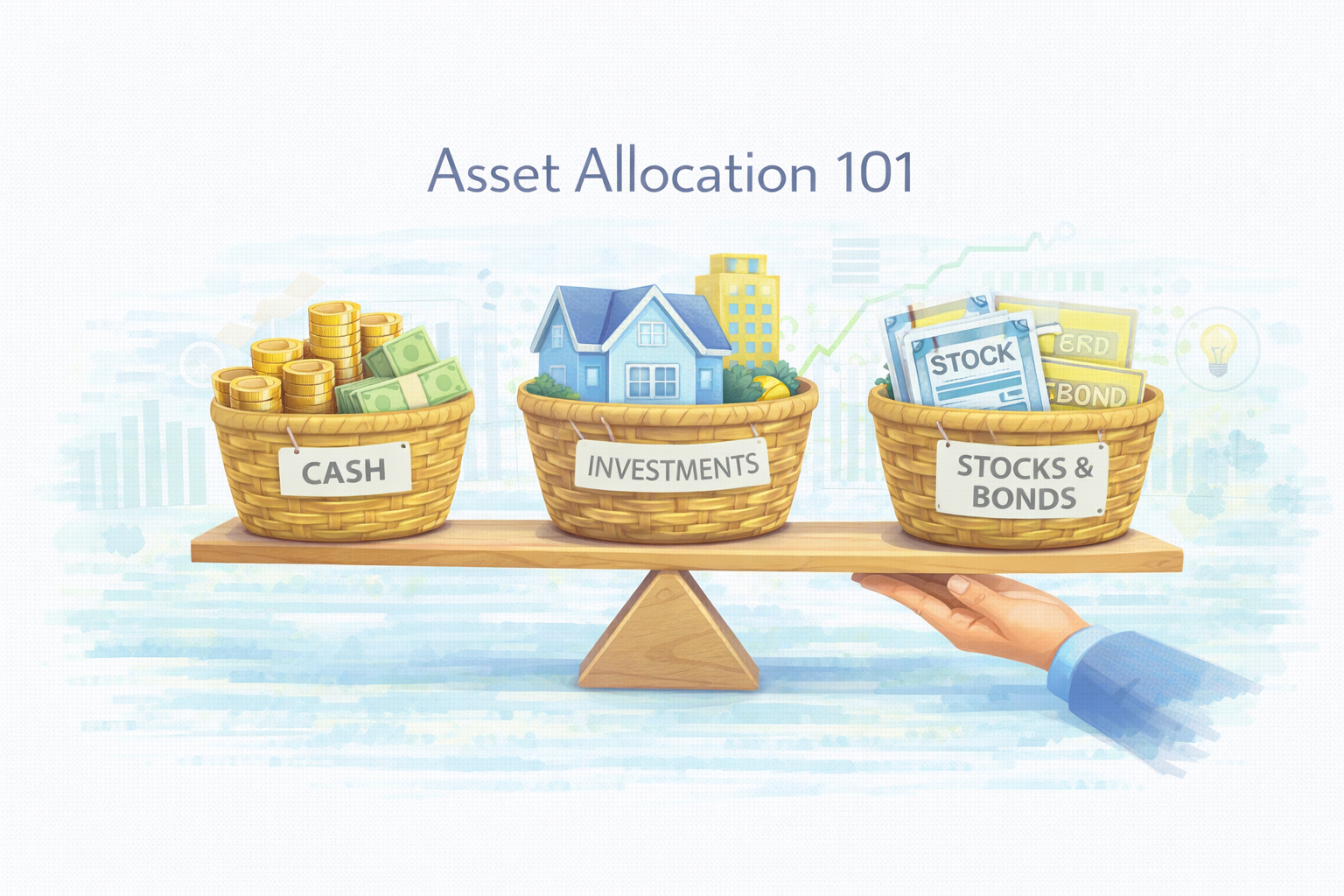
Table of contents
- Introduction
- What is asset allocation
- Asset allocation 101
- Investment portfolio
- Asset classes
- Age method
- How to build your own allocation
- Conclusion
INTRODUCTION
Sometimes people have trouble with investing their money. Some people invest their money in real estate while others prefer stocks. But investing is not some standardized activity. Investing is flexible, you can invest according to your preferences and priorities. Some people want lower risk while others’ prefer higher reward. Your investment portfolio can include both components.
WHAT IS ASSET ALLOCATION
Asset allocation is an investment strategy that involves dividing an investment portfolio into different categories, or "asset classes," such as stocks, bonds, and cash, to balance risk and potential reward. Asset allocation is important in return balance, risk management, and personal fit.
Risk management: No single asset performs best every year (as that quilt table shows). Allocation spreads risk.
Return balance: Stocks may offer growth but can be volatile; bonds may stabilize but grow slowly.
Personal fit: Your mix should match your goals, risk tolerance, and timeline.
Different asset allocation strategies represent different ways to balance returns and risk based on the investor's needs, goals, and temperament. A strategic allocation permits structure and discipline that allows emotions to not dictate decisions. A tactical allocation allows room for flexibility and for investors to take advantage of market opportunities, but also involves more risk and requires skill. Dynamic allocation takes into account that because life is not static, and our goals, income, and appetite for risk can all change, so should our investments.
- Strategic allocation is the most common method, where investors set a fixed percentage for each asset class—such as 60% stocks and 40% bonds—and stick to it over time. The idea is to create a long-term plan based on goals and risk tolerance, only rebalancing occasionally to keep the portfolio aligned.
- Tactical allocation is more flexible and involves adjusting the portfolio based on market conditions. For example, if the economy looks strong, an investor might temporarily increase stock exposure. This approach seeks to take advantage of short-term opportunities but requires more knowledge and active management.
- Dynamic allocation goes a step further by evolving along with the investor’s life stage and goals. For instance, a young professional may start with a stock-heavy portfolio for growth, but gradually shift toward bonds and cash as retirement approaches. Unlike tactical allocation, which reacts to the market, dynamic allocation adapts to personal circumstances over time.
ASSET ALLOCATION 101
Asset Allocation 101 is diversifying your money into multiple assets—like stocks, bonds, real estate, and cash—to balance risk and reward. Stocks offer more growth but more risk, while bonds and cash offer safety with small returns. The perfect mix depends on your goal, risk tolerance, and time horizon.
INVESTMENT PORTFOLIO
An investment portfolio consists of all the investments an investor has—stocks, bonds, real estate, or cash may be on the list. But a portfolio is more than holding different investments. It's how the investments are allocated. This is what is meant by asset allocation. Asset allocation is the portfolio plan; it determines what proportion of each asset class (stocks, bonds, commodities, etc.) to hold, and it establishes the risk level and potential return. If both investors hold stocks and bonds, but one investor's portfolio is 80% stocks and the other investor's portfolio has 40%, both portfolios will perform quite differently. That is, the portfolio is the "what," and the asset allocation is the "how."
ASSET CLASSES
Asset classes are groups of investments that share similar characteristics and behave in similar ways in the market. The main asset classes are:
- Stocks (equities): Ownership in companies, offering growth potential but higher risk.
- Bonds (fixed income): Loans to governments or companies, providing regular interest and more stability.
- Cash or cash equivalents: Highly liquid, low-risk assets like savings accounts or treasury bills, but with lower returns.
- Real estate: Property investments that can generate rental income and long-term value.
- Alternative assets: Other options like commodities, hedge funds, or cryptocurrencies, often used for diversification.
Different asset classes have their own risk and return levels. Here we have 15 years with asset highest to lowest ranked return levels per year. Source: Novel Investor
ASSET CLASS RETURNS
| 2016 | 2017 | 2018 | 2019 | 2020 | 2021 | 2022 | 2023 | 2024 |
| Sm Cap 21.3% | EM 37.8% | Cash 1.8% | Lg Cap 31.5% | Sm Cap 20.0% | REIT 41.3% | Cash 1.6% | Lg Cap 26.3% | Lg Cap 25.0% |
| HY Bnd 17.5% | Int’l Stk 25.6% | HG Bnd 0.0% | REIT 28.7% | EM 18.7% | Lg Cap 28.7% | HY Bnd -11.2% | Int’l Stk 18.9% | Sm Cap 11.5% |
| Lg Cap 12.0% | Lg Cap 18.4% | HY Bnd -2.3% | Sm Cap 25.5% | Lg Cap 18.4% | Sm Cap 14.8% | HG Bnd -13.0% | Sm Cap 16.9% | HY Bnd 8.2% |
| EM 11.6% | Sm Cap 14.7% | REIT -4.0% | Int’l Stk 22.7% | AA 9.8% | Int’l Stk 11.8% | Int’l Stk -14.0% | HY Bnd 13.5% | EM 8.1% |
| REIT 8.6% | AA 14.6% | Lg Cap -4.4% | AA 18.9% | Int’l Stk 8.3% | AA 10.9% | AA -16.5% | AA 12.8% | AA 7.4% |
| AA 7.2% | REIT 8.7% | AA -5.6% | EM 18.9% | HY Bnd 7.5% | HY Bnd 5.4% | Lg Cap -18.1% | REIT 11.4% | Cash 5.3% |
| HG Bnd 2.7% | HY Bnd 7.5% | Sm Cap -11.0% | HY Bnd 14.4% | HG Bnd 6.1% | Cash 0.0% | EM -19.7% | EM 10.3% | REIT 4.9% |
| Int’l Stk 1.5% | HG Bnd 3.5% | Int’l Stk -13.4% | HG Bnd 8.7% | Cash 0.6% | HG Bnd -1.5% | Sm Cap -20.4% | HG Bnd 5.5% | Int’l Stk 4.4% |
| Cash 0.3% | Cash 0.8% | EM -14.3% | Cash 2.2% | REIT -5.1% | EM -2.2% | REIT -25.0% | Cash 5.1% | HG Bnd 1.3% |
Past performance does not guarantee future returns. The historical performance shows changes in market trends across several asset classes over the past fifteen years. Returns represent total annual returns (reinvestment of all distributions) and does not include fees and expenses. The investments you choose should reflect your financial goals and risk tolerance. For assistance, talk to a financial professional. All data are as of 9/30/25.
*Asset Allocation Portfolio is 15% large cap stocks, 15% international stocks, 10% small cap stocks, 10% emerging market stocks, 10% REITs, 40% high-grade bonds, and annual rebalancing.
- Lg Cap – Large Cap Stocks – S&P 500 Index
- Sm Cap – Small Cap Stocks – Russell 2000 Index
- Int’l Stk – International Developed Stocks – MSCI EAFE Index
- EM – EM Stocks – MSCI Emerging Markets Index
- REIT – REITs – FTSE NAREIT All Equity Index
- HG Bnd – High Grade Bonds – Bloomberg Barclays U.S. Agg Index
- HY Bnd – High Yield Bonds – ICE BofA U.S. High Yield Index
- Cash – Cash – S&P U.S. Treasury Bill 0–3 Mth Index
- AA – Asset Allocation Portfolio
- Asset allocation profiles and high yield bonds have usually lower return levels because lower risk means lower return, at the same time they’re considered stable assets. You can see here they’re closer to middle.
- Emerging market stocks (EM) are the stock of companies from developing economies such as Brazil, India, or Indonesia. They often come up with higher growth potential than developed markets. At the same time they are high volatile because of factors like political instability, weaker regulations, currency swings, inflation, and heavy reliance, global trade or low stability. This mix of rapid growth and high risk makes EM stocks attractive for diversification but less stable compared to developed market stocks. You can see they’re widely spreadout.
- Cash and cash equivalents (like savings accounts or treasury bills) have lower returns and volatility because they are more liquid assets. Since they are backed by governments or banks and can be easily converted to money, the risk of losing value is minimal. They’ve lower return and risk.
- Large-cap stocks (shares of big, established companies, S&P500) generally have lower risk and lower return. S&P 500 is bunch of assets of companies that financially stable, widely recognized, and dominate their industries. With high risk and return.
AGE METHOD
The age method is a simple rule of thumb that suggests the percentage of your portfolio invested in stocks should equal 100 minus your age.
For example: If you're 35, you will keep 65% in stocks and 35% in safer assets.
100-35=65
Because of they have more time to recover from market downturns younger investors can take more risks.
As you grow older your riskier assets are minimized. Older investors can't take high risks. This method is not perfect, but it provides an easy guideline for balancing growth and safety over time.
You can use different methods in investing by help of akinda
HOW TO BUILD YOUR OWN ALLOCATION
Arranging the proper allocation is not a matter of discovering a "perfect mix". It means assembling a portfolio that matches your own goals, risk comfort, and time frames. The first stage in figuring the proper allocation is to define your end goal with the investment—do you want the money to save for retirement, purchase a house, or simply grow your wealth? There could be a longer-term objective which could justify a higher allocation to stocks, whereas if you are thinking about a shorter time frame you would want to grow your money in safer investments like bonds or cash.
Next, candidly assess your comfort with risk. If drops in the market cause you to panic and sell out of your investments, then, regardless of your age, a portfolio heavy on stocks may not be right for you. Risk comfort is like your time frame; it matters.
Now that you have decided on your goals and your comfort with risk, think about the allocation across the major asset classes: stocks for growth, bonds for stability, and cash for safety. Many investors start out using simple ratios like 70% stocks, 20% bonds, and 10% cash and adjust as you have life changes. "Rebalance" your portfolio at least once or twice each year to keep it in line with your plan.
Finally, asset allocation is not a one-and-done. It changes over time. You may age, earn more income, and approach your goals, so your allocation must change to preserve what you built while leaving a little room to continue growing
CONCLUSION
Asset allocation is fundamentally about control - control over uncertainty, control over emotion, and control over the direction of your financial path. Markets always move up and down. But with a responsible allocation, you can dictate how much of that movement has an impact on you. There is no magic formula to assure success, but a framework provides you clarity and confidence when circumstances change. Even more important, though, is that asset allocation allows you to spend less time guessing what the market will do, and more time focusing on building wealth over time - in a manner that fits your life. Ultimately, it isn't just about getting the money to grow, but about putting yourself in a position of freedom and security to achieve your goals in a way that fits with your life objectives.
References:
- “The performance of different asset classes shifts dramatically each year. For instance, according to Novel Investor’s Asset Class Returns quilt (see below), U.S. large caps led in 2021, but commodities topped in 2022.” https://novelinvestor.com/asset-class-returns/
KEY WORDS: asset allocation, what is asset allocation, asset allocation 101, investment portfolio, asset classes, types of asset allocation, strategic allocation, tactical allocation, dynamic allocation, risk tolerance, time horizon, diversification, stocks, bonds, real estate, cash equivalents, alternative assets, emerging market stocks, large-cap stocks, high-yield bonds, portfolio allocation, age method asset allocation, how to build asset allocation, asset allocation strategies, investment strategy, portfolio diversification, risk management in investing, building wealth, financial goals, portfolio rebalancing, safe investments, growth investments