
- Building with Akinda
Halal Stock Screening API for Developers
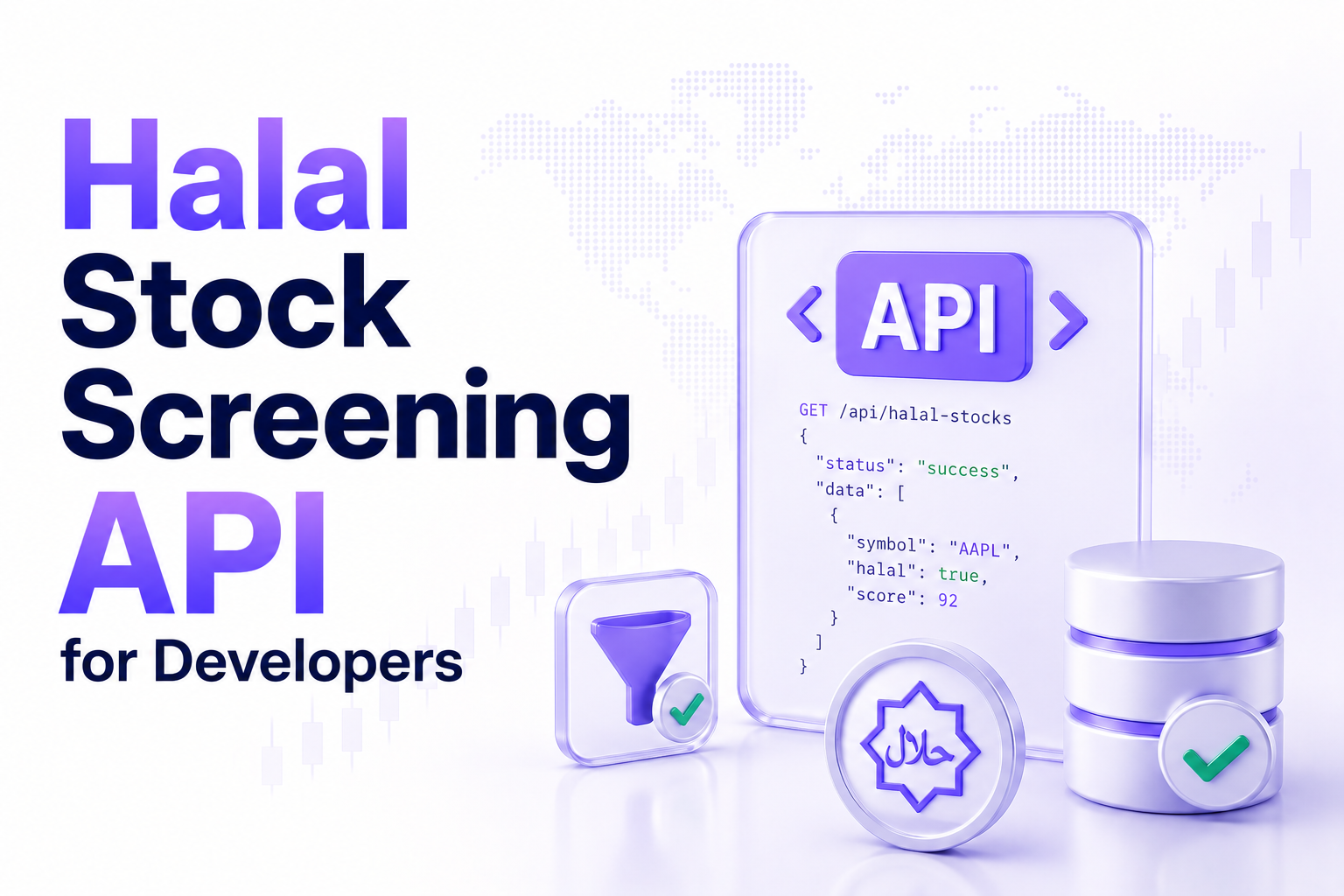
Building Shariah screening from scratch is a trap. You'd need financial-data feeds, a screening engine, a purification model, and a scholar panel to sign off on the rules, all before you ship a single feature. A halal stock screening API gives you that entire layer through a few endpoints. This guide is for developers: what you can build, how the Akinda Halal API is structured, how to integrate it, and the AAOIFI-based methodology that produces each verdict.
Quick Answer A halal stock screening API lets you send a ticker and get back a Shariah-compliance verdict plus the ratios behind it, so you can add screening to any app without building the engine yourself. The Akinda Halal API exposes three REST endpoints, compliance, basic report, and full report, that return structured JSON based on a published, AAOIFI-based methodology. You authenticate with a key, call an endpoint, and render the result. It's designed for halal robo-advisors, screeners, compliance gates, and portfolio monitors. |
Table of Contents
- What is a halal stock screening API?
- What can you build with it?
- The Akinda API endpoints
- How to integrate it
- The methodology behind the verdicts
What is a halal stock screening API?
A halal stock screening API is a web service that screens equities for Shariah compliance on demand. Your application sends a request (typically a ticker), and the API responds with a structured verdict, halal or non-compliant, usually alongside the financial ratios and business-activity result that produced it. Instead of maintaining screening logic and financial data yourself, you consume a maintained, scholar-governed data layer. You can see the same screening running on Akinda's consumer screener; the API exposes that capability programmatically.
What can you build with it?
Screening is a building block, not a product, which is why an API is so useful. A few common integrations:
- A halal robo-advisor that only ever allocates client capital to screened, compliant stocks.
- A screener feature inside an existing brokerage or research app, showing a halal badge on every ticker.
- A compliance gate on trades that checks the compliance endpoint before an order is allowed to execute, blocking non-compliant buys.
- Portfolio monitoring that re-screens holdings each quarter and alerts users when a position drifts out of compliance.
- Purification tooling that uses the full report's purification data to tell users how much to cleanse from their dividends.
The Akinda API endpoints
The API surface is deliberately small. Three endpoints cover everything from a quick check to a full compliance view.
| Endpoint | What it returns |
|---|---|
| /api/v1/compliance | A fast halal / non-compliant verdict, ideal for a trade gate or a badge. |
| /api/v1/basic-report | The verdict plus the headline screening ratios. |
| /api/v1/full-report | The complete screen: business activity, all financial ratios, and purification data. |
Each is documented with request and response schemas in the developer docs. A typical app starts with the compliance endpoint for speed, then calls the full report on a detail screen where users expect to see the reasoning.
How to integrate it
Integration follows the same pattern as any modern REST API.
- Sign up and generate an API key from the dashboard.
- Send an authenticated request to the compliance endpoint with a ticker, and parse the JSON verdict.
- Render the result, a badge, a gate decision, or a full report view, in your UI.
- For AI products, wire the endpoints into your agent or MCP toolchain so a model can screen tickers mid-conversation.
- Cache and re-screen on a schedule (quarterly is sensible) so verdicts stay current as financials change.
The structured JSON responses mean there's no HTML scraping or brittle parsing, and the small endpoint surface keeps the integration maintainable. Full details and examples live in the API documentation.
The methodology behind the verdicts
A screening API is only as good as the rules underneath it, so the Akinda API publishes its methodology in full. It runs a three-phase screen: a business-activity screen that removes impermissible industries, then two financial-ratio tests, debt and liquidity, each measured against 30% of the average 12-quarter market cap, plus a defined purification rule for incidental impermissible income.
The rules are AAOIFI-based and overseen by Akinda's Shariah advisor, so the verdicts your app renders are auditable and defensible. If your users want to understand the standard itself, link them to Akinda's explainer on AAOIFI screening.
Frequently asked questions
How do I get a halal screening API key?
Create an account on the Akinda API dashboard and generate a key, then include it in your request headers. You can start on the free tier to build and test, and upgrade to a business plan when you move to production. No sales call is required to begin evaluating the endpoints.
Can I screen an entire portfolio at once?
Yes. You call the compliance or report endpoint for each holding and aggregate the results in your own application, which is how portfolio-monitoring and re-screening features are typically built. Check the documentation for current rate limits and any bulk options when you design your integration.
Does the API return purification data?
The full-report endpoint includes purification data derived from the screening methodology, so you can build features that tell users how much of their dividend income to cleanse. The exact fields are described in the developer docs, review them against your own Shariah governance before surfacing figures to users.
Is the screening a fatwa?
No. The API returns automated screening signals based on public financial data, not a religious ruling. It's built to help you ship compliant products at scale, but you should pair it with your own Shariah oversight and make clear to users that final religious authority rests with qualified scholars.
Sources
- AAOIFI Shari'ah Standard No. 21: Financial Paper (Shares and Bonds) – the standard the Akinda API's screening methodology is built around.
- Akinda API screening methodology – the full three-phase screen, ratio formulas, and purification rule, published for integrators to audit.
- Akinda API Shariah advisor – the scholar governance behind the API's halal verdicts.
Build with the Akinda Halal API The developer-grade API for AAOIFI-based Shariah stock screening. Start on the free tier, scale when you ship. 📚 Docs: b2b.akinda.io/developer/docs 💳 Pricing: b2b.akinda.io/pricing 🔑 Get a key: b2b.akinda.io/dashboard |
Disclaimer
This article is about a software product and is for general information only. It is not financial or religious advice. Automated Shariah screening produces data-driven signals, not a fatwa; integrators should pair it with their own Shariah governance and consult qualified scholars. API features, endpoints, coverage, and pricing change over time, so verify current details on b2b.akinda.io before building.