
- Stock Market & Equities
Halal Stocks This Week: The Fed Hiked and Nothing Changed
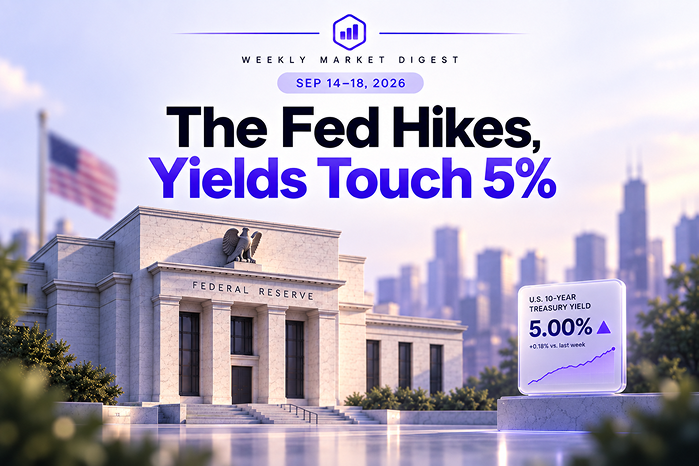
It was the loudest week markets have had in months. The Federal Reserve raised interest rates for the first time in over three years, the 10-year Treasury yield climbed to 5%, and the Dow gave up more than 1.5%. For a halal investor, the obvious question is whether any of that changes what you are allowed to own. We screened twelve stocks that drove this weekʼs headlines, along with the large caps most halal portfolios already hold, against AAOIFI Standard 21. All twelve came back halal. That result is worth more than a headline, because it shows exactly which kinds of market moves matter for compliance and which ones do not.
Quick Answer
The Fed raised rates by 25 basis points on 16 September and signalled more to come, pushing the 10-year Treasury yield to 5%. Akinda screened twelve stocks that featured in this weekʼs market coverage, including Intel, AMD, Netflix, Apple and Strategy. Every one retained a HALAL verdict. Rate moves do not change screening outcomes directly; balance sheets and market capitalisation do.
Table of Contents
- What happened in markets this week?
- Which stocks changed Shariah status?
- Which stocks are closest to failing?
- Why do screening ratios move when the company has not changed?
- What should halal investors watch next week?
- FAQ
What happened in markets this week?
Three things mattered, and they were all connected.
1. The Fed hiked, and hinted at more.
On Wednesday the Federal Reserve raised its policy rate by 25 basis points, its first increase in more than three years, and flagged further hikes ahead. Stocks sold off on the day, then recovered on Thursday as investors decided the move was already priced in. By Friday, market pricing implied roughly a 55% chance of another hike on 28 October (Investrade market review, 18 Sept 2026). Why it matters for halal investors: higher rates raise the cost of debt, and debt is the single most common reason an otherwise permissible business fails a Shariah screen.
2. Yields hit 5% and oil stayed expensive.
The 10-year Treasury yield reached its highest level since 2023, with crude near $100 keeping inflation expectations elevated. The Bank of Japan also raised rates, taking borrowing costs there to a 31-year high. Why it matters: when yields rise, interest-bearing borrowing becomes more visible on corporate balance sheets, and companies that refinance at higher coupons carry more of exactly the kind of debt AAOIFI screens cap.
3. Chips fell, then led the recovery.
Semiconductor and AI infrastructure names dropped on Monday after senior AI lab executives argued publicly for slowing frontier model development. The sector recovered through the week, with AMD gaining 6.4% and Intel 7.7% on Thursday. The Nasdaq finished the week up 0.7% while the Dow lost more than 1.5%. Why it matters: technology is one of the largest sectors in most halal portfolios, so its swings drive more of a Shariah-compliant investorʼs return than they do for the broad market.
Which stocks changed Shariah status?
None of them. We ran twelve stocks through Akindaʼs AAOIFI Standard 21 screen: the names that moved on this weekʼs news, plus the large caps that sit in most halal portfolios. Twelve halal, zero fails, zero doubtful, no missing verdicts. Here is where the ratios sit.
| Ticker | Company | Verdict | Debt / mcap | Liquidity | Non-permissible income |
|---|---|---|---|---|---|
| INTC | Intel Corp. | HALAL | 24.53% | 19.70% | 1.87% |
| CNM | Core & Main | HALAL | 22.69% | 2.32% | 0.00% |
| FLS | Flowserve | HALAL | 22.43% | 10.72% | 2.97% |
| MSTR | Strategy Inc | HALAL | 17.98% | 5.03% | 0.00% |
| NFLX | Netflix | HALAL | 4.13% | 2.59% | 0.38% |
| AAPL | Apple Inc. | HALAL | 2.90% | 1.61% | 0.00% |
| AMD | Advanced Micro Devices | HALAL | 1.28% | 3.50% | 1.64% |
| — | AAOIFI threshold | — | under 30% | under 30% | under 5% |
How we picked these names: every stock named in this weekʼs market reports as a notable mover, plus the widely held large caps halal investors ask about most. This is not a volume-ranked list of the marketʼs most-traded stocks.
A week of heavy selling in the Dow and a 5% 10-year yield produced no compliance change at all in this group. That is the useful lesson: screening verdicts respond to reported balance sheets and market capitalisation, not to sentiment, headlines or a single week of price action.
Which stocks are closest to failing?
Three names in the batch carry the least headroom on the debt test, all still comfortably inside the limit.
- Intel (INTC) - debt at 24.53% of market cap, 5.47 percentage points below the 30% ceiling. On current debt, a fall of roughly 18% in market capitalisation would be enough to breach it.
- Core & Main (CNM) - 22.69%. Roughly a 24% drop in market cap would take it over the line.
- Flowserve (FLS) - 22.43% debt and 2.97% non-permissible income, the highest income figure in the group and within 2 points of the 5% cap.
None of these is a warning. They are simply the names where a sharp repricing, or new borrowing at todayʼs higher rates, would show up in a verdict first.
Why do screening ratios move when the company has not changed?
Because two of the three tests in AAOIFI Shariʼah Standard No. 21 are measured against market capitalisation, not against assets or revenue. Interest-bearing debt must stay under 30% of market cap, and interest-earning or non-compliant investments must stay under the same 30% limit. Non-permissible income is capped at 5% of total revenue.
That denominator is the part investors miss. If a company borrows nothing new and repays nothing, but its share price falls 20%, its debt ratio rises by about a quarter. The business is identical. The screen is not. This is why compliance risk quietly increases in a falling market, and why a week like this one, with rising yields and a weak Dow, is worth watching even when no verdict actually changes.
The reverse holds too. A stock that rallies hard can move back inside the limits without repaying a dollar of debt, which is one reason verdicts should be rechecked rather than remembered.
What should halal investors watch next week?
- 28 October Fed meeting - markets currently price around a 55% chance of a second hike, with roughly 90% odds of one by the December decision.
- Oil near $100 - sustained energy prices keep inflation, and therefore rates, in play, which feeds directly into corporate borrowing costs.
- The next round of quarterly reports - new balance sheets are when screening ratios genuinely reset. Price moves shift the denominator; earnings move the numerator.
FAQ
Does a Fed rate hike make stocks non-halal?
No. A rate decision does not change any AAOIFI screening ratio by itself. It matters indirectly: higher rates make borrowing more expensive, which can increase a companyʼs interest-bearing debt over time, and they can pressure share prices, which lowers the market cap those ratios are measured against.
How often should I recheck a stockʼs Shariah status?
At least every quarter, when new financial statements are published, and again after any sharp move in the share price. Because the AAOIFI tests use market capitalisation as a denominator, a verdict that was accurate three months ago can be out of date without the company doing anything at all.
What happens to my position if a stock turns non-compliant?
Most scholars allow a reasonable window to exit rather than requiring an immediate sale, and any dividends received while the company earned non-permissible income should be purified. The specific treatment depends on your circumstances, so check with a qualified scholar before acting.
Are all technology stocks halal?
No. Technology companies usually pass the business-activity test, but they still have to clear the financial ratios. A tech company with heavy interest-bearing debt or significant interest income can fail, and several large ones do. The sector is a starting point, not a verdict.
Screening these names yourself
Every verdict and ratio in this digest comes from Akindaʼs AAOIFI Standard 21 screen, which is updated as new financial data and prices come in. You can check any ticker, screen a full portfolio at once, and calculate dividend purification on holdings you already own
Sources
- AAOIFI Shariʼah Standard No. 21, Financial Paper (Shares and Bonds)
- Weekly index and yield data — Yahoo Finance, 18 September 2026
- Fed decision and rate-path pricing — Bloomberg, TheStreet and Investrade, 16–18 September 2026
- Screening verdicts and ratios — Akinda screening data, retrieved 19 September 2026
Download the Akinda app and screen stocks instantly for free
🌐 Website: https://akinda.io
📱 App: https://onelink.to/kpqkh6
Educational content only. Not financial or religious advice. Automated screening is informational and does not replace a qualified scholar.