
- Investing Principles
How Inflation Eats Your Money While You Sleep
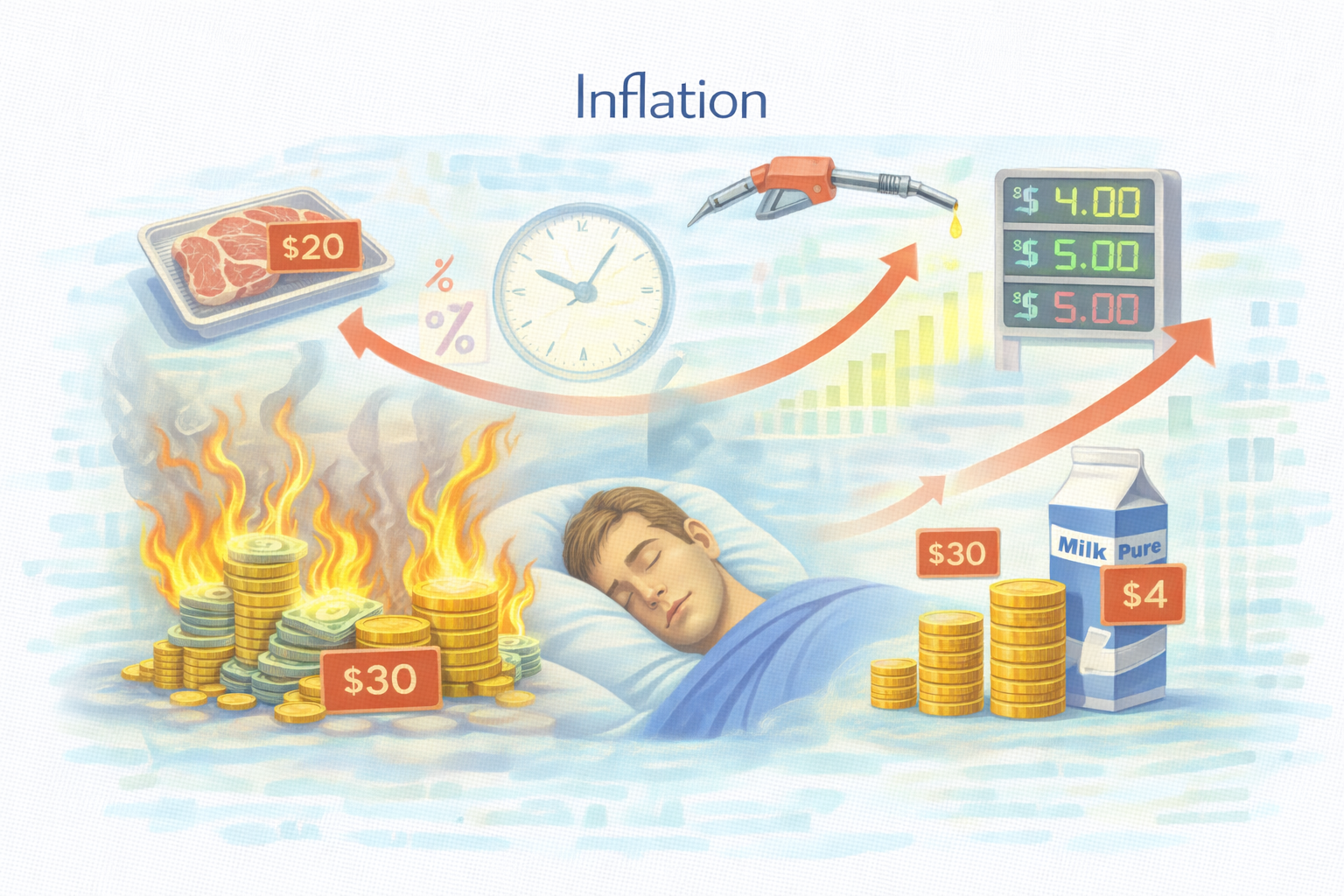
Inflation: The Silent Thief of Your Savings
How Inflation Shrinks Your Wealth Without You Noticing
Sleeping While Your Money Loses Value: Understanding Inflation
Protecting Your Future: Beating Inflation with Smart Choices
Table of Contents:
1. Introduction
2. What is Inflation?
3. Why Inflation is a Hidden Threat
4. Real-Life Examples of Inflation at Work
5. How Inflation Impacts Your Savings and Investments
6. Practical Steps to Protect Yourself
7. Conclusion
Introduction
Have you ever noticed that the money in your wallet seems to “buy less” each year? Last year’s $100 might have covered your shopping basket, but today, it barely fills half. That’s inflation at work — a silent force that eats away at your money’s value, even while you sleep.
Inflation is often called a hidden tax because it reduces your purchasing power without you even realizing it. Understanding how it works — and how to protect yourself — is one of the keys to financial security.
What is Inflation?
Inflation is simply the steady rise in prices over time. As costs go up, each unit of money buys a little less than it used to. Imagine a loaf of bread costs $1 today but $1.05 next year—that’s a 5% inflation rate.
The important thing to understand is that inflation isn’t about how much money you have in your account, but about what that money can buy. As Akinda.io explains, learning to separate “the balance you see” from “the value it represents” is one of the first steps to real financial literacy.
Why Inflation Is Called the “Silent Thief”
The danger of inflation is that it works quietly. Your bank balance doesn’t go down like it would after a robbery, but what you can actually buy with that money shrinks year after year.
Take this example: if you keep $1,000 under your mattress for 10 years while inflation runs at 3% a year, you’ll still have the same $1,000. But in terms of purchasing power, it will only be worth about $744 compared to today. That’s why inflation is often called a silent thief. Like rust, it eats away at your money slowly, continuously, and without you noticing—until the impact becomes impossible to ignore.
Why Inflation is a Hidden Threat
1. Silent but Constant – Inflation works quietly in the background, unlike sudden market crashes.
2. Affects Everyone – Whether you’re a student, worker, or retiree, rising prices reduce your real income.
3. Erodes Savings – Money sitting in a low-interest account may actually be losing value after adjusting for inflation.
Real-Life Examples of Inflation at Work
If you keep $10,000 in a savings account at 1% interest, but inflation is 4%, your “real return” is -3%. Over 10 years, your money may look like it grew slightly, but in reality, it buys much less.
Think about retirement: if you need $2,000 a month today, at 3% inflation, you’ll need nearly $3,600 a month in just 20 years.
The tricky thing about inflation is that it doesn’t feel urgent. Losing two or three percent of your purchasing power each year doesn’t seem like a big deal in the moment. But over decades, that small loss quietly compounds into something much bigger — it can completely change your financial future. Because the damage happens slowly, many people underestimate inflation until it’s already taken a heavy toll.
That’s why awareness is so important. As Akinda.io points out, inflation is like an invisible cost of doing nothing. Simply leaving your money sitting still can mean falling behind without realizing it. The first step to fighting back is to recognize this hidden threat — once you see it clearly, you can start making smarter choices to protect yourself.
How Inflation Impacts Your Savings and Investments
A lot of people think that a savings account keeps their money safe, but that’s not always true. If the interest you earn is lower than inflation, you’re actually losing money in real terms. Imagine a bank pays you 2% interest, but prices are rising at 4%. Your account balance goes up every year, but what you can buy with that money slowly goes down. As Akinda.io puts it, “seeing bigger numbers in your bank account can be an illusion of wealth if inflation grows faster.”
Inflation can feel like it’s quietly nibbling away at your money, but the good news is that there are ways to fight back. One of the best defenses is investing. Assets like stocks, bonds, and real estate usually grow faster than inflation over time. If you don’t know where to start, index funds and ETFs are great beginner-friendly options because they follow the whole market and have a strong track record of outpacing inflation. Some governments even issue bonds that are directly tied to inflation, so your savings keep their value. And of course, diversifying—spreading your money across different types of investments instead of putting it all in one place—reduces risk and gives you a better chance of staying ahead.
But protecting yourself from inflation isn’t only about investing. Daily habits matter too. Using a budgeting app can help you see exactly where your money is going. Cutting back on impulse buys, shopping smarter by using discounts or cashback offers, and buying essentials in bulk can all help you stretch your money further. Reviewing subscriptions you don’t really use is another easy win. And don’t forget the importance of an emergency fund; having that cushion means you won’t be forced to dip into investments or borrow when life throws you a surprise expense.
Inflation is never fun, but with a mix of smart investing and mindful money habits, you can stop it from taking too big a bite out of your finances.
Practical Steps to Protect Yourself
1. Invest, Don’t Just Save – Assets like stocks, real estate, or inflation-linked bonds often grow faster than inflation.
2. Diversify – Spread your money across different types of investments to reduce risk.
3. Stay Informed – Follow inflation rates and adjust your financial plan regularly.
4. Think Long-Term – Short-term price increases may sting, but consistent investing builds protection over decades.
Conclusion
Inflation is a quiet enemy of your financial future. It doesn’t happen overnight, but over years, it eats away at your money’s power — unless you take action.
The good news? You don’t need to be a financial expert to protect yourself. By investing wisely, diversifying, and staying consistent, you can beat inflation and make sure your money grows faster than prices.
📌: Don’t let inflation rob your future. Review where your money sits today — and take the first step toward investments that keep you ahead of rising prices.
References
- Bodie, Z., Kane, A., & Marcus, A. J. (2021). Investments. McGraw-Hill Education.
- Mankiw, N. G. (2022). Principles of Economics (10th ed.). Cengage Learning.
- Mishkin, F. S. (2019). The Economics of Money, Banking, and Financial Markets. Pearson.
- Investopedia. (2023). Inflation Explained: Causes, Effects, and Control. Retrieved from https://www.investopedia.com
- International Monetary Fund (IMF). (2023). World Economic Outlook: Inflation Dynamics. Washington, DC.
- Akinda.io (2025). Financial Literacy Resources on Inflation and Investing.
Keywords
inflation, inflation explained, inflation and savings, inflation investing, inflation vs interest rates, inflation and purchasing power, inflation and savings accounts, inflation as silent thief, inflation examples, effects of inflation, causes of inflation, beating inflation, investing to fight inflation, inflation and financial literacy, Akinda inflation tools