
- Stock Market & Equities
How to Analyze a Company Before You Invest?
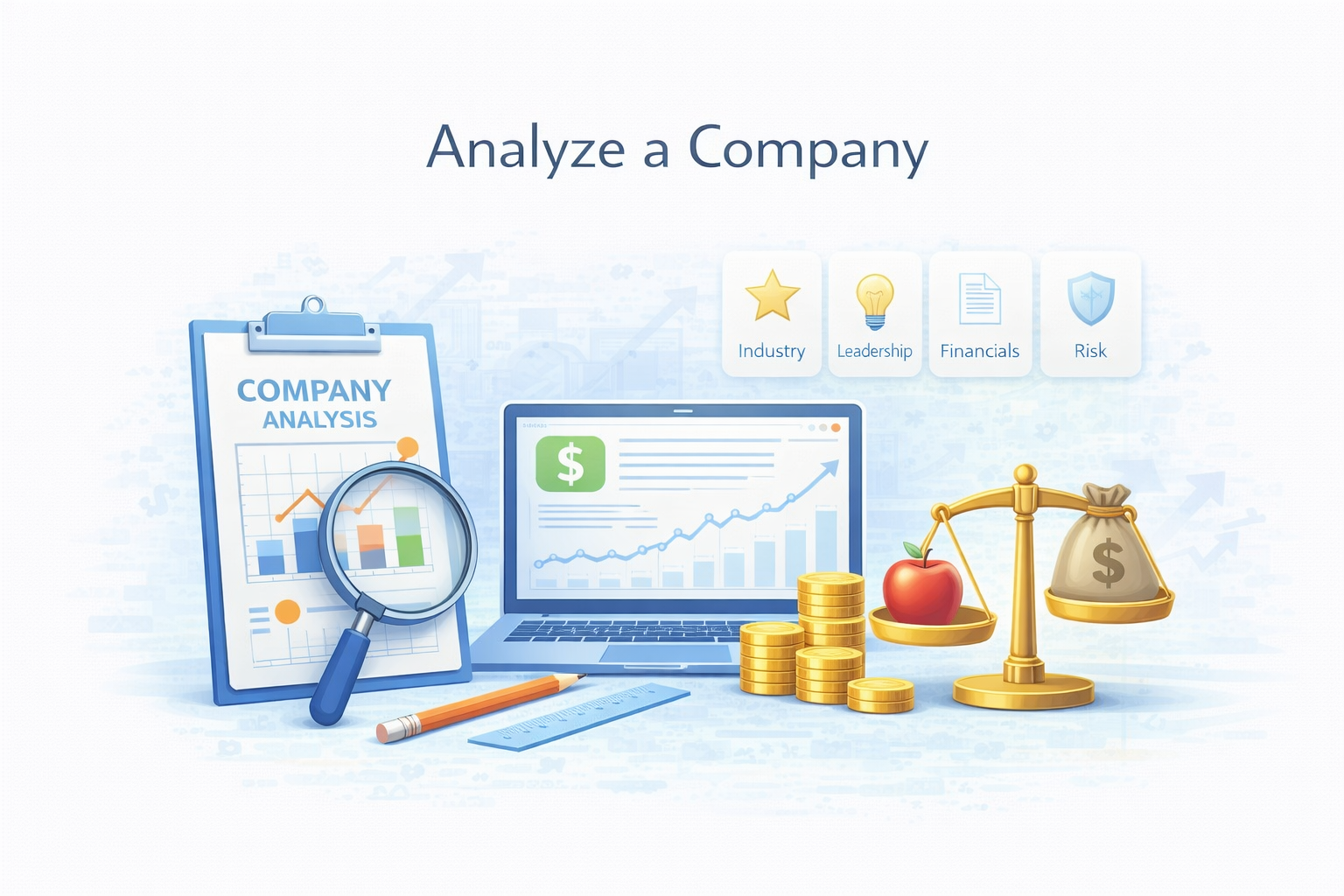
How to Analyze a Company Before You Invest?
Table of contents
- Introduction
- Understand the Company’s Business Model
- Review Key Financial Statements
- Analyze the Industry and Competition
- Evaluate Management and Leadership Quality
- Identify Investment Risks and Red Flags
- Check Company Valuation
- Read Analyst Reports and Company News
- Using Company Analysis Tools Like Akinda.io
- Conclusion
Introduction
Investing in a company can be exciting, but it’s also risky if you don’t know what you’re buying into. Before you invest your hard-earned money, it’s important to take a closer look at the business itself. Understanding how a company makes money, how healthy its finances are, and what risks it faces can save you from costly mistakes. Think of it as doing your homework before taking a big test — the better prepared you are, the better your chances of success.
Understand the Company’s Business Model
Investing in a company without understanding how it makes money is like buying a car without knowing if it runs. The business model is the foundation — it answers the question: *How does this company generate revenue?* Some companies sell physical products, others offer digital services, and some rely on advertising or subscriptions. A strong business model is simple, scalable, and sustainable.
For example, a company like Netflix earns money through monthly subscriptions. That’s easy to grasp. But if a company’s revenue streams are too complex or unclear, it might be a red flag. Ask yourself: Is the business solving a real problem? Does it have loyal customers? Is it dependent on one product or market?
Also consider how the company plans to grow. Are they expanding into new regions, launching new products, or acquiring other businesses? Growth strategy is part of the model. The more you understand the mechanics of how money flows in and out, the better you can judge whether the company is built to last — or just riding a temporary wave.
Review Key Financial Statements
Financial statements are like a company’s report card. They show how well the business is performing and whether it’s financially healthy. There are three main documents to look at: the income statement, balance sheet, and cash flow statement.
The income statement tells you if the company is profitable. Look at revenue, expenses, and net income. Is revenue growing year over year? Are profits consistent or volatile?
The balance sheet shows what the company owns and owes. Assets, liabilities, and shareholder equity give insight into financial stability. A company with too much debt compared to its assets might be risky.
The cash flow statement reveals how money moves in and out. Even profitable companies can struggle if they don’t manage cash well. Positive operating cash flow is a good sign.
Don’t worry if you’re not an accountant. Focus on trends: Is the company improving or declining? Are margins healthy? Is debt manageable? These numbers help you see beyond the hype and make decisions based on facts, not feelings.
Analyze the Industry and Competition
A company doesn’t operate in a vacuum — it’s part of a larger industry. Understanding the industry helps you see the bigger picture. Is the sector growing, shrinking, or facing disruption? For example, investing in a traditional retail company might be riskier today due to the rise of e-commerce.
Next, look at the competition. Who are the main players? Does your chosen company have a competitive edge — like better technology, stronger brand, or lower costs? If it’s just one of many similar businesses, it may struggle to stand out.
Also consider market share. Is the company gaining ground or losing it? A rising market share often signals strong performance and customer loyalty.
Regulatory environment matters too. Some industries, like healthcare or finance, face strict rules that can impact growth. Others, like tech, may have more freedom but also more volatility.
In short, a great company in a weak industry may still struggle, while an average company in a booming sector might thrive. So always zoom out before you zoom in — the context matters.
Evaluate Management and Leadership Quality
Behind every successful company is a team of people making decisions. That’s why evaluating leadership is crucial. A visionary CEO with a strong track record can steer a company through challenges and unlock growth. On the other hand, poor leadership can sink even a promising business.
Start by researching the executive team. What’s their background? Have they led other successful ventures? Do they own shares in the company? When leaders have skin in the game, they’re more likely to act in shareholders’ interests.
Transparency is another key factor. Does management communicate clearly with investors? Are they honest about setbacks and realistic about goals? Overpromising and underdelivering is a red flag.
Also look at company culture. Happy employees often lead to better performance. Sites like Glassdoor can give insight into how staff feel about leadership.
Finally, pay attention to turnover. Frequent changes in top positions may signal instability. In short, strong leadership isn’t just about charisma — it’s about competence, consistency, and credibility.
Identify Investment Risks and Red Flags
Every investment carries risk — the key is knowing what those risks are. Start by looking at the company’s financial health. Is revenue declining? Are profits shrinking? Is debt piling up? These are internal risks that can erode value over time.
Next, consider external risks. Is the company exposed to changing regulations, economic downturns, or supply chain disruptions? For example, a company heavily reliant on imports may suffer if tariffs rise.
Watch for red flags in behavior too. Sudden executive departures, accounting irregularities, or overly optimistic forecasts can be warning signs. If something feels off, dig deeper.
Also think about concentration risk. Is the company dependent on one product, customer, or market? If that single element fails, the whole business could suffer.
Finally, ask yourself: *What could go wrong?* It’s not about being pessimistic — it’s about being prepared. The best investors don’t avoid risk; they understand it and manage it wisely.
Check Company Valuation
Valuation is about figuring out whether a company’s stock price reflects its true worth. Even a great business can be a bad investment if you overpay. That’s why smart investors look beyond hype and focus on numbers.
Start with common valuation metrics. The Price-to-Earnings (P/E) ratio compares stock price to earnings. A high P/E might mean the stock is expensive — or that investors expect big growth. The Price-to-Sales (P/S) ratio is useful for companies not yet profitable. EV/EBITDA is another tool that adjusts for debt and cash.
Compare these ratios to industry averages. Is the company fairly priced compared to its peers? If it’s significantly higher, ask why. Is it justified by growth potential, or is it overvalued?
Also consider future earnings. Analysts often project growth — but don’t take their word blindly. Look at past performance and realistic expectations.
Valuation isn’t an exact science, but it helps you avoid buying into hype. The goal isn’t just to find good companies — it’s to find good companies at good prices.
Read Analyst Reports and Company News
Numbers tell one side of the story — but news and expert opinions fill in the gaps. Analyst reports offer insights into a company’s strengths, weaknesses, and future outlook. They often include price targets, earnings forecasts, and risk assessments.
Reading these reports helps you see how professionals view the company. Are they bullish or cautious? What trends are they watching? While you shouldn’t follow analysts blindly, their research can highlight things you might miss.
News coverage is equally important. Is the company launching new products, entering new markets, or facing legal issues? Staying updated helps you anticipate changes before they affect the stock price.
Social media and forums can also offer clues — but be careful. Not all opinions are informed, and hype can distort reality. Stick to credible sources and cross-check information.
In short, combining hard data with current events gives you a fuller picture. The market moves on information — and the more informed you are, the better your decisions will be.
Using Company Analysis Tools Like Akinda.io
Analyzing a company before investing doesn’t have to be overwhelming — especially with smart platforms like Akinda.io. This AI-powered tool simplifies the process by turning complex financial data into clear, actionable insights. For beginners, it’s like having a personal analyst that helps you understand whether a company is worth your money.
Akinda.io breaks down key metrics such as revenue growth, profit margins, debt levels, and cash flow trends. It also highlights strengths and weaknesses in a company’s financial structure, making it easier to spot potential risks. Instead of digging through spreadsheets, you get visual summaries and performance indicators that save time and reduce confusion.
One of the most useful features is its valuation analysis, which compares a company’s market price to its actual financial health. This helps you avoid overhyped stocks and focus on businesses with real value. Akinda.io also offers industry comparisons, so you can see how a company stacks up against its competitors.
In short, using tools like Akinda.io empowers you to make informed decisions based on data — not emotion. It’s a smart way to build confidence and clarity as you learn to analyze companies like a pro. Click here to see stock analyses of Akinda.io
Conclusion
Analyzing a company before investing isn’t just smart — it’s essential. You’re not buying a lottery ticket; you’re becoming part-owner of a business. That means understanding how it works, how it performs, and where it’s headed.
By studying the business model, financials, industry, leadership, risks, valuation, and news, you build a 360-degree view. This doesn’t guarantee success, but it dramatically improves your odds.
Take your time. Don’t rush into trades based on hype or emotion. Ask questions, challenge assumptions, and stay curious. The best investors aren’t the ones who know everything — they’re the ones who keep learning.
In the end, investing is about confidence. And confidence comes from preparation. So do your homework, trust your process, and remember: every smart decision starts with a smart analysis.
📌: Before you invest in your next company, slow down, do your homework, and make sure you’re confident in where your money is going.
 FAQ: How to Analyze a Company Before Investing
Why is it important to analyze a company before investing?
Analyzing a company helps you understand its financial health, business model, and risks. It reduces the chances of investing based on hype or emotion and improves long-term decision-making.
What is the first thing to check when analyzing a company?
Start with the business model. If you don’t understand how the company makes money, it’s difficult to judge whether it’s a good investment.
Which financial statements matter the most for beginners?
Beginners should focus on the income statement, balance sheet, and cash flow statement. Together, they show profitability, financial stability, and cash management.
How do I know if a company is overvalued?
Compare valuation metrics like P/E, P/S, or EV/EBITDA with similar companies in the same industry. A much higher valuation should be justified by strong growth prospects.
Are analyst reports reliable for investment decisions?
Analyst reports can provide useful insights, but they should not be followed blindly. Use them as additional input alongside your own research.
Can beginners analyze companies without advanced financial knowledge?
Yes. Beginners can focus on trends, consistency, and basic financial health instead of complex ratios. Over time, understanding improves with practice.
How can tools like Akinda.io help with company analysis?
Platforms like Akinda.io simplify company analysis by visualizing financial data, highlighting risks, and comparing companies within an industry — helping investors make data-driven decisions.
Is analyzing a company enough to guarantee investment success?
No. Analysis reduces risk but doesn’t eliminate it. Market conditions, unexpected events, and personal risk tolerance also play important roles.
This article is for educational purposes and reflects widely accepted principles in finance and investment analysis.
Sources & Further Reading
- Bodie, Z., Kane, A., & Marcus, A. J. (2021). Investments. McGraw-Hill Education.
- Gitman, L. J., & Zutter, C. J. (2023). Principles of Managerial Finance. Pearson.
- Malkiel, B. G. (2019). A Random Walk Down Wall Street. W. W. Norton & Company.
- Investopedia (2023). How to Analyze Stocks.
- Akinda.io (2025). Investor Education Resources.