
- Trading Strategies
How to Backtest a Trading Strategy (Before Risking Real Money)
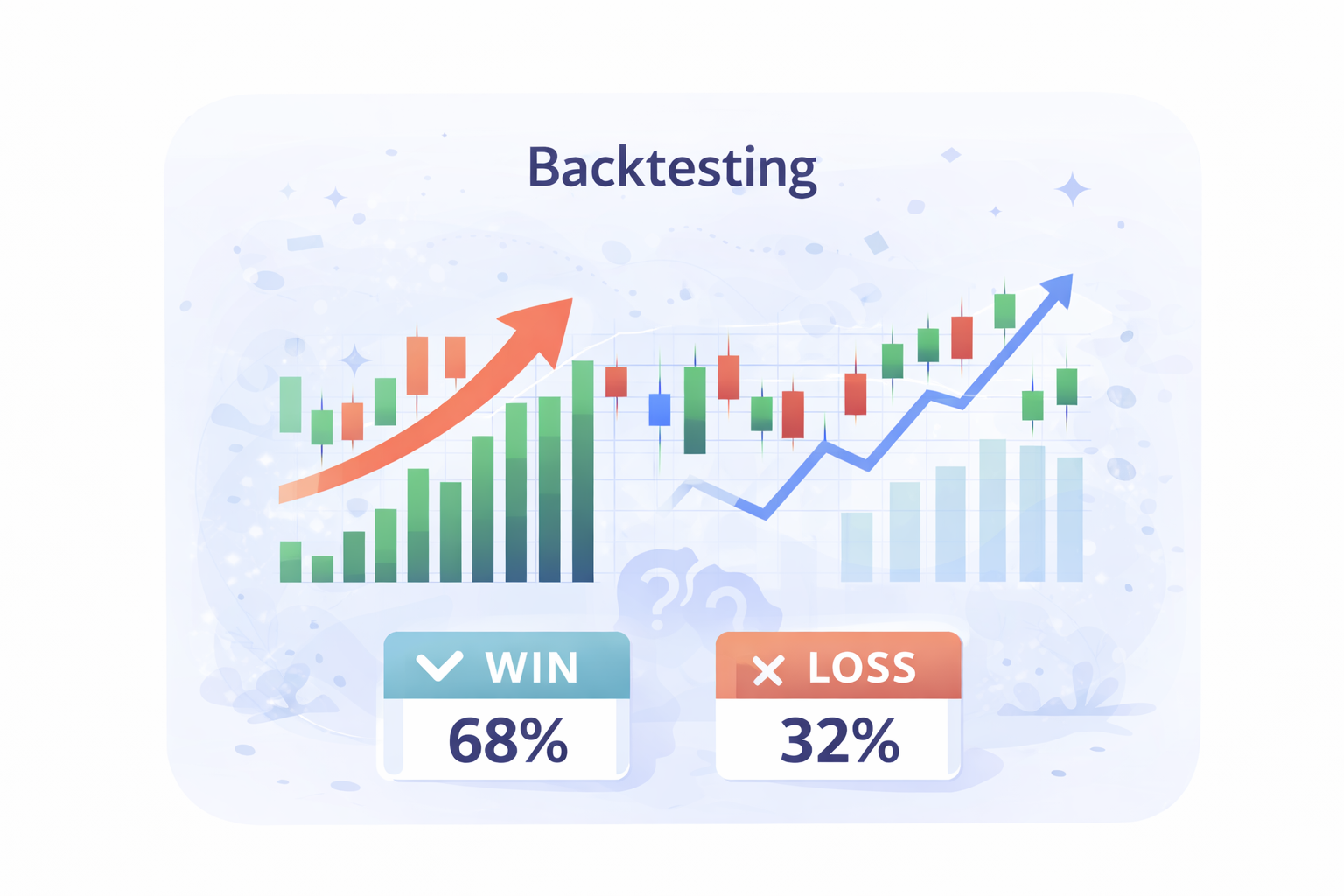
Table of contents:
- What Is Backtesting in Trading?
Why It’s Important Before Risking Real Money?
How to Backtest a Trading Strategy?
Define Your Strategy
Gather Historical Data
Choose a Backtesting Method
Run the Backtest
Analyze the Results
Refine and Improve
Conclusion
What Is Backtesting in Trading?
Backtesting is a method that traders use to test their trading strategies using historical market data. In simple terms, it's a "dry run" — you don't trade with real money in the market, but you test on past price action so you'll know how your plan would have performed. For example, if you have the rule "Buy when the price crosses above the 50-day moving average," you can look and see how many times the rule had popped in the past and what kind of profits or losses it would have made.
Backtesting enables traders to discover how their technique reacts under different market conditions — like when prices are rapidly moving, are stable, or rapidly reversing. By doing so, traders are able to test their idea to decide if it's a good one or not before using it for live trading. It's similar to running through a drill prior to playing the game. You determine what is effective and what isn't, without losing money.
There are two main ways of backtesting. The first is manual backtesting, in which you go through previous charts and mark where your entry and exit would be. The second is automated backtesting, and it uses computer software or trading programs that quickly test your rules against history. Both methods help traders get a realistic sense of how a strategy will perform in the long term.
Why It’s Important Before Risking Real Money?
Backtesting is important because it keeps traders from entering the market blindly. Most new traders enter the market enthusiastically, but without testing strategies first, they lose money quickly. Backtesting allows you to see what will happen before investing hard cash. If your strategy continues to lose during testing, that is a definite sign that you need to alter it before risking actual cash.
It also makes you more self-assured. If you've tried out your strategy in different market conditions and it's performed well, you'll be less anxious and more level-headed in live trading. Backtesting allows you to see how your system behaves — how often it wins, how much it loses, and its mean returns.
Another fundamental reason backtesting is so important is that it tells you if your plan is realistic. Strategies do not necessarily always translate well to real markets, and sometimes they look wonderful on paper. Through backtesting, you can identify weaknesses, such as excessive drawdowns or excessive number of trades, and correct them early.
In brief, backtesting is a preventive step between theory and real trading. It will not guarantee profit in the future, but it will enable you to make smarter, more knowledgeable decisions — reducing the probability of acting on emotional or rash trading mistakes.
How to Backtest a Trading Strategy?
Backtesting is a simple but powerful process that helps traders see how their trading ideas would have worked in the past. It’s like replaying old market data to check if your plan makes sense before risking any real money.
Define Your Strategy
Before you start testing, you need to have a clear trading plan. This means setting your entry and exit rules — when you’ll buy and when you’ll sell. For example, you might decide to “buy when the price goes above the 50-day moving average” and “sell when it goes below.”
Next, choose your indicators, timeframe, and assets:
- Indicators are tools that help you read charts, such as the RSI (Relative Strength Index), MACD, or Moving Averages.
- Timeframe means how often you trade — for example, 1-hour, 4-hour, or daily charts.
- Assets are what you’ll trade — like Bitcoin, gold, or stock indexes.
Your strategy should be specific, not vague. Clear rules help you test correctly and avoid confusion later.
Gather Historical Data
You need past price data to run a backtest. This includes open, high, low, and close prices for each time period. Most trading platforms like TradingView or MetaTrader offer free historical data. You can also find it from websites such as Yahoo Finance or Binance for crypto.
The more data you have, the better. Ideally, test your strategy on at least a few years of data to see how it performs in both good and bad markets. This helps you understand if your idea works consistently, not just in one lucky period.
Choose a Backtesting Method
There are two main ways to backtest:
- Manual backtesting: You go through charts yourself, marking each trade based on your rules. It’s slower but helps beginners understand how the market moves.
- Automated backtesting: Software runs your strategy automatically using code or built-in tools. It’s faster and more accurate for complex strategies.
Popular tools include TradingView, MetaTrader 4/5, and Amibroker. If you’re new, start with manual testing to get a feel for it before moving to automated systems.
Run the Backtest
Now apply your strategy to the historical data. Follow your rules exactly and record each trade — when you entered, when you exited, and what the result was (profit or loss).
Try to keep it realistic: include transaction costs (like trading fees and spreads) so your results aren’t too optimistic. The goal is to simulate what would happen in real trading as closely as possible.
Analyze the Results
Once you’ve run the test, it’s time to look at the numbers. Some key performance metrics include:
- Win rate: The percentage of trades that made a profit.
- Drawdown: The biggest drop from a peak to a low point — shows how much your account could lose before recovering.
- Profit factor: The ratio of total profit to total loss. A value above 1.5 is generally good.
If your win rate is high but your losses are huge, the strategy might still be risky. Look for a balance between profit and safety.
Refine and Improve
No strategy is perfect from the start. If results aren’t great, try adjusting parameters (like using a 20-day instead of a 50-day moving average) and retesting. This process helps you make your plan stronger.
But be careful not to overfit or curve fit — that means tweaking your strategy too much to fit past data perfectly. A strategy that looks perfect in history often fails in real markets because the future never repeats exactly. To enhance your knowledge in the markets you can learn through akinda.io.
Conclusion
Backtesting is more than a technical activity—it's a reality check for the trader. It instills patience and discipline, as well as the value of thinking in terms of data. When backtesting is done correctly, you begin to fully comprehend not only your strategy but who you are as a trader—how you react to wins, losses, and uncertainty. It also helps develop a groundwork for confidence. Confidence does not come from luck, it comes from knowing your plan has been developed, tested, and challenged, with improvements made. Backtesting encourages you to start thinking longer term and worry less about chasing quick profits—beginning to think about consistency over adventure. Most importantly, backtesting changes trading from a gamble into a process. It highlights that success in the markets is about preparation, structure, and development. Success or failure on any individual test gets you that much closer to becoming a more capable and knowledgeable trader. Explore latest stock analyses here.
Frequently Asked Questions (FAQ)
Is backtesting enough to guarantee profits?
No. Backtesting improves decision-making, but it cannot predict future market conditions.
How much historical data should I use?
Ideally several years, covering both strong trends and sideways markets.
Should beginners use automated backtesting?
Beginners should start with manual backtesting to understand price behavior before moving to automation.
What is overfitting in backtesting?
Overfitting happens when a strategy is adjusted too much to past data, making it unreliable in real markets.
Can a strategy fail even after good backtest results?
Yes. Markets change, which is why backtesting should be combined with forward testing and risk management.
This article is for educational purposes and reflects widely accepted principles in finance and investment analysis.