
- Investing Principles
How to Build Your First Investment Portfolio
- What is an Investment Portfolio
- Assets can be included
- Mistakes Beginners Should Avoid

Table of contents:
- Introduction
- What is an investment portfolio
- Risk
- Rationalization Permits
- Smart beta portfolios
- Assets can be included
- Nominal return & Real return
- Example
- Conclusion
INTRODUCTION
Assets are diverse, people pick assets according to a mix of personal, financial, and market factors. Investors have goals, risk levels, and time horizons to pick assets to buy. In this case people build their own investment portfolios.
WHAT IS AN INVESTMENT PORTFOLIO
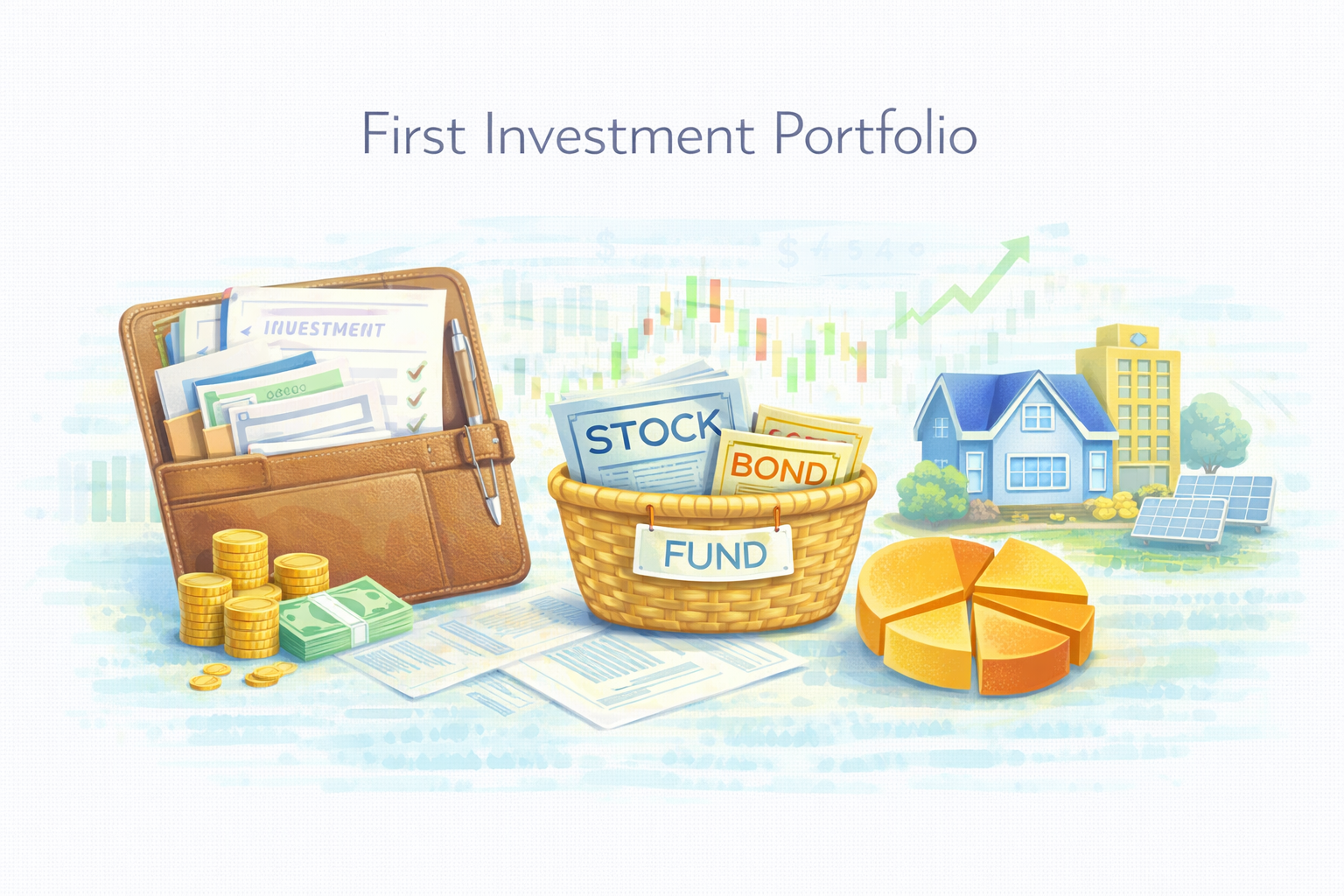
An investment portfolio is a basket of assets owned by an investor. Those assets may include Crypto currencies, Stocks, Bonds, cash. Investment. Investment portfolios have problems with diversification. Some beginner investors invest too much of their money into one type of asset. Some of the assets are correlated strongly. The market crash or any downfall makes the assets riskier because if one asset price falls other correlated ones also may lose their value. Long-term investments are not about quick wins - it is all about steady growth over time.
Risk tolerance is the amount of loss an investor is willing and able to bear to achieve potential returns. Investors should feel comfortable with the amount of risk that they’re taking. Especially short-term investments are considered riskier.
Risk level is important to measure comfort level with volatility and potential losses. There are three main risk levels:
Conservative: Bonds, cash, blue-chip stocks, TIPS
Moderate: Balanced mix of stocks, bonds, ETFs
Aggressive: Growth stocks, crypto, private equity
The various kinds of investments that constitute an investment portfolio considering each of their risk/rewards ratio and making investments in the suitable proportion is called Asset Allocation. Stocks, Bonds, Cash and Equivalents are various risk/rewards categories Money is gained and lost.
Rationalization Permits an investor to “sell high and buy low”, investing time into an increased number of probable returns. It promotes consistent, unwavering investing and helps reduce emotional decisions during the ups and downs of the market.
Smart beta portfolios are a modern approach to investing that combines the simplicity of passive investing with the strategy of active management. Smart beta portfolios outperform traditional index funds because of using specific rules or factors rather than just tracking the market blindly. In S&P 500 companies like “Apple”, “Microsoft” and “Amazon” have large shares. Concentration risk is high that your money depends on a handful of these companies.
ASSETS CAN BE INCLUDED
Stock - is the piece of company, which is offered to the public (IPO). IPO stands for initial public offering which means to sell the stock in the market. Usually, companies use this to unlock strategic opportunities, raising capital, enhancing credibility, and liquidity for existing shareholders. Stock is considered one of the riskiest assets in the financial markets. Investors appreciate the stocks because of high liquidity and high returns.
Bonds - are government issued assets, those are assets to lend the government or companies to people. Investors make money from interest rates, and this is prohibited in Islam. Bonds have a maturity date, which means when the loan ends. Principal repayments issuer repays the original amount of the loan to the bondholder. Also, investors appreciate the bonds because of fixed income (bondholders earn fixed interest rates).
Crypto currency is a digital form of money based on blockchain technology. Crypto market is considered the higher volatility which means more uncertain the costs are. Investors appreciate Crypto currencies because of decentralized control.
Commodities are the type of raw materials, like gold, oil, natural gas, coal, silver, platinum, copper, aluminum, corn, cotton. Commodities markets often have independent or inverse correlations with stock and bond markets. Investors appreciate the commodities because of non-inflation behavior. Commodities are considered the market sensitive assets to economic shift, geopolitics and weather.
MISTAKES BEGINNERS SHOULD AVOID
Mistakes done by beginners are often basic, but they still have disastrous consequences. Instead of using logic, they use emotional reasoning when investing. Because of this, they fall prey to greed and endlessly buy the latest market fads. Alternatively, they operate from a place of panic and sell whatever stocks they have at a loss. Lots of beginner investors tend to spend all their money on a few stocks, ignoring the principle of diversification. If the owning companies suffer, extensive losses will be suffered to these investors. Forgetting to set a long-term investing strategy is common, and leads to regular market attempts, which no one is successful at. This leads to buying high and selling at a loss, which is the opposite of a successful strategy. Another common beginner’s strategy is to buy low with the assumption that the negative micro economic factors will be low, and the business tax will be high. The strategy nullifies the minimum returns over an extended period. They might also invest without assessing their personal risk tolerance. This tendency leads to aggressive decisions that cause stress and thus, impulsive selling when the market goes in a negative direction. The assumption of buying without consideration of the primary dimensions of the entire market because of the blind recommendations is naive. Imagine starting out without first building an emergency fund rather which leads to the assumption. The series of blunders that are avoidable can set a new investor back financially.
Inflation is the biggest weapon against investment portfolios. Even though it doesn’t directly show up. Its consequences lead to erode purchasing power of money over time. If your portfolio grows by 6% but inflation is 7%. You’re losing money in real terms.
Nominal return & Real return. Nominal return is the raw percentage gain on an investment before considering external factors like inflation and taxes, while real return is the nominal return adjusted for inflation and taxes.
For example: if your investment has 10% annual return but inflation rate is 4%. Your real return is 6%
10%-4%=6%
That 10% is nominal return which is before taxes and/or inflations.
EXAMPLE
Let’s create an mixed up investment portfolio.
- Stocks (50%) – $5,000
- $4,000 in S&P 500 ETF (SPUS or SPY): Provides exposure to the 500 largest U.S. companies. It’s diversified and has strong long-term growth potential.
- $1,000 in International Stocks ETF: Adds global diversification, reducing reliance on just the U.S. market.
- Bonds (25%) – $2,500 in U.S. Treasury Bond ETF
- Lower risk than stocks. Provides stability and consistent income, especially during market downturns.
- Real Estate (10%) – $1,000 in REIT ETF
- Allows investing in real estate without buying property. Generates passive income through rent and property growth.
- Gold (5%) – $500 in Gold ETF
- A hedge against inflation and market volatility. Helps balance portfolio risk during economic uncertainty.
- Cash (10%) – $1,000 in savings
- For emergencies or unexpected opportunities. Prevents the need to sell investments during a downturn.
$100 - Stocks; $50 - Bonds; $30 - Real Estate; $20 - Gold
Monthly Contribution: $200=$100+$50+$30+$20
With an 8% average annual return, this portfolio could grow to $154,000+ in 20 years.
Reminder: this example made only purpose of education and do not take any responsiblities. Making the personal investment portfolio requires personal guidances like your age, risk tolerance level, your financial IQ, and your “skin in the game” . To make personal investment portfolio you can use the help of professionals like akinda.io... etc.
CONCLUSION
Constructing an investment portfolio is not an easy task, as it requires a great deal of mental preparedness, strategic thinking, and above all, self-restraint. Although accumulating wealth can happen through several different assets, it is more a matter of how sane and logical the investment strategy is, rather than how emotional it is. With the set of long-term objectives, a portfolio can be constructed which is flexible enough to cater to the life changes of an individual and the plethora of changes in the market.
KEY WORDS: Beginner Investing Mistakes, Emotional Investing, Portfolio Diversification, Long Term Investing Strategy, Risk Tolerance, Impulsive Selling, Emergency Fund, Investment Portfolio, Stock Market, IPO (Initial Public Offering), Bonds, Crypto Currency, Commodities, Portfolio Diversification, Asset Allocation, Investment Portfolio, Portfolio Diversification, Asset Allocation, Risk Tolerance, Long Term Investing, Risk level, Nominal return & Real return, Inflation.