
- Halal investing for beginners
- Investing Principles
How to Calculate Zakat on Stocks: A Practical Guide
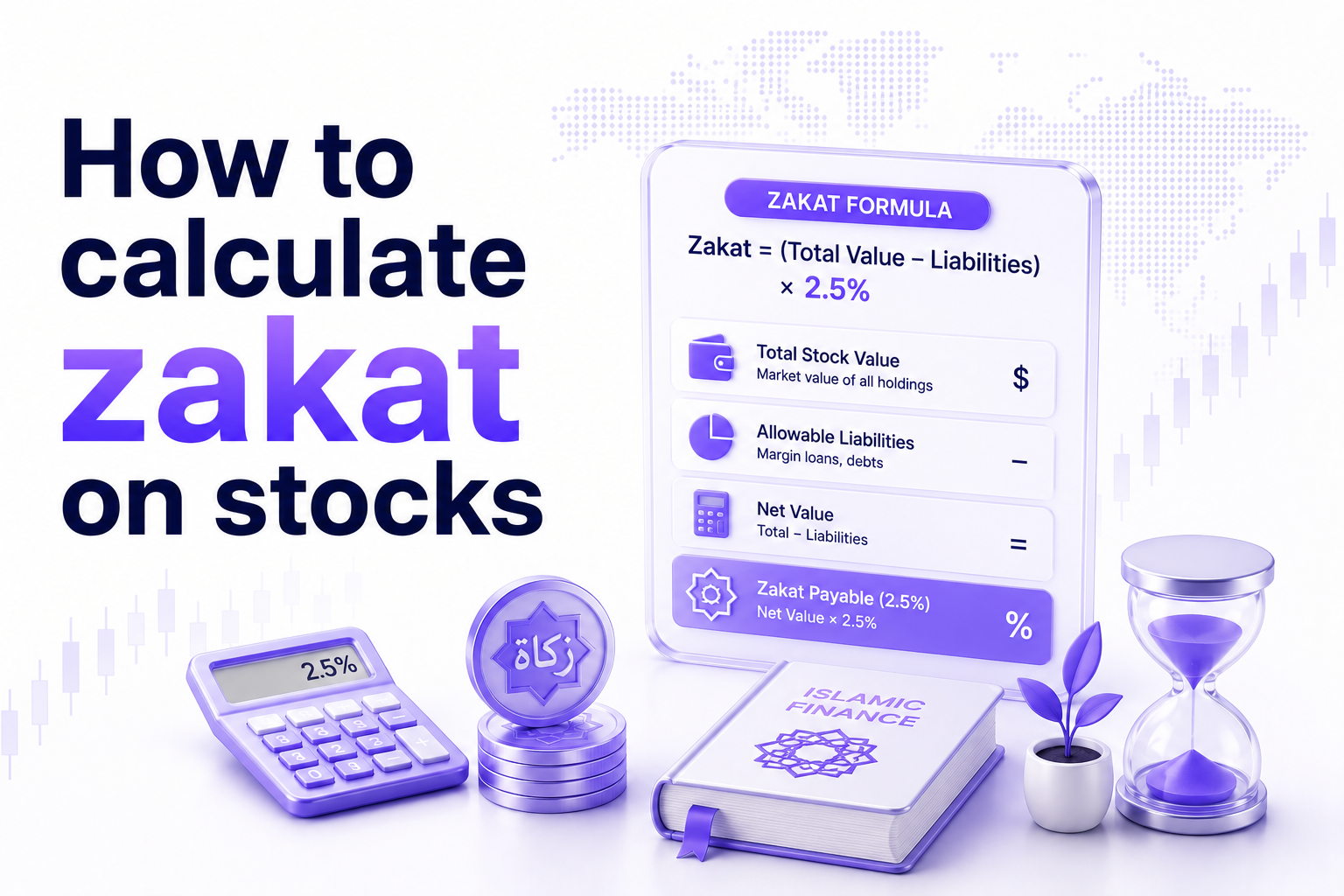
Zakat is one of the pillars of Islam, and if you own stocks, it applies to them too. But calculating zakat on stocks trips a lot of people up, because the method depends on why you own the shares. An active trader and a long-term investor work it out differently, and getting the distinction right can change your bill significantly. This guide explains how to calculate zakat on stocks: the core concepts of nisab, hawl, and the 2.5% rate, the two calculation methods with worked examples, and where to find trusted tools to do the maths.
Quick Answer You pay zakat on stocks at 2.5% once your zakatable wealth exceeds the nisab and you've held it for a lunar year. The method depends on intention. Active traders pay 2.5% on the full market value of their holdings. Long-term investors pay 2.5% only on their share of the company's zakatable assets (cash, receivables, and inventory), which is often estimated at 30% of market value when a full balance-sheet analysis isn't practical. Dividends and cash in your account are zakatable at full value. Zakat is separate from purification. |
Table of Contents
- Do you pay zakat on stocks?
- What are nisab, hawl, and the rate?
- How do traders calculate zakat on stocks?
- How do long-term investors calculate it?
- What about ETFs, dividends, and cash?
- Zakat calculators and tools
Do you pay zakat on stocks?
Yes. Stocks are a form of growing wealth, and the majority of contemporary scholars, including AAOIFI and the International Islamic Fiqh Academy, confirm that zakat is due on them. What varies is how you calculate it, and that depends on your intention in owning the shares. The classical principle is that an asset's ruling follows the intention behind holding it, so the first question to ask yourself is simple: am I trading these shares, or holding them for the long term?
What are nisab, hawl, and the rate?
Three concepts underpin every zakat calculation, and stocks are no exception.
- Nisab. The minimum wealth threshold at which zakat becomes due, equal to the value of about 85 grams of gold or 595 grams of silver. The silver nisab is lower, so using it makes more people liable, the more cautious choice.
- Hawl. The holding period. Zakat is due once your zakatable wealth has stayed at or above the nisab for one full lunar year. Many investors simply pick a fixed annual zakat date.
- The rate. 2.5% of your net zakatable wealth (or 2.577% if you calculate on the longer Gregorian year).
How do traders calculate zakat on stocks?
If you buy and sell frequently to profit from price movements, your shares are treated like trade goods, the same as inventory in a business. The calculation is simple: take the total market value of your holdings on your zakat date and pay 2.5%.
| Trader example | Amount |
|---|---|
| Market value of stock holdings on zakat date | $50,000 |
| Zakat rate | 2.5% |
| Zakat due (2.5% × $50,000) | $1,250 |
Add any cash in your brokerage account and unswept dividends to this, since those are zakatable at full value too. For active traders, the full market value is the base, because the shares are effectively working capital in a trading enterprise.
How do long-term investors calculate it?
If you hold shares for the long term, for dividends, growth, or retirement, you're a part-owner of a business, and zakat is due only on your share of the company's zakatable assets: its cash, receivables, and inventory (often called the CRI or look-through method). You don't pay on the full share price, because a large part of it reflects buildings, equipment, and brand value, which aren't zakatable.
There are two ways to do this:
- The precise method: from the company's latest balance sheet, add cash, receivables, and inventory, divide by shares outstanding to get a zakatable value per share, then multiply by the shares you own and pay 2.5%.
- The 30% approximation: if analysing balance sheets isn't practical, treat 30% of your holding's market value as zakatable. It's a conservative estimate, since the average zakatable portion of a listed company runs around 25–30%.
| Long-term investor example (30% method) | Amount |
|---|---|
| Market value of long-term holdings | $100,000 |
| Estimated zakatable portion (30%) | $30,000 |
| Zakat due (2.5% × $30,000) | $750 |
The same $100,000 held for trading would owe $2,500, so the distinction matters. If you're genuinely unsure which category you fall into, or hold with mixed intentions, err toward caution or ask a scholar.
What about ETFs, dividends, and cash?
The same logic extends to funds and to the cash side of your portfolio.
- ETFs and funds: apply the trader or investor method based on your intention. Some Shariah-certified funds publish a zakat-per-share (or zakatable-percentage) figure, which is the most accurate input, use it when available.
- Dividends and cash: cash in your account and dividends you've received and kept are zakatable at their full value, added to your zakatable base.
- Not to be confused with purification: zakat is a pillar of worship on your wealth; purification cleanses impure income and is separate, as covered in what is purification article. You do both.
Zakat calculators and tools
Because the zakatable-assets method needs company financials, most investors use a tool rather than doing it all by hand. A few trusted, non-commercial options can help:
- National Zakat Foundation and Islamic Relief offer widely-used zakat calculators run by established charities.
- Zakat Foundation of America publishes a zakat-on-stocks guide and calculator.
- Simple Zakat Guide (by scholar Joe Bradford) walks through the brokerage-account calculation in detail.
Whichever tool you use, you'll need your holdings' current market value and, for the precise method, each company's cash, receivables, and inventory. You can find a company's financials and market data on Akinda's stock screener and its per-stock financial pages, then feed those figures into a dedicated zakat calculator. Akinda focuses on screening and research, so pair it with one of the zakat tools above for the calculation itself.
Frequently asked questions
Is zakat 2.5% of my whole stock portfolio?
Only if you're an active trader. Traders pay 2.5% on the full market value. Long-term investors pay 2.5% on just the zakatable-assets portion of their holdings, cash, receivables, and inventory, which is often estimated at 30% of market value. So a long-term investor's zakat is usually much lower than 2.5% of the whole portfolio.
What is the 30% rule for zakat on stocks?
The 30% rule is a practical shortcut for long-term investors. Instead of analysing each company's balance sheet, you treat 30% of your holdings' market value as the zakatable portion and pay 2.5% on that. It's based on the average zakatable assets of listed companies being around 25–30%, with 30% chosen as a conservative buffer.
Do I pay zakat on unrealised gains?
For traders, yes, indirectly, because you pay on the full current market value, which already includes unrealised gains. For long-term investors, you pay only on your share of the company's zakatable assets, not on paper gains from rising fixed assets or brand value. Either way, zakat is assessed on your holdings' value on your zakat date.
Should I use the gold or silver nisab?
Many scholars recommend the silver nisab because it's lower, making you liable sooner, which is the more cautious and inclusive choice, especially when your wealth is a mix of assets. Some apply the gold nisab when gold dominates their wealth. Both are valid; follow the guidance of a scholar you trust.
Sources
Fiqh Council of North America – Zakah on Stocks – explains the trader vs long-term-investor methods and the 30% approximation with examples.
SeekersGuidance – Zakat on long-term investments (Hanafi) – the look-through zakatable-assets method, affirmed by the International Islamic Fiqh Academy.
Zakat Foundation of America – Zakat on stocks and investments – scholarly guidance and calculator for individual shareholders.
Download the Akinda app Screen thousands of global stocks and monitor Shariah compliance in real time. 🌐 Website: akinda.io 📱 App: onelink.to/kpqkh6 |
Disclaimer
This article is for educational purposes only and is not financial or religious advice. Zakat rulings and nisab values change with market prices and differ across scholars; verify current figures and consult a qualified scholar for your specific situation.