
- Trading Strategies
How to Set Stop-Loss and Take-Profit Targets? (Beginner-Friendly Guide)
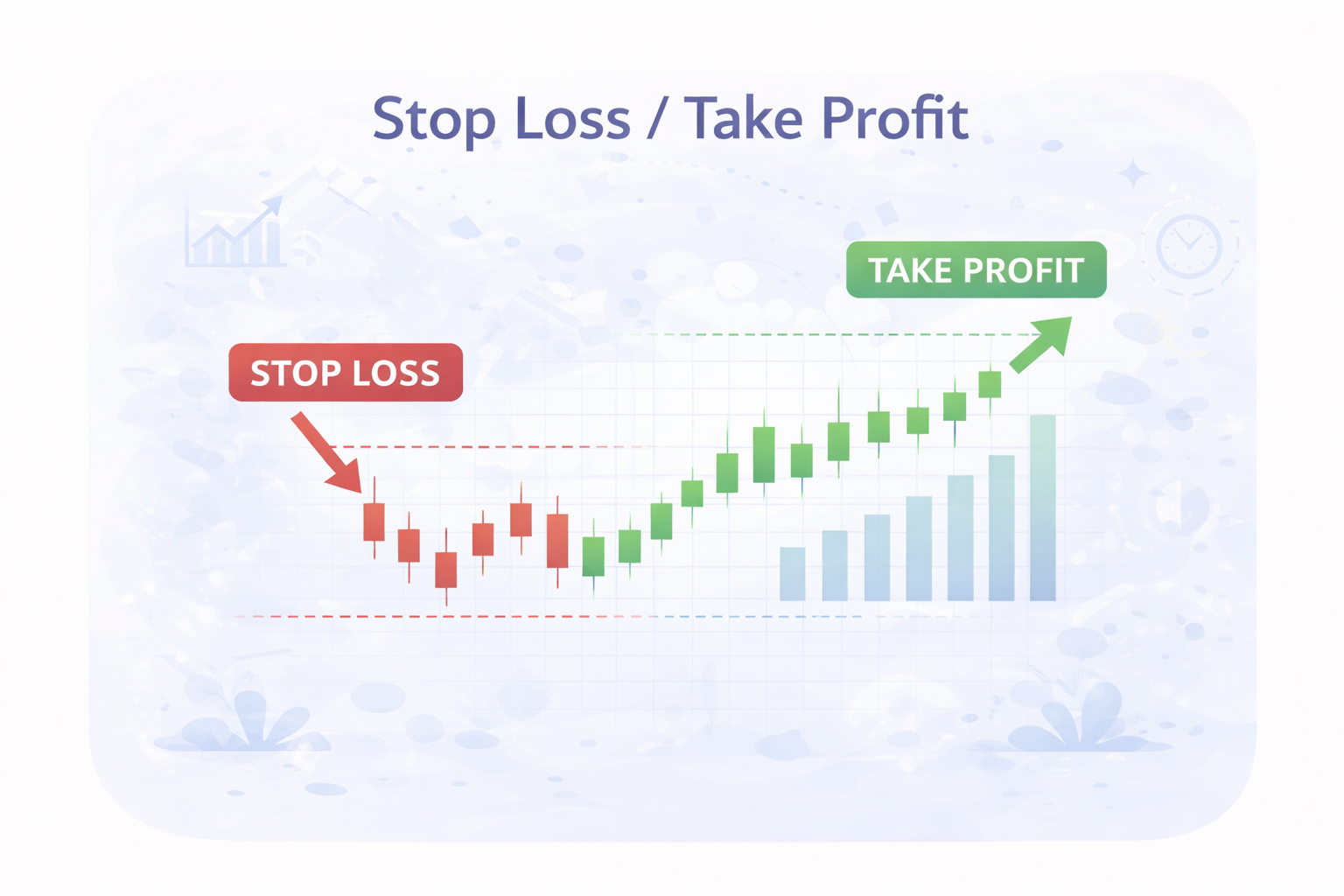
Table of contents
- Introduction
What Is a Stop-Loss?
What Is a Take-Profit?
How to Set Stop-Loss and Take-Profit Levels?
The Psychology Behind Stop-Loss and Take-Profit
Using Tools Like Akinda.io
Conclusion
Introduction
One of the hardest lessons for any investor or trader to learn is when to sell. Everyone loves the idea of buying low and selling high — but in real life, emotions get in the way. That’s where stop-loss and take-profit orders come in.
These two tools help you manage risk and remove emotion from your decisions. A stop-loss protects you from losing too much, while a take-profit helps you secure gains before the market turns. In short, they’re your safety nets in the unpredictable world of investing.
What Is a Stop-Loss?
A stop-loss is a predefined price level at which your broker automatically sells your investment to prevent further losses. It’s a risk management tool that helps you limit how much you’re willing to lose on a trade. Instead of constantly watching the market and making emotional decisions, you set a boundary — and let the system do the rest.
For example, let’s say you buy a stock at $100. You decide that the most you’re willing to lose is 10%, so you set a stop-loss at $90. If the stock price drops to that level, your position is automatically closed. This protects you from deeper losses if the market continues to fall.
Think of a stop-loss as a safety net. It’s like saying, “I’m okay with losing this much, but I won’t let it go beyond that.” It’s especially useful during volatile market conditions or when unexpected news causes sharp price movements.
Stop-loss orders also help reduce emotional trading. Fear and greed often lead investors to hold onto losing positions too long or sell winners too early. By setting a stop-loss, you remove the need to make tough decisions in the heat of the moment. It enforces discipline and helps you stick to your strategy.
In short, a stop-loss is not just a technical tool — it’s a psychological one. It gives you peace of mind, knowing that your downside is controlled, even if the market behaves unpredictably.
What Is a Take-Profit?
A take-profit is a predetermined price level at which your broker automatically sells your investment to lock in gains. It’s the counterpart to a stop-loss order, but instead of limiting losses, it helps you secure profits before the market has a chance to reverse. With a take-profit in place, you don’t have to constantly monitor your trades or guess when to exit — the system does it for you.
Imagine you buy a stock at $100 and set a take-profit at $120. If the price reaches $120, your position is automatically closed, and you walk away with a 20% gain. This prevents you from holding on too long and potentially watching your profits disappear if the market turns against you.
Think of a take-profit as a reward mechanism. It’s like saying, “I’m happy with this level of profit — I’ll take it and move on.” It encourages discipline and helps you avoid the trap of greed, which can lead to missed opportunities or unnecessary losses.
Take-profit orders are especially useful in fast-moving markets, where prices can spike and drop quickly. By setting a target in advance, you ensure that you benefit from favorable price movements without having to react in real time.
Just like stop-loss orders, take-profit levels should be based on a solid strategy. Many traders use technical analysis, previous resistance levels, or risk/reward ratios to determine where to set their take-profit. It’s not about guessing — it’s about planning.
In essence, a take-profit order is a smart way to automate your success. It helps you stay focused, reduce emotional decision-making, and stick to your trading goals with confidence.
How to Set Stop-Loss and Take-Profit Levels?
There’s no one-size-fits-all formula for setting stop-loss and take-profit levels, but there are several practical methods that beginners can use to make smart decisions. These approaches help you manage risk, stay disciplined, and avoid emotional trading.
1. Use Percentage Rules
One of the simplest ways to set a stop-loss is by using the 1–2% rule. This means you don’t risk more than 1–2% of your total account balance on a single trade. For example, if your account has $1,000, your maximum loss per trade should be around $10 to $20. This keeps your losses manageable and prevents one bad trade from wiping out your account.
2. Use Support and Resistance Levels
Support and resistance levels are key areas on a price chart where the market tends to reverse. If you enter a trade near a support level, you can place your stop-loss just below it — so if the price breaks that level, you exit the trade. For take-profit, look at the next resistance level above your entry. These levels act as natural boundaries and help you set realistic targets.
3. Use Technical Indicators
Technical indicators like Bollinger Bands, RSI (Relative Strength Index), and Moving Averages can signal potential price reversals. For instance, if RSI shows the asset is overbought, it might be a good place to set a take-profit. If it’s oversold, that could be a smart spot for a stop-loss. These tools add context to your decisions and help you avoid guessing.
4. Maintain a Risk-to-Reward Ratio
A solid risk-to-reward ratio is essential. Many traders aim for a 1:2 ratio — meaning for every $1 they risk, they aim to make $2. This way, even if only half of your trades are successful, you can still be profitable over time. It’s a simple but powerful concept that keeps your strategy balanced and sustainable.
In the end, setting stop-loss and take-profit levels is about planning ahead. It’s not just about protecting your money — it’s about trading with confidence and clarity.

The Psychology Behind Stop-Loss and Take-Profit
Trading isn’t just about charts and numbers — it’s also about mindset. Emotions like fear, greed, and hope can cloud judgment and lead to poor decisions. That’s why understanding the psychology behind stop-loss and take-profit orders is just as important as knowing how to set them.
When prices start falling, fear kicks in. You might panic and sell too early — or worse, hold on hoping the market will bounce back, only to watch your losses grow. A stop-loss helps you avoid this trap. It’s a pre-planned exit that removes emotion from the equation and enforces discipline.
On the flip side, when prices rise, greed can take over. You might think, “Just a little more,” and hold on too long — only to see your profits vanish. A take-profit order helps you stay grounded. It reminds you to be satisfied with your target and not chase unrealistic gains.
These tools act like psychological anchors. They give you structure and help you stick to your strategy, even when the market gets unpredictable. Instead of reacting emotionally, you follow a plan — and that’s what separates successful traders from impulsive ones.
In short, stop-loss and take-profit orders aren’t just technical settings. They’re mental safeguards. They protect you from yourself — from the emotional rollercoaster that comes with every trade — and help you trade with clarity, confidence, and control.
Using Tools Like Akinda.io
Setting stop-loss and take-profit levels manually can be time-consuming and stressful — especially for beginners. That’s where platforms like Akinda.io come in. These tools simplify the process by allowing you to set automated exit points directly on your trading charts, so you don’t have to constantly monitor the market.
Akinda.io offers a user-friendly interface where you can visually place your stop-loss and take-profit levels with just a few clicks. This makes it easier to plan your trades and stick to your strategy. Instead of reacting emotionally to price movements, you can rely on the system to execute your plan exactly as intended.
One of the standout features of Akinda is its built-in risk calculators. Before you even enter a trade, you can test different risk-to-reward scenarios and see how they affect your potential outcomes. For example, if you’re aiming for a 1:2 ratio, Akinda helps you calculate the exact price levels needed to meet that goal — based on your entry point and account size.
This kind of automation not only saves time but also reduces the chance of human error. It helps you stay disciplined, avoid impulsive decisions, and maintain consistency across your trades. Whether you’re a beginner or an experienced trader, using tools like Akinda.io can give you a strategic edge.
In short, Akinda.io turns complex planning into a simple, visual process — making it easier to trade with confidence and control. Explore latest stock analyses here.
Conclusion
Setting stop-loss and take-profit levels is one of the most important skills any trader or investor can develop. These tools aren’t just about numbers — they’re about protecting your capital, managing your emotions, and sticking to a plan. In a market that can change in seconds, having predefined exit points gives you structure and confidence.
Stop-loss orders help you limit losses and avoid emotional decisions during downturns. Take-profit orders help you lock in gains before the market turns against you. Together, they form a balanced strategy that keeps your trading disciplined and focused.
There’s no perfect formula, but using percentage rules, support and resistance levels, technical indicators, and risk-to-reward ratios can guide you toward smarter decisions. And with platforms like Akinda.io, you can automate these strategies and reduce the stress of manual trading.
Ultimately, successful trading isn’t just about picking the right stocks — it’s about knowing when to exit. By using stop-loss and take-profit orders wisely, you give yourself a better chance to grow your portfolio steadily and sustainably.
So whether you’re just starting out or looking to refine your strategy, remember: planning your exits is just as important as planning your entries. Trade smart, stay disciplined, and let your tools work for you.
📌: Before your next trade, take one extra minute to set your stop-loss and take-profit targets. Your future self will thank you.
Frequently Asked Questions (FAQ)
What is the difference between stop-loss and take-profit?
A stop-loss limits how much you can lose on a trade, while a take-profit locks in gains when a target price is reached.
Where should beginners place a stop-loss?
Beginners often place stop-losses based on a fixed percentage (1–2%) or just below a key support level.
Is a tight stop-loss always better?
Not always. Stops that are too tight may be triggered by normal price fluctuations. Stops should match market volatility.
Can I trade without a take-profit?
Yes, but many beginners benefit from take-profit orders to avoid emotional exits and greed-driven decisions.
What is a good risk-to-reward ratio?
Many traders aim for at least 1:2 — risking $1 to potentially earn $2.
Do stop-loss orders guarantee protection?
No. In highly volatile markets, slippage can occur, but stop-losses still significantly reduce risk.
Should I move my stop-loss during a trade?
Only if it’s part of your strategy (e.g., trailing stop). Moving it emotionally usually leads to losses.
This article is for educational purposes and reflects widely accepted principles in finance and investment analysis.
Sources & Further Reading
- Murphy, J. J. (1999). Technical Analysis of the Financial Markets. New York Institute of Finance.
- Pring, M. J. (2014). Technical Analysis Explained. McGraw-Hill Education.
- Van K. Tharp (2006). Trade Your Way to Financial Freedom. McGraw-Hill.
- Investopedia (2023). Stop-Loss and Take-Profit Orders Explained.
- Akinda.io (2025). Investor Education Resources.