Is Trading Halal? A Beginner's Guide to Halal Trading
By Akinda · 2026-05-06
Table of Contents
- Introduction
- What Does "Trading" Actually Mean?
- The Islamic Foundation: Two Core Principles
- The Golden Rule: You Cannot Sell What You Do Not Own
- When Is Stock Trading Halal?
- When Does Trading Become Haram?
- Trading Type Verdict Table: Halal, Haram, or Disputed?
- The Compliance Problem: Not Just the Activity, But the Asset
- Common Beginner Mistakes That Make Halal Trading Haram
- How to Start Trading the Halal Way
Introduction
If you have ever typed "is trading halal" into Google, you are not alone. It is one of the most searched Islamic finance questions in the world, and the answers you find are often incomplete, contradictory, or written without proper Shariah context.
This guide will give you the foundational Islamic principles you need to evaluate any form of trading - stocks, forex, futures, or beyond. We will not cover every trading type in exhaustive detail here; each deserves its own deep analysis (and we cover them in dedicated articles). What we will do is give you the core framework so you can reason clearly about any trading activity you encounter.
The short answer
Trading is not inherently halal or haram. Whether it is permissible depends on what you are trading, how you are trading it, and whether you actually own the asset before you sell it. Get those three right, and trading can be a completely legitimate halal activity.
1. What Does "Trading" Actually Mean?
In everyday conversation, "trading" and "investing" are used almost interchangeably. In financial and Islamic legal contexts, they mean different things, and the distinction matters.
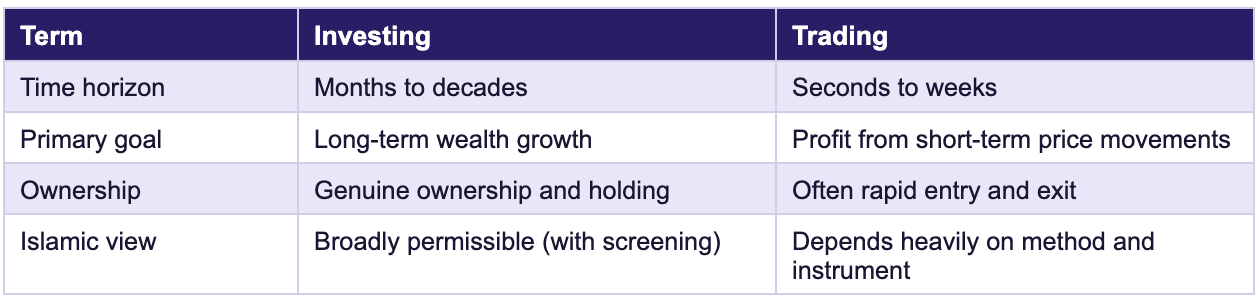
Trading, in its broadest sense, is simply buying and selling assets in financial markets. The act of trading is not inherently un-Islamic. Merchants have traded since the earliest days of Islam - the Prophet Muhammad ﷺ himself was a merchant. What Islam scrutinises is not the act of buying and selling, but the rules governing that transaction.
2. The Islamic Foundation: Two Core Principles
Before evaluating any specific trading activity, you need to understand the two principles that underpin all of Islamic commercial law. Everything else flows from these.
Principle 1 - The Prohibition of Riba (ربا)
Riba means any predetermined, guaranteed excess return on a financial transaction - what we commonly call interest or usury.
In trading, riba appears most clearly in:
- Margin accounts that charge overnight interest (swap fees) on leveraged positions.
- Conventional bonds and fixed-income instruments where the return is interest-based.
- Currency trading where delayed settlement generates implied interest.
Principle 2 - The Prohibition of Gharar (غرر)
Gharar means excessive uncertainty, ambiguity, or speculation in a contract. A transaction has impermissible gharar when its outcome is so uncertain that it resembles gambling - one party gains only because the other loses, and the result depends on chance rather than real economic activity.
Gharar is the principle that makes the following problematic:
- Options contracts - you pay a premium for the right to buy or sell at a future price. The outcome is uncertain; the contract has no underlying real exchange at the time of agreement. Is options trading halal?
- Futures contracts - you agree to buy or sell an asset at a future date and price. You are selling something that does not yet exist in your possession.
- Highly speculative day trading - when the primary driver is momentum and price psychology rather than any real assessment of underlying value.
- Key Distinction
- Islam does not prohibit uncertainty in business - all business involves risk. What it prohibits is unnecessary, manufactured uncertainty that serves no real economic purpose and benefits one party only at the guaranteed expense of another. Owning a stock and selling it later at a higher price is legitimate risk. Selling a currency you have never held for a price to be agreed next month is gharar.
3. The Golden Rule: You Cannot Sell What You Do Not Own
This is the single most important concept in Islamic trading law, and it is the foundation for understanding why so many modern financial instruments are impermissible.
The Prophet Muhammad ﷺ said: "Do not sell what you do not have." (Hadith - Tirmidhi, Abu Dawud, Ibn Majah)
This hadith, agreed upon by all major scholarly schools, establishes a foundational rule: before you can sell something, you must own it and be able to deliver it. You must bear the risk of ownership - even for a moment - before transferring it to a buyer.
This principle has enormous practical implications for modern financial instruments:
Why Forex (Spot) Trading Is Problematic
The Shariah principle of bay' al-sarf requires currency exchange to be settled hand-to-hand and simultaneously. Conventional forex settles at T+2, so you are agreeing to exchange currencies you may not yet hold - which is why the majority of contemporary scholars consider spot forex on conventional platforms haram, even without leverage. A minority position holds that electronic platforms satisfy the immediacy requirement.
Full scholarly analysis, both positions, and the leverage/swap question: Is Forex Trading Halal or Haram?
Why Futures Contracts Are Haram
A futures contract is an agreement to buy or sell an asset at a predetermined price on a specific future date. The asset does not change hands today. The price is locked in today. By the time the contract expires, the asset's market price will almost certainly be different from the agreed price, which means one party will profit at the exact expense of the other.
This violates both the "sell what you own" principle (the seller does not own the asset at the time of the contract) and contains significant gharar (the outcome is a zero-sum bet on future price movement). Almost all major Shariah scholars and bodies, including AAOIFI, have ruled futures contracts impermissible for Muslim investors.
Why Short Selling Is Haram
Short selling means selling shares you do not own - borrowing them from a broker, selling at today's price, then buying them back cheaper to return. It violates the "sell what you own" hadith directly, introduces riba through the borrowing arrangement, and is considered haram by virtually all Shariah scholars. → Is Short Selling Halal or Haram?
4. When Is Stock Trading Halal?
Despite all of the above, stock trading - buying and selling shares in publicly listed companies - can absolutely be halal. The conditions are specific and non-negotiable:
The company must be in a permissible business.
The underlying business cannot be in a haram industry: conventional banking, alcohol, tobacco, gambling, pork, weapons for civilian harm, or adult entertainment. This applies regardless of whether you are buying to hold for ten years or ten minutes. The nature of the business does not change based on your time horizon.
The company must pass financial ratio screening.
Even a permissible business can be non-compliant if it is excessively financed by interest-bearing debt (above 30% of market cap under AAOIFI standards) or earns significant interest income (above 5% of total revenue). Check compliance before trading, not after.
You must actually own the shares before selling them.
This means your brokerage account must reflect full ownership and settlement of the shares before you sell. Do not sell shares you have purchased but that have not yet settled (typically T+2 in most markets). And never short-sell.
No interest-based leverage or margin.
Trading on margin means borrowing money from your broker to buy more shares than you can afford with your own capital. Brokers charge interest on this borrowed amount - this is riba. Halal trading means using only your own capital. Some Islamic brokerage accounts offer Shariah-compliant "commodity murabahah" financing as an alternative - check carefully before using any form of leverage.
The intention should involve real economic participation.
This is the most debated condition. Some scholars argue that the intention behind a trade matters: buying a share with the genuine intention of owning a stake in a business, even briefly, is different from buying solely to exploit price volatility for speculation. Others argue that lawful trade is lawful trade regardless of time horizon. We address this debate in depth in our article on day trading.
5. When Does Trading Become Haram?
A trading activity crosses into haram territory when any of the following conditions are present:
- You are trading a non-compliant asset (haram industry or failing financial ratios).
- You are using interest-bearing margin or leverage (riba).
- You are selling an asset before you own it, including short selling and some forms of fast day trading where settlement has not occurred.
- You are trading instruments where no real asset changes hands - futures, options, CFDs, and most forex instruments on conventional platforms.
- The trading activity is purely speculative with no connection to real economic value - more akin to gambling than commerce.
- An Important Nuance
- The line between permissible active trading and impermissible speculation is not always clear, and honest scholars disagree. What is clear is that the further you move from genuine ownership of real assets and the closer you move toward betting on price movements, the more problematic the activity becomes under Shariah. When in doubt, err on the side of caution - the halal alternative (long-term investing in compliant stocks) is readily available.
6. Trading Type Verdict Table: Halal, Haram, or Disputed?
Here is a quick-reference summary of where different trading types stand according to the majority scholarly position:
| Trading Type | Verdict | Primary Reason |
| Stock investing (long-term) | ✓ Halal | Genuine ownership of real business. Permissible with compliance screening. |
| Stock trading (short-term) | ~ Disputed | Permissible if compliant stock, no margin, full ownership. Scholars differ on speculation intent. |
| Day trading | ~ Disputed | Settlement timing & speculative nature raise concerns. Covered in depth separately. |
| Forex (spot, no leverage) | ~ Disputed | Requires hand-to-hand settlement. T+2 delay problematic. Minority view: halal electronically. |
| Forex (with leverage/swap) | ✗ Haram | Interest charges on overnight positions = riba. No scholarly disagreement. |
| Options trading | ✗ Haram | Gharar: selling the right to buy/sell at future price with no current ownership. |
| Futures contracts | ✗ Haram | Selling asset not yet owned. Zero-sum speculation. AAOIFI: impermissible. |
| Short selling | ✗ Haram | Selling asset you do not own. Violates "sell what you own" hadith directly. |
| CFD trading | ✗ Haram | No asset ownership. Interest charges. Pure price speculation. |
| Margin trading | ✗ Haram | Borrowed capital with interest = riba. Clear prohibition. |
| Crypto (spot, compliant asset) | ~ Disputed | Asset itself debated. Spot purchase of certain cryptos: some scholars permit. |
7. The Compliance Problem: Not Just the Activity, But the Asset
A critical point that many beginners miss: even if your trading method is halal (you own the shares, no leverage, settled position), you can still be trading haram if the underlying stock is non-compliant.
Non-compliance happens in two ways:
Business Activity Non-Compliance
The company operates in a prohibited industry. No amount of compliant trading mechanics can make buying shares in a casino operator or a conventional bank halal. The asset itself is the problem.
Financial Ratio Non-Compliance
The company's debt or interest income exceeds AAOIFI thresholds. This is the more common and more easily missed problem. A technology company that you have held compliantly for two years may quietly cross the 30% debt threshold after a leveraged acquisition. If you do not check, you are now holding and trading a non-compliant asset.
Compliance Is Not Static
A stock's halal status changes every quarter with earnings reports. This is why checking once and forgetting is not sufficient. Use a screener that updates compliance data automatically after each quarterly report. Akinda updates all 10,000+ stocks in its database following each earnings season - you can set alerts for any compliance changes in your portfolio.
8. Common Beginner Mistakes That Make Halal Trading Haram
Mistake 1: Assuming all stocks in a halal industry are halal
A software company is not automatically halal. A technology company that earns 8% of its revenue from interest on cash deposits fails the AAOIFI 5% income threshold. A healthcare company that finances its operations with 40% interest-bearing debt fails the 30% debt ratio. Always screen, never assume.
Mistake 2: Using a conventional broker's margin feature
Most standard brokerage accounts offer margin as a default feature. Even if you never intentionally use it, some platforms automatically lend you funds for a brief period during settlement. Check your broker's terms. If interest is charged on any form of credit or overnight position, that account is not halal for margin use. Use only your own settled funds.
Mistake 3: Trading "Islamic accounts" on forex platforms without scrutiny
Swap-free accounts usually rebuild the interest cost into wider spreads or admin fees, and they leave the deeper problem - T+2 settlement and the absence of real currency ownership - completely untouched. A swap-free label does not make a forex account halal. → Is Forex Trading Halal or Haram?
Mistake 4: Confusing high-frequency trading with legitimate commerce
Some beginners assume that if long-term investing is halal, the same compliant stocks traded rapidly must be halal too - just faster. Many scholars reject this, arguing that trading with no genuine intention of holding a business stake moves the activity closer to gambling than commerce. → Is Day Trading Halal or Haram?
9. How to Start Trading the Halal Way
If you are new to halal trading, here is a clear, practical starting framework:
Start with long-term halal investing - not trading.
Before you think about trading, build the foundation. Long-term ownership of halal stocks is the most clearly permissible, most financially proven, and least risky approach. Understand what you own, why it is compliant, and how to monitor its compliance. Trading is an advanced activity built on this foundation, not a shortcut around it.
Screen every stock before any transaction.
Use a Shariah-compliant screener - like Akinda's free screener - to verify compliance before any purchase. Check the business activity and the financial ratios. Make this a non-negotiable habit, not an occasional exercise.
Use a cash account only, never margin.
When you are ready to trade more actively, use a cash account where you can only trade with funds you actually have. This eliminates margin risk and the riba associated with it. If your broker does not offer a simple cash-only account, consider switching to one that does.
Avoid instruments where ownership is unclear or deferred.
Stick to equities - actual shares in real companies - where ownership is established at purchase. Avoid options, futures, CFDs, and forex until you have thoroughly researched the specific scholarly rulings and found a credible scholarly opinion that supports your specific use case.
Monitor compliance quarterly and purify when necessary.
Set a calendar reminder after each quarterly earnings season to re-check your holdings. If a stock becomes non-compliant, scholars generally allow a reasonable period to divest. Calculate and donate any purification amount for incidental impure income at the end of each financial year.

Sources & References
- AAOIFI. Shariah Standard No. 21: Financial Paper (Shares and Bonds). Manama, 2004.
- AAOIFI. Shariah Standard No. 7: Hawala. Manama, 2004.
- Usmani, Mufti Muhammad Taqi. An Introduction to Islamic Finance. Kluwer Law International, 2002.
- Securities Commission Malaysia. Resolutions of the Shariah Advisory Council on Islamic Finance. 3rd ed., 2019.
- Investopedia. "T+2: What It Means and How Settlement Works." Updated 2025.
- Accounting and Auditing Organization for Islamic Financial Institutions (AAOIFI). aaoifi.com
- Download the Akinda app
- Screen thousands of global stocks and monitor Shariah compliance in real time.
- 🌐 Website: akinda.io
- 📱 App: onelink.to/kpqkh6
Disclaimer: This article is for educational purposes only and does not constitute financial or religious (fatwa) advice. Shariah rulings depend on individual circumstances. Consult a qualified Islamic scholar and licensed financial advisor for guidance specific to your situation.