
- Building with Akinda
Launching a Halal Investing Product: A Go-to-Market Guide
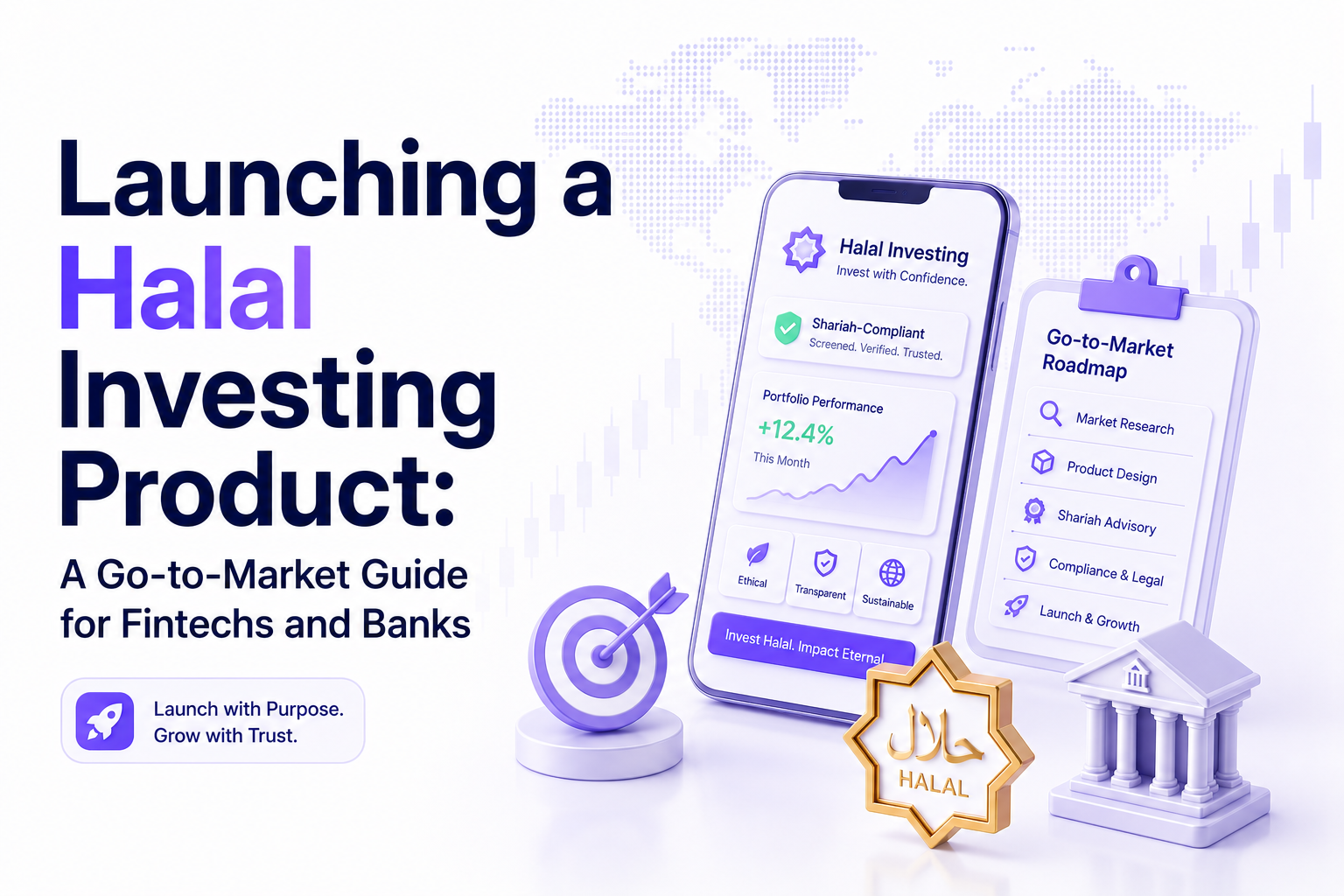
Launching a halal investing product is less about a big-bang release and more about getting a sequence of decisions right: who you're serving, how you'll deliver credible compliance, how the product surfaces it, and how you earn trust in a community where word of mouth is everything. This go-to-market guide lays out that sequence for fintechs and banks, from validating the opportunity through to launch and iteration, with the compliance foundation treated as the non-negotiable core rather than a feature bolted on at the end.
Quick Answer To launch a halal investing product, work through six steps: validate the opportunity and define your audience, decide build vs buy for the compliance layer (most teams buy), get a credible Shariah foundation in place (recognised methodology, scholar governance, purification), design the UX around clear verdicts and gates, localise and build community trust, then launch, measure, and iterate with ongoing re-screening. An AAOIFI-based API like the Akinda Halal API supplies the compliance core so you can move in weeks, not years. |
By the numbers (2026) Market: Islamic finance assets ~$5.1 trillion in 2026 → ~$8.46 trillion by 2031 (Mordor Intelligence); Islamic fintech ~$250 billion → ~$619 billion by 2033 (Grand View Research). |
Table of Contents
- Step 1: Validate the opportunity and audience
- Step 2: Decide build vs buy
- Step 3: Get the compliance foundation right
- Step 4: Design the product and UX
- Step 5: Localize and build trust
- Step 6: Launch, measure, iterate
- Pitfalls to avoid
Step 1: Validate the opportunity and audience
Start by grounding the launch in a specific audience, not “Muslim investors” in the abstract. The macro case is strong: Islamic finance assets are near $5.1 trillion in 2026 and growing at roughly 10% a year, the Islamic fintech segment faster still, and around 2 billion Muslims are underserved by conventional apps, but your product needs a sharper target than that.
Define who you're launching for: retail investors in a particular country or diaspora, existing customers of a bank adding an Islamic window, or values-driven investors who span faiths. Each implies different markets to cover, languages to support, and messages that land. Validate demand with your existing base or target community before you build, and remember that Shariah screening overlaps with ESG, so your addressable audience may be broader than the Muslim population alone.
Step 2: Decide build vs buy
The single biggest architectural decision is whether to build the Shariah screening layer or buy it. Building means licensing financial data, engineering a screening engine, modelling purification, and recruiting qualified scholars to govern the methodology, then maintaining all of it every quarter. Because that scholarship is scarce, fewer than 1,200 qualified Sharia board members serve over 2,000 institutions globally; most teams buy the compliance layer through an API and focus their build on the product experience. An AAOIFI-based API like the Akinda Halal API turns a multi-year build into an integration. Get this decision right early, because it determines your timeline, cost, and risk for everything downstream.
Step 3: Get the compliance foundation right
Whatever you decide in Step 2, the compliance foundation is what your whole product rests on, so it has to be credible from day one. Three elements are non-negotiable:
- A recognised methodology. Screen against AAOIFI-based rules and be able to show them. A published, auditable methodology lets your Shariah board and knowledgeable users verify the logic.
- Scholar governance. Verdicts should be overseen by a qualified scholar, the Akinda API's are reviewed by Dr. Muhammad Nazir Khan, who holds an AAOIFI Shari'ah Auditing Certification, so they're accountable rather than marketing.
- Purification. Provide the figure users need to cleanse impermissible income, a detail that signals you understand the practice, not just the label.
This foundation is exactly what the API supplies through its endpoints: a compliance verdict, the ratios behind it, and purification data, all governed by a documented methodology. You can sanity-check behaviour against Akinda's live halal stock screener as you build.
Step 4: Design the product and UX
With compliance data in hand, design the experience so that compliance is visible exactly where users make decisions. The core surfaces:
- Halal badges on every ticker and company page, so status is clear at a glance.
- A pre-trade compliance gate that checks a stock before an order executes and warns or blocks non-compliant buys.
- Compliant portfolios or filters that let users invest within a screened universe, whether self-directed or robo-managed.
- Purification reporting that turns compliance into a concrete number users can act on.
- Onboarding that sets expectations about how screening works and what users can and can't do, building trust from the first session.
Because the compliance endpoint returns a fast verdict, it fits latency-sensitive moments like a trade screen, while the full report powers the detail views where users want to see the reasoning.
Step 5: Localize and build trust
Halal investing is global and multilingual, and many potential users are underserved precisely because mainstream apps are English-only and culturally generic. Meeting users in their language and community is a growth lever, not a nice-to-have. Akinda's roots in Central Asia bring coverage and localization, including Russian and Uzbek, that helps if your markets include the CIS region or other non-English-speaking Muslim populations. Beyond language, trust in this category is built through transparency and presence: explain your methodology plainly, engage the communities where these investors gather, and let word of mouth, which is powerful in tight-knit communities, do the work paid acquisition can't. For the mechanics users may ask about, point them to Akinda's explainer on AAOIFI screening.
Step 6: Launch, measure, iterate
Treat launch as the start of an operating cadence, not a finish line. Two categories of work matter after go-live:
- Product metrics. Track activation, the share of users who place a first compliant trade, retention, and adoption of adjacent compliant products, since trust drives cross-sell.
- Compliance operations. Re-screen holdings on a schedule, quarterly after earnings season is a sensible baseline, and alert users when a position's status changes so verdicts never go stale.
Because the Akinda API maintains the methodology and data, your ongoing compliance work is mostly re-screening and communication rather than rebuilding rules. Generate a key on the dashboard, and review plans on the pricing page as your volume grows from launch.
Pitfalls to avoid
A few common mistakes derail halal product launches:
- Bolting compliance on late. Shariah compliance can't be retrofitted cleanly onto a conventional core; design it in from the start.
- Labelling without substance. A “halal” badge over a non-compliant universe erodes trust fast with a knowledgeable audience.
- Equating ESG with Shariah. They overlap but differ; Shariah adds financial-ratio screening and purification, so genuine screening is required.
- Letting verdicts go stale. Compliance changes with company financials; without re-screening, your data quietly becomes wrong.
- Under-investing in trust. In this community, transparency and word of mouth matter more than a big ad budget.
Frequently asked questions
How do I launch a halal investing product?
Work through six steps: validate the opportunity and define a specific audience, decide build vs buy for the compliance layer (most teams buy), put a credible Shariah foundation in place, design the UX around clear verdicts and gates, localise and build community trust, then launch and iterate with ongoing re-screening. Treat the compliance foundation as the core, not a late add-on.
Should I build or buy the screening layer for launch?
Most teams buy, because building requires scarce scholar governance plus data, engineering, and perpetual maintenance. Buying an AAOIFI-based API supplies the compliance core, verdicts, ratios, and purification, so you can launch in weeks and focus your build on the product experience. Build only if screening itself is your core differentiator.
What does a credible compliance foundation require?
Three things: a recognised, published methodology your Shariah board can audit; governance by a qualified scholar so verdicts are accountable; and purification data so users can meet their obligations. Without these, a “halal” product won't earn the trust of knowledgeable users, and trust is what drives retention and referrals in this market.
How do I reach Muslim investors at launch?
Meet them in their language and community. Localise the product and content for your target markets, explain your methodology transparently, and engage the communities where these investors gather. Word of mouth is powerful in tight-knit communities, so a genuinely compliant, well-explained product markets itself far more effectively than paid acquisition alone.
What should I measure after launch?
Activation (first compliant trade), retention, and adoption of adjacent compliant products on the growth side, and compliance operations, chiefly re-screening cadence and status-change alerts, on the trust side. Because a good API maintains the methodology and data, your ongoing compliance work is mostly re-screening and communication rather than rebuilding rules.
Sources
AAOIFI Shari'ah Standard No. 21: Financial Paper (Shares and Bonds) – the standard the Akinda API's screening methodology is built around.
Akinda API screening methodology – the full three-phase screen, ratio formulas, and purification rule, published for integrators to audit.
Akinda API Shariah advisor – the scholar governance behind the API's halal verdicts.
Mordor Intelligence – Global Islamic Finance Market (2026) – Islamic finance market size and growth projections.
Grand View Research – Islamic Fintech Market Report – Islamic fintech market size and CAGR.
Build with the Akinda Halal API The developer-grade API for AAOIFI-based Shariah stock screening. Start on the free tier, scale when you ship. 📚 Docs: b2b.akinda.io/developer/docs 💳 Pricing: b2b.akinda.io/pricing 🔑 Get a key: b2b.akinda.io/dashboard |
Disclaimer
This article is about a software product and is for general information only. It is not financial or religious advice. Automated Shariah screening produces data-driven signals, not a fatwa; integrators should pair it with their own Shariah governance and consult qualified scholars. API features, endpoints, coverage, and pricing change over time, so verify current details on b2b.akinda.io before building.