
- Building with Akinda
Shariah Compliance Data for Robo-Advisors & Brokerages
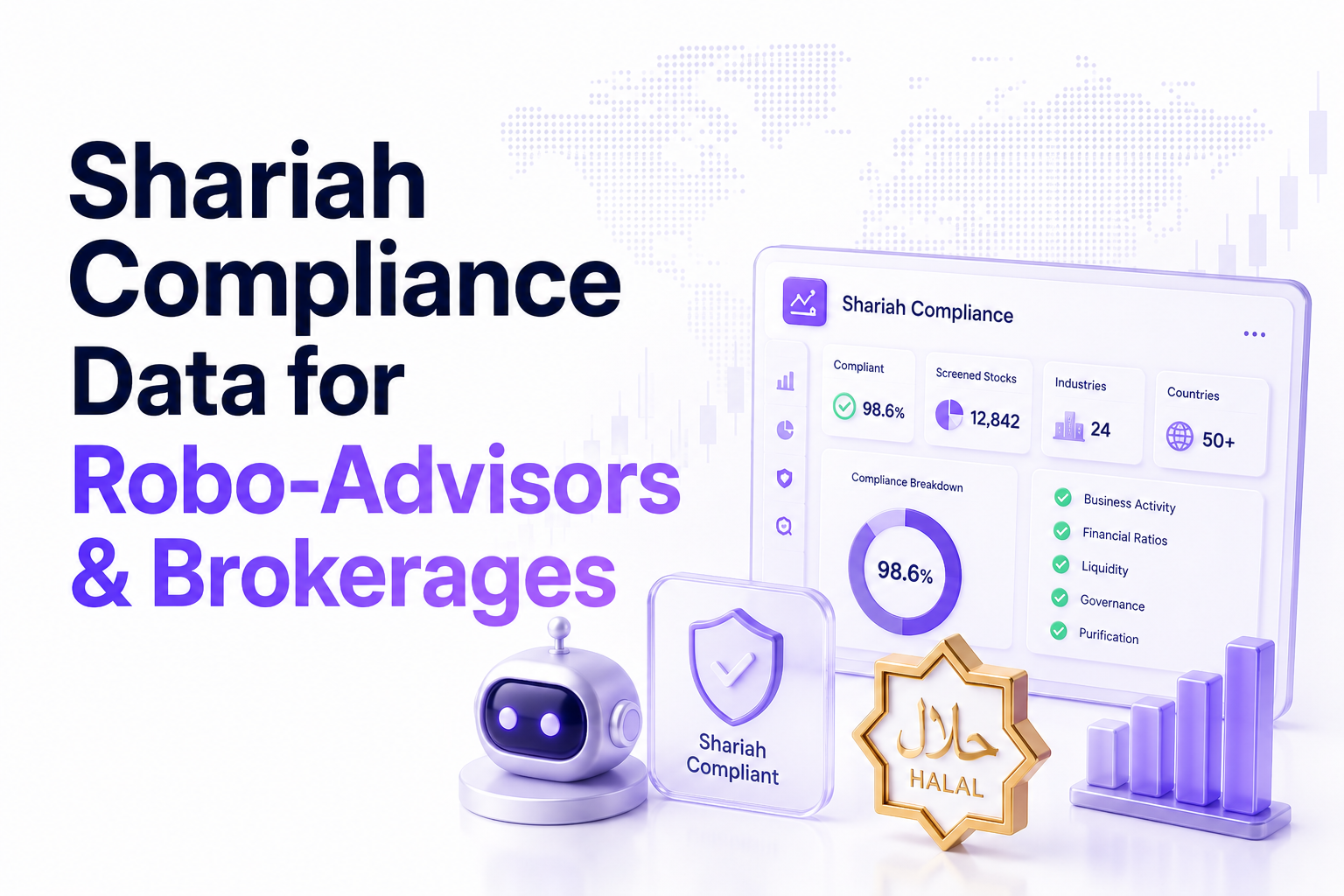
Robo-advisors and brokerages sit at the exact point where a Muslim investor decides whether to place a trade, and that's where Shariah compliance data earns its keep. Whether you're allocating a client's portfolio automatically or showing a compliance status at the moment of a trade, you need reliable, current, auditable data about which securities are halal and why. This guide covers what Shariah compliance data actually contains, how robo-advisors and brokerages each use it, and how to wire it into your platform.
Quick Answer Shariah compliance data tells a robo-advisor or brokerage whether a security is halal, and why, so it can build compliant portfolios and screen trades. It includes a compliance verdict, the business-activity result, the financial ratios behind the decision, and purification figures. Robo-advisors use it to allocate and rebalance within a compliant universe; brokerages use it for halal badges and pre-trade compliance gates. The Akinda Halal API delivers this data through AAOIFI-based endpoints with a published methodology. |
By the numbers (2026) Islamic finance assets: ~$5.1 trillion in 2026, projected to reach ~$8.46 trillion by 2031 (Mordor Intelligence). |
Table of Contents
- Why robo-advisors and brokerages need it
- What Shariah compliance data contains
- Robo-advisors: building compliant portfolios
- Brokerages: compliance at the point of trade
- Data quality and freshness
- Integrating the Akinda data layer
Why robo-advisors and brokerages need it
For a large and growing segment of investors, compliance isn't a preference, it's a prerequisite. A Muslim client won't stay with a robo-advisor that allocates their money into interest-based banks or gambling stocks, and won't trust a brokerage that gives them no way to check a stock's status. With Islamic finance assets near $5.1 trillion in 2026 and the Islamic fintech market growing at nearly 14% a year, serving this audience well is a real commercial opportunity, not a compliance chore.
There's also an ethical-investing overlap: Shariah screens exclude many of the same sectors that ESG-conscious investors avoid, so compliance data can serve values-driven non-Muslim clients too. Either way, the data has to be accurate and defensible, because you're making, or gating, investment decisions on the basis of it.
What Shariah compliance data contains
Good Shariah compliance data is more than a green checkmark. To build features you can stand behind, you want:
- The verdict - a compliant / non-compliant status for each security.
- The business-activity result - whether the company's core business is permissible, and the impermissible-revenue share where relevant.
- The financial ratios - debt and liquidity measured against the methodology's thresholds, so you can show why a stock passed or failed.
- Purification figures - how much of a dividend a holder should cleanse.
- A timestamp - so you know how current the verdict is and when to re-screen.
This is exactly what the Akinda Halal API returns, with the rules set out in a published screening methodology so your compliance team can audit them. The full-report endpoint carries the ratios and purification data; the compliance endpoint returns just the verdict for speed.
Robo-advisors: building compliant portfolios
For a robo-advisor, compliance data is an input to every allocation decision. The core pattern is to define a compliant universe, only securities that pass screening, and let your allocation and rebalancing logic operate within it. In practice that means:
- Universe construction: filter your investable set to compliant securities before optimisation runs, so a non-compliant stock can never enter a portfolio.
- Rebalancing checks: re-screen holdings before each rebalance, so a position that has drifted out of compliance is flagged for replacement rather than topped up.
- Ongoing monitoring: re-screen quarterly and alert clients (or auto-adjust) when a holding changes status after an earnings season shifts its ratios.
- Purification reporting: use purification figures to tell clients how much to cleanse, turning compliance into a concrete, trust-building number.
The result is a portfolio that's compliant by construction, not by after-the-fact spot checks, which is what a Shariah-conscious client expects from an automated advisor.
Brokerages: compliance at the point of trade
A brokerage's job is different: users choose their own trades, so compliance data has to meet them at the moment of decision. The highest-value integrations are:
- Halal badges on every ticker and company page, so a user sees status at a glance while browsing.
- A pre-trade compliance gate that checks the compliance endpoint before an order executes and warns, or blocks, non-compliant buys.
- Compliance detail views that show the business result and ratios behind a verdict, so an informed user can see why a stock is or isn't halal.
- Halal-only filters in search and screeners, letting users browse a compliant universe directly.
Because the compliance endpoint is designed for a fast verdict, it fits naturally into a latency-sensitive trade flow, where a badge or gate decision has to render instantly.
Data quality and freshness
Compliance data is only useful if it's accurate and current, and Shariah status is not static. A company can move in or out of compliance when its debt, cash, or revenue mix changes after an earnings report, so a verdict that was right last quarter can be wrong this quarter. Two things matter most:
- Coverage. The data has to span the markets your users actually trade. Confirm coverage for your target exchanges before you build.
- Freshness and re-screening. Re-screen on a schedule, quarterly is sensible, and use each verdict's timestamp to flag data that's aged past your window.
A transparent, published methodology also matters here: when a verdict changes, you and your users can see exactly why. You can compare against Akinda's live halal stock screener to sanity-check coverage and behaviour as you evaluate the data.
Integrating the Akinda data layer
Integration is a standard REST flow, so a robo-advisor or brokerage can be up and running quickly.
- Generate an API key from the dashboard and prototype on the free tier.
- For a robo-advisor, call the compliance endpoint to build and maintain your compliant universe; for a brokerage, call it to power badges and pre-trade gates.
- Pull full-report data where you need ratios and purification on detail screens or client reports.
- Cache verdicts and re-screen quarterly so decisions stay current.
- Review the pricing page and move to a business plan for production volumes.
Full request and response schemas are in the developer docs, and the Akinda for Business page covers the commercial side for platforms and institutions.
Frequently asked questions
What is Shariah compliance data?
It's structured data describing whether a security is Shariah-compliant and why, typically a verdict, the business-activity result, the financial ratios behind it, and purification figures. Robo-advisors and brokerages consume it through an API to build compliant portfolios, halal badges, and pre-trade gates without running their own screening engine.
How do robo-advisors use Shariah compliance data?
They use it to define a compliant universe and keep portfolios inside it. Allocation runs only over securities that pass screening, rebalancing re-checks holdings, and ongoing monitoring flags positions that drift out of compliance. Purification figures let the advisor tell clients how much dividend income to cleanse.
How do brokerages use it?
At the point of trade. Brokerages surface halal badges on tickers, run a pre-trade compliance gate that checks a stock before an order executes, and offer halal-only filters in search. The fast compliance endpoint fits a latency-sensitive trade flow where the verdict has to render immediately.
How often does compliance data need updating?
Regularly, because status changes with a company's finances. Re-screen on a schedule, quarterly after earnings season is a sensible baseline, and use each verdict's timestamp to catch data that's gone stale. A stock that was compliant last quarter can fail this quarter if its debt or interest income rises.
Does Shariah compliance data only serve Muslim clients?
No. Because Shariah screens exclude many of the same sectors that ethical and ESG investors avoid, the same data can serve values-driven non-Muslim clients. Surveys show a majority of sustainable-fund investors already view Islamic funds as ESG-aligned, so compliant offerings can widen your addressable audience.
Sources
AAOIFI Shari'ah Standard No. 21: Financial Paper (Shares and Bonds) – the standard the Akinda API's screening methodology is built around.
Akinda API screening methodology – the full three-phase screen, ratio formulas, and purification rule, published for integrators to audit.
Akinda API Shariah advisor – the scholar governance behind the API's halal verdicts.
Mordor Intelligence – Global Islamic Finance Market (2026) – Islamic finance market size and growth projections.
Grand View Research – Islamic Fintech Market Report – Islamic fintech market size and CAGR.
Build with the Akinda Halal API The developer-grade API for AAOIFI-based Shariah stock screening. Start on the free tier, scale when you ship. 📚 Docs: b2b.akinda.io/developer/docs 💳 Pricing: b2b.akinda.io/pricing 🔑 Get a key: b2b.akinda.io/dashboard |
Disclaimer
This article is about a software product and is for general information only. It is not financial or religious advice. Automated Shariah screening produces data-driven signals, not a fatwa; integrators should pair it with their own Shariah governance and consult qualified scholars. API features, endpoints, coverage, and pricing change over time, so verify current details on b2b.akinda.io before building.