
- Investing Principles
The Psychology of Money: Emotional Traps to Avoid
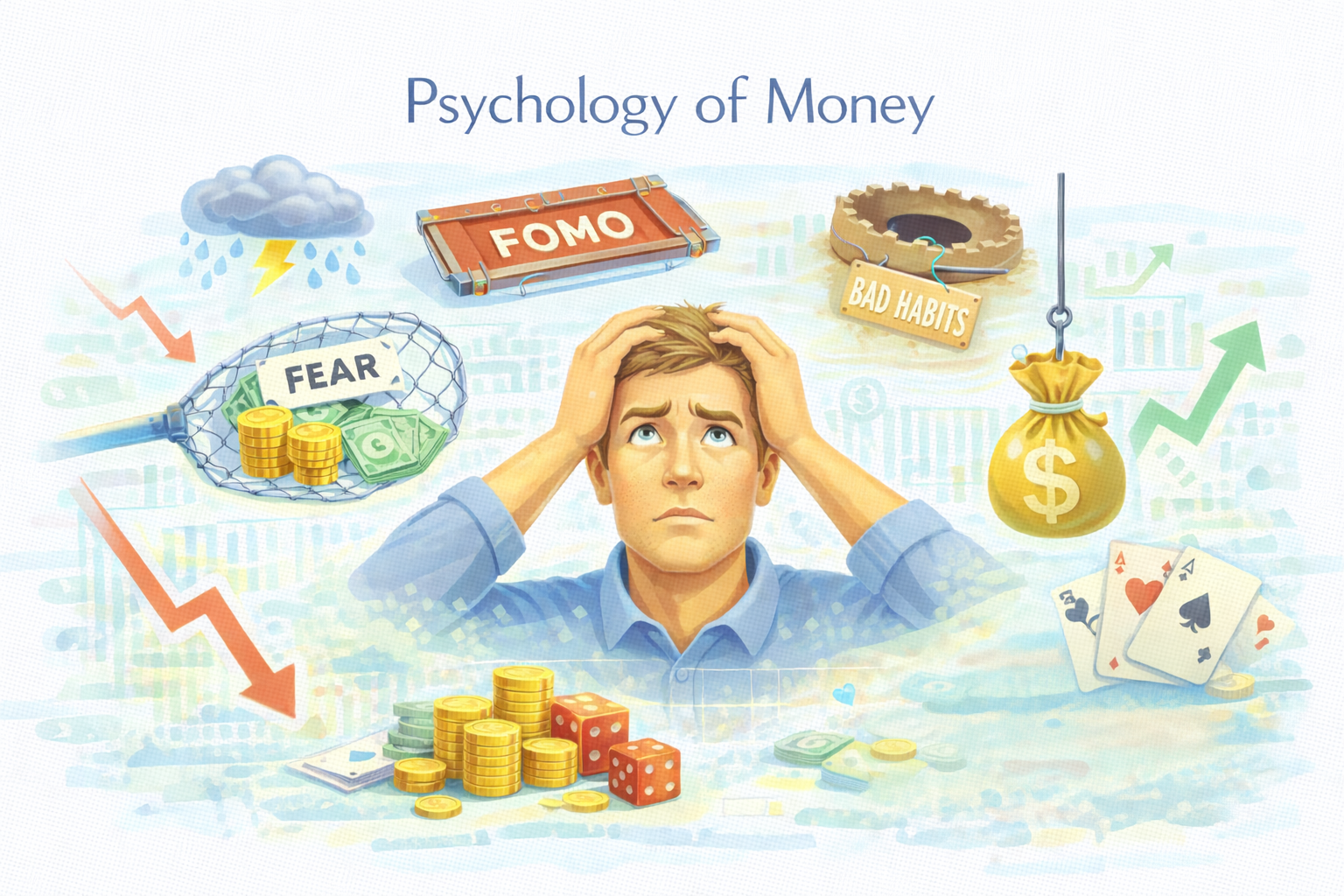
- Our financial mindset is a mirror of our early environment
- Financial success is not a science it is soft skill
- Emotional traps

Table of content:
- Introduction
- Our financial mindset is a mirror of our early environment
- Financial success is not a science it is soft skill
- Financial education
- The optimism trap
- Herd mentality
- Keeping the change
- Conclusion
INTRODUCTION
Most people think that good money management is only with calculations. The truth is money is not only calculations job it also a psychology. Big projects may require complex calculations but in daily life we make decisions with money based on our thinking. Hard skills may help you to make money, but soft skills help you to keep money. Real knowledge is not only information’s it is also emotional control.
OUR FINANCIAL MINDSET IS A MIRROR OF OUR EARLY ENVIRONMENT
Human nature makes decisions based on emotional experiences. According to scientific research, the initial 36 months are crucial in the emotional and intellectual intelligence of a child. This is a period of rapid brain growth and the establishment of foundational neural connections that are critical for future learning and emotional regulation. The current you are the result of past experiences. We can’t blame people for having low financial knowledge. Our brain always recalls experiences, not second-hand theories. If you see any person who was born in an inflation high country, you might wonder because they have lower financial knowledge in investing. Because people have more experiences about inflation, and they never used to buy bonds even if they want low riskier assets or just may have the belief that it is non permissible in their religion.
FINANCIAL SUCCESS IS NOT A SCIENCE IT IS SOFT SKILL
Finance is all about money management. Only daily basis decisions may come up in big financial achievements. Most people think that they need deep financial knowledge to reach financial freedom. Money follows habits, not formulas. Let me remind you what economics is about: Economics is all about making the best decisions with limited resources. We do have limited resources but limitless desires. We can make the best choices when we’re emotionally stable. 70% lottery winners go bankrupt within a few years. Not because they have less money but just because they do not control their emotions. We have tons of choices to spend our money on. All the money we have is always limited.
Remember Ronald Read and Richard Fuscone(From book: “Money of psychology”). One was financially educated (Richard Fuscone) but the other graduated only high school (Ronald Read). Even though Richard Fuscone had a successful career at Wall Street he ended up being poor. Ronald Read left $8 million while he didn’t even attend financial training. Can we call Ronald Read smarter and more educated than Richard Fuscone? The truth is he had better emotional control and didn’t spend money on “21,000-square-foot mansion” or over-leveraged investments. Buying a large house is not bad but you should be able to cover your bills. Expensive Real estate’s always lower liquid and have higher bills to pay.
Ratan Tata said: “Slow success builds character; fast success builds ego.” Getting rich is a marathon, not a sprint. Sprinting fast does not win the marathon, as you start faster you get tired faster. In marathons if you run slowly but consistently, organisms also get used to the same speed. Financial success is the same, it is not about going fast, it’s all about going consistent and adaptation of behavior.
FINANCIAL EDUCATION
Even though financial education would be useful, sometimes using the true resources to get financial independence is not required. Save the money for future use is also important. But how do we make money if we don’t know finance, one of the best choices is copy trading.
Copy trading is an investment method where you automatically replicate the trades of an experienced trader in your own account, often using a copy trading platform. To use this technique akinda.io provides reliable services.
THE OPTIMISM TRAP
You sometimes get emotional about some product or services; however, you end up losing interest soon on it. Your desires might be temporary. Sometimes just expectations do not meet the actual result. Or just expectations of the best possible outcome may distract. That is what sellers do. Usually, sellers try to find your interest and suggest their product according to your talks. This is so distracting, human nature tends to change its desires. Future you is more experienced. You may want something which you wouldn’t even use when you have had. It is all emotions, big companies like “Rolex”, “Ferrari”, “Apple” sell more luxury and emotions rather than just actual high-quality products. Those brands earned reputation with quality. Now they are also selling their reputations.
HERD MENTALITY
Herd mentality is following the crowd blindly, copying what others doing that assuming the crowd is right. Companies use a lot of marketing strategies to make rush people FOMO (Fear of missing out). People love to be unique at the same time they follow the crowd. These products have not unique quality features but limited quantity.
KEEPING THE CHANGE
This is not about only the buying less, sometimes buying less is might problem in terms of investing. Keeping the change is big emotional trap. The trap is being afraid losing what you have. In this situation investing might feel risky that prefer to do nothing. It might affect to keeping money in a low-interest savings account instead of investing. Remember not only buying or selling even staying still also a decision.
CONCLUSION
Financial success isn’t just about how much you earn, what you know, or even how you feel about money — it’s about understanding yourself. Most people think that a smarter plan or a better strategy will fix their financial problems, but the real challenge is knowing what you truly need. Consciousness is greatest gift given to us. This our decision to spend money, but problem is making the best choice. Money is resource to make our life better and it is limited. Unlimited desires but limited resources. Your calculations are useful tool but not as important as your mindset.
References:
- The Psychology of Money by Morgan Housel, published in 2020.
- National Endowment for Financial Education (NEFE), January 31, 2018.
KEY WORDS: Financial psychology, money mindset, behavioral finance, money habits, emotional control, financial mindset, childhood money, money beliefs, family influence, scarcity mindset, abundance mindset, emotional spending, optimism trap, herd mentality, FOMO investing, money fears, investing bias, soft skills, wealth building, financial freedom, emotional discipline, smart investing, copy trading, beginner investing, financial education, money management.