
- Stock Market & Equities
Top 5 Halal Investing Books 2026
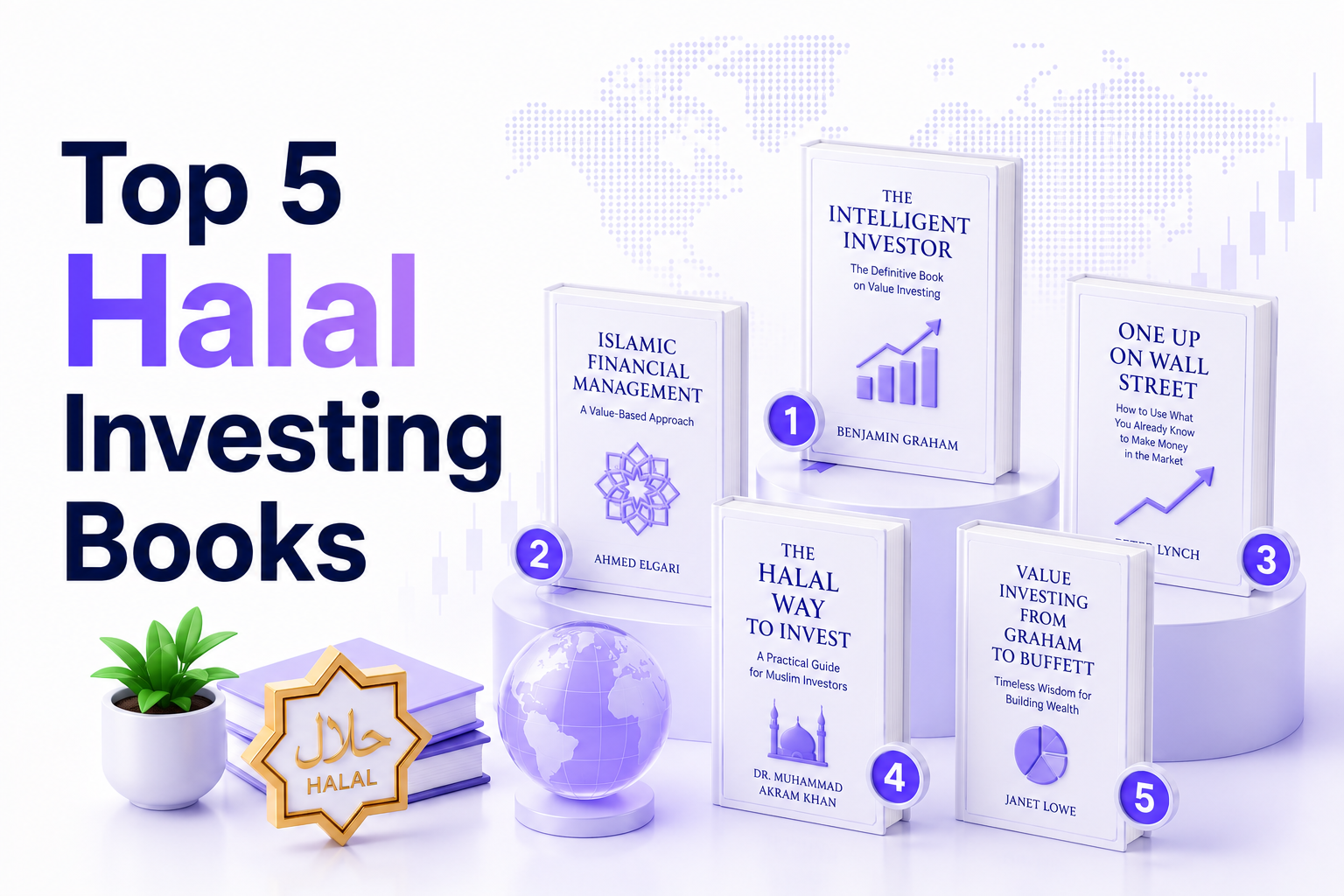
Islamic finance textbooks explain the system; halal investing books teach you to actually build a portfolio. This list is for the everyday Muslim investor who wants to grow wealth in line with their faith, not to write a dissertation. It combines the best halal-specific guides available in 2026 with two timeless investing classics that every investor, Muslim or not, should read, because the smartest approach is to learn the screening from the halal-specific books and the fundamentals from the classics, then put them together.
Quick Answer The top 5 halal investing books to read in 2026 are: Halal Investing for Beginners by Ibrahim Khan and Mohsin Patel, The Problem With Interest by Tarek El-Diwany, and Simple Zakat Guide by Joe Bradford, plus two essential, non-halal-specific classics, The Psychology of Money by Morgan Housel and The Intelligent Investor by Benjamin Graham. Read the halal-specific books for the screening, and the classics for timeless investing fundamentals. |
By the numbers (2026) A growing space: Islamic finance assets ~$5.1 trillion in 2026 → ~$8.46 trillion by 2031 (Mordor Intelligence). |
Table of Contents
- How we chose these books
- 1. Halal Investing for Beginners, Khan & Patel
- 2. The Problem With Interest, Tarek El-Diwany
- 3. Simple Zakat Guide, Joe Bradford
- 4. The Psychology of Money, Morgan Housel
- 5. The Intelligent Investor, Benjamin Graham
- Put your learning into practice
How we chose these books
The halal investing book genre is still small, so we were selective rather than padding the list. We picked the few genuinely excellent halal-specific titles, the ones that teach you to distinguish halal from haram investments and build a compliant portfolio, and paired them with two investing classics that every serious investor reads. We've labelled clearly which is which, so you know when a book covers Shariah compliance and when it's teaching universal fundamentals you'll apply through a halal lens.
1. Halal Investing for Beginners, Khan & Patel
This is the flagship. Written by Ibrahim Khan and Mohsin Patel, the Oxford-educated co-founders of Islamic Finance Guru, it's the practical, user-friendly roadmap Muslim investors had been waiting for. It covers the full range of halal asset classes, equities, gold, property, start-ups, and sukuk, alongside real-life essentials like building a halal pension, writing an Islamic will, and constructing a portfolio for any risk tolerance. Crucially, it explains the important and often-missed difference between “ethical” or ESG products and genuinely halal ones. Endorsed by scholars including Dr. Yasir Qadhi and Mufti Faraz Adam, it's the single best starting point for the everyday Muslim investor.
2. The Problem With Interest, Tarek El-Diwany
To invest the halal way with conviction, it helps to understand why interest (riba) is prohibited in the first place, and Tarek El-Diwany's book is the most accessible treatment of that question. It examines how interest works, its effects on the economy, and the case against it, in plain language rather than dense theology or economics. Reading it turns halal investing from a set of rules you follow into a philosophy you understand, which makes the discipline of avoiding riba far easier to sustain.
3. Simple Zakat Guide, Joe Bradford
Investing halal isn't only about what you buy, it's also about the obligations that come with wealth, and zakat is the big one. Joe Bradford's Simple Zakat Guide is the clear, practical reference for understanding and calculating zakat, including the often-confusing question of how to calculate it on stocks, funds, and other investments. For a Muslim investor, getting zakat right each year is as important as screening the portfolio, and this book makes a genuinely tricky calculation approachable.
4. The Psychology of Money, Morgan Housel
This one isn't halal-specific, and that's the point: the behaviours that make or break an investor are universal. Morgan Housel's modern classic is a collection of short, memorable lessons on how people think about money, why patience and temperament beat brilliance, why we take on too much risk chasing returns, and how compounding rewards those who stay the course. None of it conflicts with Islamic principles; all of it makes you a better halal investor. Read it for the mindset that keeps you invested through the ups and downs.
5. The Intelligent Investor, Benjamin Graham
Also not halal-specific, Benjamin Graham's classic is the foundation of value investing and a book Warren Buffett calls the best on investing ever written. Its core ideas, buying quality businesses at sensible prices, insisting on a margin of safety, and treating market volatility as opportunity rather than threat, map naturally onto halal investing, which already favours lower-leverage, transparent, asset-backed businesses. Combine Graham's fundamentals with the screening principles from the halal-specific books above, and you have both halves of a disciplined approach.
The five at a glance
Read the halal-specific books to learn the screening and the obligations, then the two classics for the fundamentals and mindset that apply to any portfolio. Here's how they line up:
| Book | Halal-specific? | Best for |
|---|---|---|
| Halal Investing for Beginners (Khan & Patel) | Yes | The complete practical guide |
| The Problem With Interest (El-Diwany) | Yes | Understanding why riba matters |
| Simple Zakat Guide (Bradford) | Yes | Calculating zakat on investments |
| The Psychology of Money (Housel) | No (companion) | Investor behaviour and mindset |
| The Intelligent Investor (Graham) | No (companion) | Valuation and fundamentals |
Where to find these books
- Halal Investing for Beginners - Ibrahim Khan & Mohsin Patel (Wiley)
- The Problem With Interest - Tarek El-Diwany
- Simple Zakat Guide - Joe Bradford
- The Psychology of Money - Morgan Housel (Harriman House)
- The Intelligent Investor - Benjamin Graham
Put your learning into practice
Books teach the principles; a screening tool applies them to real companies. Once you understand what makes a stock halal, you can check any ticker in seconds rather than analysing financials by hand. Try Akinda's halal stock screener to see verdicts and the ratios behind them, and read Akinda's explainer on AAOIFI screening to connect the books' concepts to the standard. The screening is built on a published, AAOIFI-based methodology overseen by a qualified scholar; and if you're building a product rather than a personal portfolio, the Akinda Halal API delivers the same compliance data programmatically.
Frequently asked questions
What is the best halal investing book for beginners?
Halal Investing for Beginners by Ibrahim Khan and Mohsin Patel. It's the most complete practical guide for the everyday Muslim investor, covering halal asset classes, portfolio construction, pensions, Islamic wills, and the key difference between ESG and genuinely halal investments. Start there, then add the classics for fundamentals and mindset.
Why are non-halal investing books on this list?
Because the skills that make a great investor, patience, valuation discipline, managing your own behaviour, are universal and fully compatible with Islamic principles. The Psychology of Money and The Intelligent Investor teach those fundamentals better than any halal-specific book, so the smart approach is to learn the screening from the halal-specific titles and the timeless fundamentals from the classics, then apply both.
Do halal investing books explain zakat?
Some do in passing, but for zakat specifically, a dedicated guide like Joe Bradford's Simple Zakat Guide is far more useful, especially for the tricky question of calculating zakat on stocks and investments. Since zakat is an annual obligation tied to your wealth, it's worth treating as its own topic alongside portfolio screening.
Is halal investing worse for returns?
Historically, no. Over the 15 years to 2019 the S&P 500 Shariah index returned 10.2% annualized versus 9.1% for the S&P 500, per S&P Global, and Islamic indices have generally tracked conventional benchmarks. Screening changes which sectors you hold rather than systematically lowering returns, so learning to invest the halal way costs nothing in performance.
In what order should I read these books?
Start with Halal Investing for Beginners to get the practical lay of the land, then read The Problem With Interest to understand the why behind avoiding riba. Add Simple Zakat Guide when you're ready to handle your annual obligation. Read The Psychology of Money early for mindset, and save The Intelligent Investor for when you want to go deeper on valuation, it's the most demanding of the five.
Sources
AAOIFI Shari'ah Standard No. 21: Financial Paper (Shares and Bonds) – the standard the Akinda API's screening methodology is built around.
Akinda API screening methodology – the full three-phase screen, ratio formulas, and purification rule, published for integrators to audit.
Akinda API Shariah advisor – the scholar governance behind the API's halal verdicts.
Mordor Intelligence – Global Islamic Finance Market (2026) – Islamic finance market size and growth projections.
Build with the Akinda Halal API The developer-grade API for AAOIFI-based Shariah stock screening. Start on the free tier, scale when you ship. 📚 Docs: b2b.akinda.io/developer/docs 💳 Pricing: b2b.akinda.io/pricing 🔑 Get a key: b2b.akinda.io/dashboard |
Disclaimer
This article is about a software product and is for general information only. It is not financial or religious advice. Automated Shariah screening produces data-driven signals, not a fatwa; integrators should pair it with their own Shariah governance and consult qualified scholars. API features, endpoints, coverage, and pricing change over time, so verify current details on b2b.akinda.io before building.