
- Stock Market & Equities
Top 5 Halal Investing Courses 2026
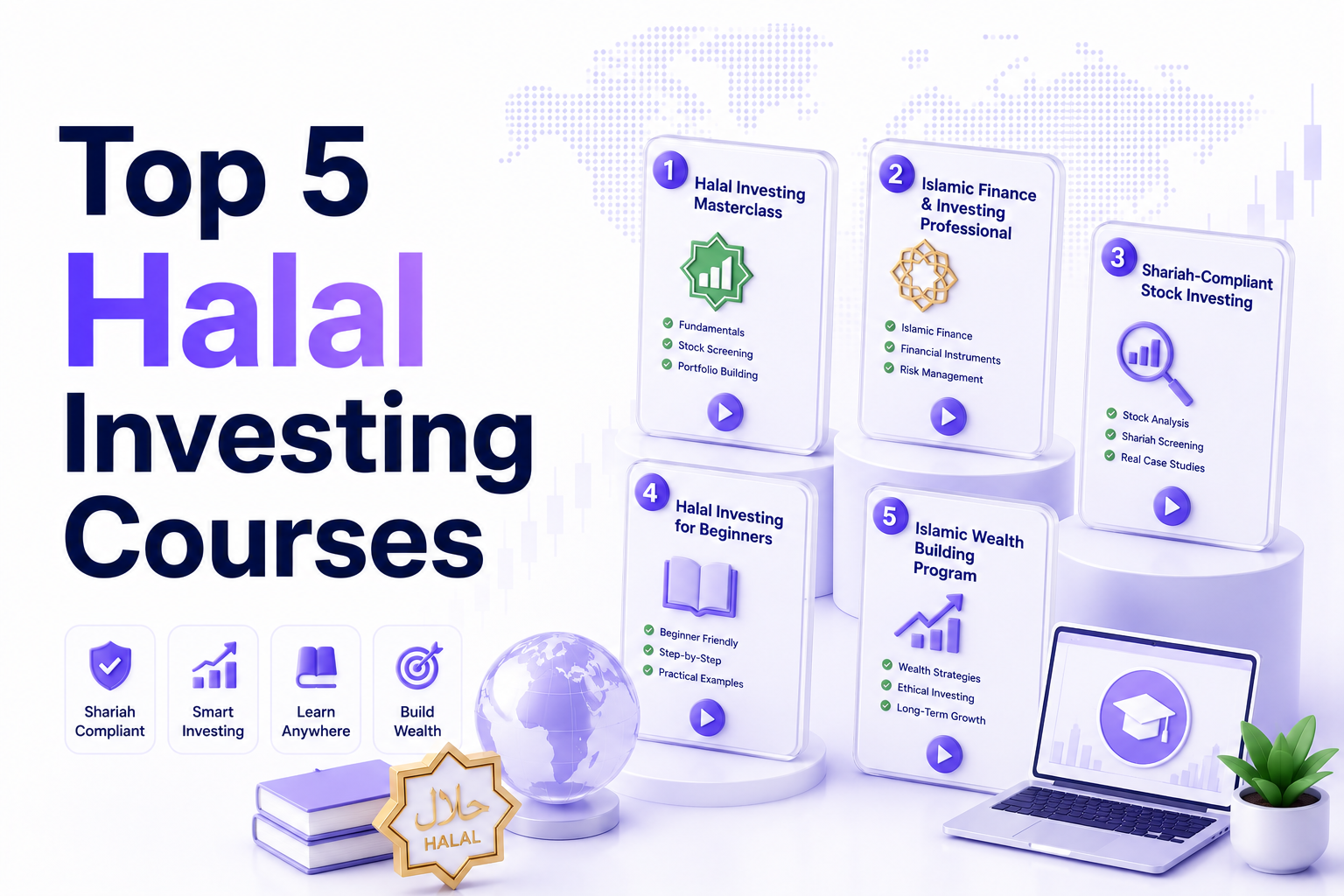
Books give you depth, but a good course gives you structure, a path from “I want to invest the halal way” to actually doing it with confidence. The options in 2026 range from free 30-minute video guides to internationally recognised professional certifications, so the right course depends entirely on your goal. This list covers five of the best, ordered roughly from beginner to professional, so you can pick the one that matches where you are and where you want to get to.
Quick Answer The top 5 halal investing courses for 2026 are: Islamic Finance Guru's Beginner's Guide to Halal Investing (free, fastest start), Practical Islamic Finance's The 1-Weekend Halal Portfolio (hands-on stock analysis), Al Balagh Academy's Islamic Banking & Finance (structured foundation), Akinda Academy (learn and apply on the platform), and the CISI Islamic Finance Qualification (IFQ) (professional certification). Choose by goal: quick start, practical investing, foundations, academic depth, or a recognised credential. |
By the numbers (2026) A growing career field: Islamic finance assets ~$5.1 trillion in 2026 → ~$8.46 trillion by 2031 (Mordor Intelligence); Islamic fintech ~$250 billion → ~$619 billion by 2033 (Grand View Research). |
Table of Contents
- How to choose a halal investing course
- 1. IFG: A Beginner's Guide to Halal Investing
- 2. Practical Islamic Finance: The 1-Weekend Halal Portfolio
- 3. Al Balagh Academy: Islamic Banking & Finance
- 4. Akinda Academy
- 5. CISI Islamic Finance Qualification (IFQ)
- Put your learning into practice
How to choose a halal investing course
Before picking a course, be honest about your goal. If you just want to make your first halal investment, a free beginner video will get you there faster than a 132-hour qualification. If you want to confidently analyse individual stocks, you need a practical, hands-on course. If you're building a career in Islamic finance, a recognised certification carries weight an informal course won't. We've ordered this list from lightest to most rigorous so you can stop wherever your goal is met, there's no need to over-invest in credentials you don't need.
1. IFG: A Beginner's Guide to Halal Investing
Islamic Finance Guru (IFG), the UK-based education platform run by the authors of Halal Investing for Beginners, offers a free, step-by-step video course designed to help you make your first halal investment in about 30 minutes. It's the fastest on-ramp on this list: no cost, no commitment, and aimed squarely at absolute beginners who want to go from confused to invested in a single sitting. If you've never bought a halal investment before and just want to start, begin here and add depth later.
2. Practical Islamic Finance: The 1-Weekend Halal Portfolio
For investors who want to pick and analyse their own stocks, Rakaan Kayali's Practical Islamic Finance offers a hands-on course built around a simple framework for assessing whether a stock is a buy, hold, or sell, from a halal perspective. It covers the practical mechanics self-directed investors actually need, including screening companies and purifying profits, and comes with a community of like-minded students for ongoing support. It's the most investing-focused course on this list, ideal once you're past the absolute basics and want to build and manage a portfolio yourself.
3. Al Balagh Academy: Islamic Banking & Finance
If you want a structured foundation rather than a quick start, Al Balagh Academy's Islamic Banking and Finance course is a strong middle option. Composed of a series of online lectures, it introduces the core norms, modes, and principles of Islamic banking and finance, covering the prohibition of riba, Islamic financial contracts, the Islamic capital market, takaful (Islamic insurance), and the real-world dilemmas Muslims face with conventional banking, loans, and mortgages. It suits learners who want more than an investing crash course but aren't ready for a full professional qualification.
4. Akinda Academy
Akinda Academy is Akinda's own learning hub, and its edge is integration: it teaches halal investing and Islamic finance right alongside the tools you'll use to apply what you learn. Instead of finishing a standalone course and then working out how to act on it, you can move straight from a lesson, on Shariah screening or purification, say, to running a real company through Akinda's halal stock screener. The education sits inside the Akinda platform (the app is free to download), pairing the principles of Islamic finance with practical investing strategy, so beginners get both the “why” and the “how” in one place. It's the most directly practical option on this list for anyone who wants to learn and invest without switching between a classroom and a toolkit. Explore it at akinda.io/academy.
5. CISI Islamic Finance Qualification (IFQ)
For anyone building a career in the field, the Islamic Finance Qualification (IFQ) is the benchmark. Awarded by the Chartered Institute for Securities & Investment (CISI) together with l'Ecole Supérieure des Affaires, it's an award-winning, internationally recognised certification that covers Islamic finance from both a technical and a Shariah perspective. Recognised as a Level 3 qualification with an estimated 132 hours of study and assessed by a multiple-choice exam, it prepares candidates for professional roles across Islamic banking, asset management, sukuk, and takaful. It's far more than most retail investors need, but if you want a credential the industry respects, this is it.
The five at a glance
Match the course to your goal and budget rather than defaulting to the most advanced one. Here's how the five compare:
| Course | Level | Cost | Best for |
|---|---|---|---|
| IFG: Beginner's Guide | Beginner | Free | A 30-minute first start |
| PIF: 1-Weekend Halal Portfolio | Intermediate | Paid | Hands-on stock analysis |
| Al Balagh: Islamic Banking & Finance | Foundational | Paid | Structured foundations |
| Akinda Academy | Beginner | Free | Learning built into the platform |
| CISI IFQ | Professional | Paid | A recognised credential |
Many learners combine them: start free with IFG or Akinda Academy, take a practical course like Practical Islamic Finance to build a real portfolio, and pursue the CISI IFQ only if you want a professional credential. There's no single right path, only the one that matches your goal.
Where to find these courses
- Islamic Finance Guru: A Beginner's Guide to Halal Investing - free video course
- Practical Islamic Finance: The 1-Weekend Halal Portfolio - hands-on stock analysis
- Al Balagh Academy: Islamic Banking & Finance - structured foundation
- Akinda Academy - learn and apply on the Akinda platform
- CISI Islamic Finance Qualification (IFQ) - professional certification
Put your learning into practice
Every course on this list teaches the same underlying screening logic, business activity, financial ratios, and purification, that a modern tool can automate. Once you understand it, put it to work: check any stock on Akinda's halal stock screener, and read Akinda's explainer on AAOIFI screening to connect the coursework to the standard. The screening runs on a published, AAOIFI-based methodology overseen by a qualified Shariah advisor. And if your learning is heading toward building rather than just investing, the Akinda Halal API and its developer docs let you put a compliance layer into your own product.
Frequently asked questions
What is the best halal investing course for beginners?
For a fast, free start, Islamic Finance Guru's Beginner's Guide to Halal Investing gets you to your first halal investment in about 30 minutes. If you want a more structured foundation, Al Balagh Academy's Islamic Banking and Finance course goes deeper, and Akinda Academy is a strong option if you'd rather learn alongside the screening tools you'll actually use.
Is there a professional halal investing certification?
Yes, the CISI Islamic Finance Qualification (IFQ) is the leading one. It's an internationally recognised, award-winning certification awarded by the Chartered Institute for Securities & Investment, covering both the technical and Shariah sides of Islamic finance. It's aimed at professionals and career-changers rather than casual investors, and is assessed by an exam.
Do I need a paid course to learn halal investing?
No. There are excellent free options, including IFG's beginner course and Akinda Academy's platform-based lessons. Paid courses and certifications add structure, hands-on frameworks, or a recognised credential, which are worth it if you want to analyse stocks seriously or build a career, but you can learn the fundamentals for free.
What should I do after finishing a course?
Apply it. Use a halal screening tool to check real stocks against what you learned, build a small portfolio within your risk tolerance, and re-screen your holdings periodically, since a company's compliance can change as its finances shift. Practicing on real companies is what turns course knowledge into investing skill.
Sources
CISI Islamic Finance Qualification (IFQ) – details of the globally recognised professional Islamic finance certification.
Class Central – Islamic Finance online courses – an aggregated directory of free and paid university Islamic finance courses.
Akinda API screening methodology – the full three-phase screen, ratio formulas, and purification rule, published for integrators to audit.
Mordor Intelligence – Global Islamic Finance Market (2026) – Islamic finance market size and growth projections.
Grand View Research – Islamic Fintech Market Report – Islamic fintech market size and CAGR.
Build with the Akinda Halal API The developer-grade API for AAOIFI-based Shariah stock screening. Start on the free tier, scale when you ship. 📚 Docs: b2b.akinda.io/developer/docs 💳 Pricing: b2b.akinda.io/pricing 🔑 Get a key: b2b.akinda.io/dashboard |
Disclaimer
This article is about a software product and is for general information only. It is not financial or religious advice. Automated Shariah screening produces data-driven signals, not a fatwa; integrators should pair it with their own Shariah governance and consult qualified scholars. API features, endpoints, coverage, and pricing change over time, so verify current details on b2b.akinda.io before building.