
- Stock Market & Equities
Weekly Market Digest: June 1-5, 2026
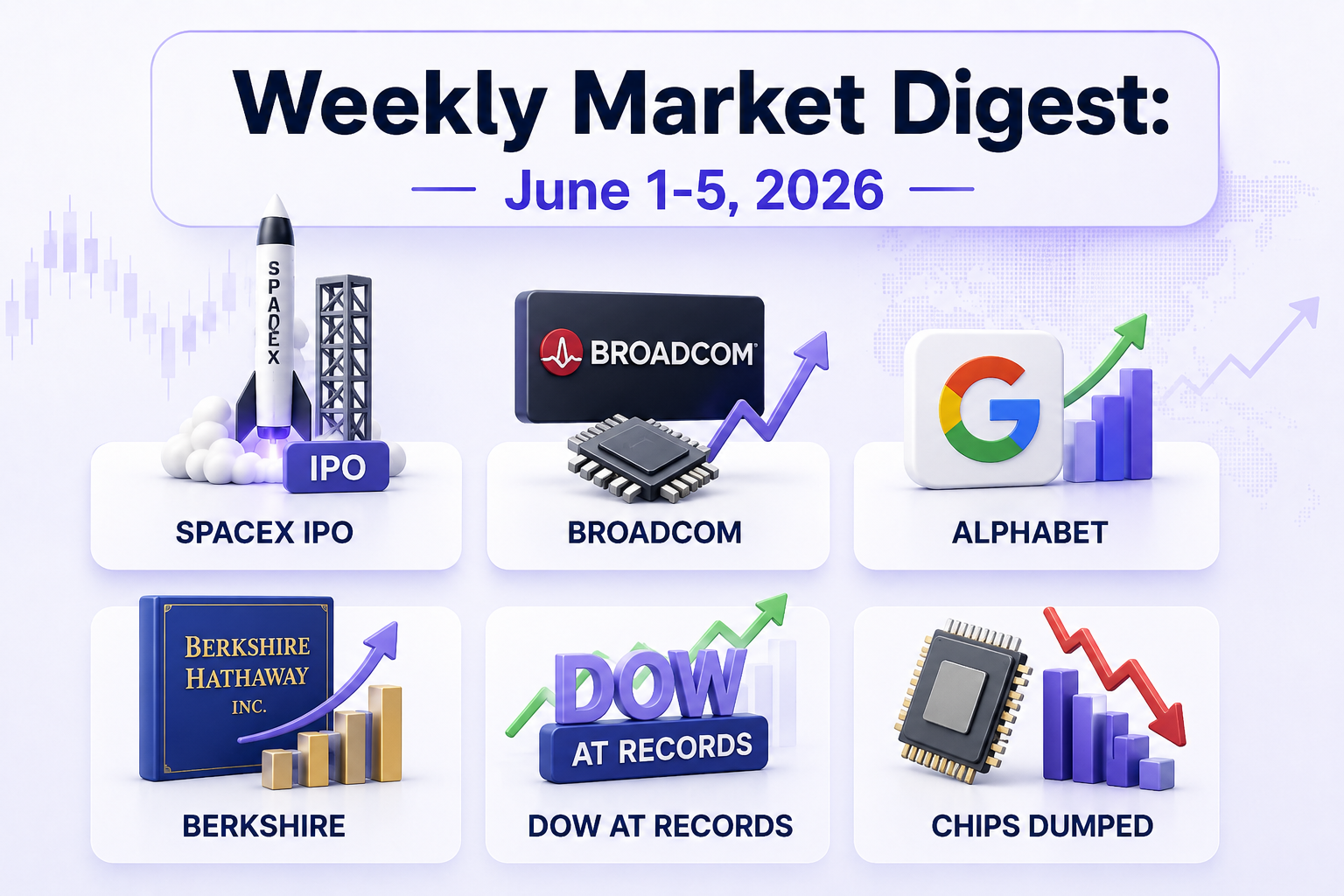
June 1–5, 2026 weekly market recap for halal investors. Alphabet's $80B raise, SpaceX prices its IPO, Broadcom's chip selloff, and a hot jobs report.
Table of Contents
- Introduction
- The Week in One Picture
- Alphabet's $80B Equity Raise (and Berkshire's $10B Cheque)
- S&P 500 Closes Above 7,600 for the First Time Ever
- Broadcom's Record Quarter, SpaceX Prices Its IPO
- The Great Rotation: Dow at Records, Chips Dumped
- A Hot Jobs Report Breaks the Chip Trade
- FAQ
Introduction
If May was the month that put markets at records, the first week of June was the one that asked whether those records made sense. The week started with Alphabet announcing one of the largest equity raises in tech history. By Tuesday the S&P 500 had closed above 7,600 for the first time ever. Wednesday brought SpaceX's expected IPO pricing and Broadcom's earnings. Thursday turned into a rotation out of chips into everything else. And Friday's jobs report triggered a sharp repricing across many AI and semiconductor stocks.
This is the kind of week where the headlines and the takeaways are not the same thing. We will walk through what happened day by day, what the numbers actually were, and what it might mean for a Shariah-compliant portfolio. Every figure is linked to its source.
The Week in One Picture
The week began at records and ended in correction territory for parts of the chip sector. According to Bloomberg's Friday wrap, the S&P 500 ended the week down 2.4% and failed to complete what would have been a 10th consecutive weekly gain. The Nasdaq 100 sank 4% on Friday alone - its worst single-day move since April 2025. A gauge of chipmakers fell 9% on Friday.
The rotation underneath was the more interesting story. As CNBC reported on Thursday, the Dow surged nearly 900 points to a fresh record close of 51,561.93 even as the Nasdaq slipped - investors were selling AI exposure and buying everything else. By Friday that rotation looked more like a broad de-risking than a clean sector rotation.
For halal investors who tend to hold heavier weight in tech and AI-linked names, the practical question coming out of the week is whether this is just a healthy pullback in an overheated trade or the start of a broader repricing of growth multiples.
Alphabet's $80B Equity Raise (and Berkshire's $10B Cheque)
Monday opened with a story that nobody expected from one of the cash-richest companies in the world. Alphabet announced an $80 billion equity offering to fund AI compute infrastructure. According to the company's own announcement filed with the SEC, the raise included $10 billion from Berkshire Hathaway in a private placement ($5B in Class A shares at $351.81, $5B in Class C at $348.20), $30 billion in underwritten offerings, and a $40 billion at-the-market program starting in Q3.
The stock reaction was sharp but contained - GOOGL closed Tuesday down nearly 4% at just under $362. Alphabet had already raised its 2026 capex guidance in April to $180–190 billion, up from $175–185 billion. The equity raise comes on top of a $25 billion bond sale completed in November 2025.
When Alphabet - a company that has bought back more than $60 billion of its own stock in 2025 alone - turns to public markets to fund AI capex, it tells you something about the scale of the buildout. The whole AI infrastructure thesis assumes hyperscalers will keep spending. This is one of them confirming they will, but doing it through dilution rather than free cash flow. Berkshire writing a $10 billion cheque to anchor the deal is a meaningful endorsement, but the broader question - whether AI returns will eventually justify the capex - has not changed. For halal investors holding Alphabet, the screening status is unchanged, but the dilution is real and should be tracked over the next two quarters.
S&P 500 Closes Above 7,600 for the First Time Ever
Tuesday delivered a milestone. TheStreet's market wrap reported the S&P 500 closed at 7,609.78 - the first close above 7,600 in history. The Dow added 228.91 points to 51,307.79, and the Nasdaq notched a fractional gain to 27,093.90.
The standout single-stock move of the day was Marvell, which surged roughly 33% after Nvidia CEO Jensen Huang publicly endorsed the company during his keynote at Computex Taipei. Hewlett Packard Enterprise also rallied on a strong earnings beat. The session marked the S&P 500's 24th record close of the year.
On the data side, JOLTS job openings for April rose 4.6% to 7.6 million - the highest level in almost two years - and beat expectations. A tight labor market would normally be good news, but in the context of sticky inflation it pushes the rate-cut narrative further out.
A 33% single-day move on one CEO's verbal endorsement is the kind of price action that tends to mark the late stages of a thematic rally rather than the early ones. The S&P 500's forward P/E sat around 23x at the close - well above the long-run average near 18x. Records are not signals to sell, but they are signals to check whether your position sizing assumed prices this far above trend. Halal investors with portfolios that have drifted heavier into semis through pure price appreciation should at least look at the weights.
Broadcom's Record Quarter, SpaceX Prices Its IPO
Wednesday brought two of the biggest corporate stories of the year, and the market read both of them more harshly than the headline numbers suggested. After the close, Broadcom reported fiscal Q2 results: total revenue of $22.19 billion (up 48% year-over-year) and adjusted EPS of $2.44, beating the $2.32 consensus. AI semiconductor revenue hit $10.8 billion, up 143% YoY - around 49% of total revenue. The official press release from Broadcom investor relations guided Q3 AI revenue growth of over 200% (implying roughly $16 billion next quarter).
And yet the stock fell sharply. According to Investing.com's analysis, Broadcom had entered the print at an all-time high of $481.57, up roughly 40% year-to-date. The market had been positioned for a guidance raise on full-year 2026 AI revenue. When CEO Hock Tan guided to $56 billion for the year - strong, but not above the implicit bar - traders read it as a ceiling rather than a floor. Some softness in the legacy software (VMware) segment compounded the reaction.
The same evening, SpaceX disclosed its expected IPO pricing terms. According to multiple reports including Stocktwits and Reuters, shares are expected to be priced at $135 each, with final pricing scheduled for June 11 and trading expected to begin around June 12 on Nasdaq under the ticker SPCX. The raise targets approximately $75 billion at a fully-diluted valuation near $1.77 trillion - which would put it on track to become the largest IPO in history. The lead underwriters are Goldman Sachs, Morgan Stanley, BofA, Citi, JPMorgan, and Barclays. Roughly 30% of the offering is being allocated to retail investors, a significant departure from the typical institutional-dominated process.
Two takeaways. First, when an 85%+ growth quarter (Nvidia in May) and a 143% AI segment growth quarter (Broadcom this week) both fail to push the stocks higher, the multiple is doing all the work and the next catalyst has to be even bigger than the last. That math is hard to sustain. Second, SpaceX's expected pricing puts it on track to become the largest IPO in history by dollar terms. For halal investors, the screening question is still open: defense contracts and ongoing losses remain on the table, and the 30% retail allocation means a lot of new investors will be asked to make a call without traditional screening guidance. Wait for the platforms to publish.
The Great Rotation: Dow at Records, Chips Dumped
Thursday looked like two different markets running at once. The Dow Jones Industrial Average rallied 874.86 points (+1.73%) to a record close of 51,561.93, while the Nasdaq finished slightly lower at 26,830.96. The S&P 500 closed at 7,584.31, up 0.41%. CNBC's coverage described it as a rotation: investors sold AI-linked names and bought everything else.
Broadcom led the chip selloff, tumbling 15% on the day after its earnings reaction soured overnight. UnitedHealth was the Dow leader, rising more than 5%. JPMorgan added 3% and Walmart climbed nearly 1%. Outside the Dow, Costco gained around 1% and Eli Lilly added more than 4%. On the IPO front, Quantinuum opened at $68 per share on Nasdaq after pricing its upsized IPO at $60 (above the $53–55 range), valuing the quantum computing firm at roughly $17.6 billion.
A market where the Dow hits records while the Nasdaq slides is a market quietly re-pricing concentration risk. For most of 2026, the easy money came from being long the same handful of AI-infrastructure names. Thursday was the first session in a while where investors got paid to be in defensives, financials, and consumer staples instead. Whether that lasts is the question, but the setup matters for any halal portfolio that has been letting its tech weight drift higher through pure price action.
A Hot Jobs Report Breaks the Chip Trade
Friday's nonfarm payrolls report blew past expectations. The BLS reported that the economy added 172,000 jobs in May, well above the consensus near 85,000. The unemployment rate held at 4.3%. March payrolls were revised up by 29,000 and April was revised up by 64,000 - meaning the prior two months were 93,000 stronger than first reported.
On any normal day a strong jobs print is bullish for stocks. Not this Friday. According to Reuters via the Detroit News, markets sharply increased expectations that the Fed could remain restrictive for longer, with implied rate hike probabilities for later this year rising materially. Estimates varied by source - Reuters cited money-market pricing near 98%, while The Motley Fool's same-day coverage put the December hike probability closer to 70% - but the direction of the move was unmistakable.
The selloff was concentrated in chips. Per CNBC's live blog, Broadcom fell another 6%+ (after Thursday's 12-15%), Marvell dropped roughly 12%, Micron about 11%, Intel more than 9%, and AMD roughly 10%. Meta also slid around 5.5% on a Financial Times report that it may be weighing a share sale of its own. The Nasdaq Composite lost more than 3% on the day, the S&P 500 dropped over 2%, and the Dow fell about 491 points (around 1%).
A 4% Nasdaq day is not noise. The combination of a hot labor market, an inflation backdrop that has been sticky at 3.8%, and a new Fed Chair who has not yet held a press conference creates a setup where the bond market is doing most of the talking. Rising 10-year yields put downward pressure on long-duration tech multiples - exactly the names that drove the rally. Halal investors holding heavy AI infrastructure exposure should expect more volatility around the June 10 CPI release and the new Fed Chair's first FOMC, which is later this month. Position sizing matters more than thesis quality when the macro overhang is this large.
FAQ
Why did stocks fall on a strong jobs report?
Counterintuitive, but logical: a stronger labor market gives the Fed more room to keep rates high (or even hike) to fight inflation. Higher rates pressure long-duration growth stocks the most - which is where most of the 2026 rally lived.
Should I buy the dip in chip stocks?
That is a question only you can answer in the context of your own portfolio. What we can say is that the AI capex numbers (Broadcom guiding to over 200% YoY AI revenue growth, Alphabet committing tens of billions more) suggest demand is not collapsing. The risk is multiple compression on a macro repricing, not a demand collapse. Those are different problems.
How is the SpaceX IPO different from past mega IPOs?
Three ways. First, the size - a $75B target raise is more than double Saudi Aramco's $29.4B record from 2019, which would put SpaceX on track to be the largest IPO in history if it prices as expected. Second, the structure - SpaceX disclosed a fixed expected share price ($135) rather than running a traditional roadshow with a price range, with final pricing scheduled for June 11 and trading expected on June 12. Third, the retail allocation - around 30% to retail investors via brokers like Fidelity, far higher than typical institutional-dominated IPOs.
Is the SpaceX IPO halal?
Too early to say. Defense contracts, ongoing losses, and reliance on capital markets all need review by Shariah screening platforms once the final prospectus details are clear. Standard practice is to wait for explicit classifications before treating it as eligible.
What should I watch next week (June 8–12)?
Three things. The May CPI release on June 11 - if inflation surprises hot again, expect more pressure on rate-sensitive sectors. SpaceX's final IPO pricing also scheduled for June 11, with trading expected to begin on June 12. And reactions to the new Fed Chair's commentary as we move closer to the next FOMC meeting.
Disclaimer
This article is for educational purposes only and does not constitute investment, tax, or legal advice. All data points are sourced from publicly available reports linked inline. Shariah compliance status of individual securities can change over time and should be independently verified before any investment decision. Past performance does not guarantee future results.