
- Stock Market & Equities
Weekly Market Digest (June 15–19, 2026): Peace in the Gulf, a Hawkish Fed, and Five Central Banks in Five Days
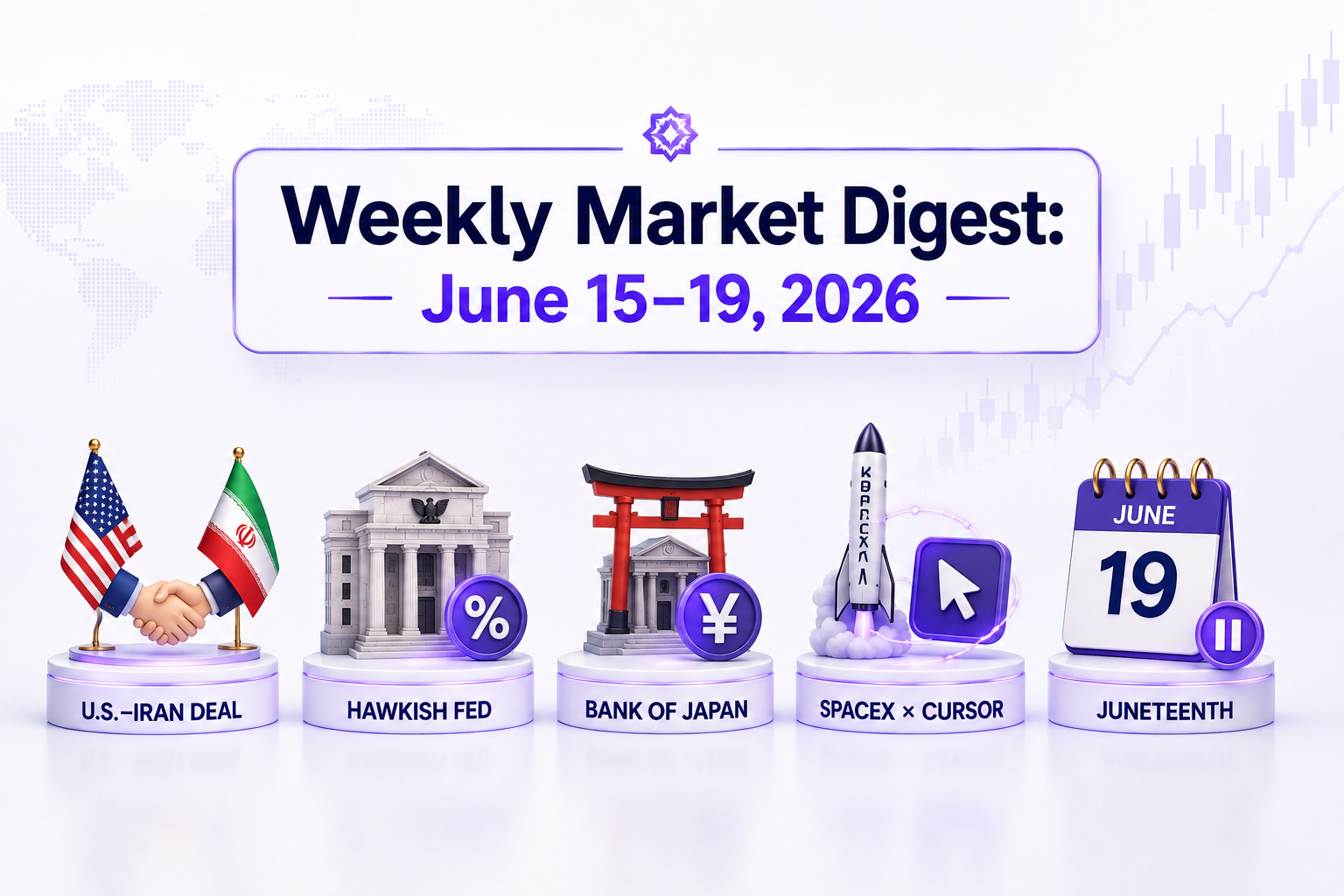
Table of Contents
- Introduction
- The Week in One Picture
- The U.S. and Iran Announce a Deal, Markets Surge
- The Bank of Japan Hikes, SpaceX Buys Cursor for $60B
- Warsh's First FOMC: A Hold With a Hawkish Twist
- The MOU Is Signed, the Bank of England Holds
- Markets Closed for Juneteenth
- What This Week Means for Halal Investors
- FAQ
Introduction
Few weeks pack in as much as this one did. The U.S. and Iran signed a deal to end a war that had run since late February, oil dropped from the high $80s to the low $70s, and the Dow hit a fresh record high - all before Wednesday. Then the Federal Reserve, in Kevin Warsh's first meeting as Chair, held rates steady but delivered a dot plot hawkish enough to spook the dollar, gold, and growth stocks all at once. On top of that, the Bank of Japan, the Bank of England, and the Bank of Canada all announced their own decisions within the same eight-day window and fresh off the largest IPO in history, SpaceX turned around and spent $60 billion buying an AI startup.
This is a dense week, so we will move through it chronologically, with every figure linked to where it was reported, and close with what it might mean for a halal portfolio.
The Week in One Picture
Markets spent the first half of the week pricing in peace and the second half pricing in a more hawkish Fed. Per a weekly recap from financial commentator Alain Guillot, the Dow hit a fresh all-time high and closed Monday at a record 51,671.03, while the Nasdaq surged 3.07% - its best single day since March 31. Oil fell from roughly $89 a barrel on Monday's open to $73.52 by Thursday's close, a $15 drop in four trading days.
By the close of trading Thursday - the market's last session before the Juneteenth holiday - the Dow stood at 51,564.70, up 0.71% for the holiday-shortened week, according to a market wrap published Friday. The same source reported the S&P 500 closed Thursday at 7,500.58 (up 1.08% on the day) and the Nasdaq gained 1.91% on the day, alongside a separate report noting the Nasdaq's weekly gain came in at 2.4% for the full week. Five central banks - the Bank of Canada, the European Central Bank, the Bank of Japan, the Federal Reserve, and the Bank of England - announced rate decisions across this week and the one before it, and for the first time in years they were not all pointing the same direction.
For halal investors, the headline takeaway is that the geopolitical risk premium that had been priced into oil, gold, and the dollar for months started coming out this week - but a new, different kind of uncertainty (monetary policy divergence across major economies) moved in to take its place.
The U.S. and Iran Announce a Deal, Markets Surge
The week opened with the biggest geopolitical news of the year. Late Sunday, President Trump posted on social media that “The Deal with the Islamic Republic of Iran is now complete,” according to NPR. Pakistan's prime minister, who had played a mediating role, said a formal signing ceremony was planned for Friday in Switzerland. The framework, per NBC News' reporting on the 14-point memorandum of understanding, declared an intent to bring about an “immediate and permanent termination of military operations” in the conflict that began February 28, with the Strait of Hormuz reopening to commercial vessels toll-free for 60 days while further negotiations with Oman would determine its longer-term administration.
Markets reacted immediately. U.S. crude fell more than 4.5% to around $80 a barrel on the announcement, NBC News reported, its lowest level since early March, while Brent touched $83. By Monday's close, TheStreet's live blog reported broad gains across U.S. equities, alongside notable single-stock moves: chipmaker AXT jumped nearly 15% and Seagate Technology rose 9% in early trading, while Fox Corp fell almost 18% on the announcement that it would acquire streaming platform Roku for roughly $22 billion. SpaceX shares, a week into trading, climbed another 8.1% to $173.95.
An MOU is not the same thing as a final peace treaty - the agreement itself set up 60 days of further negotiations on Iran's nuclear program, and Trump explicitly warned he could resume strikes if Tehran failed to honor its commitments. But the immediate market reaction - a four-and-a-half percent single-day drop in oil - shows how much of a war premium had been baked into energy prices. For halal investors, this is the clearest signal yet that the inflation and energy story that dominated May and early June may start to ease, assuming the framework holds.
JThe Bank of Japan Hikes, SpaceX Buys Cursor for $60B
Tuesday brought the first of the week's central bank decisions. The Bank of Japan raised its policy rate by 25 basis points to 1.00%, according to Finance Calendar's coverage of the decision, in a 7-1 vote with board member Asada Toichiro dissenting over downside risks to production and employment. At 1.00%, the policy rate reached its highest level since September 1995. Trading Economics reported the move was explicitly aimed at preventing the Iran-war-driven energy shock from feeding into broader Japanese inflation, with policymakers saying they would continue raising rates as warranted while monitoring the Middle East conflict's economic impact.
Separately, TheStreet reported the Dow notched another record high while the Nasdaq and Russell 2000 pulled back slightly ahead of the next day's Fed decision. The bigger story of the day, though, came from SpaceX. Just four days after its record-setting IPO, the company announced it had entered a definitive agreement to acquire Anysphere - the parent company of AI coding tool Cursor - in an all-stock deal valuing the startup at $60 billion, according to CBS News. Per TechCrunch's reporting, the deal had effectively been pre-arranged in April, when SpaceX secured an option to either pay a $10 billion break-up fee or acquire Cursor outright for $60 billion; this week's filing confirmed SpaceX exercised the acquisition option. The deal is expected to close in Q3 2026, pending regulatory approval, and Cursor's annualized revenue had reportedly grown from $2 billion to $4 billion in the four months between February and June, per Quartz's coverage.
Spending $60 billion - the equivalent of roughly 80% of the cash raised in its own IPO - on an acquisition within a week of going public is an aggressive signal about how SpaceX intends to use its newly public currency. For halal investors who were already treating SPCX as unscreened pending clarity on its business mix, this acquisition adds another layer to evaluate: Cursor is a software company, generally more straightforward from a screening perspective than rockets or defense contracts, but the all-stock structure means SpaceX's own classification questions now extend to Cursor by extension. The size and speed of the deal is also a reminder that newly public companies with large war chests can move very quickly - a single week's news flow can meaningfully change what a company actually is.
Warsh's First FOMC: A Hold With a Hawkish Twist
Wednesday was the week's pivot point. The Federal Open Market Committee voted unanimously, 12-0, to hold the federal funds rate at 3.50–3.75% - widely expected, with Investing.com reporting that CME FedWatch had priced in 99% odds of no change heading into the decision. What moved markets was everything underneath the headline rate. Per StockTitan's coverage of the Summary of Economic Projections, the median policymaker now expects rates to end 2026 higher than where they stand today - a complete flip from March, when the median dot still implied a cut. Of the 18 FOMC participants who submit projections, 9 now see at least one rate hike this year, and 17 of 18 judged inflation risks to be tilted to the upside, versus none seeing downside risk.
Chair Warsh also overhauled how the Fed communicates. CNBC reported the post-meeting statement ran just 130 words, compared with 341 words in the prior release - with language signaling a future easing bias stripped out entirely. Warsh also declined to submit his own projection in the dot plot and announced he was launching five internal task forces to review Fed operations, while emphasizing a shift away from the kind of detailed forward guidance markets had relied on for over a decade. “That statement just gives you the facts, as best we can judge it,” Warsh said, per the same CNBC report.
Markets did not like the uncertainty. TheStreet's headline captured the reaction directly: “S&P 500, Nasdaq plummet as Fed meeting points to rate hike in late 2026.” The dollar surged, gold tumbled, and growth-sensitive equities and crypto sold off, per Babypips' weekly forex and markets recap.
This is arguably the most consequential macro event of the month. A Fed that explicitly removes forward guidance and declines to commit to a path is a structural change in how markets have to operate - for roughly fifteen years, traders have priced assets partly off what the Fed signals it will do next. Warsh's approach forces a shift toward pure data-dependency: every CPI, PCE, and jobs report now carries more weight than it did under the prior communication style, because there is no dot-plot narrative to fall back on. For halal investors with rate-sensitive holdings (real estate, leveraged businesses, long-duration growth names), this raises the bar for how closely upcoming inflation data needs to be watched, since the market's old crutch of “the Fed told us what's coming” is no longer reliable.
The MOU Is Signed, the Bank of England Holds
Thursday brought resolution on two fronts. Iran's Ministry of Foreign Affairs confirmed the U.S.-Iran memorandum of understanding had been signed electronically by both governments, according to Al Jazeera. Trump told reporters he had personally signed the agreement at the Palace of Versailles near Paris: “It's signed,” he said. “I signed it in Versailles. Just signed it.” Iranian Foreign Ministry spokesperson Esmaeil Baghaei said Iran would monitor U.S. compliance “without any leniency” and would not fulfill its own commitments if Washington failed to honor its obligations. Because the deal was signed digitally, the previously planned in-person ceremony in Geneva was effectively superseded, though negotiating teams still traveled to Switzerland to begin the 60-day window of follow-on talks.
The same day, the Bank of England's Monetary Policy Committee voted 7–2 to hold its Bank Rate at 3.75%, according to the Bank's own published minutes, with two members preferring a 0.25 percentage point increase. The Bank noted that global energy prices had fallen since its prior meeting in response to Middle East developments, but remained above pre-conflict levels and volatile; UK CPI inflation stood at 2.8% in May, per the House of Commons Library, with the Bank projecting it would rise toward “a little over 3¼%” by the fourth quarter.
U.S. equities recovered some of Wednesday's losses. TheStreet reported the Nasdaq rose 1.9% on Thursday, reversing part of its post-Fed decline, as the now-finalized peace framework offset some of the lingering hawkish overhang from Wednesday's FOMC meeting.
A signed MOU is meaningfully more durable than a verbal announcement, even if the underlying issues (Iran's nuclear program, the longer-term status of the Strait) remain unresolved for now. Combined with the Bank of England's relatively dovish hold - a clear contrast to the Bank of Japan's hike and the Fed's hawkish dot plot - this week made unmistakably clear that the world's major central banks are no longer reading from the same script. For halal investors with international exposure, currency and rate divergence across the U.S., UK, Japan, and eurozone is now a live variable to factor into any hedged or unhedged fund selection.
Markets Closed for Juneteenth
Friday, June 19, U.S. equity and bond markets were closed for the Juneteenth National Independence Day holiday, as confirmed by Fidelity's official market holiday calendar. With Thursday's session as the final trading day of the week, the Dow closed at 51,564.70 (up 0.71% for the week), the S&P 500 at 7,500.58, and the Nasdaq up 2.4% for the week, per market data reported Friday. Trading was scheduled to resume Monday, June 22.
Holiday closures often get skipped in weekly recaps, but they matter for two practical reasons: thinner pre-holiday and post-holiday liquidity can produce sharper-than-usual price moves, and a three-day weekend gives markets extra time to digest a week as dense as this one before the next session opens. Anyone holding positions into a long weekend after a week with this much news flow should expect a potentially volatile open on Monday.
What This Week Means for Halal Investors
Five honest takeaways from a week that genuinely changed the macro picture:
- The Iran war premium is unwinding - but slowly and conditionally. Oil's drop from the high $80s to the low $70s in four days was dramatic, but the MOU only guarantees 60 days of negotiation, not a permanent resolution. Energy-sensitive CPI and PPI readings should be watched closely over the coming two months.
- The Fed just changed how it communicates, not just what it decided. Warsh's stripped-down statement and refusal to submit his own dot signal a genuine shift away from forward guidance. Expect more volatility around individual data releases going forward, since the market no longer has a clear Fed roadmap to lean on.
- Central banks are diverging, not converging. The BoJ hiked, the ECB hiked the week before, the Fed signaled a possible future hike, and the BoE held - all in response to the same Iran-driven energy shock, but reaching different conclusions. That divergence has real implications for currency-hedged versus unhedged international halal funds.
- SpaceX is moving fast - fast enough to outrun screening clarity. A $60 billion acquisition four days after IPO is aggressive even by tech standards. Halal investors evaluating SPCX now have to assess not just the parent company but what it's acquiring, and how quickly the business mix can change.
- Geopolitical relief and monetary tightening can coexist. This week is a useful reminder that markets process multiple, sometimes contradictory inputs simultaneously. Peace-deal optimism and hawkish-Fed anxiety both moved prices in the same five days - neither single narrative explains the whole picture.
The bigger picture: this was the week the Iran conflict's market story shifted from "how bad can it get" to "how does the world adjust now that it's de-escalating" - right as a new Fed Chair made clear that adjusting won't come with the usual roadmap.
FAQ
Did the Fed raise interest rates in June 2026?
No. The FOMC voted unanimously to hold the federal funds rate at 3.50–3.75% on June 17. What moved markets was the Summary of Economic Projections: the median dot now points to higher rates by year-end, a reversal from March's projection of a cut, with 9 of 18 participants projecting at least one hike in 2026.
Is the US-Iran war actually over?
A memorandum of understanding was signed electronically on June 17–18, declaring an intent toward “immediate and permanent termination of military operations” and reopening the Strait of Hormuz. However, the deal opens a 60-day negotiating window to resolve more entrenched issues, including Iran's nuclear program, and Trump has warned strikes could resume if Iran does not honor its commitments. Treat it as a major de-escalation rather than a fully finalized peace treaty.
Why did the dollar and gold move in opposite directions this week?
Both moves trace back to the same event: the Fed's hawkish dot plot on June 17. A more hawkish rate outlook tends to strengthen the dollar (higher expected yields attract capital) while weighing on gold (which carries no yield and becomes relatively less attractive when rates rise or are expected to).
Is SpaceX's Cursor acquisition relevant to halal screening?
Potentially, yes. SpaceX's acquisition of Cursor (an AI coding assistant) is an all-stock deal expected to close in Q3 2026. Cursor itself is a software business, which is typically more straightforward to screen than aerospace or defense revenue. But because the deal converts Cursor into SpaceX stock, Cursor's eventual screening status will be tied to SpaceX's overall classification - which, as of this week, had not yet been published by major screening platforms.
What should I watch next week (June 22–26)?
With markets reopening Monday, June 22 after the Juneteenth holiday, watch for follow-through on this week's heavy news flow - particularly any data points on energy prices now that the Strait of Hormuz is reopening, and any market reaction to the 60-day U.S.-Iran negotiation window getting underway. Marvell Technology's formal addition to the S&P 500 is also effective this week. Beyond that, the data calendar is comparatively lighter, making it a week where markets may simply be digesting the volume of news from the prior seven days.
Disclaimer
This article is for educational purposes only and does not constitute investment, tax, or legal advice. All data points are sourced from publicly available reports linked inline. Shariah compliance status of individual securities can change over time and should be independently verified before any investment decision. Past performance does not guarantee future results.