
- Stock Market & Equities
Weekly Market Recap: August 17–21, 2026
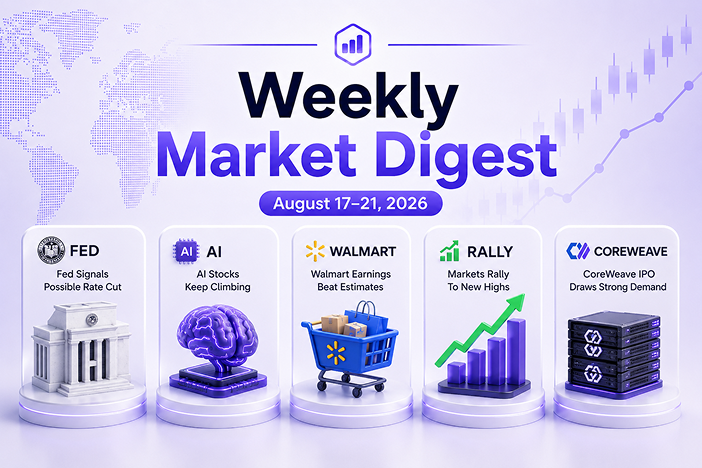
This was the week the bond market took the story back from the Fed. The 30-year Treasury yield touched its highest level in nineteen years on Tuesday, and it did so while the odds of a rate hike were falling. Long-term borrowing costs rose on their own, and the most leveraged corner of the AI trade broke first.
Then the Fed's own minutes named the problem out loud on Wednesday, Walmart delivered its worst same-store sales number since 2020 on Thursday, and on Friday a business survey said the US economy is growing at its fastest pace in more than four years. Every index still finished the week lower.
Quick answer: US stocks fell in the week of August 17–21, 2026, the first weekly declines since late July. The S&P 500 lost 1.4% to close at 7,674.37, the Nasdaq Composite fell 2.1% and the Dow slipped 0.8%, despite a strong Friday rally. The 30-year Treasury yield topped 5.337% on Tuesday, a 19-year high, dragging heavily indebted AI infrastructure names with it. Walmart dropped more than 9% on Thursday, while Friday's flash composite PMI hit a 52-month high of 56.0. For halal investors the week split cleanly along the debt line: Walmart, Home Depot, Target and Ross Stores all pass AAOIFI screening, while Lowe's misses by 0.31 percentage points and CoreWeave misses by nearly 35. |
Table of Contents
- Monday–Tuesday: The Long End Breaks
- Wednesday: The Fed Names the AI Debt Problem
- Thursday: Walmart Breaks the Consumer Story
- Friday: A Rally, and a Survey That Contradicts Everything
- Which of This Week's Names Pass AAOIFI Screening?
- What This Week Means for Halal Investors
- FAQ
- Sources
Monday–Tuesday: The Long End Breaks
The 60-day negotiating window agreed between Washington and Tehran in June expired on Monday. Asked whether he would extend it, President Trump said no. A senior Iranian official told Reuters that Tehran would shift to a fully offensive posture in the Strait of Hormuz if diplomacy failed, and Jared Kushner said Iran was showing no interest in a workable deal.
Oil pushed higher - Brent traded around $90.71 and WTI around $84.84 on Tuesday - but the sharper move was in bonds. The 30-year Treasury yield briefly eclipsed 5.337%, its highest in nearly 19 years, while the 10-year pushed toward 4.75%. Stocks slipped in both sessions, with the Nasdaq worst hit.
Daniela Hathorn of Capital.com explained the mechanism precisely: the long end was responding to persistent inflation risk, heavy government borrowing, and growing competition for capital - including the debt issuance tied to the AI investment boom. Her conclusion is the sentence of the week. Financial conditions can tighten even without the Fed raising rates.
The market proved it immediately. CoreWeave fell 8.3% on Tuesday, and the stated reason was not earnings or guidance. It was that surging long-term yields pressure a heavily leveraged company. Chip names went with it, with Micron down 4%, SanDisk 4.4%, Western Digital 5.4% and AMD 3.3%. Reddit joined the S&P 500 the same morning.
Why this matters Two weeks ago this digest flagged CoreWeave at 64.69% interest-bearing debt to market capitalisation, more than double the AAOIFI ceiling, while the stock was up 19% on record revenue. This week the long end of the curve moved and that is the exact name that broke, on a day with no company news at all. That is worth sitting with, because it shows what the debt screen is doing. AAOIFI Standard 21 caps interest-bearing debt for reasons rooted in fiqh, not in risk management. But the same ratio also measures how much of a company's future belongs to lenders rather than owners. When the price of borrowing rises, that is precisely the group that suffers first. A halal investor who applied the screen was not being clever about interest rates. They were simply not permitted to own the thing that fell. |
Wednesday: The Fed Names the AI Debt Problem
The minutes of the 28–29 July FOMC meeting landed Wednesday afternoon and were more hawkish than the 9–3 vote had suggested. Many participants judged that policy tightening would likely be necessary if inflation did not decline, and some questioned whether financial conditions were restrictive enough to return inflation to 2%. There was no discussion of support for a cut at all. Three regional presidents - Hammack, Kashkari and Logan - had formally dissented in favour of a quarter-point increase, but the minutes made clear the hawkish bloc was considerably larger than three.
Two details deserve more attention than they got. Chair Kevin Warsh opened a discussion about cutting the number of annual FOMC meetings from eight to six, arguing it would let more information accumulate between decisions; no conclusion was reached and the 2026 schedule is unchanged. More relevant here, the committee held an unusually pointed discussion of financial stability risks - rich equity valuations, record hedge-fund borrowing, and the debt-financed artificial intelligence build-out.
Markets barely reacted, because the minutes describe a room that met three weeks before the weak jobs and retail data arrived. The Treasury Department then said it would more than double its buybacks of 10-, 20- and 30-year debt, long yields fell hard, and stocks closed higher, snapping a three-day losing streak.
Retail earnings split the same day. Target reported comparable sales up 3.8%, well ahead of expectations, with traffic up 3.6%, and lifted its full-year sales growth guidance from 4% to 5%. Lowe's managed comparable sales of just 0.2% and moved its full-year outlook to the bottom of its prior range. Home Depot, reporting Tuesday, had beaten with comparable sales up 1.7% and raised its dividend to $2.33 a quarter, its 156th consecutive payout.
Why this matters When the central bank itself lists debt-financed AI capital spending alongside record hedge-fund borrowing in a financial stability discussion, that is not a screening opinion. That is the Fed describing the same balance sheets the AAOIFI debt ratio flags, arriving at concern from an entirely different direction. The practical lesson is about what the screen is not. Passing the 30/30/5 test does not make a stock cheap, well-run or timely. Lowe's and Home Depot sell similar products to a similar customer, and the gap between their quarters had nothing to do with either balance sheet. What the screen does reliably is keep a portfolio out of businesses whose survival depends on the price of money staying low. |
Thursday: Walmart Breaks the Consumer Story
Walmart beat on earnings and still fell 9.2%, the worst performer in the Dow. US same-store sales rose 2.6% against a 3.8% consensus, the slowest growth since 2020, and average ticket grew only 1.1% versus 3.1% a year earlier. Falling drug prices weighed on US sales, and adjusted operating income included a 750-basis-point benefit from tariff refunds. The company nudged its annual targets higher on e-commerce strength.
Brian Jacobsen of Annex Wealth Management put it best: for the consumer economy, this is like Nvidia posting a slowdown. Walmart has been winning the trade-down trade, and that tailwind may be fading.
The rest of the session compounded it. Treasury yields reversed Wednesday's decline, and President Trump promised a crushing economic operation against Iran, sending WTI up 2.83% to $86.78 and Brent up 2.58% to $93.98, the highest in nearly a month. The Dow fell 703.84 points, or 1.3%, to 52,759.21, the S&P 500 lost 0.9% to 7,641.16 and the Nasdaq Composite dropped 1% to 26,067.17. Advance Auto Parts fell about 25% on weak guidance and Coty lost 18% after declining to give a fiscal 2027 outlook. Bitcoin surged 11.5% on the Treasury buyback news.
Why this matters Walmart, Target, Home Depot and Lowe's reported within 48 hours of each other and told one consistent story: the customer is trading down and buying less per visit. Walmart's average ticket growing 1.1% while inflation runs at 3.4% means the real basket is shrinking. Halal portfolios feel this more directly than conventional ones, because consumer staples and retail are among the sectors that clear the business-activity screen most cleanly and therefore tend to be over-represented. There is no bank or bond allocation to offset a weak consumer quarter. The response is not to sell on one print. It is to expect softer numbers from consumer-facing holdings over the next two quarters, and to prefer the ones whose balance sheets can absorb a slow year without refinancing anything. |
Friday: A Rally, and a Survey That Contradicts Everything
Stocks rebounded to close the week. The S&P 500 rose 0.43% to 7,674.37, the Dow gained 517.80 points or 0.98% to 53,277.01, the Nasdaq Composite added 0.43% to 26,180.45 and the Russell 2000 rose 0.9% to 3,017.87. Health care led, with Merck and Johnson & Johnson among the gainers. Ross Stores rallied on stronger-than-expected profit.
The rally did not rescue the week. The S&P 500 finished down 1.4%, the Nasdaq down 2.1%, the Dow down 0.8% and the Russell 2000 down 1.6% - the first weekly declines since late July, and back-to-back weekly losses for the Dow. Information technology shed more than 3% across the five sessions, with Meta down almost 7%. Bitcoin reached about $77,000, its best week in two years, and gold traded above $4,585.
The surprise came at 9:45am. S&P Global's flash composite output index rose to 56.0 in August from 54.5, the strongest reading since April 2022, against forecasts nearer 53. Services jumped to 56.8, a 20-month high, while manufacturing eased to 53.2. Employment grew at its fastest rate since the start of 2025. Chris Williamson of S&P Global Market Intelligence said US business is booming, with third-quarter growth tracking close to 3% annualised against 1.5% in the second quarter. Output charge inflation, meanwhile, softened to a six-month low.
Why this matters Friday's survey does not fit Thursday's Walmart report, and it would be dishonest to pretend otherwise. One says households are buying less per trip; the other says firms are producing more and hiring faster than at any point in four years. Both can be true. Business activity and consumer basket size are different measurements, and services - which drove the entire PMI beat - are not what Walmart sells. But the tension is real, and it is exactly why the September meeting is genuinely unsettled: an economy growing at 3% with easing selling prices argues one way for policy, and a shrinking real consumer basket argues the other. For a halal investor, the honest response to conflicting macro data is to stop trying to resolve it. Screening verdicts move on quarterly financials, not on survey prints, and the balance sheet quality that protects a portfolio in a tightening cycle is the same whether growth comes in at 3% or 1.5%. |
Which of This Week's Names Pass AAOIFI Screening?
Akinda screens to AAOIFI Shari'ah Standard No. 21, commonly summarised as the 30/30/5 rule: interest-bearing debt under 30% of market capitalisation, interest-earning or non-compliant investments under 30%, and non-permissible income under 5% of revenue. Breaching any single limit fails the stock. Figures retrieved 22 August 2026; breaches marked in red.
| Company | Ticker | Verdict | Debt (<30%) | Investments (<30%) | Non-perm. income (<5%) |
|---|---|---|---|---|---|
| Ross Stores | ROST | Halal | 2.92% | 8.84% | 0.87% |
| Walmart | WMT | Halal | 6.24% | 1.49% | 0.36% |
| Home Depot | HD | Halal | 15.70% | 0.39% | 0.09% |
| Target | TGT | Halal | 28.61% | 9.54% | 0.00% |
| Lowe's Companies | LOW | Not halal | 30.31% | 1.03% | 0.14% |
| CoreWeave | CRWV | Not halal | 64.69% | 11.79% | 0.60% |
The Lowe's line is the most instructive number in this digest. At 30.31%, it misses the debt limit by 0.31 percentage points — roughly one good quarter of debt repayment, or a modest rise in the share price, away from passing. Home Depot, selling similar goods into the same market, sits at 15.70%. Two companies, one industry, opposite verdicts, and the deciding factor is entirely the balance sheet.
It also shows why a verdict is a snapshot rather than a sentence. Lowe's is not permanently excluded; it is currently outside the line and could move back inside. That is a reason to re-check before every purchase, not to write a company off.
Ross Stores and Walmart are the cleanest of the group, at 2.92% and 6.24% interest-bearing debt, unusually low for retailers of that size. Target passes at 28.61%, comfortably inside but close enough to be worth watching each quarter. Screen any stock on Akinda halal stock screener.
What This Week Means for Halal Investors
- The debt screen did real work this week. CoreWeave fell 8.3% on a day with no company news, purely because long-term yields rose. The AAOIFI debt limit is a fiqh rule, but it removed exactly the holding that was most exposed to it.
- Financial conditions can tighten without the Fed. The 30-year hit a 19-year high while rate-hike odds were falling. Watching only the policy rate misses where the pressure actually arrives.
- Near-miss verdicts deserve a diary entry, not a delete. Lowe's fails by 0.31 points. That is close enough that the verdict could change with one quarter of deleveraging or a move in the share price. Re-check before you act.
- The data is genuinely conflicted, and that is fine. A booming PMI and a shrinking Walmart basket landed 24 hours apart. Screening does not depend on resolving that; it depends on balance sheets, which move quarterly and slowly.
The coming week decides more than this one did. July PCE inflation and Nvidia's fiscal second-quarter results both land on Wednesday 26 August, the latter treated by the market as the verdict on the entire AI capital spending cycle. Jackson Hole then opens on Thursday 27 August, with Warsh delivering his first keynote as chair on Friday morning - nineteen days before the 15–16 September FOMC meeting and its first fresh dot plot since June.
FAQ
Did the stock market rise or fall during the week of August 17–21, 2026?
It fell. The S&P 500 lost 1.4% over the week to close at 7,674.37, the Nasdaq Composite fell 2.1% and the Dow Jones Industrial Average slipped 0.8%, despite all three rising on Friday. These were the first weekly declines since late July, driven by a sell-off in long-dated Treasuries, higher oil prices and a sharp drop in Walmart.
Is Lowe's stock halal?
Lowe's currently returns a Not Halal verdict on Akinda's AAOIFI screen. Interest-bearing debt stands at 30.31% of market capitalisation against a 30% ceiling, a miss of 0.31 percentage points. Its other two ratios are excellent, at 1.03% investments and 0.14% non-permissible income. Because the miss is so narrow, the verdict could change with modest deleveraging or a rise in the share price, so it is worth re-checking rather than treating as permanent.
Is Walmart stock halal?
Walmart returns a Halal verdict on Akinda's screen, with interest-bearing debt at 6.24% of market capitalisation, interest-earning investments at 1.49% and non-permissible income at 0.36%. All three sit far inside AAOIFI thresholds. A small purification obligation would still apply to dividends, since non-permissible income is above zero.
Why did stocks fall when rate-hike odds were falling?
Because long-term Treasury yields rose independently of the policy rate. The 30-year briefly topped 5.337% on Tuesday, a 19-year high, driven by persistent inflation risk, heavy government borrowing and competition for capital from AI-related debt issuance. Higher long-term borrowing costs tighten financial conditions and compress valuations even when the Fed is on hold.
What did the July FOMC minutes actually say?
They showed a committee leaning more hawkish than its 9–3 hold implied. Many participants judged that tightening would likely be necessary if inflation did not decline, some questioned whether financial conditions were restrictive enough, and there was no discussion of support for a cut. The minutes also recorded a financial stability discussion covering equity valuations, hedge-fund borrowing and the debt-financed AI build-out.
Sources
- AAOIFI — Shari'ah Standard No. 21, Financial Paper (Shares and Bonds) — https://aaoifi.com/ss-21-financial-paper-shares-and-bonds/?lang=en
- TheStreet — Stock Market Today, 18 August 2026 (30-year yield, CoreWeave, chips, Iran) — https://www.thestreet.com/stock-market-today/stock-market-today-dow-jones-sp-500-nasdaq-updates-aug-18-2026
- TheStreet — Stock Market Today, 20 August 2026 (Walmart, oil, Treasury buybacks) — https://www.thestreet.com/stock-market-today/stock-market-today-dow-jones-sp-500-nasdaq-updates-aug-20-2026
- CNBC — Dow surges 500 points Friday, but index posts back-to-back weekly losses — https://www.cnbc.com/2026/08/20/stock-market-today-live-updates.html
- Yahoo Finance / AP — How major US stock indexes fared Friday 21 August 2026 — https://finance.yahoo.com/markets/world-indices/articles/major-us-stock-indexes-fared-202316400.html
- Benzinga — S&P Global flash US PMI hits 52-month high — https://www.benzinga.com/markets/economic-data/26/08/61363926/sp-global-flash-us-pmi-august-2026-composite-52-month-high
- Yahoo Finance — Fed July 2026 FOMC minutes: rate hike debate details — https://finance.yahoo.com/economy/policy/articles/fed-july-2026-fomc-minutes-181529233.html
- Lowe's Corporate — Second Quarter 2026 Sales and Earnings Results — https://corporate.lowes.com/newsroom/press-releases/lowes-reports-second-quarter-2026-sales-and-earnings-results-08-19-26
- CNBC — Lowe's (LOW) Q2 2026 earnings — https://www.cnbc.com/2026/08/19/lowes-low-q2-2026-earnings.html
- ETF Trends — Target vs. Lowe's: A Tale of 2 Retail Q2s — https://www.etftrends.com/sector-investing-content-hub/target-lowes-2-retail-q2s/
- 24/7 Wall St. — Home Depot Q2 FY26 results and dividend increase — https://247wallst.com/investing/2026/08/19/home-depot-just-delivered-a-big-vote-of-confidence-in-its-business/
- Charles Schwab — Market update, 21 August 2026 (next week's calendar) — https://www.schwab.com/learn/story/stock-market-update-open
- Screening verdicts and ratios — Akinda AAOIFI screening engine, retrieved 22 August 2026
Download the Akinda app:
Screen thousands of global stocks and monitor Shariah compliance in real time.
Website: akinda.io
App: onelink.to/kpqkh6
Disclaimer: This digest is for educational purposes only and is not financial or religious advice. Market figures reflect the close on Friday 21 August 2026 and may have changed since. Automated Shariah screening is a starting point based on reported financial data and does not replace the judgement of a qualified scholar. Always verify a stock's current ratios before investing.