
- Stock Market & Equities
What Are Stocks and How Do They Work?
Understanding Stocks: A Complete Guide for Beginner Investors
Table of contents:
- Introduction
What Are Stocks?
Why Companies Issue Stocks?
Types of Stocks Explained
How Stock Prices Are Determined?
How Investors Make (or Lose) Money in Stocks?
Key Risks of Stock Investing
Stock Markets and Stock Exchanges
Key Investment Metrics for Stock Investors
Practical Advice for Stock Beginners
Conclusion
Introduction
Stocks are one of the most fundamental building blocks of the financial world. They represent ownership in a company and provide investors with the opportunity to participate in that company’s growth, profits, and decision-making. For centuries, stocks have been a key driver of wealth creation and economic development.
What Are Stocks?
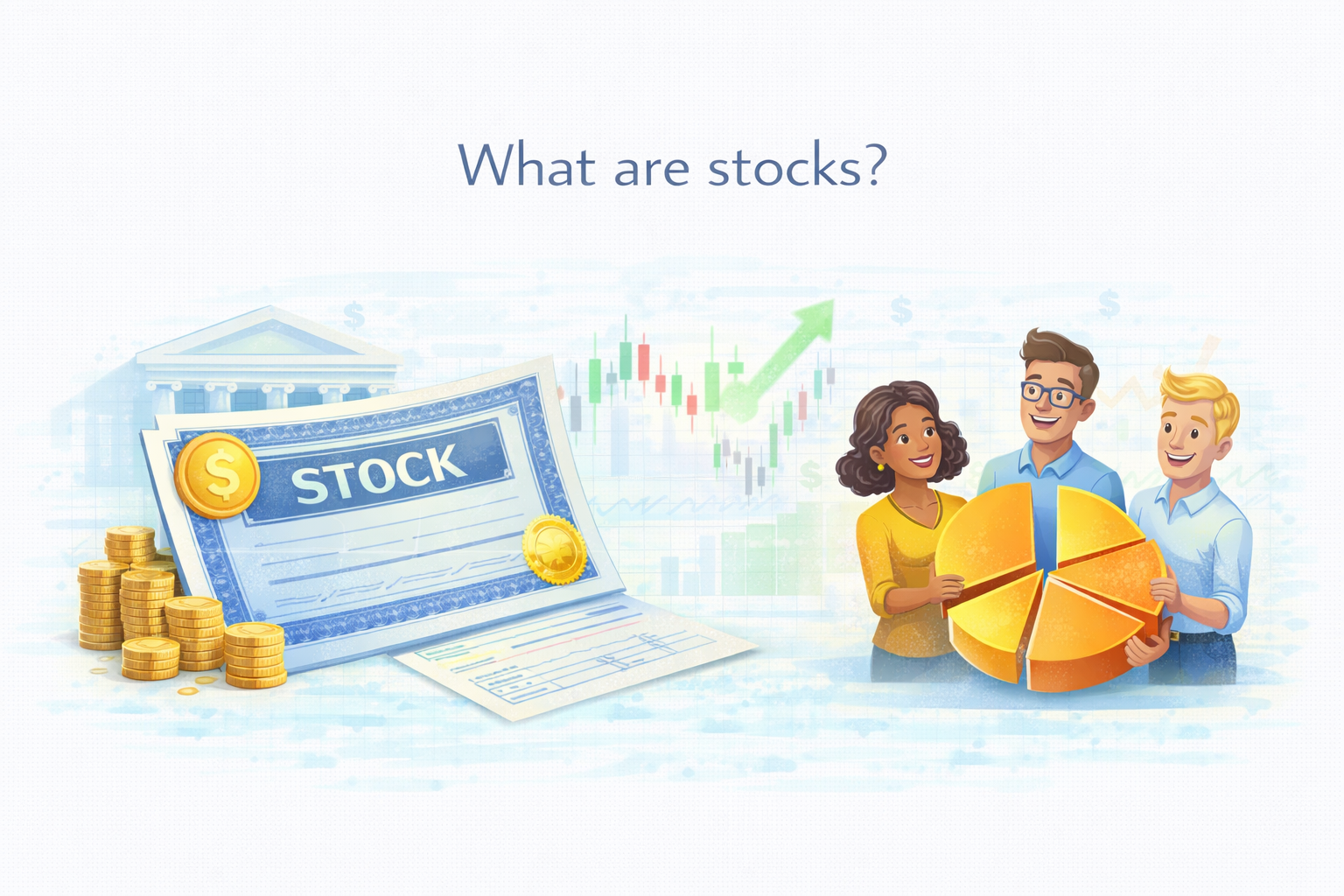
A stock (also known as a share or equity) is a financial security that represents partial ownership of a company. By purchasing a stock, you become a shareholder — owning a piece of the company and gaining certain rights, such as voting at shareholder meetings and receiving dividends if they are declared. Shareholders can earn income through dividends, which are portions of a company’s profits, and through capital gains when stock prices rise.
Today’s investors have access to various learning tools and simulations that make understanding the stock market easier. For example, platforms like akinda.io offer interactive courses that help beginners explore real-world stock behavior safely before committing real money — an effective way to build confidence.
From a theoretical perspective, a stock can be seen as a claim to future cash flows. Its value is often calculated as the present value of expected future dividends plus the anticipated future sale price, as explained in models such as the Gordon Growth Model. However, uncertainty surrounding these future cash flows introduces investment risk.
Why Companies Issue Stocks?
Reasons Why Companies Issue Stocks:
1. Raising Capital: The main reason companies issue stocks is to raise funds for expansion, new projects, research and development, or acquisitions. Unlike loans, equity financing does not require repayment or interest payments, allowing companies to use the capital more flexibly.
2. Debt Reduction: Companies may issue shares to reduce their reliance on borrowed funds. Selling equity helps improve the balance sheet by lowering debt levels and interest expenses, which can make the company financially healthier.
3. Risk Distribution: Issuing stock spreads the company’s financial risk among many shareholders instead of concentrating it on a few owners or debt-holders. This shared ownership structure provides stability and reduces financial vulnerability during market fluctuations.
4. Reputation and Credibility: Being listed on a stock exchange enhances the company’s public image and increases investor trust. A public listing often attracts media attention, improves transparency, and makes it easier to raise additional funds in the future.
5. Liquidity: Publicly traded shares allow investors and existing shareholders to buy or sell stock easily in secondary markets. This liquidity makes investing in the company more appealing to potential shareholders.
6. Employee Incentives and Ownership: Many companies offer stock options or shares to employees as part of their compensation package. This aligns employees’ interests with the company’s success and motivates them to perform better.
7. Initial Public Offering (IPO): The first time a company issues shares to the public is called an IPO. After the IPO, the company’s shares are traded in secondary markets between investors, rather than between the company and investors.
In summary, companies issue stocks not only to raise funds but also to strengthen financial stability, build credibility, distribute risk, and motivate employees — all of which contribute to long-term growth and competitiveness.
Types of Stocks Explained
There are several categories of stocks, each with distinct features:
| Type / Category | Description | Pros & Cons |
| Common stock | Represents ownership in a company and usually grants voting rights. Dividends are not guaranteed and depend on company performance. | Pros: Potential for high returns and voting rights. Cons: Higher risk; in bankruptcy, common shareholders are paid last. |
| Preferred stock | Offers fixed dividends and priority over common stock in both dividend payments and asset claims. Typically does not grant voting rights. | Pros: More stable income and higher claim priority. Cons: Limited profit potential and usually no voting rights. |
| Growth stocks | Issued by companies expected to grow faster than the market average. These firms often reinvest profits instead of paying dividends. | Pros: High potential for capital gains. Cons: Often volatile and risky, especially in market downturns. |
| Value stocks | Stocks that appear undervalued compared to their intrinsic worth, based on metrics like earnings, dividends, or book value. | Pros: Potential to outperform when prices correct; less speculative. Cons: May remain undervalued for long periods; slower returns |
| Dividend / Income Stocks | Issued by stable companies that consistently pay dividends, attracting long-term and income-focused investors. | Pros: Reliable income and lower volatility. Cons: Slower growth compared to high-growth stocks. |
| Large Cap Stocks | Belong to companies with large market capitalizations (often over $10 billion). Generally stable and less volatile. | Pros: Reliable performance and steady growth. Cons: Limited rapid growth potential. |
| Small Cap Stocks | Represent smaller companies with high growth potential but higher risk. | Pros: Greater potential for rapid expansion. Cons: More volatile and sensitive to economic changes. |
In summary, common and preferred stocks differ by ownership rights and dividend policies, while growth, value, and dividend stocks vary by investment strategy and risk level. Large- and small-cap classifications further indicate a company’s size, stability, and potential return. Together, these categories help investors build diversified portfolios suited to their individual objectives.
How Stock Prices Are Determined?
Stock prices constantly rise and fall, mainly because of supply and demand. When more investors want to buy a stock than sell it, prices increase; when selling dominates, prices drop. But behind these movements lie deeper financial and psychological factors.
1. Risk and Return. In finance, higher risk usually means higher potential return. Systematic risk affects the entire market and can’t be avoided. Unsystematic risk is company-specific and can be reduced by diversification.
The relationship between risk and return is complex — how a stock moves with the market (its covariance) often matters more than its volatility.
2. Market Efficiency. The Efficient Market Hypothesis argues that prices already reflect all available information, so consistently beating the market is very hard. Still, studies find exceptions — like value and momentum stocks — showing that markets aren’t perfectly efficient.
3. Pricing Models
CAPM: Explains a stock’s return based on its risk (beta), the market risk premium, and the risk-free rate.
Fama-French Model: Adds more factors, showing that smaller and cheaper “value” companies often earn higher returns.
4. Human Behavior. Emotions like fear, greed, and overconfidence can push prices away from their true value. Behavioral finance studies these effects and helps investors understand how psychology shapes the market.
How Investors Make (or Lose) Money in Stocks?
Investing in the stock market is one of the most common ways people try to grow their wealth over time. But how exactly do investors make money — and what risks do they face along the way? Let’s break it down in simple terms.
1. Capital Gains: Buying Low, Selling High. This is the most familiar way to earn money from investing. When you buy a stock at a certain price and sell it later at a higher price, the difference is your capital gain.
For example, if you bought one share of a company for $50 and sold it for $70, you earned a $20 profit. Of course, the opposite can happen too — if the price drops to $40, that’s a capital loss.
2. Dividends: Earning Income While You Hold. Some companies share part of their profits with shareholders in the form of dividends. These are usually paid quarterly and can be a steady source of income.
Imagine you own 100 shares of a company that pays $1 in annual dividends — you’ll receive $100 a year, regardless of whether you sell your shares or not.
This makes dividend-paying stocks especially attractive to long-term and income-focused investors.
3. Total Return: The Big Picture. Your total return is the sum of all the money you make from a stock — including both price appreciation and dividends, after subtracting taxes and trading fees.
Total Return = (Capital Gains + Dividends) – Costs and Taxes
This gives a full picture of how well your investment has performed overall.
Key Risks of Stock Investing
While investing can be rewarding, it’s never risk-free. Stock prices move due to many factors, and not all of them can be predicted or controlled.
1. Market Risk. Sometimes, the entire market falls — due to recessions, inflation, or political tension. Even strong companies see their prices drop in such periods. This is known as systematic risk, and it cannot be completely avoided, only managed.
2. Company-Specific Risk. Each company faces its own challenges — like poor management, product recalls, or lawsuits. These risks are called unsystematic risks and can be reduced through diversification, meaning owning shares in many different companies instead of just one.
3. Liquidity Risk. Some stocks are easy to buy and sell; others are not. If few investors are trading a certain stock, you might have trouble selling it quickly at a fair price.
4. Behavioral Mistakes. Emotions like fear and overconfidence often lead to bad investment choices. People panic and sell too soon, or chase hyped-up stocks and lose money when the excitement fades.
To combat this, using structured learning tools or practice environments — such as.io’s interactive stock simulations — helps new investors build experience without risking real money.
Stock Markets and Stock Exchanges
Stocks are traded on stock exchanges — organized platforms where buyers and sellers meet.
Famous examples include the New York Stock Exchange (NYSE), NASDAQ, and London Stock Exchange.
After a company goes public through an Initial Public Offering (IPO), its shares can be freely bought and sold on these markets. Prices are set through supply and demand — when more people want to buy a stock, the price rises, and when more want to sell, it falls. Market participants include retail investors, institutional investors (funds, pensions), market makers, high-frequency traders, etc.
Key Investment Metrics for Stock Investors
Several key investment metrics are used to evaluate companies in stock market:
| Concept | What It Means | Why It Matters |
| Market Capitalization | Total value of the company’s outstanding shares (price × number of shares) | Shows company size; helps classify small-cap, mid-cap, or large-cap stocks. |
| Ticker Symbol | The unique code used to identify a company on an exchange | Needed for searching or trading stocks. |
| Dividend Yield & Payout Ratio | Yield = annual dividends divided by stock price; payout ratio = portion of earnings paid out as dividends | Helps investors assess income potential & sustainability. |
| Beta | Measure of how volatile a stock is relative to the market | Helps assess risk level. |
| Sharpe Ratio | (Return – risk-free rate) ÷ risk | Measures how much return an investor gets per unit of risk. |
| Efficient Frontier | Optimal mix of risk and return | Guides portfolio diversification decisions. |
Practical Advice for Stock Beginners
Getting started with investing in stocks can feel exciting yet overwhelming. The good news is that anyone can learn to invest wisely by following structured steps, practicing patience, and using reliable tools. Here’s a simple and practical guide to help you begin your investing journey with confidence.
1. Set Clear Goals. Before you buy your first stock, think about why you want to invest. Are you saving for retirement, future education, or simply growing your wealth? Clear goals help you choose the right time horizon and risk level. Long-term investors, for example, can handle more short-term market ups and downs because they have time to recover from downturns.
2. Know Your Risk Tolerance. Every investor is different. Some can handle price fluctuations calmly, while others panic when markets fall. Understanding your personal comfort with risk will help you choose suitable investments. In finance, models like the Sharpe ratio or Value at Risk are used to measure how much risk is worth taking for a given level of return — but for beginners, the key is to stay realistic and not invest money you can’t afford to lose.
3. Learn the Basics of Research. Successful investing starts with knowledge. Study a company’s financial health by reviewing its income statement, balance sheet, and cash flow statement. Try to understand how the business makes money, whether it’s growing, and what challenges it faces.
Look at valuation ratios such as Price-to-Earnings (P/E) or Price-to-Book (P/B) to see if a stock seems fairly priced. You don’t need to become a financial analyst — just develop the habit of asking “Is this company worth investing in?”
4. Diversify Your Portfolio. Don’t put all your money into one company or one sector. Academic research, such as Modern Portfolio Theory and the Fama-French model, shows that diversification helps reduce risk and improve long-term returns.
Try investing across different industries (like technology, healthcare, and energy) and even different countries. A balanced portfolio protects you from big losses if one stock performs poorly.
5. Choose Between Active and Passive Investing. There are two main strategies investors use:
Active investing: Picking individual stocks and trying to beat the market through research and timing.
Passive investing: Buying index funds or ETFs that simply track the market, such as the S&P 500.
Most beginners find passive investing easier and more cost-effective, while active investing requires more time, skill, and discipline.
6. Build Your Portfolio Wisely. Decide how much of your total money you’ll invest in stocks versus safer assets like bonds or cash. This is known as asset allocation. Within your stock portion, include both growth stocks (companies expected to expand quickly) and value stocks (companies that seem undervalued). Balance is key — a mix of different asset types and sectors can stabilize your overall performance.
7. Monitor and Rebalance Regularly. Check your investments periodically — once every few months is enough for most people. If one part of your portfolio grows much faster than others, adjust (rebalance) it to maintain your preferred mix. However, avoid checking your account every day or reacting emotionally to short-term price movements.
8. Keep Emotions in Check. Emotional investing is one of the biggest mistakes beginners make. Fear and greed can lead to bad decisions, like selling during downturns or chasing “hot” stocks. Create a plan and stick to it.
9. Be Mindful of Costs and Taxes. Even small fees can reduce your profits over time. Choose low-cost brokers and funds, and learn about taxes on dividends and capital gains in your country. The less you spend on fees, the more your money can grow through compounding.
10. Keep Learning and Practicing. Investing is a lifelong learning process. Read books, follow reliable financial news, and practice strategies before committing real money. Tools like akinda.io offer virtual investing experiences where you can simulate trades and see how different decisions play out — a safe way to build experience without risk.
Starting small, staying patient, and continuously learning are the true secrets of successful investing. Remember: the stock market rewards discipline and time, not speed and emotion. By following these steps, you can build a foundation for long-term financial growth — one smart decision at a time. Explore real company stock reports and analysis tools on Akinda.io.
Conclusion
Stocks are the foundation of modern investing, allowing individuals to participate in the world’s economic growth. They offer opportunities for wealth creation — but also carry risks that require knowledge, discipline, and patience. Whether you are a beginner or an advanced investor, continuous education is essential. Digital learning and simulation platforms like akinda.io make it easier than ever to practice, analyze, and understand stock market dynamics safely and effectively.
FAQ: Understanding Stocks for Beginners
What is a stock in simple terms?
A stock represents partial ownership in a company. When you buy a stock, you become a shareholder and may benefit from price increases and dividends.
Why do companies sell stocks instead of taking loans?
Stocks allow companies to raise money without paying interest or repaying debt. This gives them more financial flexibility and reduces bankruptcy risk.
What is the difference between common and preferred stock?
Common stock usually provides voting rights and higher growth potential, while preferred stock offers fixed dividends and priority in payouts but often no voting rights.
How do beginners make money from stocks?
Beginners typically earn money through capital gains (selling stocks at a higher price) and dividends paid by profitable companies.
Are stocks risky for beginners?
Yes, stocks involve risk due to market fluctuations and company-specific issues. However, risk can be managed through diversification, long-term investing, and education.
What is the safest way for beginners to invest in stocks?
Many beginners start with diversified index funds or ETFs, which reduce risk by spreading investments across many companies.
What metrics should beginners look at first?
Market capitalization, dividend yield, P/E ratio, and beta are useful starting points for understanding stock risk and valuation.
How can beginners practice stock investing safely?
Beginners can use stock simulators and virtual trading platforms like Akinda.io to practice investing without risking real money.
This article is for educational purposes and reflects widely accepted principles in finance and investment analysis.
Sources & Further Reading
Barberis, N. & Thaler, R. (2003). A Survey of Behavioral Finance. Handbook of the Economics of Finance.
Brealey, R. A., Myers, S. C. & Allen, F. (2019). Principles of Corporate Finance. McGraw-Hill.
Damodaran, A. (2020). Investment Valuation: Tools and Techniques for Determining the Value of Any Asset. Wiley.
Fama, E. F. & French, K. R. (1993). “Common risk factors in the returns on stocks and bonds.” Journal of Financial Economics, 33(1), 3–56.
Markowitz, H. (1952). “Portfolio Selection.” The Journal of Finance, 7(1), 77–91.
Sharpe, W. F. (1964). “Capital Asset Prices: A Theory of Market Equilibrium under Conditions of Risk.” The Journal of Finance, 19(3), 425–442.