
- Building with Akinda
White-Label & Embedded Halal Investing (Shariah-as-a-Service)
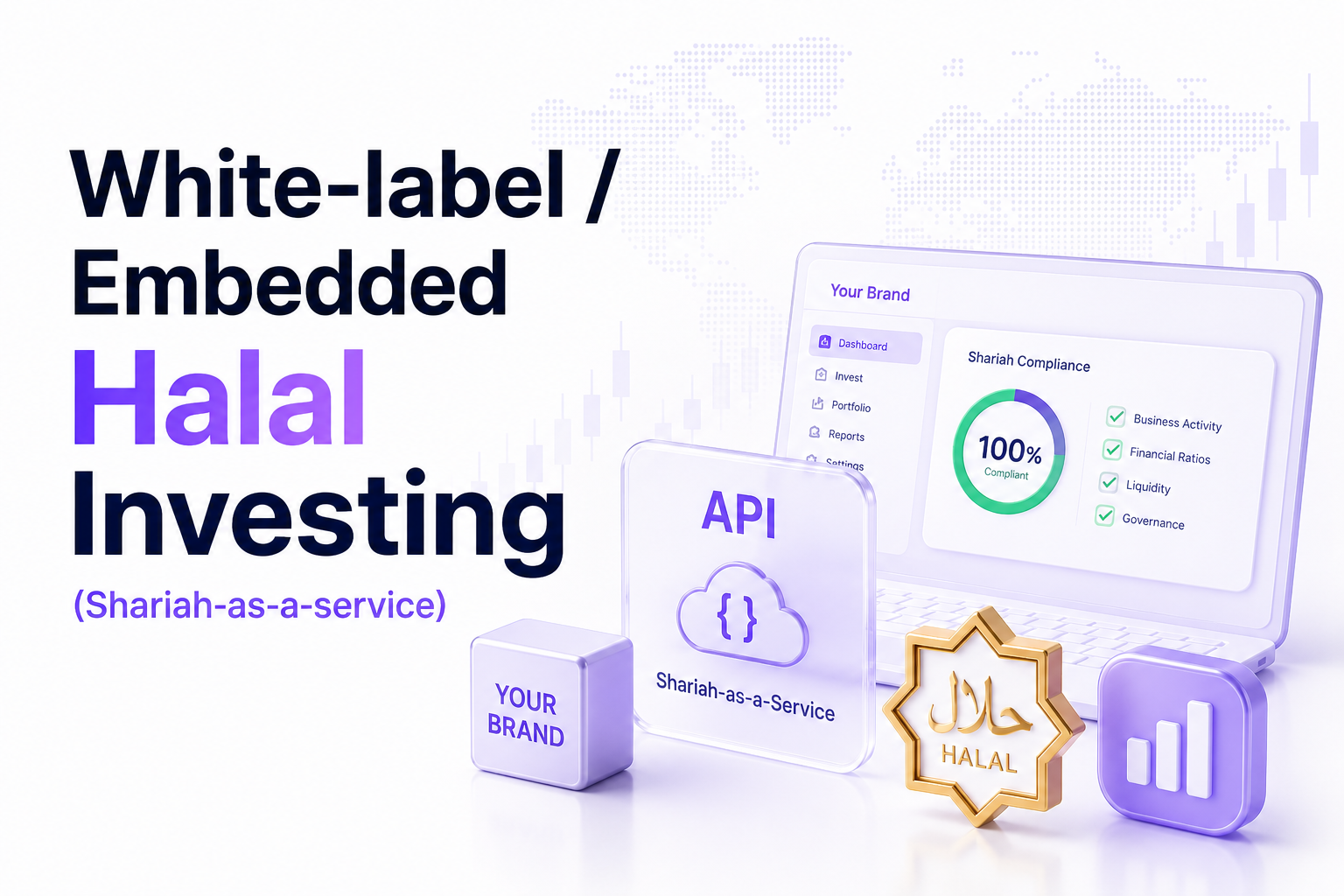
The fastest way to launch a halal investing product in 2026 isn't to build one from scratch, it's to embed compliance infrastructure that already exists. Just as embedded finance let any app add payments or lending through an API, Shariah-as-a-service lets fintechs, banks, and brokerages add halal screening, compliant portfolios, and purification through a compliance layer they don't have to build. This guide explains what white-label and embedded halal investing is, why it's growing, and how to stand it up on top of an AAOIFI-based screening API.
Quick Answer White-label or embedded halal investing means offering Shariah-compliant investing inside your own product using a third-party compliance layer, “Shariah-as-a-service.” Instead of building a screening engine, hiring scholars, and licensing financial data, you integrate an AAOIFI-based API like the Akinda Halal API to power halal verdicts, compliant universes, and purification under your own brand. It turns a multi-year build into an integration, and lets banks, brokerages, and neobanks launch a halal offering in weeks. |
By the numbers (2026) Islamic finance assets: ~$5.1 trillion in 2026, projected to reach ~$8.46 trillion by 2031 (Mordor Intelligence). |
Table of Contents
- What is Shariah-as-a-service?
- Why embed instead of build?
- What a Shariah-as-a-service layer includes
- Who embeds halal investing
- How to embed it with the Akinda API
- Branding, governance, and compliance
What is Shariah-as-a-service?
Shariah-as-a-service is the delivery of Islamic-finance compliance as an on-demand, API-based product. Rather than each institution rebuilding the same screening engine and scholar workflow, a specialist provider maintains the methodology, the financial data, and the governance, and exposes it through endpoints any product can call. Your app sends a ticker or a portfolio and gets back compliant verdicts, ratios, and purification figures, all under your own brand. It's the same pattern as banking-as-a-service or payments-as-a-service, applied to halal investing. You can see the underlying screening in action on Akinda's live screener; embedding it means putting that capability inside your product instead of sending users elsewhere.
The “white-label” part matters: the compliance layer runs invisibly behind your interface. Users experience your brand, your UX, and your product, while the halal verdicts they rely on come from a maintained, scholar-governed engine underneath.
Why embed instead of build?
Building halal investing infrastructure in-house is a serious undertaking. You'd need licensed financial data across every market you cover, a screening engine that encodes the business and financial rules correctly, a purification model, and, hardest of all, qualified Shariah scholars to design and govern the methodology and rule on edge cases.
That last requirement is a genuine bottleneck. The Islamic International Rating Agency estimates there are fewer than 1,200 qualified Sharia board members worldwide serving over 2,000 institutions, and an INCEIF study found that 42% of Islamic banks in Africa operate without a certified Sharia compliance officer. Professionals who combine Islamic jurisprudence with financial engineering are scarce and expensive. Embedding a Shariah-as-a-service layer lets you inherit that governance instead of recruiting it.
The economics follow the same logic. Building means a long, uncertain project plus ongoing maintenance as company financials shift every quarter; embedding means an integration you can ship in weeks and predictable, usage-based costs. For most fintechs and banks, the build-versus-buy math points clearly to buy, so engineering can focus on the product experience rather than on reconstructing Islamic-finance infrastructure.
What a Shariah-as-a-service layer includes
A complete embedded halal-investing layer is more than a single yes/no flag. The pieces you'll want to surface in your product:
- Compliance verdicts. A fast halal / non-compliant status for any ticker, the core of every halal feature.
- The reasoning behind them. Business-activity results and the financial ratios, so verdicts are transparent rather than a black box.
- A compliant universe. The ability to filter to only compliant securities, which is what powers halal portfolios and screeners.
- Purification data. The figure users need to cleanse the impermissible portion of their dividends.
- A published methodology. Documented rules your own compliance team and Shariah board can audit.
- Scholar governance. A named advisor and a review process behind the verdicts.
The Akinda Halal API packages these into three endpoints: a compliance verdict, a basic report, and a full report, documented in the developer docs, with the rules laid out in the published screening methodology.
Who embeds halal investing
Embedded halal investing suits any product whose users care about Shariah compliance, or could. The most common adopters:
- Brokerages and trading apps that add halal badges and pre-trade compliance gates so Muslim users can invest with confidence.
- Robo-advisors that build and rebalance portfolios drawn only from a compliant universe.
- Neobanks and super-apps adding an investing tab that needs to be compliant from day one to fit their audience.
- Conventional banks launching an Islamic window that need a Shariah-native compliance layer rather than a bolt-on to their existing core.
- Wealth and advisory platforms serving Muslim clients who expect compliance screening as standard.
In each case, embedding lets the institution offer a credible halal product without becoming an Islamic-finance infrastructure company itself.
How to embed it with the Akinda API
Standing up embedded halal investing on the Akinda Halal API follows a straightforward path:
- Generate an API key from the dashboard and prototype on the free tier.
- Call the compliance endpoint to add halal verdicts and badges across your product.
- Use the compliant universe to power screeners, halal-only filters, or robo portfolios.
- Pull full-report data where you need ratios and purification figures on detail screens.
- Schedule quarterly re-screening so verdicts stay current after each earnings season.
- Review the pricing page and move to a business plan for production volumes.
Because responses are structured JSON, the same layer also plugs into AI-agent and MCP workflows. The Akinda for Business page covers how the halal data layer supports fintechs and Islamic banks commercially.
Branding, governance, and compliance
White-labelling means your brand is on the experience, so the credibility of the compliance layer behind it becomes your credibility. Choose a provider whose methodology is published in full and whose verdicts are overseen by a qualified scholar, so you can defend them to your users, your own Shariah board, and regulators. The Akinda API's rules are reviewed by Dr. Muhammad Nazir Khan, who holds a PhD in Islamic Economics and Finance and an AAOIFI Shari'ah Auditing Certification.
Three practices keep an embedded offering trustworthy: present verdicts as data-driven screening rather than fatwas, keep a qualified scholar in the loop for edge cases such as mergers and partial-period reporting, and be transparent with users about which methodology powers the compliance they see. Done well, that transparency is exactly what earns the trust that drives retention and cross-sell in halal financial products.
Frequently asked questions
What is Shariah-as-a-service?
It's the delivery of Islamic-finance compliance, screening, compliant universes, purification, and governance, as an API-based product you embed in your own app. Instead of building the engine and hiring scholars, you integrate a maintained compliance layer and present halal investing under your own brand. It's the halal-investing equivalent of banking-as-a-service.
Is embedded halal investing white-label?
It can be. The compliance layer runs behind your interface, so users see your brand and UX while the verdicts come from a third-party, scholar-governed engine. You control the experience; the provider maintains the methodology, data, and governance underneath.
How long does it take to launch?
Because the hard parts, screening logic, financial data, and scholar governance, already exist, integration is measured in weeks rather than the months or years a from-scratch build would take. You generate an API key, wire up the endpoints, and design the UX around the verdicts, then re-screen on a schedule to stay current.
Do I still need my own Shariah board?
You should keep qualified Shariah oversight in the loop, especially for edge cases and product-level decisions, but you don't need to build the entire screening methodology yourself. A good provider publishes its rules and has its own scholar governance, which your board can review and rely on rather than reconstruct.
Does this work for a conventional bank's Islamic window?
Yes. Rather than forking a conventional core, a bank can run a parallel, Shariah-native compliance layer through an API and expose a unified front end. Embedding the screening avoids retrofitting compliance into a system that wasn't designed for it, which is a common failure mode in Islamic-window projects.
Sources
AAOIFI Shari'ah Standard No. 21: Financial Paper (Shares and Bonds) – the standard the Akinda API's screening methodology is built around.
Akinda API screening methodology – the full three-phase screen, ratio formulas, and purification rule, published for integrators to audit.
Akinda API Shariah advisor – the scholar governance behind the API's halal verdicts.
Mordor Intelligence – Global Islamic Finance Market (2026) – Islamic finance market size and growth projections.
Grand View Research – Islamic Fintech Market Report – Islamic fintech market size and CAGR.
Build with the Akinda Halal API The developer-grade API for AAOIFI-based Shariah stock screening. Start on the free tier, scale when you ship. 📚 Docs: b2b.akinda.io/developer/docs 💳 Pricing: b2b.akinda.io/pricing 🔑 Get a key: b2b.akinda.io/dashboard |
Disclaimer
This article is about a software product and is for general information only. It is not financial or religious advice. Automated Shariah screening produces data-driven signals, not a fatwa; integrators should pair it with their own Shariah governance and consult qualified scholars. API features, endpoints, coverage, and pricing change over time, so verify current details on b2b.akinda.io before building.