
- Investing Principles
Сompound Interest: The Most Powerful Force You’re Not Using
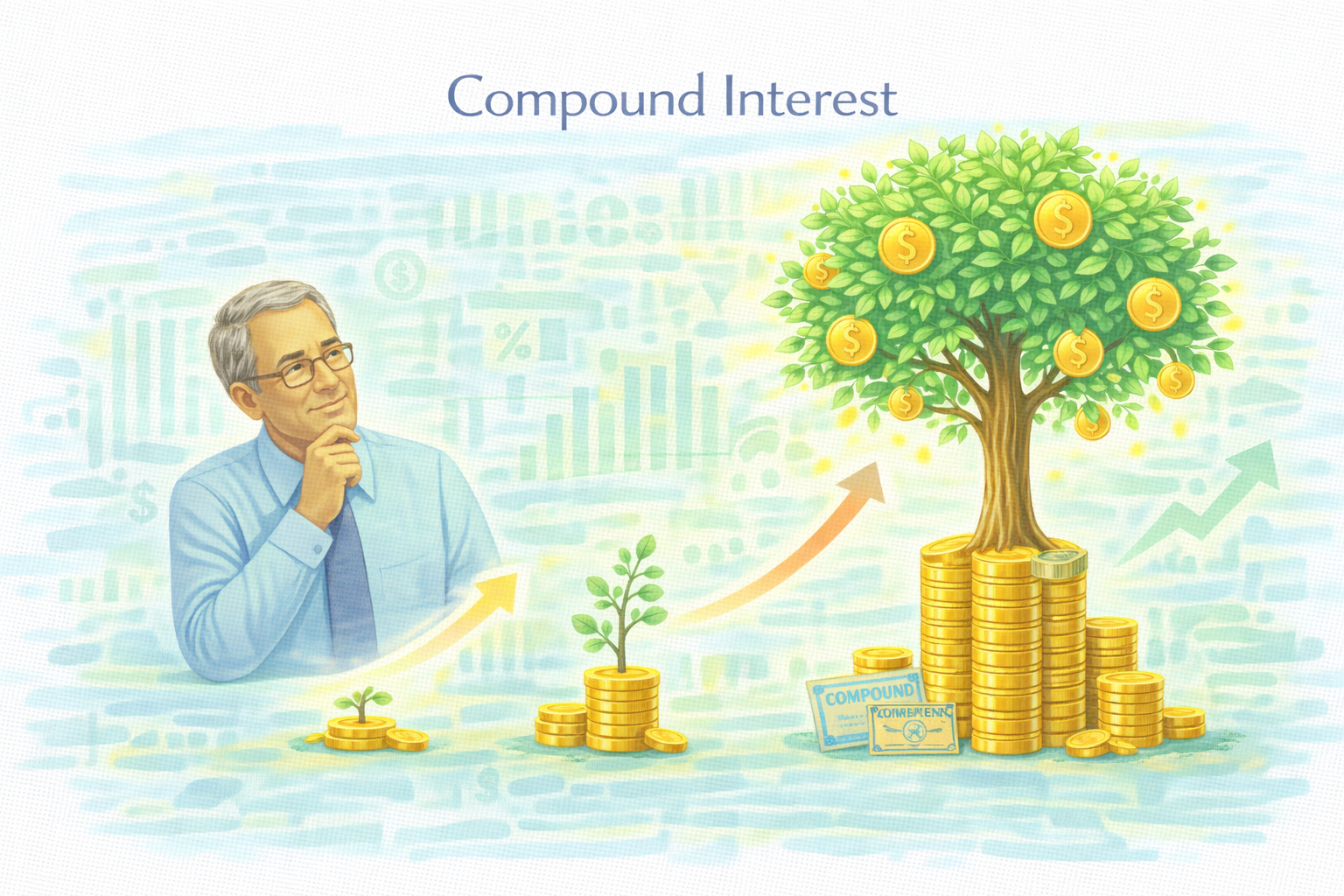
Headline A: Compound Interest: Key to Financial Freedom
Headline B: Grow Your Money Smarter: How Compound Interest Works for You
Headline C: From Pennies to Prosperity: Why Compound Interest Changes Everything
Table of contents:
Warren Buffet about compound interest
What Is Compound Interest?
Why It’s So Powerful
Real-Life Example 1: One-Time Investment
Real-Life Example 2: Monthly Contributions
Real-Life Example 3: The Cost of Waiting
How to Manage Compound Interest
Common Misconceptions About Investing and Compounding
Where we see compound interest?
When your money doubles?
Conclusion
Warren Buffet about compound interest
“My wealth has come from a combination of living in America, some lucky genes, and compound interest” said Warren Buffett. Buffett began investing as a child and allowed his investments to grow for decades, illustrating the power of compounding.
Compound interest is one of the simplest yet most powerful concepts in finance — a force that quietly builds wealth over time. Yet, many people either overlook it or start using it too late.
What Is Compound Interest?
Compound interest means you earn interest not just on the money you originally put in (the principal), but also on the interest that builds up over time. Your money grows, and the growth itself keeps growing.
This is different from simple interest, which only pays you interest on your original deposit. With compound interest, the interest you’ve already earned gets added back to your balance before the next calculation, so each period your total grows faster.
The basic formula looks like this:
Future Value = Principal × (1 + Rate ÷ Compounding Periods)^(Compounding Periods × Years)
(Investopedia, 2024).
This simple idea is one of the most powerful ways to build wealth steadily over time.
Here you can easily calculate compound interest.
Why It’s So Powerful
The magic of compounding lies in time. Even modest sums can grow significantly if given enough time. Compounding rewards patience and consistency. The longer your money compounds, the faster it grows. Even small amounts, invested consistently, can become substantial over decades.
Real-Life Example 1: One-Time Investment
At age 30, Ali invests a single lump sum of €4,000 into a balanced index fund earning an average 6.2% annual return, compounded annually. He makes no further contributions and leaves it untouched for 25 years.
| Year | Balance (approx.) |
| Start (age 30) | €4,000 |
| After 10 years (age 40) | €7,350 |
| After 20 years (age 50) | €13,330 |
| After 25 years (age 55 | €18,150 |
If this were simple interest at 6.2%, Dilshod would have only about €10,200 after 25 years. By letting compound interest do its work, he ends up with €18,150 — nearly 80% more.
Key Lesson: Even a one-time investment can grow dramatically over time when you leave it to compound.
Real-Life Example 2: Monthly Contributions
Sahla invests $100 per month starting at age 25 in a low-cost index fund that earns an average 6% per year, compounded monthly. She does this for 25 years.
| Years Saving | Total Contributions | Balance with Compounding |
| 10 years | $12,000 | $16,000 |
| 20 years | $24,000 | $43,000 |
| 30 years | $30,000 | $60,000 |
By putting away just $100 each month — a total of $30,000 over 25 years — she ends up with about $60,000, thanks to compound interest.
Key Lesson: Even small, regular investments can grow to twice what you put in simply by giving compound interest time to work.
Real-Life Example 3: The Cost of Waiting
Imagine two friends, Layla and Omar.
Layla begins investing at age 23, putting €150 per month into a fund earning an average of 6% annually. She invests for 12 years and then stops contributing but leaves the money to grow until she’s 65.
Omar waits until age 35 to start. He contributes €150 per month all the way until age 65 — a full 30 years of contributions.
Here’s what happens:
| Saver | Total Contributed | Balance at 65 |
| Layla (starts at 23) | €21,600 | €395,000 |
| Omar (starts at 35) | €54,000 | €300,000 |
Even though Omar contributed over twice as much money, Layla ends up with about €95,000 more by retirement — simply because she started earlier and let compound interest work longer.
Key Lesson: Time in the market beats money invested. Starting early, even for a shorter period, can grow into a larger nest egg than contributing more but beginning later.
How to Manage Compound Interest
To manage compound interest:
–Start Early — Time Is Your Biggest Ally
The earlier you begin investing, the more time your money has to grow. Compound interest works exponentially: each period’s earnings are added to your principal, so the base on which you earn returns keeps increasing. Even small sums invested in your 20s can grow to far more than larger sums invested later in life. Time turns modest contributions into substantial wealth.
–Invest Regularly — Consistency Boosts Growth
Making consistent contributions — for example, monthly or quarterly — ensures you’re steadily adding to your principal, which accelerates compounding. Regular investing also smooths out the impact of market fluctuations (sometimes called “dollar-cost averaging”), because you’re buying at different price points over time rather than trying to “time” the market perfectly.
–Reinvest Earnings — Put Dividends and Interest Back In
Instead of withdrawing dividends, interest, or capital gains, reinvest them. This is what allows compound interest to fully work its magic. When your earnings are reinvested, they themselves start generating new earnings, which significantly accelerates the growth of your investment portfolio over long periods.
–Keep Fees Low — High Costs Reduce Returns
Management fees, trading costs, and other expenses can quietly erode your investment returns, especially over decades. Even a seemingly small difference — like paying 1% per year versus 0.2% per year in fees — can mean tens of thousands of dollars less in your account at retirement. Choosing low-cost investment options such as index funds or ETFs can help keep more of your returns working for you.
–Stay Invested — Patience Lets Compounding Work Through Ups and Downs
Markets rise and fall in the short term, but historically they trend upward over the long term. Withdrawing during downturns locks in losses and interrupts compounding. By staying invested through volatility and focusing on your long-term goals, you give compound interest the uninterrupted time it needs to deliver its full effect.
Common Misconceptions About Investing and Compounding
Despite its power, many people hesitate to take advantage of compound interest because of a few persistent myths:
“You need a lot of money to start.”
In reality, compound growth works even with small sums. Regularly investing €50–€100 a month can accumulate into a significant amount over time because the returns themselves start earning returns.
“Investing is only for experts.”
Thanks to online tools and educational platforms — such as Akinda.io, which provides accessible resources for ethical and beginner investors — anyone can learn to invest confidently without needing a finance degree.
“It’s too late to start.”
While starting early gives the biggest advantage, compounding still works if you begin later in life. Even a decade or two of consistent investing can meaningfully increase savings, especially if you reinvest returns.
“Picking individual stocks is required.”
You don’t have to choose individual winners. Low-cost index funds and ETFs already spread your money across many companies, making it simpler and safer to participate in long-term market growth.
Where we see compound interest?
Compound interest plays a role in many financial products, both positive and negative:
Savings accounts: Earn interest on your deposits, compounding daily, monthly, or yearly.
Certificates of deposit (CDs): Offer higher rates than savings accounts but lock up your money for a set period; interest usually compounds daily or monthly.
Stocks: Reinvesting dividends lets you buy more shares, creating a compounding effect that boosts long-term returns.
Real estate: Property value growth and reinvesting rental income can compound over time to build wealth.
Student loans: Some private loans use compound interest (interest capitalization), increasing the total owed.
Credit cards: Often compound interest daily or monthly on unpaid balances, which can quickly grow debt if not managed carefully.
However, not all of these financial instruments are Islamic friendly, most of them forbidden in Islamic law. Platforms like Akinda.io can you to distinguish what is shariah complient and what is not.
When your money doubles?
In order to know when your money doubles, you do not have to calculate interests and balances for several years. There is secret weapon – The Rule of 72 is a quick way to estimate how long it will take for your money to double with compound growth. Divide 72 by your annual return rate to get the approximate number of years.
Example: A 10% annual return means your money doubles in about 7.2 years (72 ÷ 10 = 7.2).
It’s a handy shortcut, but works best with moderate, predictable returns and shouldn’t replace detailed planning or professional advice.
Conclusion
Compound interest is not a financial trick reserved for experts — it’s a simple yet powerful process that quietly builds wealth over time. As Warren Buffett’s own career demonstrates, consistent investing and patience can turn even modest sums into substantial assets. By starting early, contributing regularly, reinvesting earnings, and keeping costs low, anyone can to secure a stronger financial future.
Understanding where and how your money grows — especially through responsible, ethical, and Shariah-compliant options identified by tools like Akinda.io — ensures that your financial success aligns with both your goals and values.
References:
Buffett, W. (2010) Berkshire Hathaway Annual Meeting (Q\&A session). Omaha, Nebraska. Transcript available at: CNBC Warren Buffett Archive [https://www.cnbc.com/warren-buffett-archive/](https://www.cnbc.com/warren-buffett-archive/) (Accessed: 23 September 2025).
CNBC (2020) Full Transcript: Billionaire Investor Warren Buffett Speaks with CNBC’s Becky Quick on Squawk Box. Available at: [https://www.cnbc.com/2020/02/24/full-transcript-billionaire-investor-warren-buffett-speaks-with-cnbcs-becky-quick-on-squawk-box-today.html](https://www.cnbc.com/2020/02/24/full-transcript-billionaire-investor-warren-buffett-speaks-with-cnbcs-becky-quick-on-squawk-box-today.html) (Accessed: 17 September 2025).
Investopedia (2024) Compound Interest Definition. Available at: [https://www.investopedia.com/terms/c/compounding.asp](https://www.investopedia.com/terms/c/compounding.asp) (Accessed: 17 September 2025).
Klaus, K. (2025). The Power of Compounding: How Time Can Be Your Best Investment Ally - Fiducient. [online] Fiducientadvisors.com. Available at: https://www.fiducientadvisors.com/blog/the-power-of-compounding-how-time-can-be-your-best-investment-ally.
Rueger, A. (2025). Compound interest: Your greatest ally or your worst enemy. [online] Fortune. Available at: https://fortune.com/article/compound-interest/.
Keywords
compound interest, what is compound interest, how compound interest works, benefits of compound interest, power of compound interest, compound interest examples, compound interest formula, compound interest investing, compound interest vs simple interest, rule of 72 compound interest