
- Building with Akinda
Halal Screening API Pricing vs Institutional Data Feeds
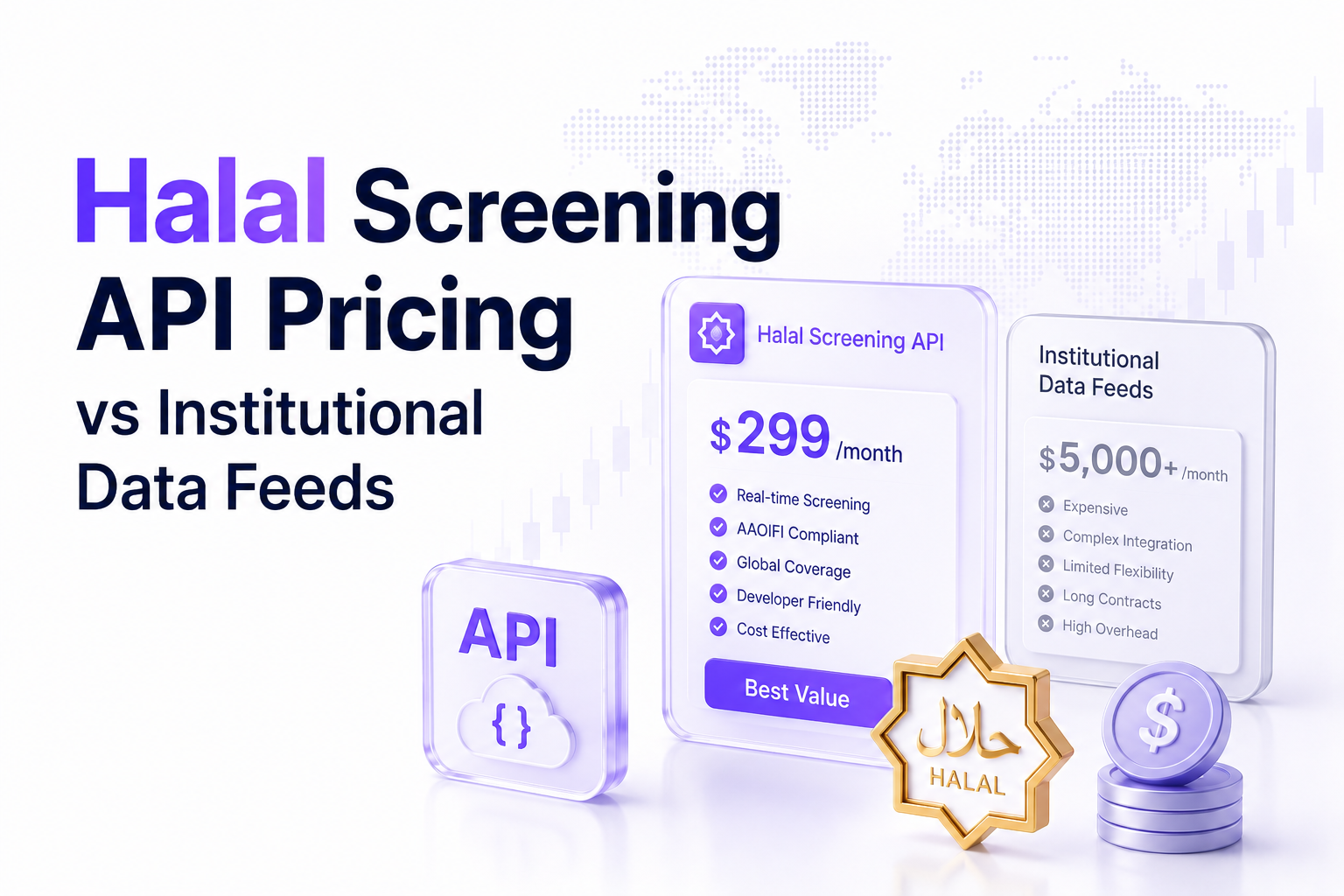
If you're pricing out a halal investing product, the first sticker shock usually comes from traditional market-data feeds. A single Bloomberg Terminal seat runs close to $32,000 a year in 2026, and its enterprise data API can reach six figures, and none of that includes a Shariah compliance layer. A purpose-built halal screening API is a fundamentally different pricing model: self-serve, usage-based, and starting from a free tier. This guide compares the two, explains what drives the cost of Shariah screening, and helps you think about total cost of ownership.
Quick Answer Institutional data feeds like Bloomberg (~$32,000/seat/year in 2026), FactSet (~$12,000–$50,000/seat), and LSEG Workspace (~$22,000/seat) are priced per seat on multi-year contracts, and none include Shariah screening, you'd still have to build it. A halal screening API such as the Akinda Halal API flips that model: a free tier to start, then usage-based pricing, with the Shariah layer built in. For exact plans, see the pricing page. The result is a far lower entry cost and no per-seat licensing. |
Table of Contents
- What institutional data feeds cost
- Why traditional feeds fit halal screening poorly
- How halal screening API pricing works
- What drives the cost of a halal screening API
- Total cost of ownership: build vs buy vs feed
- How Akinda prices
What institutional data feeds cost
Traditional market-data terminals are priced for large institutions, per seat, on annual or multi-year contracts, with opaque, negotiated rates. As of 2026, published and verified figures put the majors here:
| Provider | Approx. annual cost | Model |
|---|---|---|
| Bloomberg Terminal | ~$32,000 / seat | Per-seat, ~2-year contract |
| FactSet | ~$12,000–$50,000 / seat | Per-seat, modular add-ons |
| LSEG Workspace (Refinitiv) | ~$14,000–$24,000 / seat | Per-seat |
| S&P Capital IQ Pro | ~$12,000–$30,000 / seat | Per-seat |
| Bloomberg B-PIPE (data API) | ~$50,000–$200,000+ | Enterprise, volume-based |
Those are per-seat numbers. A five-person desk on Bloomberg is comfortably into six figures a year before add-ons, and the enterprise data-API products that let you pull data programmatically are priced higher still. Contracts typically lock you in for one to two years with limited ability to scale down.
Why traditional feeds fit halal screening poorly
Beyond the price, institutional feeds are a poor structural fit if what you actually need is Shariah compliance data:
- They don't include Shariah screening. A Bloomberg or FactSet seat gives you raw financial data, not halal verdicts. You'd still have to build the screening engine, encode the methodology, and add scholar governance on top, paying twice, in effect.
- They're priced per seat, not per call. Terminal licensing is designed for human analysts at desks, not for an app making programmatic screening calls for thousands of users.
- They require enterprise procurement. Opaque pricing, sales negotiations, and multi-year commitments are the opposite of the self-serve, ship-this-week workflow most fintech teams want.
- They're built for breadth you may not need. You're paying for real-time trading, messaging, and cross-asset analytics when your product needs one thing: is this stock halal?
For a halal investing product, paying institutional-terminal prices for general data and then building the compliance layer yourself is the most expensive path available.
How halal screening API pricing works
A purpose-built halal screening API uses a modern, developer-first pricing model rather than per-seat licensing. The typical shape:
- A free tier to evaluate and prototype without a credit card or a sales call, so you can confirm the data fits before you commit.
- Usage- or tier-based pricing that scales with how much you actually call the API, rather than how many people sit at a desk.
- Self-serve onboarding where you generate a key and start building the same day.
- The Shariah layer included - verdicts, ratios, and purification come with the API, not as a separate build.
This is the model the Akinda Halal API uses: start free on the dashboard, then move to a business plan as your volume grows. Because pricing scales with usage, a small product pays a small amount, and the entry cost is a tiny fraction of a single institutional-terminal seat.
What drives the cost of a halal screening API
Not all halal screening APIs are priced the same, and the differences usually reflect what you're actually getting:
- Coverage. The number of markets and securities screened, broader coverage costs more to maintain.
- Methodology depth. Whether you get a bare verdict or the full business result, ratios, thresholds, and purification data.
- Governance. Scholar oversight and a published, auditable methodology add real value, and cost, versus an unaccountable flag.
- Freshness. How often data is re-screened as company financials change.
- Support and reliability. Commercial support and uptime guarantees on business plans versus self-serve on free tiers.
The Akinda API's methodology is published in full and overseen by a qualified scholar, so what you pay for is transparent, auditable compliance data, not a black box.
Total cost of ownership: build vs buy vs feed
The honest comparison isn't just the sticker price of an API, it's the total cost of each path to getting halal verdicts into your product.
- Build in-house. License financial data, build and maintain a screening engine, model purification, and, hardest of all, hire scholars. With fewer than 1,200 qualified Sharia board members worldwide, that governance talent is scarce and expensive, and the whole thing needs re-checking every quarter.
- Buy an institutional feed and build on top. Pay per-seat terminal or enterprise-API prices for raw data, then still build the compliance layer yourself. The most expensive option, because you carry both costs.
- Buy a halal screening API. Integrate a maintained, scholar-governed compliance layer through a few endpoints, on usage-based pricing that starts free. The lowest total cost for most teams, and the fastest to ship.
For the large majority of fintechs and platforms, the third path wins on both cost and time-to-market, which is why API-first compliance has become the default for new halal products.
How Akinda prices
The Akinda Halal API is priced to let you start for free and scale on usage, with the AAOIFI-based Shariah layer included rather than bolted on. Because exact limits and prices are updated over time, the authoritative source is always the pricing page, which shows personal and business plans, and the dashboard, where you generate a key. The Akinda for Business page covers volume and partnership options for platforms and institutions.
The headline point stands regardless of the exact numbers: a halal screening API's entry cost is a small fraction of one institutional-terminal seat, it scales with usage rather than headcount, and it includes the compliance layer a raw data feed makes you build yourself.
Frequently asked questions
How much does a halal screening API cost?
Far less to start than an institutional data feed. Halal screening APIs typically offer a free tier and then usage- or tier-based pricing, so a small product pays a small amount and scales as it grows. For the Akinda API's exact plans and limits, check the pricing page, since these are updated over time.
Why is a halal screening API cheaper than Bloomberg or FactSet?
Because the models are different. Bloomberg (~$32,000/seat/year) and FactSet (~$12,000–$50,000/seat) charge per seat for broad, real-time market data on multi-year contracts, and neither includes Shariah screening. A halal screening API charges based on usage, starts free, and includes the compliance layer, so it solves the specific problem, “is this stock halal?”, without the terminal overhead.
Do institutional data feeds include Shariah screening?
No. Terminals like Bloomberg, FactSet, and LSEG Workspace provide financial data, not halal verdicts. If you use them, you still have to build the screening engine, encode a methodology, and add scholar governance yourself, which is why pairing a raw feed with an in-house build is the most expensive route to a halal product.
What should I compare besides price?
Coverage, methodology depth, governance, freshness, and support. A cheap API that returns an unaccountable flag is worth less than one with a published, scholar-governed methodology and the ratios and purification data behind each verdict. Weigh total cost of ownership, including what you'd otherwise build, not just the headline number.
Is there a free halal screening API?
Yes. The Akinda API offers a free tier so you can evaluate and prototype before paying, generate a key from the dashboard and test the endpoints. Production traffic runs on a business plan, but the free tier lets you confirm fit at no cost, something institutional feeds, with their sales-led procurement, rarely offer.
Sources
Bloomberg Terminal Cost 2026 (godeldiscount) – single-seat Bloomberg Terminal pricing for 2026.
Refinitiv vs Bloomberg vs FactSet vs Capital IQ (2026) – per-seat list pricing across the major institutional data terminals.
AAOIFI Shari'ah Standard No. 21: Financial Paper (Shares and Bonds) – the standard the Akinda API's screening methodology is built around.
Build with the Akinda Halal API The developer-grade API for AAOIFI-based Shariah stock screening. Start on the free tier, scale when you ship. 📚 Docs: b2b.akinda.io/developer/docs 💳 Pricing: b2b.akinda.io/pricing 🔑 Get a key: b2b.akinda.io/dashboard |
Disclaimer
This article is about a software product and is for general information only. It is not financial or religious advice. Automated Shariah screening produces data-driven signals, not a fatwa; integrators should pair it with their own Shariah governance and consult qualified scholars. API features, endpoints, coverage, and pricing change over time, so verify current details on b2b.akinda.io before building.