
- Investing Principles
Risk vs Reward: Understanding the Trade-Off in Investing
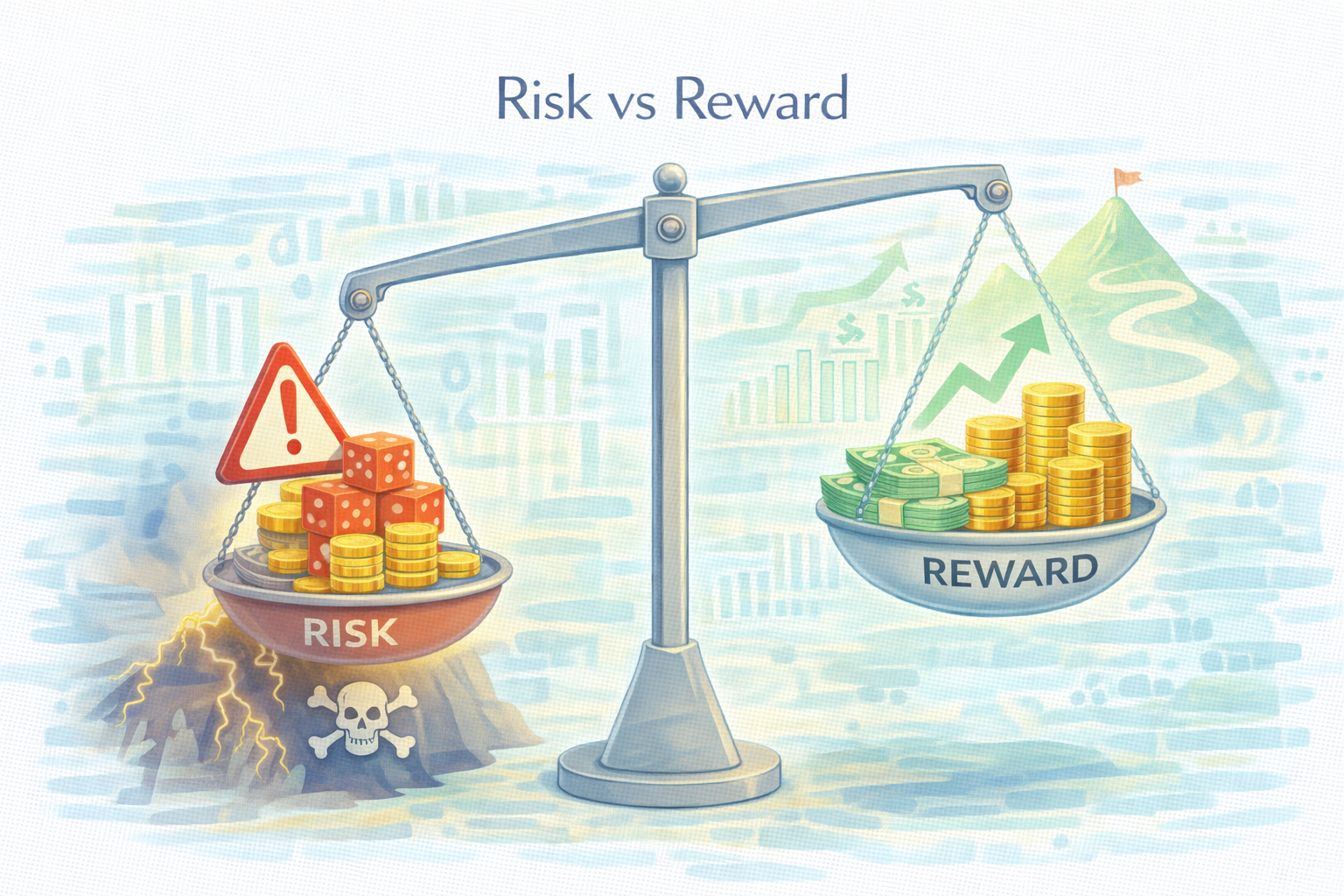
Risk vs Reward: Understanding the Trade-Off in Investing
Risk vs Reward: The Balancing Act Every Investor Faces
Why Higher Returns Come with Higher Risks
Investing Smart: Managing the Risk-Reward Trade-Off
No Risk, No Reward? Understanding Investment Choices
Table of Contents:
- Introduction
- Risk and Reward: What It Really Means
- The Risk-Reward Trade-Off Explained
- Real-World Examples of Risk vs Reward
- What Really Shapes Our Investment Decisions?
- Practical Steps to Balance Risk and Reward
- Conclusion
Introduction
Every investor dreams of high returns — but nobody wants to lose money. The truth is, in investing, risk and reward go hand in hand. Understanding how they work together is one of the most important lessons for building long-term wealth.
If you want safe investments, you may have to accept smaller returns. If you want higher returns, you must be willing to take on more risk. The key is finding the right balance for your goals, time horizon, and comfort level.
Risk and Reward: What It Really Means
When people talk about investing, you’ll often hear the phrase “risk and reward.” But what does it actually mean in real life?
Risk is the chance that your investment could lose value. For example, if you buy stock in a company and that company struggles, the stock price may fall — and you could lose money.
Reward is the potential profit you could earn. In general, the bigger the risk, the bigger the possible reward — though nothing is guaranteed.
Here’s a simple way to see the trade-off:
- If you invest $1,000 in government bonds, you’ll probably earn a safe but small return of around 2–3% a year. Low risk, low reward.
- If you put that same $1,000 into stocks or cryptocurrencies, you could make much higher profits… or lose a large portion of it.
At the end of the day, investing is about finding the right balance — the level of risk and reward that matches your personal goals and comfort.
The Risk–Reward Trade-Off
At the core of investing is a simple truth: bigger rewards usually come with bigger risks. There’s really no way around it.
Savings accounts or government bonds → Safe and predictable, but the returns are small.
Diversified mutual funds → A middle ground. Your money can grow steadily because the risk is spread across many investments.
Cryptocurrencies, speculative trades, or start-ups → High risk, high reward. You could strike it rich… or lose a big chunk quickly.
That’s why there’s no single strategy that works for everyone. A 25-year-old at the start of a career might accept more risk to build wealth over decades. But a 60-year-old nearing retirement usually prefers safety and stability, protecting what they’ve already built.
Real-World Examples of Risk and Reward
Tesla (2020): The stock price sometimes jumped or dropped 10–12% in a single day. Traders who could handle that roller coaster made money fast — but they could also lose just as quickly.
Apple (2015–2025): An investor who simply bought shares and held them for a decade enjoyed steady growth and regular dividends. Here, patience turned risk into a long-term reward.
Emergency Savings: During the COVID-19 pandemic, families with a six-month emergency fund were far better prepared for sudden job losses or medical bills. Not exciting, maybe — but this low-risk safety net proved to be priceless when life got unpredictable.
What Really Shapes Our Investment Decisions?
When it comes to investing, there is no universal formula that works for everyone. Each of us brings our own goals, past experiences, and even emotions into the process, and these things heavily shape how we decide to use our money.
The type of investment you choose makes a big difference. Stocks, for example, can be exciting because they offer the possibility of significant gains, but they are also unpredictable and often move up and down like a rollercoaster. Bonds usually offer more stability, giving investors steady income and fewer surprises, which can feel more comfortable for those who value security. Then there’s cryptocurrency, which stands in its own category—highly unpredictable and definitely not for those who want peace of mind.
It’s not just about what you invest in, though. The environment around us matters, too. When the economy feels shaky, prices are rising quickly, or there’s political uncertainty, investors tend to become more cautious. In those times, safer options like gold or government bonds become more attractive because they are seen as reliable.
Another factor is time. If you’re investing for the long term, such as saving for retirement, you usually have the ability to ride out the market’s ups and downs. But if you need your money in the near future, safer and less volatile choices often make more sense. And of course, personality plays a role. Some people naturally accept risk and are willing to face possible losses in exchange for a chance at bigger gains. Others prefer a slow and steady path, even if that means missing out on higher returns.
At the end of the day, investing is deeply personal. The best decisions are not about finding a perfect, universal rule but about choosing what fits your situation, your goals, and your comfort level. Taking the time to understand what matters most to you is what should guide your investment journey.
The Psychology of Risk
We often like to believe our investment decisions are based purely on logic, but emotions play a huge role. Many people experience what’s called loss aversion: the pain of losing money feels stronger than the joy of making it. This can make us overly cautious, sometimes to the point where we avoid good opportunities. Another challenge is information overload. With so much advice, data, and news available, it’s easy to freeze up and avoid making any decision at all. And then there’s the fear of missing out—FOMO. Watching other people profit from a hot trend can push us to jump in without carefully weighing the risks.
Beyond Economics: The Human Side of Risk and Reward
Risk and reward aren’t just about numbers or money — they also touch on psychology and ethics. How much risk a person is willing to take often comes down to personality, upbringing, and even cultural values. For example, in Islamic finance, excessive speculation (gharar) and interest (riba) are discouraged. The idea is that making money should go hand in hand with responsibility and fairness, not just profit at any cost.
That’s why “halal investing” platforms have become so important. They give Muslims the chance to grow their wealth while staying true to their beliefs. It shows that risk and reward are not purely financial choices — they are also moral ones, shaped by who we are and what we value.
Tools That Help: Akinda.io
This is where tools like Akinda.io can make a difference. Akinda is designed to help investors make smarter choices by cutting through the noise and presenting information in a clear way. It provides SWOT analysis, which highlights a company’s strengths, weaknesses, opportunities, and threats. It also offers valuation models to determine whether a stock is fairly priced, along with a wide library of lessons and articles that support both beginners and experienced investors.
Imagine you’re considering buying a stock. Akinda’s SWOT analysis might reveal that the company has heavy debt, which is a weakness, but also has a strong expansion plan into new markets, which is an opportunity. By seeing both the risks and the potential, you can make a decision that feels balanced and right for you.
Here you can access the portfolios of Akinda.io.
Practical Steps to Balance Risk and Reward
So how do you actually apply the risk–reward idea in real life? The truth is, a few common-sense habits can make a big difference. One of the most important is to spread your money around. If you rely on a single asset—only stocks, or only cryptocurrency—you’re putting yourself in a vulnerable position. But when you have a mix of stocks, bonds, ETFs, and other instruments, you’re more balanced, and a downturn in one area doesn’t hurt you as much. It’s also important to think in years, not weeks. If you have a five- or ten-year plan, those daily or even monthly market swings won’t feel nearly as stressful. Time smooths out much of the volatility.
Another thing many people overlook is cost. Broker fees, taxes, and hidden charges may seem small, but over time they quietly eat into your profits. What really matters is your net return after those expenses are taken out.
Of course, no plan is complete without a safety net. Having an emergency fund means you don’t have to sell investments at the worst possible time just to pay your bills. That extra cushion gives you flexibility and peace of mind.
And finally, the smartest investors lean on data, not emotions. Tools like Akinda can help you make decisions based on actual numbers rather than gut feelings or hype. Following this kind of discipline won’t eliminate risk, but it will help you manage it in a way that keeps your financial journey on track.
Conclusion
Risk and reward are two sides of the same coin. You can’t have one without the other. But by understanding the trade-off, you can make smarter choices that fit your goals and comfort level.
Investing isn’t about eliminating risk — it’s about managing it wisely so that your rewards outweigh your risks over time.
📌: Take a look at your investments today. Are you taking on the right amount of risk for the rewards you want? If not, now is the time to adjust and build a balanced portfolio for your future.
References
- Bodie, Z., Kane, A., & Marcus, A. J. (2021). Investments. McGraw-Hill Education.
- Gitman, L. J., & Zutter, C. J. (2023). Principles of Managerial Finance. Pearson.
- Malkiel, B. G. (2019). A Random Walk Down Wall Street. W. W. Norton & Company.
- Markowitz, H. (1952). Portfolio Selection. The Journal of Finance, 7(1), 77–91.
- Investopedia. (2023). Risk and Return Basics. Retrieved from https://www.investopedia.com
- Akinda.io (2025). Investment Education Resources.
Keywords
risk vs reward, investment trade-off, risk tolerance, investment decisions, risk management, investing psychology, high risk high reward, low risk investments, portfolio diversification, safe vs risky assets, risk reward examples, Tesla stock risk, Apple stock reward, long-term investing, halal investing, ethical finance, Akinda investing tools