
- Investing Principles
The Rule of 72: How Long Will It Take to Double Your Money?
The Rule of 72: A Simple Shortcut to Grow Your Wealth
How Fast Can Your Money Double? The Rule of 72 Explained
The Power of Compounding: Understanding the Rule of 72
A Beginner’s Guide to the Rule of 72: Making Finance Simple
Table of Contents:
1. Introduction
2. What is the Rule of 72?
3. Why the Rule of 72 Matters
4. How It Works (with Examples)
5. Practical Applications in Everyday Life
6. Common Limitations to Keep in Mind
7. Simple Steps to Use the Rule in Your Finances
8. Conclusion
Abstract
Have you ever asked yourself: “How long will it take for my money to double?” The Rule of 72 gives a simple answer. Instead of using complicated formulas, this shortcut helps you quickly estimate how fast your savings or investments can grow.
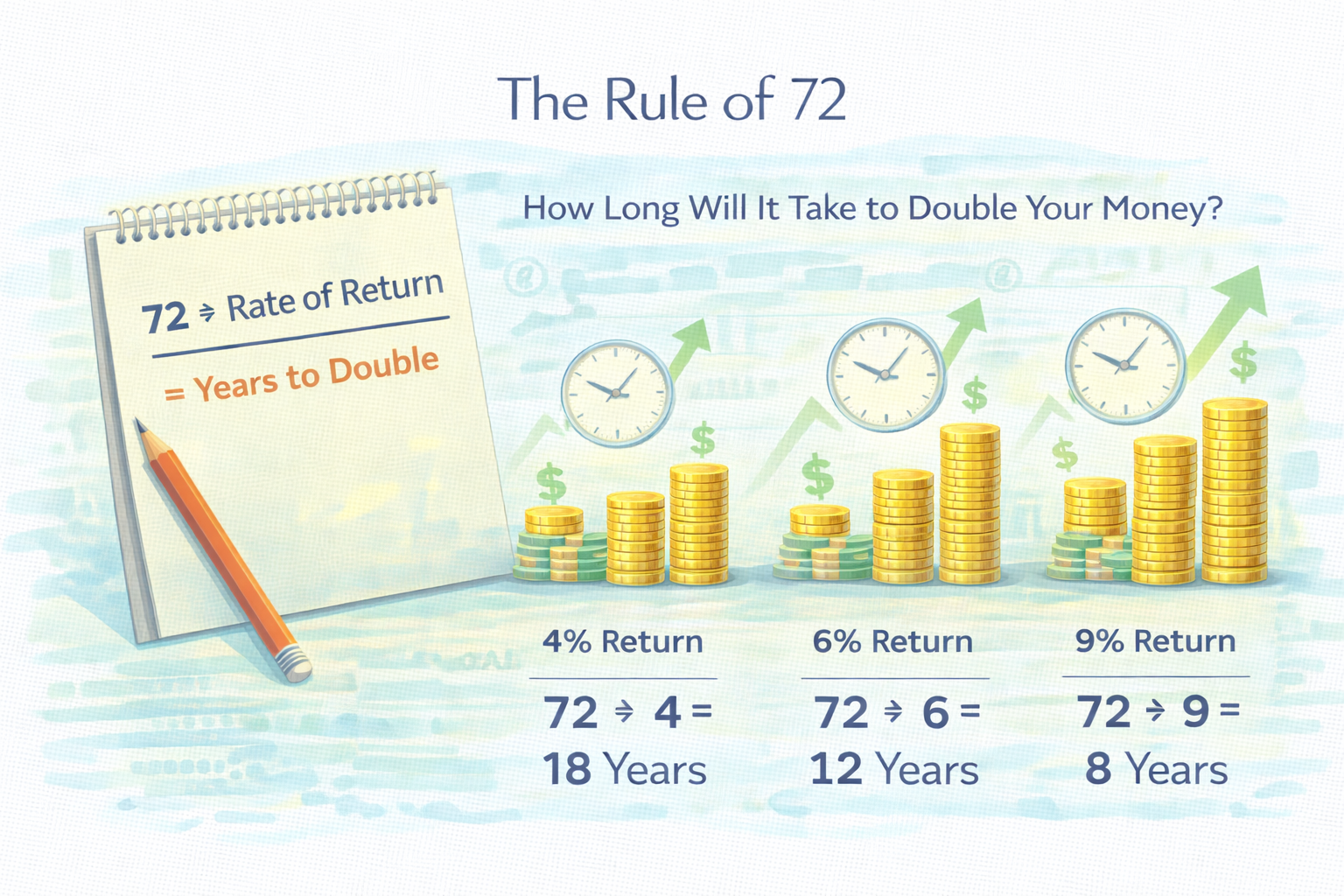
The idea is easy: take the number 72 and divide it by your annual rate of return — the result is the number of years it takes for your money to double. For example, at 6% interest, your savings would double in about 12 years.
While the Rule of 72 is not perfect, it’s powerful because it explains the effect of compounding in a way anyone can understand. That’s why investors, teachers, and financial planners still use it today. More than just a formula, it’s a practical tool that helps people compare opportunities, avoid unrealistic promises, and make smarter financial decisions.
Introduction
Have you ever heard someone promise: “I can double your money in just two years”? Sounds exciting, right? But is it realistic? The Rule of 72 is a simple mental shortcut that helps you check such claims. It’s not a complicated formula — it’s a quick way to understand how fast your savings or investments could double over time.
In personal finance, this rule is a classic because it makes the concept of compounding — earning interest on top of interest — easy to grasp.
What is the Rule of 72?
The Rule of 72 is a quick formula:
Years to double ≈ 72 ÷ Annual Return (%)
For example:
If your investment grows at 6% annually, it will double in about 12 years.
At 8%, your money doubles in 9 years.
At 12%, only about 6 years.
It’s not magic. It’s just a smart way to do fast calculations in your head.
Why 72?
You might be wondering, “Why the number 72?” It’s not random. The reason is simple: 72 gives fairly accurate results for interest rates that most people usually see — between 4% and 12%. On top of that, 72 is easy to work with because it’s divisible by many small numbers like 2, 3, 4, 6, 8, 9, and 12. This makes the mental math quick and practical.
Of course, the rule isn’t perfect, but it’s a great shortcut when you want a fast estimate without pulling out a calculator or doing complicated formulas.
Practical Use and Akinda.io’s Perspective
For Akinda.io, the Rule of 72 is more than a math trick — it’s a simple teaching tool that helps people understand how money grows.
Here’s how it looks in action:
At 5% growth, your money doubles in about 14 years.
At 10% growth, it doubles in just 7 years.
This side-by-side comparison shows how powerful higher returns can be. But it also reminds us that bigger rewards usually come with bigger risks.
That’s why Akinda.io uses the Rule of 72 in financial education — it helps people stay realistic, avoid falling for “get-rich-quick” promises, and make smarter investment choices.
Why the Rule of 72 Matters
1. Financial Awareness – It teaches you the real effect of growth rates. A higher return can dramatically shorten the time it takes to double your money.
2. “Gut Check” for Promises – If someone says you’ll double your money in two years, but the math doesn’t fit the Rule of 72, you know something’s fishy.
3. Empowers Beginners – It helps newcomers see the power of compounding without diving into advanced finance.
Beyond Numbers: The Psychological Value
The Rule of 72 isn’t just about numbers — it also has a psychological advantage. Unlike complex formulas, it’s easy to remember and practical to use. Imagine someone promises, “I can double your money in two years.” Before getting excited, you can quickly test the claim with the Rule of 72. If the math doesn’t add up, that’s your signal to be cautious.
When Is the Rule of 72 Most Useful?
Think about this: you’re talking with a friend about different savings accounts or investment options. Instead of reaching for a calculator, you use the Rule of 72. In just a few seconds, you can see how long it might take for your money to double.
It’s also a fantastic tool to teach beginners about the power of compounding. Seeing how money grows over time makes the concept click in a way that numbers alone can’t.
But Remember Its Limits
Of course, the Rule of 72 isn’t perfect. It doesn’t consider things like inflation, taxes, or fees — all of which reduce your real returns. Also, most investments don’t have fixed interest rates forever, and compounding more than once a year can throw off the estimate.
That’s why the Rule of 72 should be seen as a quick shortcut — not a replacement for detailed financial planning. Use it for quick comparisons or everyday conversations, but for big money decisions, it’s always worth doing the exact math.
How It Works (with Examples)
At 4% interest → 72 ÷ 4 = 18 years (actual: ~17.7 years).
At 8% interest → 72 ÷ 8 = 9 years (almost exact).
At 20% return → 72 ÷ 20 = 3.6 years (real math: ~3.8 years).
Pretty close, right? That’s why financial planners still use it after decades.
Here you can easily calculate return of your investment.
Practical Applications in Everyday Life
Savings Accounts: If your bank pays just 1% interest, doubling takes 72 years! A clear sign that investing is more powerful than just saving.
Investments: At 10%, your money doubles in about 7 years. Imagine investing consistently over decades — the growth becomes massive.
Decision Making: Helps you quickly compare options — should you keep money in a bond, or invest in a stock portfolio?
Common Limitations
Works best between 4% and 12% growth rates.
Assumes annual compounding (not monthly or daily).
Doesn’t account for taxes, inflation, or fees.
Markets aren’t fixed — rates of return can change.
Simple Steps to Use the Rule in Your Finances
1. Check Your Investments – Calculate how long your current savings or investments might take to double.
2. Compare Options – Use it when choosing between bank deposits, bonds, stocks, or funds.
3. Set Realistic Goals – Understand that higher returns mean higher risks.
4. Stay Consistent – Small, regular investments still benefit massively from compounding over time.
Conclusion
The Rule of 72 is more than just a math trick — it’s a financial compass. It shows you how time and growth rates shape your future wealth.
While not perfect, it’s a practical tool for anyone who wants to think smarter about money. Next time someone promises “quick riches,” do the Rule of 72 check in your head — it’ll tell you if the claim makes sense.
Start small, stay consistent, and let compounding do the heavy lifting.
References
- Akinda.io (2025). Investment Education Resources. https://Akinda.io
- Malkiel, B. G. (2019). A Random Walk Down Wall Street. W. W. Norton & Company.
- Bodie, Z., Kane, A., & Marcus, A. J. (2021). Investments. McGraw-Hill Education.
- Investopedia (2023). Rule of 72 Explained.
🔑 Keywords: how to double your money, investing basics, compounding interest explained, financial shortcuts, beginner investing tips, simple investing rules, power of compounding, time to double investment, practical finance tools, financial literacy for beginners, quick investment calculation