
- Building with Akinda
- Stock Market & Equities
Top 5 Islamic Finance Books 2026
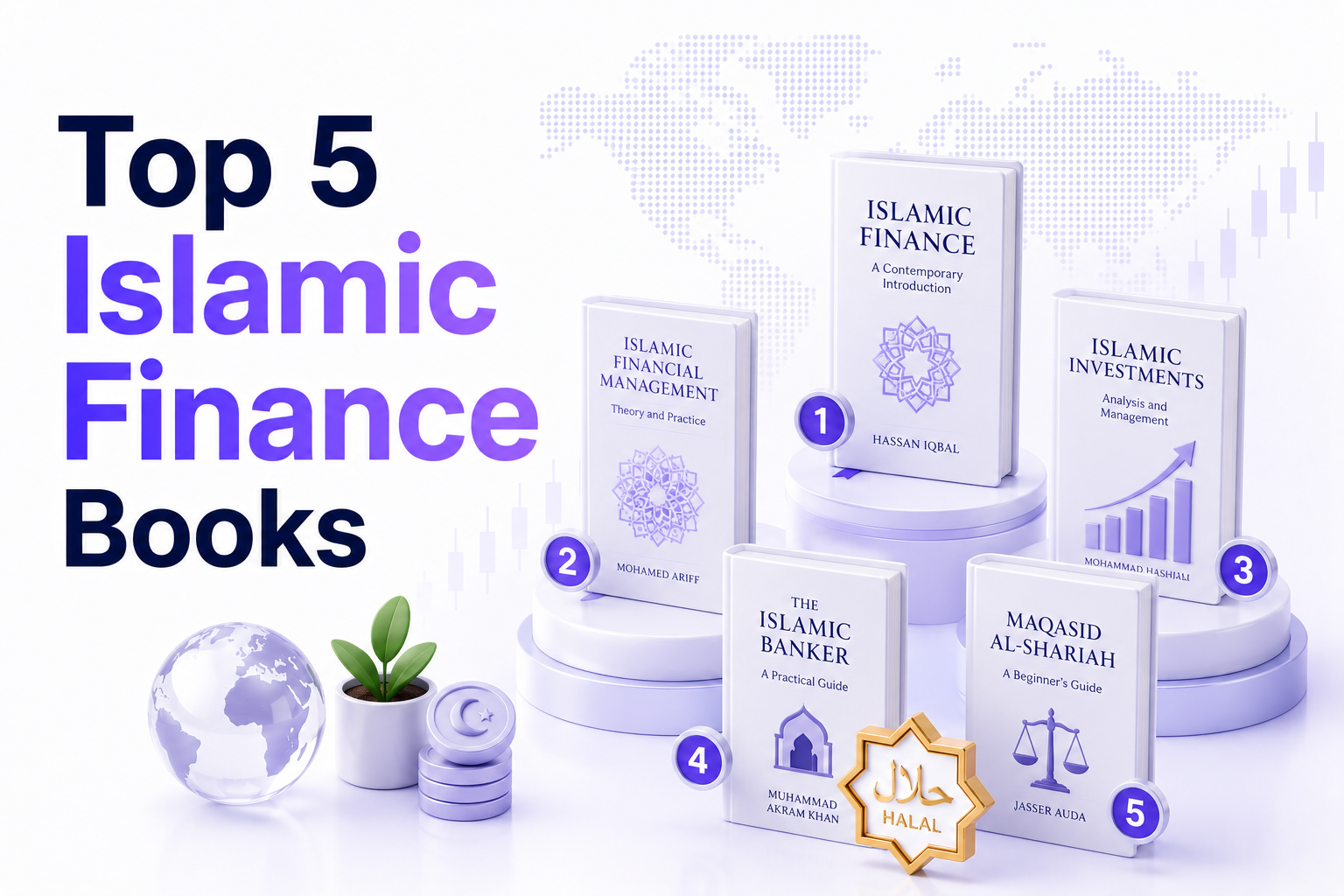
Islamic finance is a field where a handful of well-chosen books can take you from complete newcomer to genuinely informed. The best titles have aged well, the core principles, riba, gharar, risk-sharing, the contract structures, don't change with the news cycle, so a 2026 reading list is less about what was published this year and more about which books remain the clearest, most authoritative guides. This list gathers the five Islamic finance books worth your time in 2026, spanning a leading scholar's classic, comprehensive textbooks, a rigorous critical analysis, and an accessible insider narrative.
Quick Answer The top 5 Islamic finance books to read in 2026 are: An Introduction to Islamic Finance by Mufti Muhammad Taqi Usmani, Understanding Islamic Finance by Muhammad Ayub, Islamic Finance: Law, Economics, and Practice by Mahmoud El-Gamal, An Introduction to Islamic Finance: Theory and Practice by Zamir Iqbal and Abbas Mirakhor, and Heaven's Bankers by Harris Irfan. Together they cover the principles, contracts, economics, and real-world practice of the field. |
By the numbers (2026) Why it's worth learning: global Islamic finance assets are ~$5.1 trillion in 2026, projected to reach ~$8.46 trillion by 2031 (Mordor Intelligence). |
Table of Contents
- How we chose these books
- 1. An Introduction to Islamic Finance, Mufti Taqi Usmani
- 2. Understanding Islamic Finance, Muhammad Ayub
- 3. Islamic Finance: Law, Economics, and Practice, Mahmoud El-Gamal
- 4. An Introduction to Islamic Finance: Theory and Practice, Iqbal & Mirakhor
- 5. Heaven's Bankers, Harris Irfan
- Put your learning into practice
How we chose these books
A good Islamic finance reading list balances authority with accessibility. We prioritised books that are widely used in university and professional programmes, written by recognised scholars or practitioners, and still accurate on the fundamentals in 2026. We also aimed for range: a foundational scholarly text, comprehensive reference textbooks, a critical academic analysis, and a narrative account for readers who prefer story to structure. Start wherever your background fits, then work outward.
1. An Introduction to Islamic Finance, Mufti Taqi Usmani
If you read one book on this list, make it this one. Written by Justice Mufti Muhammad Taqi Usmani, a leading contemporary scholar who has chaired numerous Shariah supervisory boards and the AAOIFI Shari'ah Standards Council, it clearly delineates what separates Islamic practice from conventional, interest-based finance. Usmani walks through the main modes of financing used by Islamic banks, murabaha, ijarah, musharakah, and others, explaining the Shariah requirements for each and the practical problems that arise in applying them. It's authoritative without being impenetrable, which is why it remains the standard entry point to the field.
2. Understanding Islamic Finance, Muhammad Ayub
Muhammad Ayub's Wiley textbook is the comprehensive reference many students and practitioners keep on their desks. Drawing on Ayub's long career in Shariah compliance and Islamic banking regulation, it provides an in-depth background to the subject and clear descriptions of all the major products and processes, from the underlying economic principles to the mechanics of specific contracts. It's more of a thorough textbook than a weekend read, but if you want a single volume that covers the whole landscape systematically, this is it.
3. Islamic Finance: Law, Economics, and Practice, Mahmoud El-Gamal
For readers who want rigour and a critical eye, Mahmoud El-Gamal's book is essential. A renowned economist, El-Gamal analyses the legal, economic, and practical dimensions of Islamic finance and, unusually, doesn't shy away from its controversies, including the interpretation of Shariah rulings, the role of Shariah boards, and the risk of what he calls Shariah arbitrage. It's more analytical and forward-looking than the textbooks above, making it the best choice for anyone who wants to think critically about where the industry succeeds and where it falls short.
4. An Introduction to Islamic Finance: Theory and Practice, Iqbal & Mirakhor
Zamir Iqbal and Abbas Mirakhor's book is the balanced overview many instructors recommend as a starting point. It blends theoretical foundations with practical application, tracing the historical evolution of Islamic finance and explaining the core prohibitions, riba (interest), gharar (excessive uncertainty), and maysir (gambling), before moving through the various Islamic financial instruments and institutions. Accessible to newcomers yet substantial enough for those with some finance background, it pairs well with Usmani's book as a first one-two introduction to the field.
5. Heaven's Bankers, Harris Irfan
Not every great finance book is a textbook. Harris Irfan, a former global head of Islamic finance at Barclays and co-founder of Deutsche Bank's Islamic finance team, wrote Heaven's Bankers as an insider's narrative of the industry, its landmark deals, its personalities, and its unresolved tension between principle and practice. The Financial Times called it a superb introduction to the subject, and it reads more like a story than an economic treatise. It's the book to hand someone who's curious about Islamic finance but would never pick up a textbook.
Which book should you read first?
If you're building a reading path, start accessible and go deeper. Begin with Usmani's introduction for the principles, add Iqbal and Mirakhor for a broader overview, then move to Ayub's textbook for comprehensive reference and El-Gamal for critical depth. Read Heaven's Bankers whenever you want the human story rather than the theory. This table sums up where each fits:
| Book | Level | Best for |
|---|---|---|
| An Introduction to Islamic Finance (Usmani) | Beginner | The authoritative starting point |
| An Introduction: Theory and Practice (Iqbal & Mirakhor) | Beginner–Intermediate | A balanced overview |
| Understanding Islamic Finance (Ayub) | Intermediate | A comprehensive reference |
| Islamic Finance: Law, Economics & Practice (El-Gamal) | Advanced | Critical, analytical depth |
| Heaven's Bankers (Irfan) | All levels | An accessible industry narrative |
Where to find these books
- An Introduction to Islamic Finance - Mufti Muhammad Taqi Usmani
- Understanding Islamic Finance - Muhammad Ayub (Wiley)
- Islamic Finance: Law, Economics, and Practice - Mahmoud El-Gamal (Cambridge University Press)
- An Introduction to Islamic Finance: Theory and Practice - Zamir Iqbal & Abbas Mirakhor (Wiley)
- Heaven's Bankers - Harris Irfan
Put your learning into practice
Reading builds the foundation; applying it makes it stick. The principles these books describe - the business and financial screens, the treatment of interest, purification - are exactly what a modern Shariah screening tool automates. You can see them applied in Akinda's published screening methodology, a documented, AAOIFI-based screen overseen by a qualified Shariah advisor, and try the screening yourself on Akinda's halal stock screener. For a plain-language explainer of the standard these books discuss, see Akinda's guide to AAOIFI screening, and for developers or institutions building compliant products, the Akinda Halal API turns the same methodology into a data layer.
Frequently asked questions
What is the best book to start with in Islamic finance?
An Introduction to Islamic Finance by Mufti Taqi Usmani is the most widely recommended starting point. It explains the key differences between Islamic and conventional finance and the main modes of financing in clear, authoritative terms. Pair it with Iqbal and Mirakhor's Theory and Practice for a fuller theoretical grounding before moving to the more comprehensive textbooks.
Are these Islamic finance books suitable for beginners?
Several are. Usmani's introduction and Iqbal and Mirakhor's overview are accessible to newcomers, and Heaven's Bankers is a narrative anyone can enjoy. Ayub's textbook and El-Gamal's critical analysis are more substantial and are best tackled once you have the basics, though motivated beginners will still get a lot from them.
Do I need a finance background to read them?
Not for all of them. The introductory titles and Heaven's Bankers assume little prior knowledge and define their terms as they go. A finance background helps with Ayub's comprehensive textbook and El-Gamal's economic analysis, but it isn't essential; the books are written to teach the field, not to assume it.
Are older Islamic finance books still relevant in 2026?
Yes. The core principles of Islamic finance, the prohibition of riba, the emphasis on risk-sharing and asset-backing, the contract structures, are stable, so foundational texts remain accurate. What changes is the market and the products, which is why pairing these books with a current screening tool and up-to-date resources gives you both the timeless principles and the present-day application.
What's the difference between Islamic finance and halal investing books?
Islamic finance books, like those on this list, explain the whole system: banking, contracts, capital markets, and the economics behind them. Halal investing books are narrower and more practical, focused on helping an individual build a Shariah-compliant portfolio. If your goal is to invest your own money, a halal investing guide is the faster route; if you want to understand the field as a whole, start here.
Sources
AAOIFI Shari'ah Standard No. 21: Financial Paper (Shares and Bonds) – the standard the Akinda API's screening methodology is built around.
Akinda API screening methodology – the full three-phase screen, ratio formulas, and purification rule, published for integrators to audit.
Akinda API Shariah advisor – the scholar governance behind the API's halal verdicts.
Mordor Intelligence – Global Islamic Finance Market (2026) – Islamic finance market size and growth projections.
Build with the Akinda Halal API The developer-grade API for AAOIFI-based Shariah stock screening. Start on the free tier, scale when you ship. 📚 Docs: b2b.akinda.io/developer/docs 💳 Pricing: b2b.akinda.io/pricing 🔑 Get a key: b2b.akinda.io/dashboard |
Disclaimer
This article is about a software product and is for general information only. It is not financial or religious advice. Automated Shariah screening produces data-driven signals, not a fatwa; integrators should pair it with their own Shariah governance and consult qualified scholars. API features, endpoints, coverage, and pricing change over time, so verify current details on b2b.akinda.io before building.