
- Stock Market & Equities
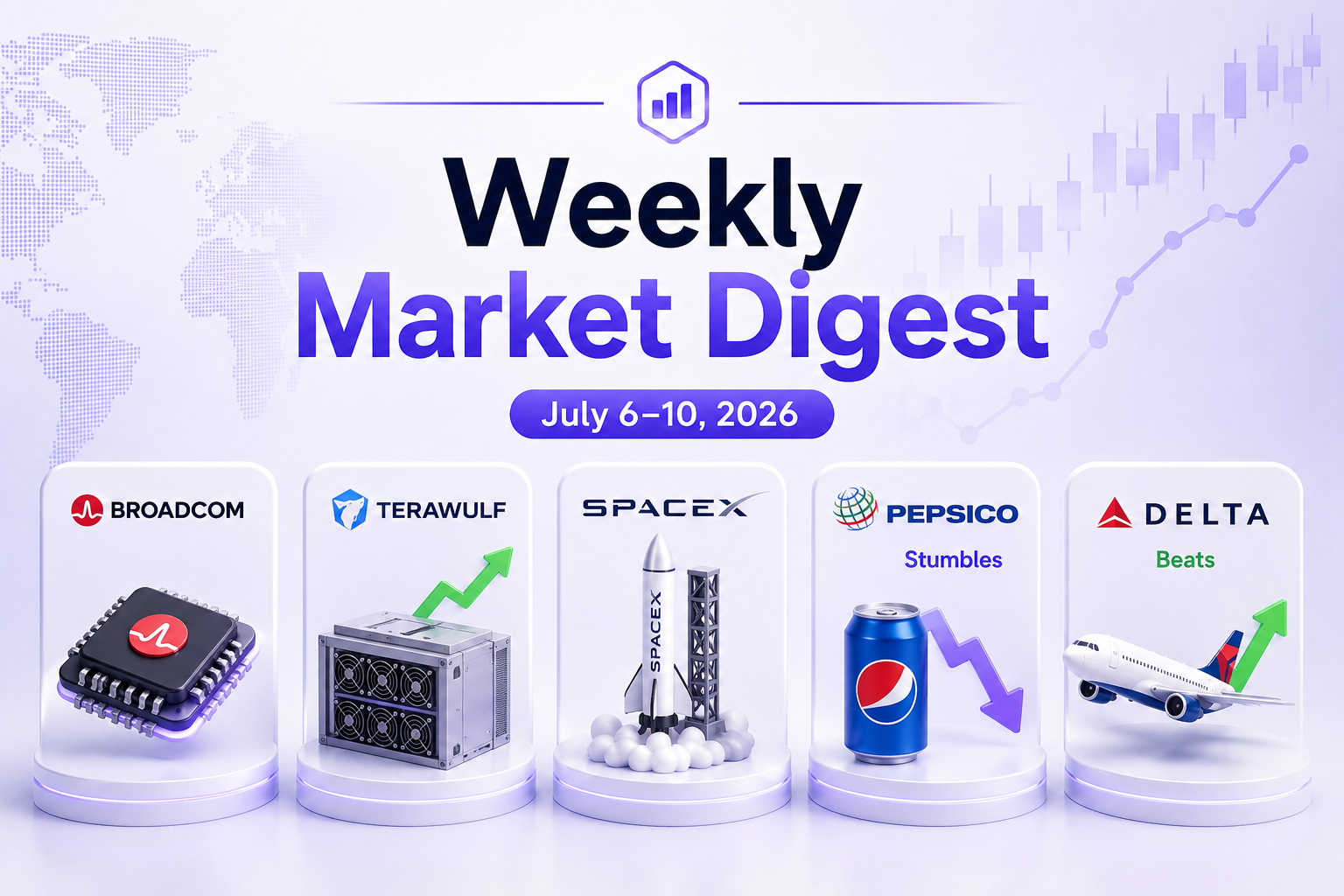
Weekly Market Digest (July 6–10, 2026): Record Highs, an AI-Chip Whipsaw, and a Divided Fed
Introduction
Wall Street came back from the Independence Day break at record highs and spent the week testing whether the AI trade could keep carrying the market. It could not do it in a straight line. The Dow closed above 53,000 for the first time on Monday, chip stocks sold off hard on Tuesday, the Fed's first meeting minutes under new Chair Kevin Warsh landed on Wednesday and revealed a committee openly split on rate hikes, and by Friday the focus had swung to the start of Q2 earnings season, with PepsiCo stumbling and Delta beating and raising its dividend. Underneath all of it, the Iran conflict flared back to life around the Strait of Hormuz, putting a floor under oil even as demand forecasts softened.
This was a dense week, so we move through it chronologically, with every figure linked to where it was reported, and close with what it means for a halal portfolio.
Quick Answer
| Over July 6-10, 2026, U.S. stocks finished modestly higher after a volatile week. The Dow set a record above 53,000 on Monday, semiconductors whipsawed midweek, and the Fed's June minutes showed officials divided between rate cuts and hikes. PepsiCo missed slightly on earnings; Delta beat and lifted its dividend 15%. For halal investors, the permissible movers sat in tech hardware, consumer staples, and travel, while the record-setting index leaned partly on interest-based financials that fail Shariah screening. |
Table of Contents
- Introduction
- The Week in One Picture
- Dow Tops 53,000; Broadcom, TeraWulf, and SpaceX Lead the AI Story
- Chips Sell Off and Oil Jumps as Iran Tensions Return
- Warsh's First FOMC Minutes: A Committee Openly Split
- Earnings Season Opens: PepsiCo Stumbles, Chips Rebound
- Delta Beats and Raises Its Dividend; Oil Ends a Bumpy Week
- FAQ
- Sources
The Week in One Picture
Markets spent the week rotating rather than trending. Monday was risk-on: per The Motley Fool's market wrap, the S&P 500 rose about 0.7% to around 7,538 and the Nasdaq Composite climbed 1.1% to roughly 26,121, while the Dow pushed above 53,000 for the first time. Tuesday reversed much of it as chipmakers slid and the Dow closed down 0.25% at 52,925. By Thursday the AI trade had steadied again, with the Nasdaq up 1.3% to 26,206.89 and the S&P 500 up 0.8% to 7,543.64, and Friday drifted to a quiet finish.
Oil was the week's second storyline. Fresh attacks around the Strait of Hormuz and a revoked U.S. license on Iranian oil sales pushed crude higher midweek, though by Friday Brent sat near $77 and U.S. crude near $73, still far below the wartime peak close to $120. For halal investors, the headline takeaway is that the market's leadership narrowed to a handful of AI names while a geopolitical energy risk quietly rebuilt in the background.
Dow Tops 53,000; Broadcom, TeraWulf, and SpaceX Lead the AI Story
The week opened with a broad rally as traders returned from the holiday weekend. The Motley Fool reported the S&P 500 closing up 0.74% at about 7,538 and the Nasdaq up 1.12% at 26,121, with the Dow clearing 53,000 for the first time. Semiconductors led, and three corporate stories set the tone.
First, chip and AI-infrastructure names surged. TeraWulf was among the day's biggest movers after it announced a 20-year lease with Anthropic for an AI data-center campus in Hawesville, Kentucky, expected to generate roughly $19 billion in contracted revenue over the initial term. CNBC reported the stock jumped sharply on the news as the former bitcoin miner leaned further into AI infrastructure. Broadcom also gained after extending its custom-chip partnership with Apple through 2031.
Second, SpaceX completed its entry into the Nasdaq-100 just 15 trading days after its record IPO, per IBTimes, the fastest such inclusion in the index's history, drawing fresh demand from index-tracking funds.
Why this matters: The day's leaders were concentrated in AI hardware and infrastructure, sectors that usually clear the Shariah business-activity screen because their core work is technology, not interest-based finance. That makes them a natural home for halal portfolios. The caution is concentration: when a record index is driven by a narrow set of names, a swing in that group moves the whole market, and screening ratios that are measured against market capitalisation can shift quickly after big price moves. SpaceX remains a screening question mark for many halal investors given its mixed business lines, so its index inclusion is a reason to check exposure through passive funds, not an automatic green light.
Chips Sell Off and Oil Jumps as Iran Tensions Return
Tuesday flipped the mood. CNBC reported the Dow fell 0.25% to 52,925.15, the S&P 500 slipped 0.45% to 7,503.85, and the Nasdaq dropped 1.16% to 25,818.69 as investors rotated out of AI-linked chip names. Micron fell about 4.7%, with KLA, Marvell, Broadcom, and AMD also lower, and the VanEck Semiconductor ETF slid more than 3%. The selling started overseas, where South Korea's Kospi dropped nearly 5% after Samsung fell about 7% despite a jump in quarterly profit, as spending and demand worries overshadowed the beat.
Oil added pressure. After Iran attacked a tanker near the Strait of Hormuz and the U.S. Treasury moved to revoke the license permitting Iranian oil sales, Brent crude settled up about 3% near $74 a barrel, reversing part of the peace-driven decline from earlier weeks. SpaceX, meanwhile, briefly slid toward its $135 IPO price on a legal dispute tied to a data center.
Why this matters: Two lessons for halal investors sit in this one session. First, valuation risk is real even in permissible sectors: chip stocks are Shariah-friendly on activity, but a business that is halal to own can still be expensive to buy, and a 3–5% single-day drop shows how fast sentiment turns. Second, the return of Iran tensions is a reminder that the energy risk premium never fully left. Rising oil feeds inflation, which keeps rate pressure alive, which in turn weighs hardest on the most leveraged companies, exactly the names most likely to fail the AAOIFI debt screen.
Warsh's First FOMC Minutes: A Committee Openly Split
Wednesday was the macro pivot. At 2 p.m. ET the Federal Reserve released the minutes of its June 16–17 meeting, the first under new Chair Kevin Warsh. The committee had held rates at 3.50–3.75% unanimously, but the minutes revealed a body far from settled underneath that clean vote.
A few officials made a case for raising rates immediately before ultimately supporting the hold, according to CNBC's coverage, which described Warsh characterising the debate as a "family fight" over policy direction. The minutes showed the committee split roughly down the middle on where rates end 2026: some participants judged the appropriate rate would sit within or slightly below the current range, while many others thought it would end up above today's level. Per Yahoo Finance, Fed staff raised their 2026 and 2027 inflation forecasts, citing the Middle East war and the effects of the AI build-out, and nine of 18 policymakers now expected rates to be slightly higher by year end.
True to Warsh's stated dislike of forward guidance, the minutes offered little on the path ahead, noting decisions would depend on "incoming information," and a majority of participants favoured shortening the policy statement and dropping earlier easing-bias language. Broadcom and Apple's roughly $30 billion chip agreement also landed midweek, lifting Broadcom, though the broader market ended the session mixed.
Why this matters: A Fed that removes forward guidance changes how every investor has to operate. For over a decade, markets priced assets partly off what the Fed signalled next. Warsh's approach forces pure data-dependency: each inflation and jobs report now carries more weight, because there is no dot-plot narrative to lean on. For halal investors, the practical read is that inflation may prove stickier than hoped, especially with AI-driven demand and energy costs cited directly in the minutes. Rate-sensitive holdings, from real estate exposure to highly leveraged businesses, face a higher bar, and the next FOMC meeting on July 28–29 becomes the event to watch.
Earnings Season Opens: PepsiCo Stumbles, Chips Rebound
Thursday unofficially opened Q2 earnings season, and consumer names went first. PepsiCo reported adjusted earnings of $2.20 per share, a penny short of the $2.21 expected, even as revenue came in slightly ahead. The company pointed to moderating U.S. food and beverage demand as consumer budgets tightened, partly due to rising gas prices, and shares slipped around 1%. Levi Strauss fell more than 4% despite beating on both lines, as its forward guidance disappointed.
The AI trade, though, came back to life. Per CNBC, the Nasdaq rose 1.3% to 26,206.89 and the S&P 500 gained 0.8% to 7,543.64, led by a 2.5% jump in the VanEck Semiconductor ETF and a 4.5% gain in Micron. Demand for SK Hynix's U.S. share offering, reported as more than seven times oversubscribed, helped restore confidence in memory-chip names. On the economy, jobless claims came in subdued while fresh overnight strikes around the Strait of Hormuz kept the market watchful without triggering a full risk-off move.
Why this matters: PepsiCo's soft U.S. demand and Levi's guidance caution paint an early picture of a stretched consumer, useful context for any halal investor holding consumer-staples or discretionary names. Food, beverage, and apparel are permissible business lines, but a specific stock still has to clear the full financial screen, and softening demand can pressure the very margins that keep a balance sheet within the AAOIFI limits. The chip rebound, meanwhile, shows how quickly a Shariah-friendly sector can swing on sentiment, reinforcing that permissibility and timing are two separate questions.
Delta Beats and Raises Its Dividend; Oil Ends a Bumpy Week
The week closed with the first major airline report. Delta Air Lines posted adjusted earnings of $1.56 per share on $17.67 billion in revenue, beating estimates, and announced a 15% dividend increase while affirming full-year adjusted EPS guidance of $6.50 to $7.50. CEO Ed Bastian pointed to strong premium-cabin demand in a "K-shaped" economy and said pricing power should hold even as fuel prices ease. The stock still slipped about 1.6% on the day, per the Associated Press, as the airline noted it spent more on fuel than in any quarter in its history.
Oil ended the week where it had spent most of it, choppy. The AP reported Brent near $77 and U.S. crude near $73 as tankers kept crossing the Strait of Hormuz despite renewed attacks, while the International Energy Agency projected 2026 would end with the first annual drop in oil demand since the pandemic. U.S. stocks drifted to a quiet finish, with the S&P 500 on track for its fourth winning week in five.
Why this matters: Delta is a clean case study in two-stage screening. Air travel is a permissible activity, so the business passes the first test, and strong premium demand is a genuine positive. But an airline's balance sheet is the deciding factor: aircraft financing and leases can push interest-bearing debt above the 30% AAOIFI threshold, so a dividend increase, welcome as it is, does not by itself make the stock halal. Returns should be understood as a share of real business profit, and any small slice of income from impermissible sources should be purified. Verify Delta's current ratios before treating it as portfolio-ready.
What This Week Means for Halal Investors
Four honest takeaways from a week of records and reversals:
- Record highs are not automatically halal opportunities. Part of the Dow's strength came from interest-based financials that fail the Shariah business screen. Isolating the permissible movers, tech hardware, staples, and travel, matters more than tracking the headline index.
- Permissibility and timing are separate questions. Semiconductors are Shariah-friendly on activity, but this week's 3–5% swings show a halal-to-own business can still be volatile and richly valued. Screen the business first, then decide on the entry.
- The Fed just made data the whole story. With forward guidance stripped out and the committee split, every inflation and jobs print now moves markets more. That raises the stakes for rate-sensitive and leveraged names, the ones most likely to breach the AAOIFI debt limit.
- The energy premium is back, quietly. Renewed Strait of Hormuz tensions put a floor under oil even as demand forecasts soften. Energy-linked inflation is worth watching over the next two months, since it feeds directly into the rate outlook.
A quick reminder of the screen these takeaways lean on. Akinda screens to the AAOIFI Shari'ah Standard No. 21, the same framework behind major Islamic indices such as the S&P Dow Jones Islamic Market Indices. A stock must pass a business-activity screen (no interest-based finance, alcohol, pork, gambling, tobacco, weapons, or adult content) and a financial screen, commonly summarised as the 30/30/5 rule: interest-bearing debt under 30% of market cap, interest-earning investments under 30% of market cap, and non-permissible income under 5% of revenue. Any income from impermissible sources should be purified.
FAQ
Was this week's record Dow driven by halal-compliant stocks?
Only partly. The Dow's record close above 53,000 drew on a mix of sectors, including interest-based financials that generally fail Shariah screening. Halal investors gain more from isolating the permissible movers, such as technology hardware, consumer staples, and travel, than from tracking the headline index itself.
Are semiconductor stocks halal?
Semiconductor and chip-hardware companies usually pass the Shariah business-activity screen because their core work is technology, not interest-based finance. Each specific stock must still clear the financial-ratio screen, and because those ratios are measured against market capitalisation, sharp price swings like this week's can change the outcome, so they are worth re-checking after big moves.
Is Delta Air Lines halal after its dividend increase?
Air travel is a permissible activity, so Delta passes the business screen, but a dividend increase does not by itself make a stock halal. Airlines often carry heavy interest-bearing debt from aircraft financing, which can breach the 30% AAOIFI threshold. Whether Delta is halal depends on its current financial ratios, which should be verified before investing.
How do rising interest rates affect a halal portfolio?
Higher rates pressure the most leveraged companies, which are also the ones most likely to fail the Shariah debt screen. With the Fed now data-dependent and openly split, inflation and jobs data carry more weight for rate-sensitive holdings. Halal investors who favour lower-debt businesses are, by the nature of the screen, somewhat insulated from that pressure.
What is the 30/30/5 rule in halal investing?
It is shorthand for the AAOIFI Standard 21 financial screen. Interest-bearing debt must not exceed 30% of market capitalisation, interest-earning or non-compliant investments must not exceed 30% of market capitalisation, and non-permissible income must not exceed 5% of total revenue. A stock that breaches any one of these fails the screen.
Sources
- The Motley Fool - Stock Market Today, July 6, 2026 (TeraWulf, index levels)
- TeraWulf - Anthropic lease press release, July 6, 2026
- CNBC - Anthropic–TeraWulf data center lease
- IBTimes - SpaceX Nasdaq-100 entry
- CNBC - Stock market coverage, July 7 (chip selloff, oil)
- Federal Reserve - FOMC minutes, June 16–17 2026 (released July 8)
- CNBC - Fed minutes analysis, July 8, 2026
- Yahoo Finance - Fed officials' rate-hike case
- CNBC - Stock market coverage, July 8–9 (PepsiCo, chip rebound)
- Charles Schwab - Market update, July 9, 2026
- CNBC - Delta Air Lines Q2 2026 earnings
- SEC / Delta - June Quarter 2026 8-K
- Associated Press (US News) - Friday market and oil wrap, July 10
- AAOIFI - Shari'ah Standards
- S&P Dow Jones Islamic Market Indices
Disclaimer: This digest is for educational purposes only and is not financial or religious advice. Market data reflects reporting for the week of July 6–10, 2026 and may change. Automated Shariah screening is a starting point and does not replace the judgment of a qualified scholar. Always verify a stock's current financial ratios before investing.