
- Stock Market & Equities
Weekly Market Digest (June 8–12, 2026): The Iran Whiplash Week, a 4.2% CPI Print, and the Largest IPO in History
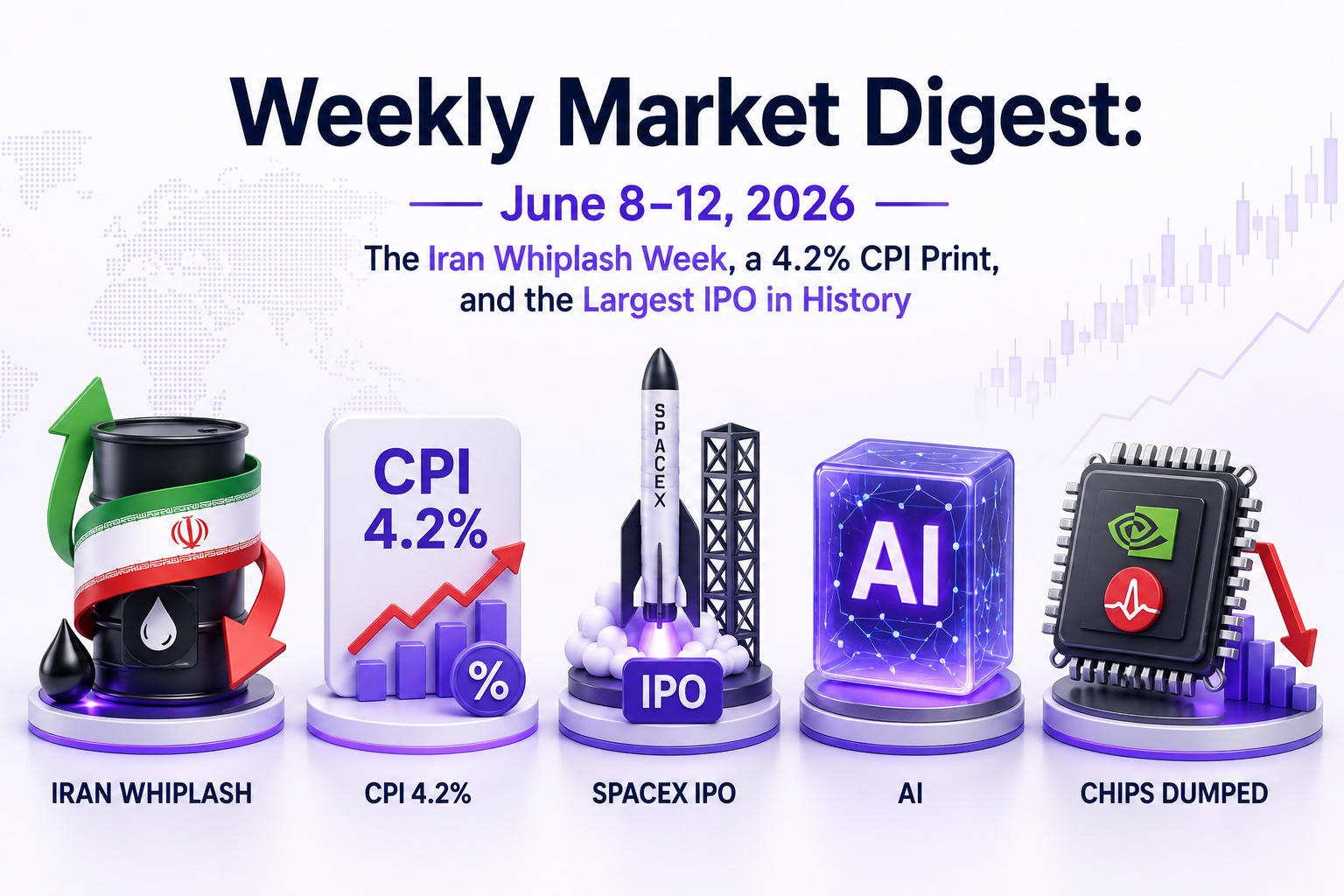
Markets swung wildly this week as inflation hit 4.2%, the ECB raised rates, and SpaceX launched the largest IPO in history. Here's what halal investors need to know.
Table of Contents
- Introduction
- The Week in One Picture
- Marvell Joins the S&P 500, Iran Pauses Strikes on Israel
- Markets Plummet on Renewed Strike Threats
- A 900-Point Dow Drop and a 4.2% CPI Print
- The ECB Hikes, Trump Signals a Deal Is Close
- SpaceX's Record Debut Caps the Week
- FAQ
Introduction
If the first week of June asked whether the market's records made sense, the second week answered with a five-day mood swing that touched almost every part of that question at once. A 900-point Dow drop. A 4.2% inflation print - the highest in over three years. A surprise rate hike from the European Central Bank. And, on Friday, the largest IPO in stock market history, debuting into a market that had spent the week trying to figure out whether the U.S. and Iran were about to sign a peace deal or escalate further.
This week was a reminder that headlines and price action do not always move in the direction you'd expect. We'll walk through the week day by day, with every figure linked to its source, and close with what it might mean for a halal portfolio.
The Week in One Picture
The week was bookended by extremes. It opened with markets attempting to recover from the prior Friday's selloff, and it closed with the S&P 500 at 7,431.46, the Nasdaq Composite at 25,888.84, and the Dow Jones Industrial Average at 51,202.26, according to CNBC's Friday market wrap. That S&P 500 level is meaningfully below the 7,580–7,600 range the index had reached just a week earlier - a reminder of how much ground was given up and partially recovered within five trading days.
The week's narrative was dictated almost entirely by the U.S.-Iran conflict and its knock-on effects on inflation and rate expectations. According to Babypips' weekly recap, the week swung through an Iran ceasefire announcement, a Trump accusation of bad faith, a three-year-high CPI print, a Bank of Canada hold, an ECB rate hike, the SpaceX mega-IPO, and ultimately Trump's Thursday-afternoon decision to cancel planned strikes. By Friday's close, crude had shed nearly $10 from its weekly peak.
For halal investors, the throughline is that geopolitics, energy prices, and monetary policy are now tightly linked in a way that is driving day-to-day volatility - not just monthly trends.
Marvell Joins the S&P 500, Iran Pauses Strikes on Israel
Monday brought a partial rebound from the prior Friday's chip-led selloff. Per TheStreet's live blog, Marvell Technology surged about 9% in premarket trading to $287.05 after S&P Global announced the AI chipmaker would be added to the S&P 500, effective June 22. By midday, the Nasdaq was up around 1.7% and the Russell 2000 around 1.3–1.7%, while the Dow lagged, down roughly 0.15% on weakness in 17 of its 30 components.
On the geopolitical front, Iran's military halted strikes against Israel, according to a statement reported by CNBC, though Tehran warned it would resume hostilities if Israeli operations in Lebanon continued.
A single index-inclusion announcement moving a stock 9% before the open is a good illustration of how mechanical, non-fundamental flows (index funds rebalancing to match S&P 500 weights) can move prices independent of a company's actual business performance. For halal investors holding Marvell or similar names, index inclusion itself does not change Shariah screening status, but it does change the ownership base and potentially the volatility profile of the stock.
Markets Plummet on Renewed Strike Threats
Tuesday reversed Monday's gains sharply. TheStreet reported that the Nasdaq and S&P 500 "plummet[ed]" after President Trump teased new strikes on Iran. The session reversed much of Monday's relief rally, with risk sentiment souring across equities as oil prices climbed on renewed escalation fears.
Two days in a row of double-digit percentage swings driven by single statements from a head of state is not a normal market environment. For portfolios with any leverage or concentrated positioning, a week like this is a reminder that headline risk from an active conflict can dominate fundamentals on any given day, regardless of how strong a company's underlying numbers are.
A 900-Point Dow Drop and a 4.2% CPI Print
Wednesday was the week's low point for sentiment. TheStreet's headline captured it directly: "Dow dips 900 points as U.S. signals more strikes in Iran." The same day, the Bureau of Labor Statistics released the May CPI report, showing headline inflation rose 0.5% month-over-month and 4.2% year-over-year - the highest annual rate since April 2023, according to CNBC and Fox Business.
Both the monthly and annual figures came in exactly in line with economist expectations. Core CPI - excluding food and energy - rose 0.2% on the month and 2.9% year-over-year, per the BLS release. The energy index rose 3.9% in May and was up 23.5% over the past 12 months, accounting for over 60% of the month's overall CPI increase. Gasoline prices alone rose 7% on the month and were up 40.5% year-over-year, Fox Business reported. Separately, the Bank of Canada held its policy rate at 2.25% at its June 10 meeting, according to FXStreet's coverage of Rabobank's analysis, citing energy-driven inflation risk alongside signs of a technical recession.
A 4.2% headline CPI - above 4% for the first time in three years - lands at a genuinely awkward moment. Markets had spent most of 2026 debating when the Fed would cut rates. As CBS News noted, some economists now think the central bank's next move could be a hike rather than a cut, even though the Fed is widely expected to hold steady at its June 17 meeting while it assesses whether the inflation spike persists. For halal investors, the practical read is that the inflation story is now inseparable from the energy story: as long as the Strait of Hormuz situation remains unresolved, gasoline-driven CPI prints are likely to keep surprising to the upside on an annual basis, even if monthly increases moderate.
The ECB Hikes, Trump Signals a Deal Is Close
Thursday brought a genuine pivot in tone, both geopolitically and on the data front. The European Central Bank raised its three key interest rates by 25 basis points, lifting the deposit facility rate to 2.25%, the refinancing rate to 2.40%, and the marginal lending rate to 2.65% - its first hike since September 2023. Per the ECB's own statement, the move was driven by inflation pressure from the Middle East conflict, with new staff projections putting 2026 headline inflation at 3.0% (revised up from a prior estimate) and 2026 GDP growth cut to 0.8%. CNBC reported that markets had priced in a near-100% probability of the hike beforehand, and that Lagarde's press conference left the door open to further tightening.
On the same day, U.S. producer prices for May rose 1.1% month-over-month, putting the annual wholesale inflation rate at 6.5% - well above the 0.7% monthly increase economists had expected, per TheStreet's live coverage. Despite that, U.S. equities rallied. TheStreet's headline summarized it as "Nasdaq, S&P 500 rise after Trump, Iran signal deal is close." According to the Times of Israel's live coverage, Trump said he had called off planned strikes and suggested a memorandum of understanding with Iran - covering a 60-day ceasefire extension and a reopening of the Strait of Hormuz - could be signed within days. The same Times of Israel report noted Netanyahu said Israel was "not a party" to the emerging deal, and that Trump declined to commit to the 60-day timeline specifically.
An ECB hike, a hot PPI print, and a sharply de-escalating geopolitical headline all landed on the same day, and equities chose to focus on the de-escalation. That is a useful illustration of how, in a conflict-driven market, peace headlines can temporarily override inflation data that would normally be market-negative on its own. The durability of any ceasefire framework remains the key variable: as of Thursday, the framework was described as close but not finalized, with "difficult technical questions" still open, according to reporting from Time.
SpaceX's Record Debut Caps the Week
Friday's main event was SpaceX's Nasdaq debut under the ticker SPCX. After pricing its IPO at $135 per share - raising roughly $75 billion at a valuation near $1.75 trillion - the stock opened at $150 and closed its first session up about 19% at roughly $161, according to NPR, valuing the company above $2 trillion and making it, on paper, the largest IPO in history - surpassing Saudi Aramco's 2019 record by a wide margin.
Per TheStreet's live blog, SpaceX was added to MSCI's Standard and Large-Cap Indexes the same day, with further index additions expected in the days following. The broader market closed modestly higher: the S&P 500 added 0.5% to 7,431.46, the Dow rose 0.7% (353.51 points) to 51,202.26, and the Nasdaq Composite gained 0.31% to 25,888.84. The Russell 2000 outperformed, rising 0.79% to 2,943.99, with materials, financials, and utilities leading sector gains.
Geopolitically, the week ended on a more cautious note than Thursday's optimism suggested. According to Al Jazeera, Trump on Friday called leaked Iranian state media reports about the ceasefire terms "fake news," describing Iran as "very dishonorable people to deal with" after reports suggested Iran had made few concessions in the framework. The deal remained unsigned as of Friday's close.
SpaceX's debut was, by any measure, a landmark event - the company's first-day pop pushed its market cap above $2 trillion and reportedly made Elon Musk the world's first trillionaire on paper, per Yahoo Finance's live coverage. For halal investors, the Shariah-screening questions we flagged last week (defense contracts, ongoing losses, the mixed Starlink/launch/xAI business) are unchanged - a strong first-day pop does not resolve those questions, and may in fact make valuation-based objections more relevant if the stock continues trading well above its IPO price. On the geopolitical side, Friday's "fake news" comment from Trump is a reminder that ceasefire headlines this month have moved markets before being finalized, and have occasionally been walked back within 24 hours.
FAQ
Is SpaceX halal to invest in?
Not yet determined. As of its June 12 debut, major Shariah screening platforms had not published a classification for SPCX. The open questions are the same ones flagged before listing: SpaceX's revenue mix includes Starlink (generally screen-friendly telecom/connectivity), launch services with significant U.S. Department of Defense contracts (a potential issue for screens that exclude defense-related revenue above certain thresholds), and ongoing losses that imply reliance on debt or capital markets. Until a platform publishes a specific ruling, treat SPCX as unscreened rather than assuming it passes or fails.
Why did inflation rise to 4.2% in May 2026?
According to the BLS, the May CPI rose 4.2% year-over-year, driven overwhelmingly by energy: the energy index was up 23.5% over 12 months and accounted for more than 60% of the month's overall increase, with gasoline up 40.5% year-over-year. The proximate cause is the ongoing U.S.-Iran conflict and its disruption of oil flows through the Strait of Hormuz. Core inflation (excluding food and energy) was more contained at 2.9% year-over-year, suggesting the shock is concentrated in energy rather than broadly embedded across the economy - for now.
Will the Fed raise rates in June 2026?
Most economists expect the Fed to hold rates steady at its June 17 meeting, even after the 4.2% CPI print and a hot May PPI reading (6.5% year-over-year). The Fed is widely seen as wanting more data before reacting to what may be an energy-driven, temporary inflation spike. That said, the May data has shifted some analysts from a cuts-focused conversation toward debating whether a hike could be back on the table later in 2026 if the energy shock broadens into core inflation. Chair Warsh's press conference following the decision will likely be closely watched for tone.
How does the Iran conflict affect stock markets?
Primarily through two channels: energy prices and headline-driven sentiment. The conflict's disruption of oil flows through the Strait of Hormuz has pushed gasoline and broader energy prices sharply higher, which feeds directly into CPI and PPI readings and complicates central bank policy (as seen with the ECB's June 11 hike). Separately, day-to-day statements about strikes, ceasefires, or negotiations have driven some of the sharpest single-day moves of the month - including a roughly 900-point Dow drop on June 10 and a recovery rally on June 11 - independent of any actual change in corporate fundamentals.
Why did the Dow drop 900 points on June 10?
Per TheStreet's same-day coverage, the drop followed signals from the U.S. that more strikes on Iran were possible, compounding a hot CPI print released the same morning. The combination of renewed conflict-escalation risk and a 4.2% inflation reading drove a broad risk-off move.
Did the U.S. and Iran actually sign a ceasefire deal this week?
Not as of June 12. Thursday brought optimistic signals from Trump about a framework being close, including a possible 60-day ceasefire extension and Strait of Hormuz reopening. By Friday, Trump was calling leaked terms reported by Iranian state media "fake news." The situation remained fluid and unsigned at week's end.
How big was the SpaceX IPO compared to past records?
SpaceX raised approximately $75 billion at a $1.75 trillion valuation, pricing at $135 per share. That is more than double Saudi Aramco's previous record $29 billion raise from 2019. After a 19% first-day gain to around $161, SpaceX's market cap exceeded $2 trillion.
What does the ECB rate hike mean for U.S. investors?
Directly, not much - the ECB sets policy for the eurozone, not the U.S. Indirectly, it signals that at least one major central bank has concluded the Iran-driven energy shock requires a tightening response, which may inform how markets price the Fed's own reaction function at its June 17 meeting.
What should I watch next week (June 15–19)?
The Federal Reserve's rate decision on June 17 is the headline event - markets widely expect a hold, but the 4.2% CPI print makes the accompanying statement and Chair Warsh's press conference more consequential than usual. The Bank of Japan and Bank of England also announce decisions this week (June 16 and June 18 respectively). And any further developments on the U.S.-Iran ceasefire framework, which remained unsigned as of Friday, will likely continue to drive day-to-day volatility.
Disclaimer
This article is for educational purposes only and does not constitute investment, tax, or legal advice. All data points are sourced from publicly available reports linked inline. Shariah compliance status of individual securities can change over time and should be independently verified before any investment decision. Past performance does not guarantee future results.