
- Stock Market & Equities
Weekly Market Digest: May 18-22, 2026
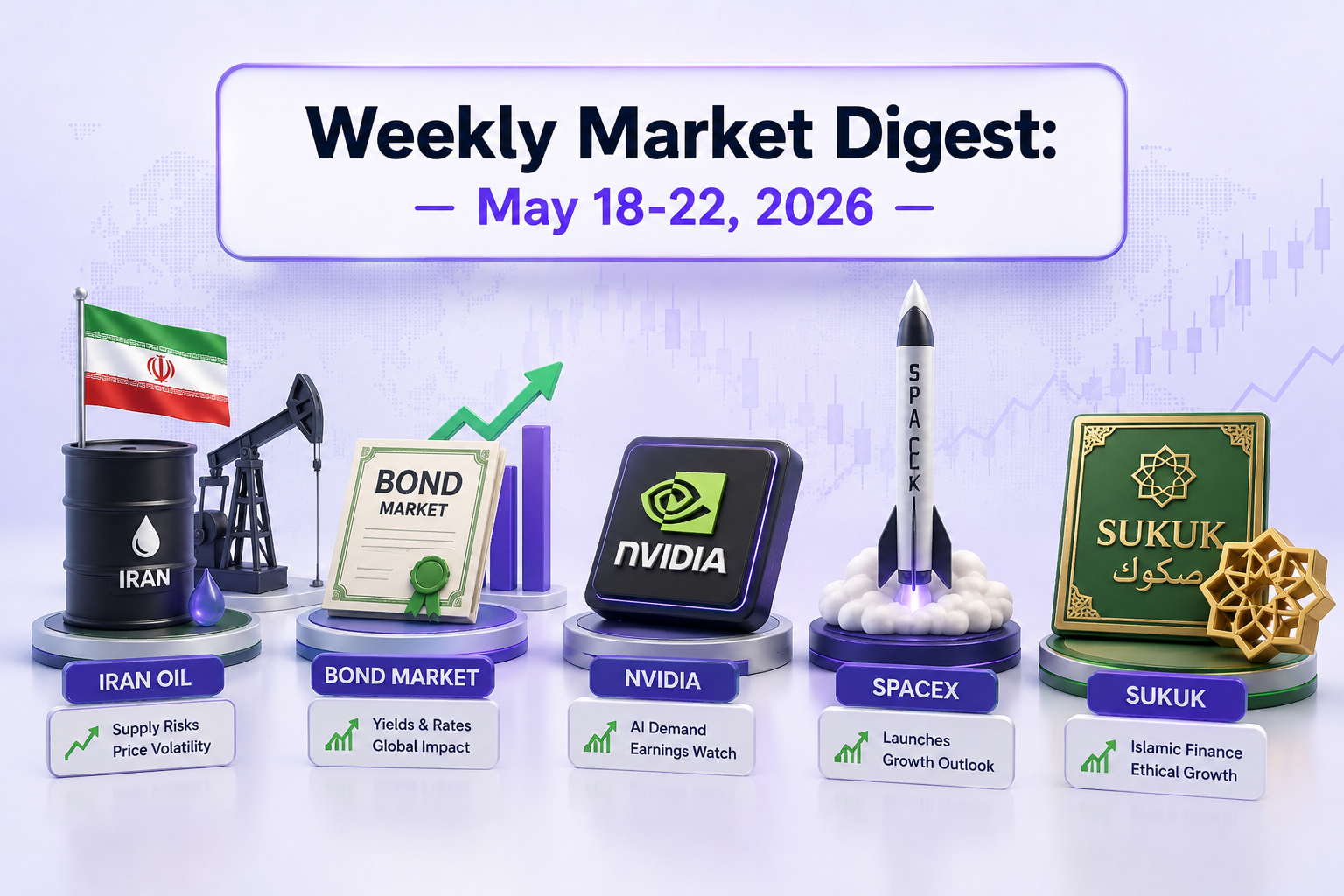
Weekly halal market digest covering May 18–22, 2026: Iran-driven oil shock, Nvidia's record $81.6B quarter, SpaceX IPO filing, and what it means for halal investors.
Table of Contents
- Introduction
- Weekly Market Snapshot: Index Closes and Key Moves
- The Iran Oil Shock: Brent Above $110, Then a Sharp Reversal
- Bond Market Rebellion: 10-Year Yield Hits One-Year High
- Nvidia's $81.6 Billion Quarter: AI Capex Has Not Slowed
- SpaceX Files for What Could Become the Largest IPO in History
- The Consumer Check: Home Depot, Target, and Walmart
- Sukuk and Islamic Finance: GCC Issuance Up 13.1%
- Halal Sector Spotlight: Where the Money Moved
- What to Watch Next Week
Introduction
The week of May 18–22, 2026 will be remembered as the week the Iran conflict, the AI trade, and the bond market collided. The halal market digest for May 2026 has rarely had this much to unpack in five sessions: oil swung between $98 and $112 a barrel, the 10-year Treasury yield touched a one-year high, Nvidia posted the largest revenue quarter in chip history, SpaceX filed for what would be the biggest IPO ever recorded, and the Dow Jones Industrial Average closed at a fresh all-time high on Wednesday before drifting through Friday.
For halal investors, the week was a stress test of conviction. Energy-driven volatility doesn't move Shariah-compliant portfolios the way it moves conventional ones - most halal screens exclude oil majors anyway, but the spillover into tech, retail, and consumer names is where the action lives. Here is the full breakdown, with every number sourced.
Weekly Market Snapshot: Index Closes and Key Moves
Five sessions, two reversals. The week opened with risk-off pressure, found a powerful one-day rally on Wednesday, and ended on a quiet, mixed Friday with the Dow at a fresh record.
| Date | S&P 500 | Dow | Nasdaq | Key Driver |
| Mon May 18 | 7,408.50 (−1.2%) | 49,526.17 (−1.1%) | 26,225.15 (−1.5%) | Iran fears, oil spike |
| Tue May 19 | 7,353.61 (−0.67%) | 49,363.88 (−0.65%) | 25,870.71 (−0.84%) | 10Y yield 4.687% |
| Wed May 20 | 7,432.97 (+1.08%) | 50,009.35 (+1.31%) | 26,270.36 (+1.54%) | Iran de-escalation |
| Thu May 21 | ≈ 7,433 (−0.31%) | (modest decline) | (modest decline) | Nvidia digestion |
| Fri May 22 | 7,445.72 (+0.17%) | 50,285.66 (+0.55%) | 26,293.10 (+0.09%) | Iran talks progress |
The Iran Oil Shock: Brent Above $110, Then a Sharp Reversal
Oil was the single most important variable for global markets this week - and the chart looks like a heartbeat monitor.
Brent crude opened the week at $110.08 a barrel on Monday morning (May 18) and climbed to $112.93 by Tuesday morning, fueled by renewed concerns over the Iran conflict and the strategic Strait of Hormuz.
Then Wednesday delivered the sharpest one-day pullback of the month. West Texas Intermediate (WTI) futures fell 5.66% to $98.26 a barrel, and Brent crude pulled back 5.63% to $105.02, after President Trump canceled a planned action on Iran citing "serious negotiations" with Tehran. The drop in oil triggered the index rally on the same day.
By Friday, Iran's Supreme Leader had publicly ordered enriched uranium reserves to remain inside the country, complicating peace talks, and Brent climbed back above $104 a barrel. Despite Friday's rebound, Brent futures still finished the week down more than 4%, the largest weekly decline since the conflict began.
Bond Market Rebellion: 10-Year Yield Hits One-Year High
The bond market quietly delivered the biggest macro signal of the week.
On Monday, May 18, the 10-year US Treasury yield climbed to 4.61%, its highest level in roughly a year. On Tuesday it pushed higher still - touching 4.687% intraday - while the 30-year Treasury yield briefly topped 5.19%, the highest level in nearly 19 years.
Why yields matter for stocks: the 10-year Treasury is the benchmark discount rate for future corporate earnings. When it rises, the present value of future profits falls - and that hits long-duration assets first: tech, growth names, REITs, and utilities. This is the engine behind Monday's 1.5% drop in the Nasdaq.
By Friday, the yield had eased to around 4.57% as oil cooled and traders priced in the possibility of an Iran agreement. Even so, markets are now pricing in roughly a 40% probability of a 25-basis-point Federal Reserve rate hike by December - a complete reversal of the easing narrative that dominated early 2026.
Nvidia's $81.6 Billion Quarter: AI Capex Has Not Slowed
Wednesday after the close, the most-watched earnings report of the year landed and it was a blowout.
The headline numbers (Q1 FY2027, ended April 26, 2026)
- Revenue: $81.6 billion — up 85% year-over-year and up 20% sequentially
- Data Center revenue: $75.2 billion — up 92% year-over-year, a fresh record
- GAAP gross margin: 74.9%
- Adjusted EPS: $1.87 vs. consensus $1.77
- Q2 revenue guidance: $91.0 billion ±2% — well above the $87.4B consensus
- Dividend raised from $0.01 to $0.25 per share (a 2,400% increase)
- New $80 billion share repurchase authorization
CEO Jensen Huang's takeaway from the call: "The buildout of AI factories - the largest infrastructure expansion in human history - is accelerating at extraordinary speed." Despite the blowout, Nvidia shares slipped on Thursday and Friday as some investors took profits and analysts noted growing competition from custom silicon at hyperscalers.
Nvidia (NVDA) is widely classified as Shariah-compliant by major screening providers because its core business - semiconductor design and AI infrastructure - passes both sector and financial-ratio screens. With a market cap above $5 trillion entering the report, Nvidia is now one of the largest single positions in the S&P 500 Shariah Index. The data center figure tells halal investors a more important story: the AI capex cycle is being underwritten by real customer demand from sovereign AI, enterprise, and AI-native cloud customers, not just by hyperscaler concentration. Critically, the quarter included zero Data Center Hopper shipments to China, compared with $4.6 billion a year ago - meaning the $75.2B Data Center print did not rely on the China revenue line at all.
SpaceX Files for What Could Become the Largest IPO in History
On Wednesday, May 20, Space Exploration Technologies Corp. filed its Form S-1 with the SEC - the public prospectus for what is set to be the largest IPO ever recorded.
Key terms in the filing
- Targeted raise: up to $75 billion (more than 2.5x the previous record, Saudi Aramco's $29.4B)
- Targeted valuation range: $1.75 trillion to $2 trillion
- Proposed Nasdaq ticker: SPCX
- Target Nasdaq debut: June 12, 2026
- Lead underwriters: Goldman Sachs, Morgan Stanley, BofA, Citi, JPMorgan
- Mission record: approximately 650 orbital launches with a 99%+ success rate as of March 31, 2026
The Consumer Check: Home Depot, Target, and Walmart
Three retailers reported during the week, and together they gave the clearest read of the US consumer.
Home Depot (May 19) - beat, lowered bar
- Revenue: $41.77 billion vs. $39.86B a year ago (+4.8%), beating Wall Street's $41.59B estimate
- Adjusted EPS: $3.43 vs. $3.41 expected
- Comparable sales: +0.6%; US same-store sales: +0.4%
- Maintained 2026 full-year guidance
Target (May 20) - best print since 2022
- Revenue: $25.44 billion (+6.7% YoY), beating estimates by 4%
- Same-store sales: +5.6% - first positive comp in five quarters
- Digital sales: +8.9%; traffic: +4.4%
- Full-year sales growth guidance raised to +4%
Walmart (May 21) - strong top line, fuel pressure
- Revenue: $177.8 billion (+7.3% YoY)
- Absorbed $175 million in fuel costs during the quarter
- CFO John David Rainey warned: "If the current elevated cost environment persists, we'd expect somewhat higher retail price inflation in Q2 and the second half of the year"
Home Depot, Target, and Walmart all pass standard Shariah sector screens (general retail is permitted), but financial-ratio screens vary by provider - investors should check current screening status before committing. The consumer is holding, but Walmart's fuel-cost commentary is a direct read on how the Iran-driven oil spike is flowing into consumer prices.
Sukuk and Islamic Finance: GCC Issuance Up 13.1%
While equity markets dominated headlines, the Islamic finance story this month came from S&P Global Ratings.
In the first four months of 2026, sukuk issuance across Gulf Cooperation Council (GCC) countries rose 13.1% year-on-year, driven by Saudi Arabia's local-currency issuances. Global sukuk issuance climbed 20% over the same period, with Malaysia, Turkey, and Indonesia contributing significantly.
But S&P Global warned that the broader Islamic finance industry, which expanded 10.2% in 2025, is expected to grow only 5–10% in 2026 as the Middle East conflict drags on. Mohamed Damak, head of Islamic finance at S&P Global Ratings, said the war has "significantly affected the economic growth outlook in several core Islamic finance countries."
The GCC accounted for roughly 45% of global sukuk issuance in 2025, so a resolution of the Iran conflict - or escalation of it - will directly shape sukuk supply for the rest of the year.
Halal Sector Spotlight: Where the Money Moved
On Wednesday's relief rally (May 20), the sector breakdown was clean: Discretionary (+2.39%) and Technology (+2.11%) led, while Energy (−2.08%), Staples (−0.52%), and Health Care (−0.07%) lagged. Three of those five sectors are core to most halal portfolios.
Airlines also surged on Wednesday's oil pullback: Delta gained 9.39% and Southwest 6.29% in a single session as jet-fuel cost pressure eased. Most halal screens exclude conventional airlines due to insurance and interest-bearing debt thresholds, but the move illustrates how directly oil price relief translates to specific Shariah-screened consumer and industrial names.
What to Watch Next Week (May 25–29)
- Iran negotiations: Pakistani mediators are expected to visit Tehran. Any concrete progress - or breakdown - moves oil within hours
- PCE inflation print (May 30): the Fed's preferred inflation gauge will tell us whether the oil spike is feeding into core prices
- FOMC minutes from the last meeting
- SpaceX roadshow: marketing reportedly begins around June 4, ahead of the targeted June 11 pricing and June 12 Nasdaq debut
- Treasury auctions: with the 10-year near a one-year high, demand at this week's auctions will signal whether the yield spike has more room to run
FAQ
Was Nvidia's Q1 FY2027 report Shariah-compliant news?
Nvidia (NVDA) itself passes most major Shariah screens. The earnings report - record revenue, raised dividend, and an $80B buyback - does not change its compliance status. Halal investors should still verify current screening status with their chosen provider before making decisions.
Did the oil spike affect halal indices the same way it affected the S&P 500?
No. Halal indices like the S&P 500 Shariah and Dow Jones Islamic Market exclude most conventional energy producers and all financials. They miss the direct upside from rising oil prices but also avoid the volatility that comes with it. The indirect impact - through tech, consumer, and industrials - is what halal portfolios feel.
Is SpaceX going to be halal?
Unknown until it lists. Shariah screening will depend on its post-IPO debt ratios and revenue mix. The xAI merger turned SpaceX into a loss-maker in 2025, which means leverage and interest-bearing debt thresholds will need to be re-evaluated. Wait for post-listing screening from providers like Akinda before committing capital.
Why does the 10-year Treasury yield matter for halal investors who don't own bonds?
Because the 10-year yield is the discount rate the entire equity market uses to value future earnings. When it rises, growth and tech stocks - which are heavily weighted in most halal indices - get hit hardest. Halal investors don't need to own Treasuries to feel the impact.
How did Akinda's halal sectors perform this week?
Tech and consumer discretionary led on Wednesday's relief rally, which is favorable for most halal portfolios. The week's net result for Shariah-screened US equities was roughly flat to slightly positive, mirroring the broader market: down hard early, recovered mid-week, mixed close.
Disclaimer: This content is for educational and informational purposes only and does not constitute investment advice, a recommendation, or an offer to buy or sell any security. All market data is as reported by the cited sources at the time of publication and may have changed since. Shariah-compliance status of individual securities can change with each rebalancing; investors should verify current status with their chosen Shariah screening provider before making decisions. Past performance is not indicative of future results.
Download the Akinda app and screen stocks instantly for free
🌐 Website: https://akinda.io
📱 App: https://onelink.to/kpqkh6