
- Building with Akinda
Why Muslim Users Leave Conventional Investing Apps (and How to Keep Them)
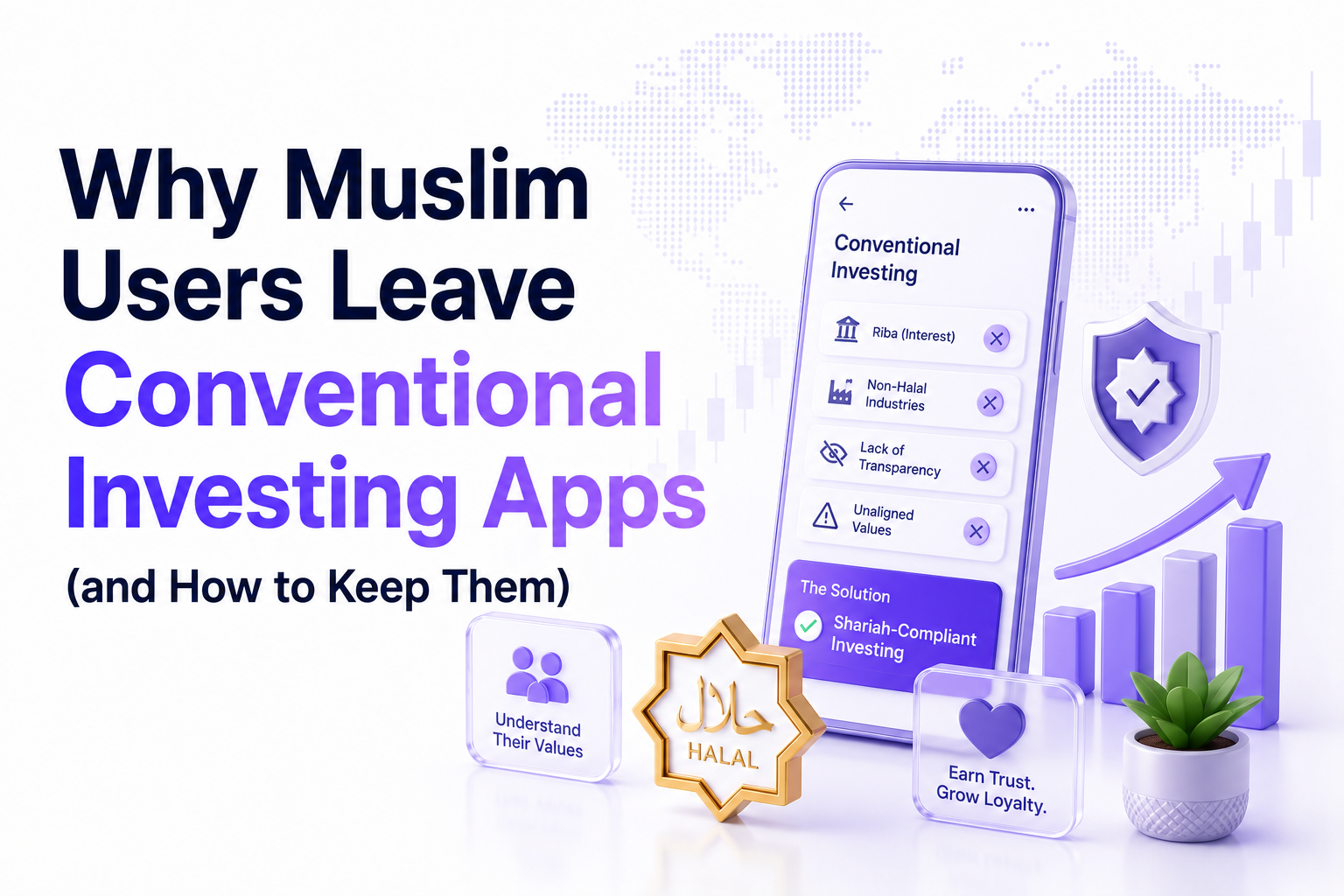
A Muslim user signs up for your investing app, funds an account, and then quietly goes dormant, or leaves. Often the reason isn't your fees, your UX, or your onboarding; it's that your product asks them to choose between investing and their faith. Conventional investing apps are built on assumptions, interest is fine, any stock is fair game, that simply don't hold for observant Muslim investors. This guide explains the specific reasons Muslim users churn from conventional apps, and how to keep them by building real Shariah compliance into the product.
Quick Answer Muslim users leave conventional investing apps because those apps can't tell them what's halal, surround them with interest-based features, and offer no purification or Shariah guidance, forcing a choice between investing and their values. You keep them by building compliance in: screen securities against a recognised standard, show a clear verdict before each trade, provide purification figures, and back it with a transparent, scholar-governed methodology. Most teams add this fast through an AAOIFI-based API like the Akinda Halal API. |
By the numbers (2026) Underserved audience: ~2 billion Muslims worldwide, many using conventional apps that don't fit their values, or none at all. |
Table of Contents
- The core reason: a values mismatch
- Reason 1: No way to know what's halal
- Reason 2: Interest-based features everywhere
- Reason 3: No purification or guidance
- Reason 4: Generic ESG isn't Shariah
- How to keep them: build compliance in
- The retention and referral upside
The core reason: a values mismatch
Every specific reason below traces back to one root cause: conventional investing apps are designed for a user whose only goal is return, while a Muslim investor is optimising for return and compliance at once. When an app ignores the second goal, it quietly makes itself unusable for that investor, even if everything else about it is excellent. The churn often looks like disengagement rather than a dramatic exit: the user just stops, because they can't act confidently. Understanding that mismatch is the key to fixing it.
Reason 1: No way to know what's halal
The most immediate problem is informational. A conventional app shows a Muslim user thousands of tickers with no indication of which are permissible, leaving them to research each company's business and financials by hand, or to guess. That friction is enough to stall most users. They want to invest, but they can't tell what's compliant, so they hesitate, park cash, or leave for a tool that answers the question. The fix is to answer it for them: a clear halal verdict on every ticker, ideally with the reasoning behind it. You can see what that looks like on Akinda's halal stock screener.
Reason 2: Interest-based features everywhere
Conventional apps are built around interest (riba), which is prohibited in Islam regardless of how the proceeds are used. Uninvested-cash sweep programmes that pay interest, margin lending, interest-bearing savings features, even the default handling of idle balances can all put a Muslim user in a position they consider impermissible. When the product's convenience features conflict with a user's values quietly, the message they receive is that the app wasn't built for them. Keeping these users means letting them turn interest-based features off, or offering compliant alternatives, so using your app doesn't force a compromise.
Reason 3: No purification or guidance
Even a Muslim investor holding screened, compliant stocks has obligations a conventional app ignores, most notably purification: cleansing the small, incidental portion of dividend income that comes from impermissible sources by giving it to charity. A conventional app provides no figure and no guidance, leaving the user to work it out alone or worry they're getting it wrong. That absence signals, again, that the product doesn't understand how they invest. Providing purification data, and light guidance on what it means turns a source of anxiety into a reason to stay.
Reason 4: Generic ESG isn't Shariah
Some apps assume an ESG or “ethical” filter is close enough. It isn't. ESG screens and Shariah screens overlap, both exclude sectors like gambling and weapons, but they aren't the same: Shariah compliance also requires financial-ratio screening (limits on interest-bearing debt and income) and purification, which ESG filters don't address. A Muslim user who tries an app's ESG option and finds conventional banks still in the universe, or no purification, concludes, correctly, that it doesn't meet their needs. Keeping these users means offering genuine Shariah screening against a recognised standard, not repackaged ESG.
How to keep them: build compliance in
The retention fix mirrors the reasons for churn: give Muslim users a product that lets them invest in line with their faith without extra work. Concretely:
- Show a clear verdict. A halal / non-compliant badge on every ticker and a check before each trade, so users never have to guess.
- Gate the risky moments. Warn or block non-compliant buys, and let users disable interest-based features like cash sweeps.
- Provide purification. Surface the figure users need to cleanse their dividends, with brief guidance.
- Be transparent. Screen against a recognised, published methodology with scholar governance, so users trust the verdicts.
- Keep it current. Re-screen holdings quarterly and alert users when a position's status changes.
The Akinda Halal API delivers each of these through a few endpoints: a compliance endpoint for verdicts and gates, a full report for ratios and purification, all governed by a published methodology and overseen by a qualified scholar. Generate a key on the dashboard and start on the free tier.
The retention and referral upside
Fixing this doesn't just stop churn; it flips the dynamic. A Muslim investor who finally finds an app that genuinely respects their values has little reason to leave, and strong word-of-mouth within tight-knit communities turns satisfied users into a low-cost acquisition channel. Trust also deepens the relationship: users consolidate more of their financial life into a product they believe in, adopting adjacent compliant offerings at higher rates. And because compliance carries no historical returns penalty, over the 15 years to 2019 the S&P 500 Shariah index actually outpaced the S&P 500, you can keep these users without asking them to give anything up. In a category where compliant options are scarce, being the app that gets it right compounds into retention, referrals, and lifetime value that conventional apps can't match.
Frequently asked questions
Why do Muslim users leave conventional investing apps?
Because those apps force a choice between investing and their faith. They can't tell users which securities are halal, surround them with interest-based features that conflict with Islamic principles, and offer no purification or Shariah guidance. The churn often looks like quiet disengagement, the user simply can't act confidently, rather than a dramatic exit.
Isn't an ESG or ethical filter enough for Muslim users?
No. ESG and Shariah screens overlap but aren't the same. Shariah compliance also requires financial-ratio screening, limits on interest-bearing debt and income, and purification, which ESG filters don't address. A Muslim user who finds conventional banks still in an app's “ethical” universe will conclude it doesn't meet their needs. Genuine Shariah screening against a recognised standard is what retains them.
What features keep Muslim users on an investing app?
A clear halal verdict on every ticker, a pre-trade compliance check, the ability to disable interest-based features, purification figures for dividends, and a transparent, scholar-governed methodology behind it all. Together these let a Muslim user invest in line with their faith without extra work, which is exactly what conventional apps fail to provide.
Does adding compliance mean my Muslim users earn lower returns?
Historically, no. Over the 15 years to 2019 the S&P 500 Shariah index returned 10.2% annualized versus 9.1% for the S&P 500, per S&P Global, and Islamic indices have generally tracked conventional benchmarks. So you can retain Muslim users with compliant products without asking them to sacrifice performance.
How fast can I add retention-saving compliance features?
With an API, in weeks. The screening, data, and scholar governance already exist, so you integrate the endpoints, add badges, gates, and purification, and set up quarterly re-screening. That's far faster than building the compliance layer in-house, and fast enough to stem churn before more users drift away.
Sources
AAOIFI Shari'ah Standard No. 21: Financial Paper (Shares and Bonds) – the standard the Akinda API's screening methodology is built around.
Akinda API screening methodology – the full three-phase screen, ratio formulas, and purification rule, published for integrators to audit.
Akinda API Shariah advisor – the scholar governance behind the API's halal verdicts.
Mordor Intelligence – Global Islamic Finance Market (2026) – Islamic finance market size and growth projections.
Build with the Akinda Halal API The developer-grade API for AAOIFI-based Shariah stock screening. Start on the free tier, scale when you ship. 📚 Docs: b2b.akinda.io/developer/docs 💳 Pricing: b2b.akinda.io/pricing 🔑 Get a key: b2b.akinda.io/dashboard |
Disclaimer
This article is about a software product and is for general information only. It is not financial or religious advice. Automated Shariah screening produces data-driven signals, not a fatwa; integrators should pair it with their own Shariah governance and consult qualified scholars. API features, endpoints, coverage, and pricing change over time, so verify current details on b2b.akinda.io before building.