
- Investing Principles
Why Starting Early Beats Starting Big in Investing
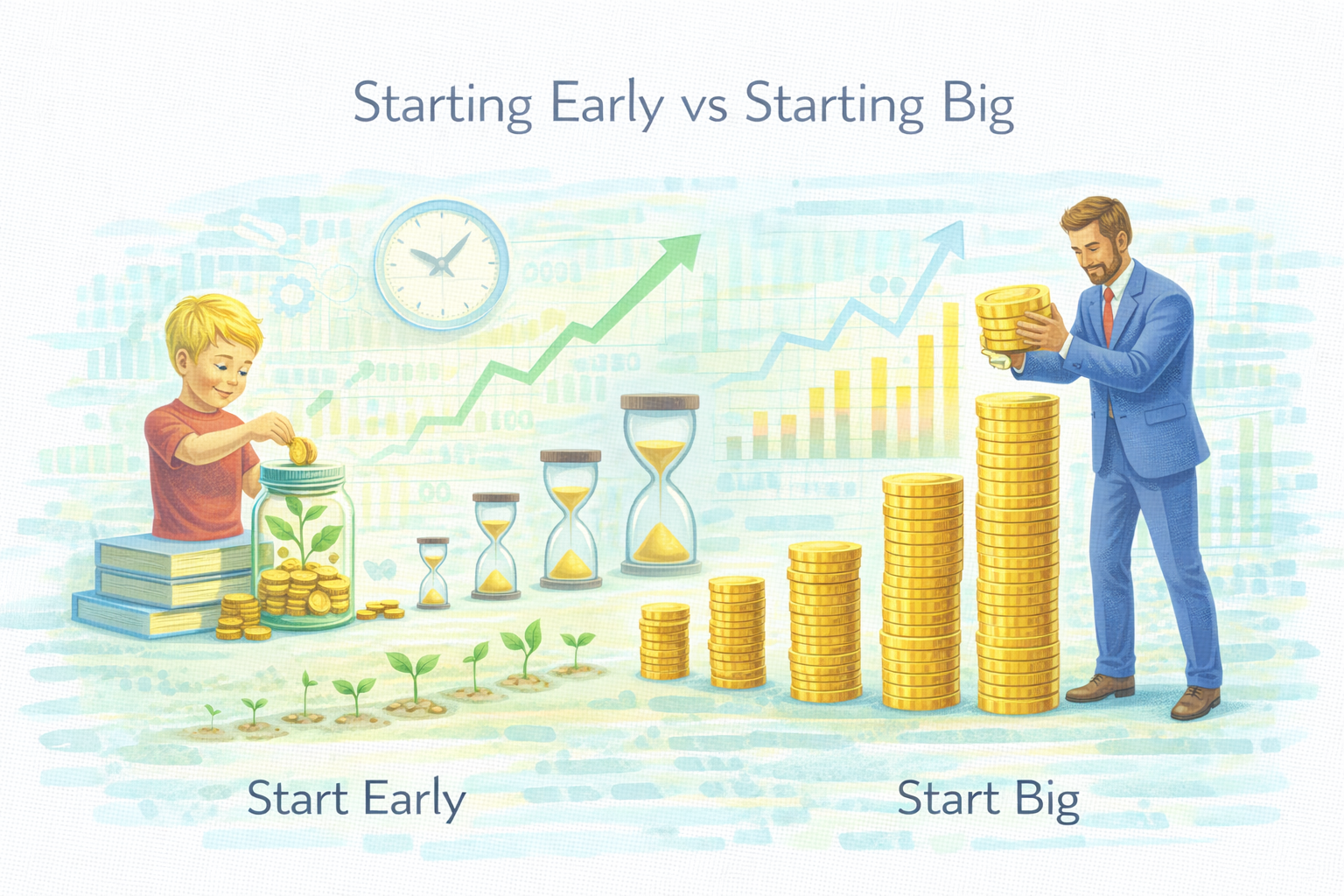
Time is the biggest tool in investing.
Money works on its own when passively managed.
Early investing isn’t risky, waiting is.

Table of contents
- Time is the biggest tool in investing.
- Money works on its own when passively managed.
- Example.
- Early investing isn’t risky waiting is.
- Conclusion.
TIME IS THE BIGGEST TOOL IN INVESTING.
In investing the greatest weapon is neither money nor skill, it is time... Short-term investments are less time consuming but riskier. All skills and money could be earned, but time isn’t, even the highly skilled investors may lose if risk is high. Short term investments may make more money when you have a high financial educational background. Short-term investments also have higher volatility. Higher volatility defines uncertainty. Volatility is higher in a short period. Companies set strict strategic plans, but tactical mistakes may occur because of human factors, usually it affects the market volatility of company stock prices. Market fluctuations and correcting errors usually don’t get enough time to impact market returns in a long period. While the stocks are considered risky assets, time heals that. For example: If a company's monthly statements are late it may cause price falling. Trend movement dramatically changes in the short term, but more time acts like a stabilizer. Because the company is strategically and fundamentally still stable.
Warren Buffet said: "The stock market is a device for transferring money from the impatient to the patient.” Patience requires time. At the same time Warren Buffet started investing at 11. He purchased stock. As you grow older responsibilities also grow. Young investors have fewer financial responsibilities, they don’t pay medical bills for the whole family, pay less taxes, no home loans, or no kids' education expenses. They have more room for mistakes do not cause serious consequences. Noone is harmed and retry do not cost much. Even as an adult investing is important. Sometimes people face financial problems after retirement. Saving for retirement provides financial security after stopping working.
If you were invested $1000 right before 2008 financial crisis, you would have about $6,483.48. With 548.35% grows rate. Average per year this rate is 11.22%. Even the small percentages adding up to big results.
MONEY WORKS ON ITS OWN WHEN PASSIVELY MANAGED.
Actively managed assets require more knowledge and attention. Accountability is high, which makes it time consuming. Passive investing in stocks indexes comfortable for retirement savings.
“Snowball effect” theory defines compounding. The idea of “Snowball effect” is to imagine pushing a small snowball. As you roll the ball it gathers snow, as it grows the surface of the ball gets bigger, more snow is added to a larger surface. This is how assets add up with more value.
“Compound interest is the eighth wonder of the world. He who understands it, earns it; he who doesn’t, pays it.” – Albert Einstein. Compounding is making the money out of every single money added as a profit. Compounding makes more money with ROI (Return on investment) of last month. ROI (return on investment) is the percentage of profit made from investment.
For example: 3000$ invested money with 12% monthly compound interest rate. The first month makes 3360$, next month it makes 12% out of 3360$.
Month 2; 3763.2$,
Within a year that estimates: 11,687$
Truth is these percentages are not stable in every period; the stock market comes up with different returns. Sometimes lower, sometimes higher.
EARLY INVESTING ISN’T RISKY, WAITING IS.
If you wait for a convenient time to invest you only lose time. Keeping the cash is not safe. Inflation erodes money. Currency is non-return asset. There are other assets like stocks, real estate, bonds, ETFs. Those assets are more profitable. Since the last 100 years stock market trended upward average around 10%. Some companies pay dividends for their customers per stock. Dividend from investment is making money without sacrifices. Dividends are proof that your money is working as hard as you are — and eventually harder than you ever could.
45% U.S individual investors have ETFs in their portfolios. In a 2024 State Street Global Advisors survey found that nearly 70% of ****financial advisors regularly recommend ETFs. This is how reliable asset is. SPUS (SP Funds S&P 500 Sharia Industry Exclusions ETF) has had an average 15.4% annual return for the last 5 years. SPUS is not the only halal ETF. There are around 50 halal ETFs.
Bonds are considered one of the low riskier assets in the world. The asset is government backed. Bonds are not permissible in Islam.
Here you can see top halal stocks to invest.
CONCLUSION
Investing isn’t only about growing wealth — it’s about shaping the life you want to live in the future. Money that sits idle loses value, but money put to work becomes a tool for freedom, security, and opportunity.
Ultimately, wealth is not just measured in numbers, but in stability and perspective. Time doesn’t just grow assets — it reveals their true value.
Time is the most powerful ally an investor can have. It turns small, consistent actions into life-changing results through compounding and patience. Waiting for the “perfect moment” often leads to missed opportunities, while starting early allows your money to grow and work for you. Investing isn’t just about building wealth — it’s about creating freedom, security, and stability for the future. Markets rise and fall, but over time, they reward those who stay consistent. Remember, money can be earned and lost, but time can never be replaced. Use it wisely, and it will shape the life you dream of. To start earlier investing you can use the help of akinda.io
References:
- According to OfficialData.org, $100 invested in the S&P 500 in 2008 would have grown to about $648 by 2025 (OfficialData.org, 2025).
- According to the 2024 ETF Impact Survey by State Street Global Advisors, 45% of U.S. individual investors currently have ETFs in their investment portfolios.
- According to the 2024 ETF Impact Survey by State Street Global Advisors, nearly 70% of U.S. financial advisors “always” or “often” recommend ETFs to their clients.
- SPUS has averaged ~ 17.7% annualized return over the past 5 years (Dividend.com).
KEY WORDS: ETFs, SPUS, Dividend asset. Compound interest rate, Snowball effect, invested money, Stock Market, Short-term investments, risk, volatility, strategic plan, risky asset, financial statements.