
- Halal investing for beginners
- Investing Principles
Are ETFs Halal? A Guide to Shariah-Compliant ETFs
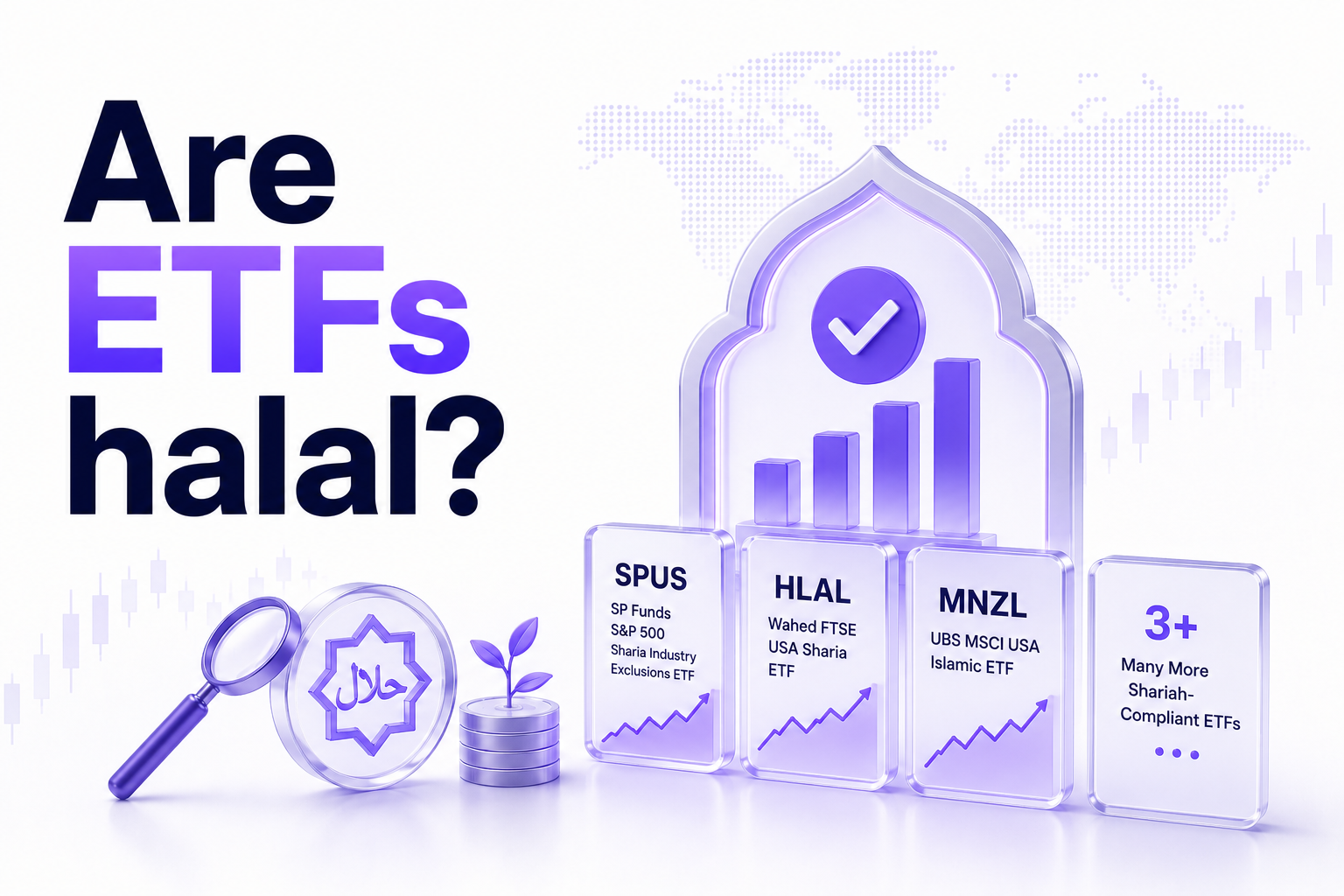
ETFs are how a lot of people invest now: one trade buys you a whole basket of companies, cheaply and without much effort. Naturally, Muslim investors want to know if they're allowed. Are ETFs halal? It depends entirely on what the fund holds. An ETF is just a wrapper, and the wrapper itself is fine, so the real question is whether the securities inside it are Shariah-compliant. A regular S&P 500 fund is not halal, because it's packed with banks, insurers, and other names that fail screening. But purpose-built halal ETFs exist that hold only screened companies. This guide explains the difference and how to invest the right way.
Quick Answer An ETF is halal only if everything it holds is Shariah-compliant. The ETF structure itself is permissible, since you own a proportional share of a basket, not a derivative or a loan. But most conventional ETFs are not halal because they include conventional banks, alcohol, gambling, and heavily-indebted firms. Dedicated Shariah-compliant ETFs, such as SPUS and HLAL for equities or SPSK for sukuk, screen their holdings, avoid interest-based instruments, and are supervised by a Shariah board. Even these require purifying a small amount of incidental impure income. |
Table of Contents
- Are ETFs halal or haram?
- What makes an ETF halal?
- What are the main types of halal ETFs?
- Which ETFs are not halal?
- Halal ETFs vs picking individual stocks
- How do you invest in halal ETFs?
Are ETFs halal or haram?
It comes down to what's inside the fund. An ETF, or exchange-traded fund, is a basket of securities that trades on an exchange like a single stock. When you buy a share of one, you own a proportional slice of everything it holds. That wrapper is permissible in itself: you're buying ownership of a basket of assets, not a derivative or a debt instrument.
So the ruling follows the holdings. A conventional broad-market ETF is not halal, because it includes exactly the companies screening rules out: conventional banks and insurers, alcohol, gambling, and firms drowning in interest-based debt. A Shariah-compliant ETF, by contrast, holds only companies that pass the screen. The answer to “are ETFs halal” is therefore: some are, most aren't, and there's a growing set built specifically to be.
What makes an ETF halal?
A halal ETF has to clear a few conditions, not just avoid the obvious haram sectors.
- Screened holdings. Every company in the fund must pass the business and financial screens, the same AAOIFI-based screening applied to individual stocks.
- No interest-based instruments. The fund can't hold conventional bonds or interest-bearing securities. For fixed income, the halal equivalent is sukuk.
- A permissible structure. It should represent real ownership of the basket, with no leverage and no synthetic, derivative-based replication.
- Shariah supervision. A recognised Shariah board should certify the fund with a fatwa and re-screen the holdings regularly, usually every quarter, so names that drift out of compliance are removed.
- Purification. Because holdings still earn a little incidental interest, a small amount of impure income needs purifying, which the fund either handles or discloses so you can.
That last point is easy to overlook: even a certified halal ETF usually carries a sliver of impure income to clean, covered in purification article.
What are the main types of halal ETFs?
The halal ETF market has grown past $8 billion in assets, and it now spans most of the asset classes a diversified investor needs. These funds are designed and certified to be Shariah-compliant, though you should still check each one's current fatwa.
| Type | Examples | What it holds |
|---|---|---|
| US equity | SPUS, HLAL, MNZL | Screened large- and mid-cap US companies. |
| Global / international | UMMA, IGDA, SPWO | Screened non-US or global developed-market stocks. |
| Sukuk (fixed income) | SPSK | Sukuk, asset-backed Islamic certificates, not interest-bearing bonds. |
| REIT (real estate) | SPRE | Screened, income-producing real estate companies. |
| Gold | Backed gold ETFs | Fully-allocated physical gold, no leverage or derivatives. |
The sukuk category deserves a note. Conventional bond ETFs are off-limits because bonds pay interest, but sukuk are structured differently: they give you a share in a real asset and its cash flows, governed by AAOIFI's standard on investment sukuk, which is why a sukuk ETF like SPSK can serve as the fixed-income sleeve of a halal portfolio. Gold ETFs are also possible, but only when fully backed by allocated physical gold, as covered in halal gold investing article.
Which ETFs are not halal?
Just as important is knowing what to avoid. Several common ETF types fail on structure or holdings, no matter how popular they are.
- Conventional broad-market ETFs (a standard S&P 500 or total-market fund) hold prohibited sectors and leveraged companies.
- Conventional bond ETFs are built on interest, so they're impermissible; sukuk ETFs are the halal alternative.
- Leveraged and inverse ETFs rely on borrowing and derivatives to amplify or reverse returns, combining riba, gharar, and speculation.
- Sector ETFs in haram industries such as conventional banking, gambling, or alcohol funds fail at the business level.
- Any ETF you can't verify, where the holdings or structure aren't transparent enough to confirm compliance.
Halal ETFs vs picking individual stocks
A halal ETF isn't the only way to build a compliant portfolio. The other route is owning individual screened stocks, and the two suit different investors.
- A halal ETF gives you instant diversification in a single, hands-off trade. The trade-offs are higher fees than conventional ETFs, no control over the exact holdings, and a heavy tilt toward technology in most funds.
- Individual screened stocks give you full control, no fund fee, and a portfolio you can tailor to your own convictions. The cost is effort: you screen and monitor each holding yourself, and re-check them as their ratios move.
This is where a screener earns its place. You can build your own basket of screened companies, or check the top holdings of an ETF you're considering, on Akinda's halal stock screener. If you'd rather hand-pick, browse the top halal stocks to start from a compliant shortlist.
How do you invest in halal ETFs?
If the ETF route fits you, a few practical steps keep it clean and diversified.
- Choose certified funds and verify the Shariah board and fatwa before buying.
- Combine for balance: a core US-equity ETF, an international one, and a sukuk ETF for fixed income, weighted to your risk tolerance.
- Hold them in a swap-free or Islamic brokerage account, so idle cash isn't earning interest.
- Purify residual impure income each year using the ratios the fund publishes.
- Mind the costs and concentration, since halal ETFs charge more than conventional ones and lean heavily on tech.
Whichever route you take, the principle is the same as with any halal investment: own real, screened assets, avoid interest and leverage, and clean the small impure remainder. An ETF is simply a convenient wrapper for doing that at scale, as long as what's inside it passes.
Frequently asked questions
Are SPUS and HLAL halal?
SPUS and HLAL are designed to be Shariah-compliant. Both track screened indices of US equities, exclude prohibited sectors and over-indebted firms, and are supervised by a Shariah board that re-screens holdings each quarter. They're among the most widely used halal ETFs, though you should still confirm the current fatwa and purify residual income.
Is a regular S&P 500 ETF halal?
No. A standard S&P 500 ETF holds the whole index, which includes conventional banks, insurers, alcohol and gambling companies, and heavily-leveraged firms. That fails both the business and financial screens. The halal equivalent is a Shariah-screened version of the index, such as SPUS or HLAL, which excludes the non-compliant names.
Do you need to purify halal ETF dividends?
Usually yes. Even screened companies earn a small amount of incidental interest, so a halal ETF passes a little impure income through its dividends. Most providers publish a purification ratio, or purify at the fund level. You donate that small portion to charity, separate from zakat, to keep the income clean.
Are gold ETFs halal?
Only if the fund is fully backed by allocated physical gold, avoids leverage and interest-bearing instruments, and is Shariah-supervised. Synthetic or futures-based gold ETFs fail the possession requirement that applies to gold as a ribawi commodity. Always confirm a gold ETF is physically backed and allocated before treating it as halal.
Are bond ETFs halal?
Conventional bond ETFs are not halal, because bonds pay interest, which is riba. The Shariah-compliant alternative is a sukuk ETF. Sukuk represent ownership of a real asset and its cash flows rather than a loan at interest, so a sukuk ETF like SPSK can fill the fixed-income role in a halal portfolio.
Sources
AAOIFI Shari'ah Standard No. 21: Financial Paper (Shares and Bonds) – the screening criteria every company in a halal ETF must meet.
AAOIFI Shari'ah Standard No. 17: Investment Sukuk – the standard behind sukuk, the halal fixed-income alternative to interest-bearing bonds.
Fiqh Council of North America – ruling on investing in shares – confirms that owning screened, permissible equities (the basis of a halal ETF) is allowed.
Download the Akinda app and screen over thousands of global stocks, monitor Shariah compliance in real time
🌐 Website: https://akinda.io
📱 App: https://onelink.to/kpqkh6
Disclaimer
This article is for educational purposes only and is not financial or religious advice. Fund structures and Shariah supervision vary; the permissibility of a specific ETF depends on its holdings and certification. Verify the current fatwa for any fund and consult a qualified scholar for your situation.