
- Stock Market & Equities
Growth vs. Value Stocks: What’s the Difference?
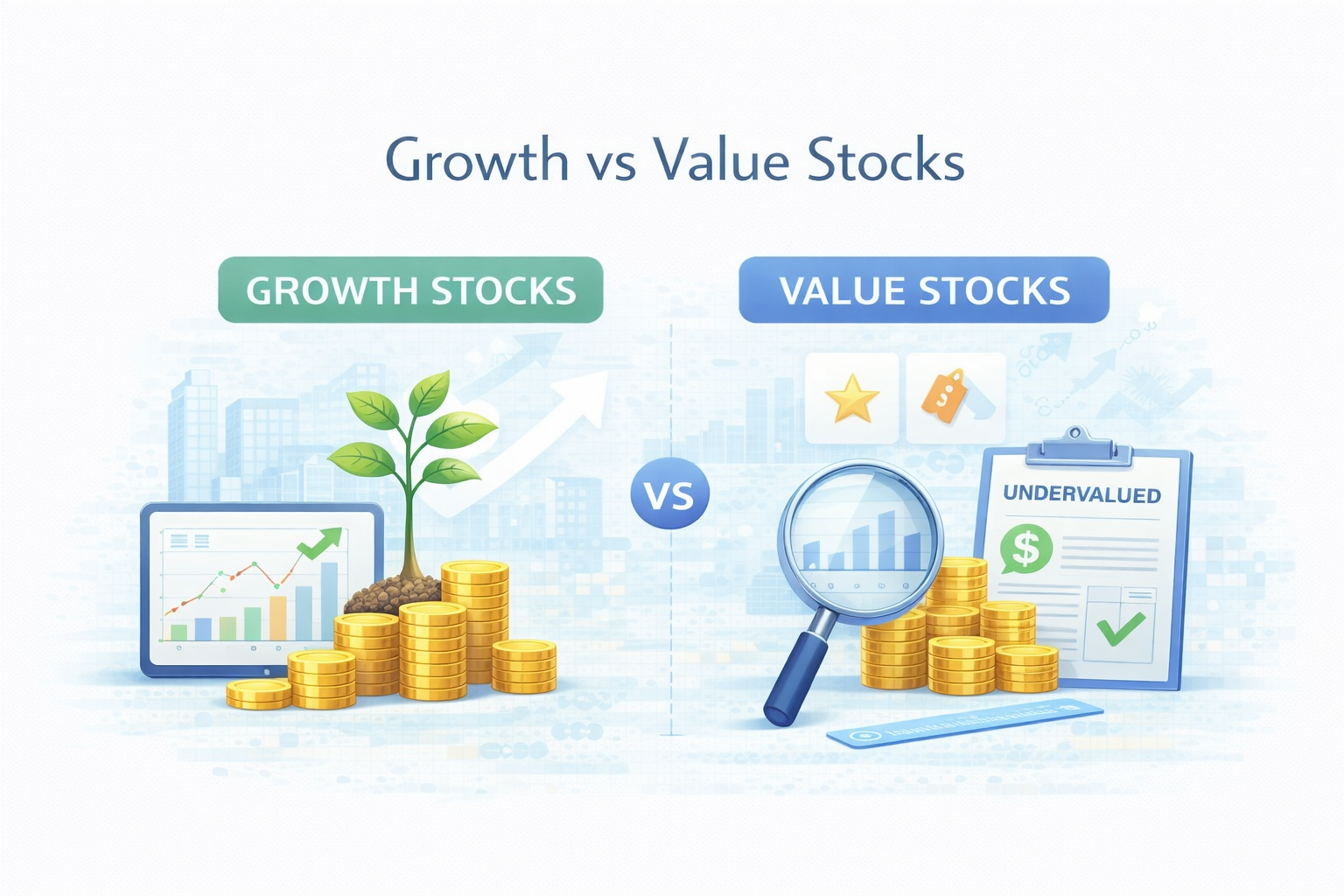
Growth vs. Value Stocks: Key Differences, Performance, and Strategy
Table of contents:
- Introduction
- What Are Growth Stocks?
- Key Features, Advantages, and Risks of Growth Stocks
- What Are Value Stocks?
- Key Features, Advantages, and Risks of Value Stocks
- Growth vs. Value Stocks: Side-by-Side Comparison
- Performance Trends Across Market Cycles
- How Economic Conditions Affect Growth and Value Investing?
- Academic Theories Behind Growth and Value Investing
- How to Combine Growth and Value Investing Strategies?
- Conclusion
Introduction
Investing in the stock market offers numerous strategies for building wealth, but two of the most widely followed approaches are growth investing and value investing. Each strategy reflects a distinct philosophy and mindset, guiding investors on how to identify opportunities and maximize returns. Understanding their differences is essential for creating a well-balanced and informed portfolio.
Growth investing focuses on companies with the potential for rapid expansion in the future. Investors who follow this approach are often willing to accept higher risks in exchange for the possibility of significant long-term gains. On the other hand, value investing targets companies that appear undervalued relative to their intrinsic worth. Value investors look for bargains — stocks trading below their true value — with the expectation that the market will eventually recognize their potential, resulting in price appreciation.
Both strategies have unique advantages, risks, and time horizons, making them suitable for different types of investors and investment goals. Today, financial platforms such as Akinda.io provide user-friendly analytics and stock comparison tools that make it easier for investors to explore growth and value opportunities in real time, helping them make more informed decisions.
What Are Growth Stocks?
Growth stocks are shares of companies expected to expand their earnings and revenue faster than the market average. These companies typically operate in innovative and fast-evolving industries, such as technology, healthcare, or renewable energy, where rapid growth is possible.
Instead of paying regular dividends, growth companies often reinvest their profits into research, development, marketing, and market expansion. The goal is to capture greater market share and increase long-term profitability. Growth investors are essentially paying today for the company’s potential tomorrow.
Examples of Growth Stocks:
Apple Inс. (AAPL): Known for continuous innovation and steadily increasing product sales.
Amazon (AMZN): Expanded rapidly by reinvesting earnings into logistics, cloud computing, and retail operations.
Tesla (TSLA): Focused on growth through electric vehicle innovation and sustainable energy solutions.
Here you can find top halal stocks to invest.
Key Features, Advantages, and Risks of Growth Stocks
Key Features of Growth Stocks
Growth stocks are distinguished by several defining characteristics that set them apart from other types of investments:
High Price-to-Earnings (P/E) and Price-to-Book (P/B) Ratios: Investors are willing to pay a premium for growth stocks because they expect substantial future earnings. High P/E and P/B ratios reflect these elevated expectations, signaling that the market anticipates significant expansion in the company’s profits and asset value.
Low or No Dividend Payments: Many growth-oriented companies choose to reinvest their profits back into the business rather than paying dividends to shareholders. This reinvestment supports research, innovation, marketing, and expansion, all aimed at fueling long-term growth.
High Market Expectations: Growth stocks are often the focus of investor optimism, as the market anticipates rapid earnings growth, technological advancement, or market share expansion. This optimism can drive stock prices higher, sometimes beyond what current fundamentals alone would justify.
Greater Price Volatility: Due to their reliance on future potential rather than current earnings, growth stocks tend to experience larger price swings. These fluctuations can present opportunities for savvy investors but also increase risk.
Advantages of Growth Stocks
Investing in growth stocks offers several potential benefits for those with the right risk tolerance and investment horizon:
Substantial Long-Term Capital Appreciation: Investors in growth stocks can achieve significant wealth accumulation if the company meets or exceeds its growth projections. Historically, many successful growth companies have generated returns far exceeding those of more stable, dividend-focused stocks.
Exposure to Emerging Industries and Technologies: Growth stocks often represent innovative sectors such as technology, biotechnology, renewable energy, and artificial intelligence. Investing in these companies allows shareholders to participate in new market trends and benefit from rapid industry evolution.
Reinvestment into Expansion: By focusing on growth rather than immediate dividends, these companies reinvest earnings to strengthen operations, expand market share, and develop new products, which can further enhance long-term stock value.
Risks of Growth Stocks
Despite their potential, growth stocks come with notable risks:
High Sensitivity to Market Expectations: If a company fails to meet the market’s growth expectations, its stock price can decline sharply, sometimes resulting in significant short-term losses.
Vulnerability to Economic Changes: Growth stocks are often more affected by interest rate changes, inflation, and broader market downturns. Rising interest rates, for example, can make future earnings less valuable in today’s terms, causing stock prices to fall.
Greater Volatility: While volatility offers opportunities, it also increases the potential for dramatic losses, making growth stocks less suitable for risk-averse investors or those needing stable income.
What Are Value Stocks?
Value stocks are shares of companies that appear undervalued compared to their intrinsic worth. These companies often have stable revenues, proven management, and consistent dividend payments, but the market may temporarily overlook them.
Value investing, popularized by Benjamin Graham and Warren Buffett, is based on the principle that markets sometimes overreact to short-term challenges. Patient investors can take advantage of these mispricings by buying solid companies at a discount and profiting when the market eventually recognizes their true value.
Examples of Value Stocks:
Coca-Cola (KO): A well-established company with steady profits and strong brand recognition.
Johnson & Johnson (JNJ): Offers stable earnings and reliable dividends.
Procter & Gamble (PG): Known for predictable consumer demand and low volatility.
Key Features, Advantages, and Risks of Value Stocks
Key Features of Value Stocks
Value stocks are characterized by features that make them attractive to investors seeking stability, income, and long-term reliability:
Low Price-to-Earnings (P/E) and Price-to-Book (P/B) Ratios: Value stocks typically trade at lower multiples compared to the market or their sector peers. This suggests they may be undervalued relative to their intrinsic worth, creating potential opportunities for investors who can identify quality companies overlooked by the market.
Regular Dividend Payments: Unlike growth stocks, many value companies distribute a portion of their profits to shareholders in the form of dividends. This provides a steady income stream, making value stocks appealing to income-focused investors or those seeking cash flow during market volatility.
Stable or Slowly Growing Earnings: Value companies often operate in mature industries with predictable demand. Their earnings tend to grow gradually rather than rapidly, providing a measure of predictability and reducing the risk of sudden performance swings.
Lower Volatility Compared to Growth Stocks: Because value stocks rely on established business models and steady cash flows, their prices usually experience smaller fluctuations, offering a more stable investment environment.
Advantages of Value Stocks
Investing in value stocks offers several distinct benefits:
Greater Stability and Predictable Returns: Value stocks are generally less sensitive to market speculation and investor sentiment, making them suitable for conservative investors or those with a low tolerance for risk.
Consistent Income Through Dividends: Regular dividend payments provide a reliable source of income, which can be reinvested to compound returns or used for cash flow needs.
Strong Performance During Market Recoveries: Historical evidence shows that value stocks often outperform during periods of economic recovery or when markets shift focus from speculative growth to fundamentals.
Opportunity to Buy Undervalued Companies: Value investing allows investors to identify high-quality companies trading below their true worth, potentially generating significant long-term returns once the market recognizes their intrinsic value.
Risks of Value Stocks
May Remin Undervalued for Extended Periods: A stock being undervalued does not guarantee immediate appreciation; prices can stay depressed for years, requiring patience from investors.
Slower Long-Term Capital Appreciation: Because these companies grow at a steady pace, they typically offer lower potential for explosive gains compared to growth stocks.
Risk of “Value Traps”: Some stocks appear cheap for a reason. Low prices may reflect underlying business problems, declining industries, or management issues, which can result in poor returns if not carefully analyzed.
Growth vs. Value Stocks: Side-by-Side Comparison
| Feature / Criteria | Growth Stocks | Value Stocks |
| Goal | Capital appreciation | Undervalued stability |
| Company Type | Emerging or rapidly expanding firms | Mature, established companies |
| Dividends | Usually reinvested | Regularly paid |
| Valuation | High P/E and P/B ratios | Low P/E and P/B ratios |
| Risk Profile | Higher volatility | Lower volatility |
| Performance Environment | Tend to perform well in bull markets | Often perform well during recoveries or downturns |
| Ideal Investor | Long-term, risk-tolerant growth seekers | Conservative, income-focused investors |
Performance Trends Across Market Cycles
The performance of growth and value stocks often varies with economic conditions and market cycles. Growth stocks tend to outperform during periods of economic expansion, low interest rates, and technological innovation, when borrowing is cheap and future earnings potential is high. Value stocks, on the other hand, often shine during market recoveries, inflationary periods, or when stability and income become more attractive to investors.
Historically, value stocks have delivered higher average returns over long economic cycles, compensating for their perceived risks. However, growth stocks, particularly in the technology sector, dominated during the 2010s due to rapid innovation and digital transformation. For example, during the COVID-19 pandemic, tech-oriented growth stocks like Zoom, Amazon, and Netflix surged, while value stocks in travel and energy lagged. By 2022–2023, as inflation rose and interest rates increased, many value stocks regained strength.
Modern analytical platforms, such as Akinda.io, provide portfolio simulators and real-time data tools, allowing investors to visualize how growth and value portfolios perform under different market conditions—resources once limited to professionals.
How Economic Conditions Affect Growth and Value Stocks Investing
Several macroeconomic factors influence which type of stock performs better:
Interest Rates: Low interest rates favor growth stocks by reducing borrowing costs and boosting future earnings potential.
Inflation: Higher inflation often benefits value stocks, particularly in sectors like energy, materials, and finance.
Economic Recovery: Value stocks tend to outperform during recovery phases when the market rewards stability.
Technological Innovation: Growth stocks thrive when new technologies create demand for innovative products and services.
Academic Theories Behind Growth and Value Investing
Several financial theories explain why growth and value investing can both be profitable under different conditions:
Fama-French Three-Factor Model: Demonstrates that value stocks tend to outperform due to risk factors not captured by the broader market.
Behavioral Finance: Suggests that investors often overreact to recent performance, causing growth stocks to become overvalued and value stocks to be temporarily undervalued.
Graham and Dodd’s Fundamental Analysis: Emphasizes buying undervalued companies based on intrinsic worth rather than market hype.
How to Combine Growth and Value Investing Strategies?
Many investors adopt a blended approach, including both growth and value stocks in their portfolios to balance risk and reward. Exchange-Traded Funds (ETFs) such as the Vanguard Growth ETF (VUG) and Vanguard Value ETF (VTV) allow investors to gain exposure to both investment styles with ease.
A mixed approach provides several benefits:
- Smooths returns across market cycles
- Captures opportunities in both rising and falling markets
- Reduces the risk of concentration in one style that may underperform for extended periods.
Rather than choosing one strategy over the other, blending growth and value investing helps investors create more resilient portfolios tailored to their goals, risk tolerance, and time horizon.
Conclusion
The debate between growth and value investing has persisted for decades, and both strategies have proven successful in different market environments. Growth stocks offer the potential for high capital appreciation and exposure to innovation, while value stocks provide stability, dividends, and protection during volatile periods.
Understanding the balance between these approaches is essential for building a resilient, diversified portfolio. Smart investors recognize the strengths of both styles and use them strategically, tailoring their portfolios to personal goals, risk tolerance, and investment horizons.
Modern financial tools like Akinda.io make this process easier than ever. Investors can analyze performance data, compare stock fundamentals, and make evidence-based decisions—transforming complex investing strategies into actionable insights.
Key Takeaways:
Focus on growth stocks if you seek long-term growth and can tolerate volatility.
Choose value stocks if you prioritize stability, income, and lower risk.
For a balanced approach, combine both, capturing opportunities from multiple market cycles while managing risk effectively.
By understanding and applying both strategies thoughtfully, investors can position themselves for long-term success, no matter how markets evolve.
FAQ: Growth vs. Value Stocks Explained
What is the main difference between growth and value stocks?
Growth stocks focus on future expansion and capital appreciation, while value stocks are typically undervalued companies that offer stability and dividends. Growth prioritizes potential, value prioritizes price and fundamentals.
Are growth stocks riskier than value stocks?
Generally, yes. Growth stocks tend to be more volatile because their prices depend heavily on future expectations. Value stocks usually have steadier cash flows and lower volatility.
Which performs better: growth or value investing?
Neither consistently outperforms in all market conditions. Growth stocks often do well during economic expansion and low interest rates, while value stocks tend to outperform during recoveries or higher inflation periods.
Should beginners invest in growth or value stocks?
Beginners often start with value stocks due to their stability and dividends. However, a mix of both strategies can help balance risk and return.
Can growth and value stocks be combined in one portfolio?
Yes. Many investors combine both to diversify across market cycles, reduce risk, and capture different sources of returns.
How do interest rates affect growth and value stocks?
Rising interest rates usually hurt growth stocks more because future earnings become less valuable. Value stocks are often more resilient in high-rate environments.
How can tools like Akinda.io help compare growth and value stocks?
Platforms like Akinda.io allow investors to compare valuation metrics, growth rates, risk factors, and performance trends—making it easier to balance growth and value strategies objectively.
This article is for educational purposes and reflects widely accepted principles in finance and investment analysis.
Sources & Further Reading
Basu, S. (2018) Investment Performance of Common Stocks in Relation to Their Price-Earnings Ratios. The Journal of Finance, 32(3), pp. 663–682.
Bauman, W.S. and Miller, R.E. (1997) Investor Expectations and the Performance of Value Stocks versus Growth Stocks. Journal of Portfolio Management, 23(3), pp. 57–68.
Fama, E.F. and French, K.R. (1992) The Cross-Section of Expected Stock Returns. Journal of Finance, 47(2), pp. 427–465.
Fama, E.F. and French, K.R. (2007) Dissecting Anomalies. Journal of Finance, 63(4), pp. 1653–1678.
Fama, E. and French, K. (2015) A Five-Factor Asset Pricing Model. Journal of Financial Economics, 116(1), pp. 1–22.
Graham, B. and Dodd, D.L. (2008) Security Analysis: Principles and Techniques. 6th ed. New York: McGraw-Hill.
John, T. (2021) Growth Investing Strategies and Market Behavior. Financial Review Journal, 34(2), pp. 112–125.
Jones, L. and Brown, P. (2021) Market Cycles and Asset Performance. Economic Studies Quarterly, 52(4), pp. 201–220.
Lakonishok, J., Shleifer, A. and Vishny, R.W. (1994) Contrarian Investment, Extrapolation, and Risk. Journal of Finance, 49(5), pp. 1541–1578.
Miller, R. (2020) Value Stocks in the Modern Economy. Journal of Finance and Economics, 45(3), pp. 87–102.
Smith, J. (2022) Balancing Growth and Value Portfolios. Journal of Investment Insights, 29(1), pp. 56–70.