
- Halal investing for beginners
- Investing Principles
How Does Shariah Stock Screening Work? A Step-by-Step Guide
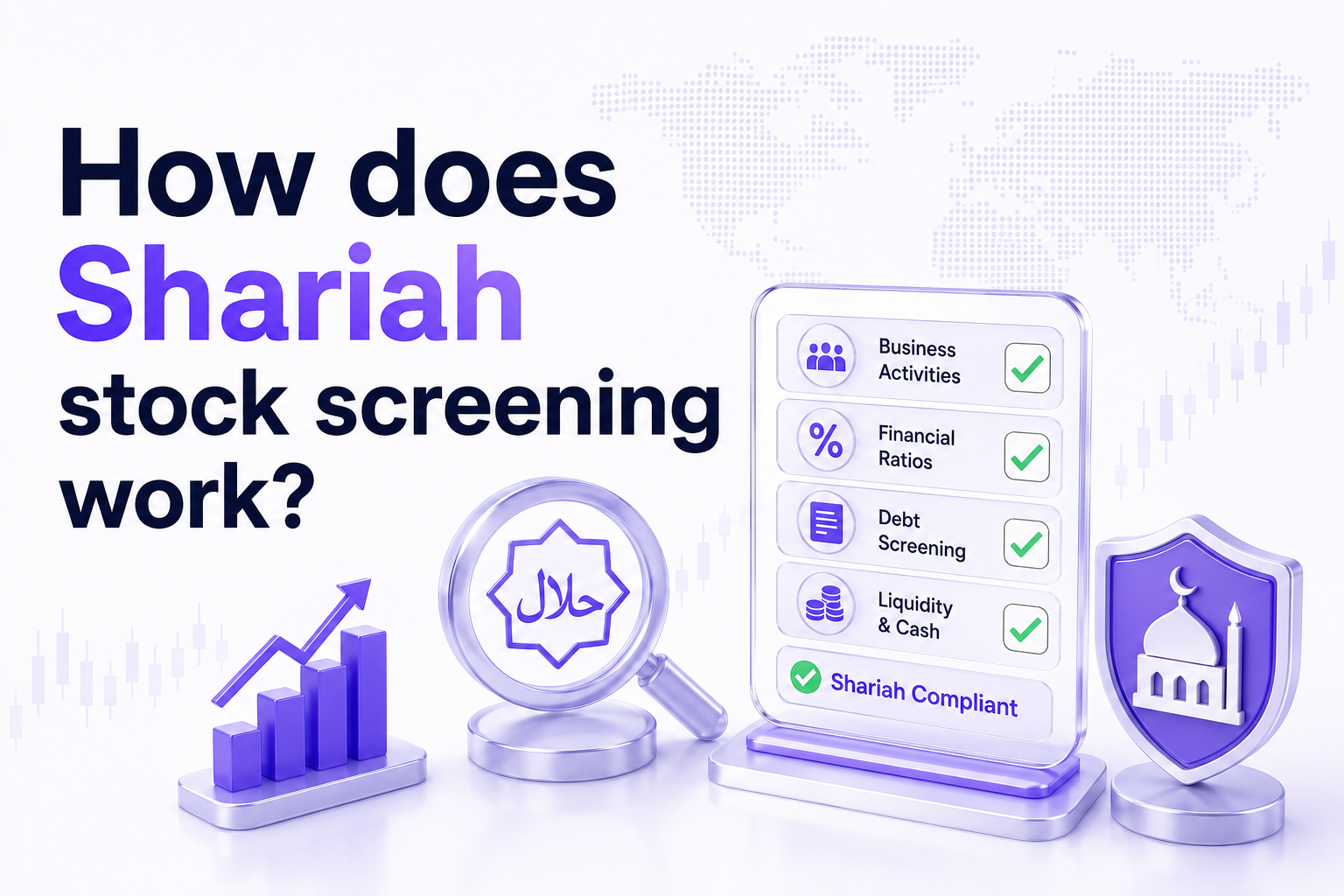
Every halal stock verdict, whether it comes from an app, a fund, or a scholar, rests on the same underlying process: Shariah stock screening. It's how you turn a vague question, “is this company halal?”, into a repeatable test with a clear yes or no. The process has two stages: one looks at what the business does, the other at how its finances are built. Pass both and the stock is considered compliant. Fail either and it isn't. This guide walks through each stage, the numbers behind the well-known 30/30/5 rule, why different standards sometimes disagree, and how to screen a stock yourself.
Quick Answer Shariah stock screening tests whether a company's shares are permissible in Islam using two stages. First, a business-activity screen removes companies whose core work is prohibited (conventional finance, alcohol, gambling, pork, tobacco, weapons, adult content). Second, a financial-ratio screen checks that interest-bearing debt and interest-bearing assets each stay under 30% of market cap, and that impermissible income stays at or under 5% of revenue (AAOIFI's 30/30/5 rule). A stock must pass both, and because the numbers change, it's re-checked each quarter. |
Table of Contents
- What is Shariah stock screening?
- How does the business activity screen work?
- How do the financial ratio screens work?
- Why do screening standards disagree?
- What is dividend purification?
- How do you screen a stock in practice?
What is Shariah stock screening?
Shariah stock screening is the process of checking whether owning a company's shares is permissible under Islamic law. It grew out of a 1998 fatwa written for the Dow Jones Islamic Market Index and was later formalised by AAOIFI Shari'ah Standard No. 21, which most scholars and platforms now treat as the benchmark. The screen has two independent stages, and a stock has to clear both: a qualitative check on the business, then a quantitative check on the finances.
Because it's rule-based and data-driven, screening can be automated, which is why apps can return a verdict in seconds. But the thresholds themselves come from scholarly judgment (ijtihad), so different bodies set them slightly differently. That's worth keeping in mind: screening is precise, but it isn't the same as a personal fatwa.
How does the business activity screen work?
The first stage is the qualitative, or business-activity, screen, and it always comes first. It asks a simple question: what does this company actually do to make money? If the core business is prohibited, the stock fails immediately, no matter how healthy the balance sheet looks.
A company is excluded at this stage if its primary revenue comes from conventional banking or insurance (built on riba), alcohol, gambling, pork, tobacco, weapons, or adult entertainment. Gambling is a clear case: a casino or betting firm earns its money through “gharar and maysir”, so it's out at the business level regardless of its finances. Screeners identify this using sector and industry codes alongside the company's own business description. Only companies with a permissible core business move on to the financial screen.
How do the financial ratio screens work?
A permissible business can still fail if it leans too heavily on interest. The second stage measures that with three ratios, summarised as the 30/30/5 rule under AAOIFI Standard 21:
- Interest-bearing debt must not exceed 30% of market capitalisation. This caps how much of the company runs on riba-based borrowing.
- Interest-bearing deposits and investments must not exceed 30% of market capitalisation. This limits cash parked in interest-earning instruments.
- Impermissible income must stay at or under 5% of total revenue. This covers any minor income from non-compliant sources, such as interest earned on balances.
Break any one of the three and the stock fails the screen. One practical wrinkle: because these ratios use market capitalisation, which moves with the share price, a stock can drift in and out of compliance on price swings alone. Akinda addresses this by applying the AAOIFI screen against an averaged market capitalisation rather than a single day's price, so a verdict doesn't flip on short-term volatility.
Why do screening standards disagree?
You'll sometimes see the same company called halal by one source and questionable by another. Usually nobody is wrong; they're just using different rulebooks. Three settings vary between the major standards.
- The threshold. AAOIFI uses 30%, while the Dow Jones, S&P, FTSE, and MSCI Islamic indices use 33.33%. Both trace back to staying below the “excessive” one-third line drawn from classical fiqh.
- The denominator. AAOIFI, Dow Jones, and S&P measure debt against market cap, which moves with price. FTSE and MSCI use total assets, which is steadier.
- Interest income. AAOIFI and FTSE count interest income inside the 5% limit; S&P, Dow Jones, and MSCI leave it out.
| Standard | Debt limit | Denominator | Interest income in 5%? |
|---|---|---|---|
| AAOIFI | 30% | Market cap | Included |
| Dow Jones & S&P | 33% | Market cap | Excluded |
| FTSE | 33% | Total assets | Included |
| MSCI | 33% | Total assets | Excluded |
These differences are documented in academic reviews of the standards, and they're why the choice of methodology matters. Akinda screens to AAOIFI, the strictest and most widely recognised of the group, so a pass on Akinda tends to hold up under looser standards too.
What is dividend purification?
Screening allows companies with a small amount of impermissible income, up to that 5% line. So even a compliant stock can pass a sliver of impure income to you through its dividend. Purification is the step that cleans it: you give that portion away to charity rather than keeping it.
The calculation is straightforward. Take the company's impure-income ratio, multiply it by the dividend you received, and donate the result, separate from your zakat. The amount is usually small, often well under 1%. Screeners publish the ratio so you don't have to dig through filings. For a fuller walkthrough with income examples, see our guide to “halal dividend stocks”.
How do you screen a stock in practice?
You can run all of this by hand from a company's filings, but it's slow, and the numbers need refreshing every quarter as new earnings come out. In practice most investors use a screener that automates both stages and re-checks compliance on a schedule.
- Enter the ticker and read the business-activity verdict first.
- Check the three financial ratios against the 30/30/5 limits.
- Note the impure-income ratio for purification.
- Re-screen at least quarterly, since debt, cash, and revenue mix all move.
On Akinda's free halal stock screener, each of these shows on a single report. You can open a name like NVIDIA (NVDA) to see the business verdict and the AAOIFI ratios behind it, or browse the top halal stocks that currently pass. If you're still weighing whether equities are permissible at all, start with [internal link: “Is investing in stocks halal or haram?”. And to compare tools, see the top halal investing apps and the wider halal investment platforms for 2026.
Frequently asked questions
What is the 30/30/5 rule?
The 30/30/5 rule is shorthand for AAOIFI's three financial ratios: interest-bearing debt under 30% of market cap, interest-bearing deposits and investments under 30% of market cap, and impermissible income at or under 5% of revenue. A stock must clear all three, on top of passing the business-activity screen, to count as compliant.
Which Shariah screening standard is best?
There's no single “best” standard, but AAOIFI Standard 21 is the most widely recognised and the strictest on thresholds. Dow Jones, S&P, FTSE, and MSCI use 33.33% and differ on the denominator and interest income. Screening to AAOIFI is the safest default because a pass usually holds under looser standards.
How often should you re-screen a stock?
At least once a quarter, after each earnings report. Debt levels, cash positions, and revenue mix all change over time, so a stock that passes today can fail a later review. Good screeners revalidate their coverage every quarter, and serious investors re-check holdings on the same cadence.
Can a halal stock become haram?
Yes. Because screening depends on financial ratios that move with the business, a company can breach the debt or income limits in a later quarter, or shift its business mix into a prohibited area. Compliance is a snapshot, not a permanent label, which is why ongoing monitoring matters.
Do screening apps replace a scholar?
No. A screener automates the data checks against criteria that scholars established, which makes it fast and consistent, but its verdict isn't a fatwa. For borderline names or questions specific to your situation, a qualified scholar or Shariah board should have the final word.
Sources
- AAOIFI Shari'ah Standard No. 21: Financial Paper (Shares and Bonds) – the standard defining the two-stage screen and the 30/30/5 financial ratios.
- Fiqh Council of North America – Halal stock investing: Shariah standards explained – detail on the ratios, the 1998 Dow Jones fatwa origin, and dividend purification.
- From Binary Screens to Continuous Compliance: A Shariah Screening Measure (academic paper) – comparison of thresholds, denominators, and income treatment across AAOIFI, FTSE, MSCI, and others.
Download the Akinda app and screen over thousands of global stocks, monitor Shariah compliance in real time
🌐 Website: https://akinda.io
📱 App: https://onelink.to/kpqkh6
Disclaimer
This article is for educational purposes only and is not financial or religious advice. Automated Shariah screening does not replace the judgement of a qualified scholar. Thresholds and interpretations differ across standards and jurisdictions, and compliance status changes over time; verify current figures before investing.