
- Halal investing for beginners
- Investing Principles
How to Build a Halal Investment Portfolio
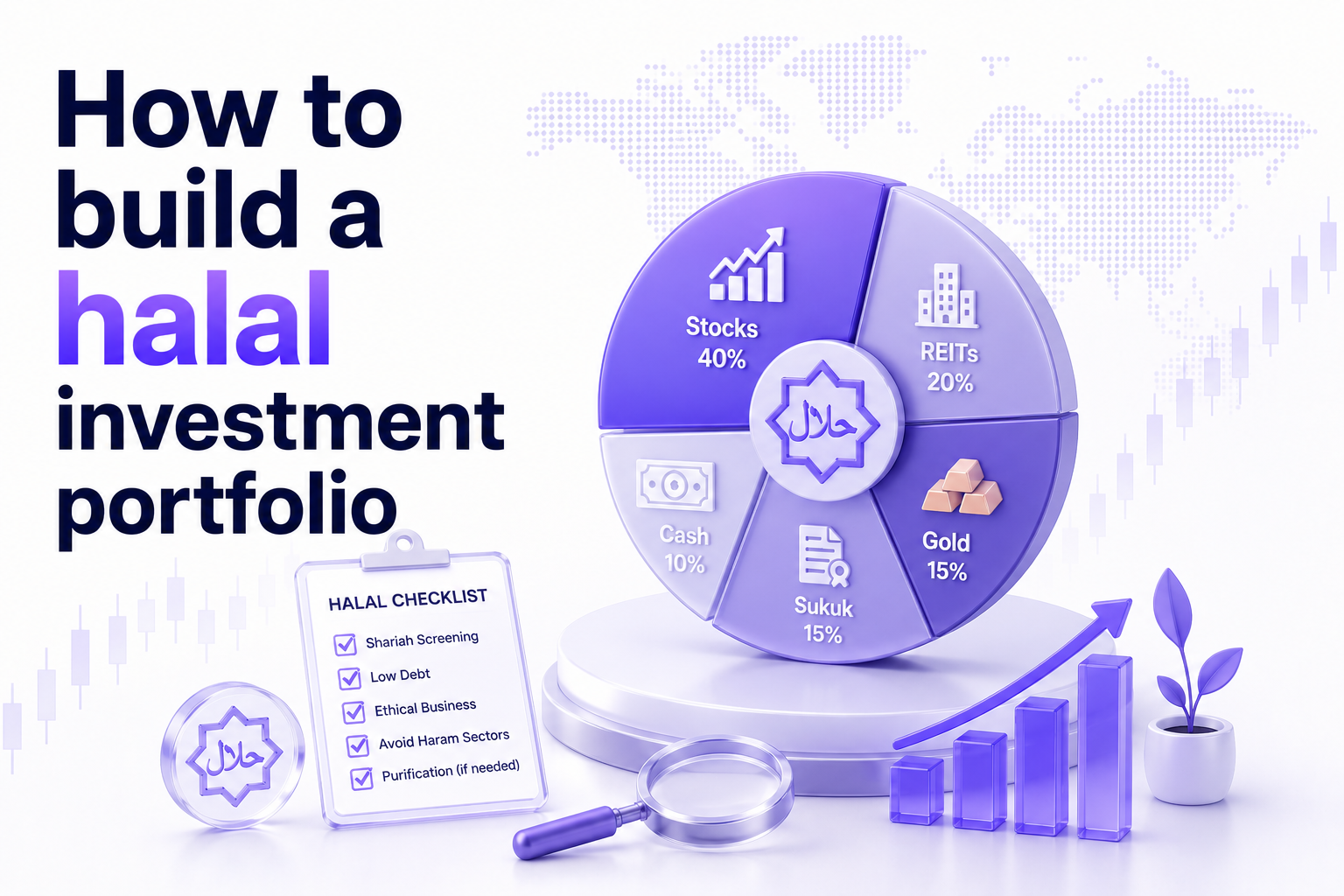
Building wealth and staying true to your faith aren't in conflict; they just need a plan. A halal investment portfolio is one where every holding is Shariah-compliant and the whole thing is balanced to your goals. The building blocks are familiar, screened stocks, halal ETFs, sukuk, gold, and real estate, and the discipline is in how you combine and maintain them. This guide walks through what goes into a halal portfolio, how to set your allocation, and how to keep it compliant over time, whether you pick each holding yourself or follow a ready-made model.
Quick Answer To build a halal investment portfolio, first decide your goals and risk tolerance, then choose an allocation across Shariah-compliant assets: screened stocks or halal ETFs for growth, sukuk for stability, and a little gold or cash. Screen every stock against Shariah criteria (or use certified halal funds), hold it all in a swap-free account, and avoid interest and speculation. Then maintain it: re-screen quarterly, purify small impure income, and rebalance periodically. You can build it yourself or follow a ready-made halal portfolio and track it in one place. |
Table of Contents
- What is a halal investment portfolio?
- What can you put in it?
- How do you set your asset allocation?
- How do you build it step by step?
- How do you keep it halal over time?
- Tools to build and track your portfolio
What is a halal investment portfolio?
A halal investment portfolio is a collection of investments that all comply with Islamic law, arranged to match your financial goals. Every holding avoids riba (interest), gharar (excessive uncertainty), and maysir (gambling), and steers clear of prohibited industries. Beyond that, it follows the same principles as any sound portfolio: diversification, a sensible balance of risk and return, and a long-term view. If you're new to the foundations, start with Shariah-compliant investing explained article.
What can you put in it?
A halal portfolio can hold most of the asset classes any diversified investor uses. The wrapper differs, but each must represent real, permissible ownership.
- Screened stocks in companies that pass the business and financial screens, for long-term growth.
- Halal ETFs that hold only screened securities, for instant diversification in one trade.
- Sukuk as the fixed-income sleeve, sharing in real asset cash flows instead of paying interest.
- Gold, physical or fully-allocated, as a store of value and inflation hedge.
- Real estate directly or through screened, income-producing property companies (REITs).
Conventional bonds, interest-bearing savings, and speculative derivatives sit outside all of this and have no place in a halal portfolio.
How do you set your asset allocation?
Allocation, how you split your money across asset classes, matters more than any single pick. It flows from two things: how long until you need the money, and how much volatility you can stomach. Longer horizons and higher risk tolerance can lean more into equities; shorter horizons favour sukuk and cash.
| Profile | Stocks / ETFs | Sukuk | Gold / cash |
|---|---|---|---|
| Aggressive (long horizon) | 80–90% | 5–10% | 5–10% |
| Balanced (medium horizon) | 60% | 25% | 15% |
| Conservative (short horizon) | 40% | 40% | 20% |
These are illustrative starting points, not advice. Adjust them to your own situation, and rebalance back toward your targets as markets move.
How do you build it step by step?
With a target allocation in mind, the build itself is straightforward.
- Set your goals and horizon. Know what the money is for and when you'll need it.
- Pick your allocation across stocks or ETFs, sukuk, and gold, using your risk tolerance as the guide.
- Select the holdings. Screen individual stocks for compliance, or choose certified halal ETFs that screen for you.
- Diversify across sectors and regions so no single position or theme dominates.
- Open a swap-free brokerage account so idle cash doesn't earn interest, and buy your positions.
If you'd rather not assemble it from scratch, you can follow Akinda's publicly tracked Ready-Made Portfolio, a model set of screened holdings you can use as a template or starting point.
How do you keep it halal over time?
A halal portfolio isn't set-and-forget, because a company's compliance can change as its finances shift. Maintenance keeps it clean.
- Re-screen quarterly. Check that your holdings still pass after each earnings season, and replace any that drift out of compliance.
- Purify impure income. Donate the small portion of dividends that comes from incidental interest, as explained in what is purification article.
- Rebalance periodically. Trim what's grown beyond target and top up what's lagged, to hold your intended risk level.
- Pay zakat annually on your zakatable wealth, separate from purification.
Tools to build and track your portfolio
The right tools turn this from a chore into a routine. On Akinda, you can screen any company on the halal stock screener, start from a compliant shortlist by browsing the top halal stocks, and follow the Ready-Made Portfolio if you want a model to build around.
Once you're invested, My Portfolio lets you track your halal holdings in one place and monitor their Shariah compliance in real time, so you can catch a holding slipping out of compliance before it becomes a problem. That ongoing monitoring is what keeps a portfolio halal, not just on the day you build it, but every quarter after.
Frequently asked questions
How much money do I need to start a halal portfolio?
Not much. With fractional shares, you can start a diversified halal portfolio with a small amount, even a single halal ETF gives broad exposure. What matters more than the starting sum is consistency, keeping the account swap-free, and screening what you hold. You can add asset classes like sukuk and gold as your portfolio grows.
Can I build a halal portfolio with just ETFs?
Yes. A common structure combines a US-equity halal ETF, an international one, and a sukuk ETF for fixed income, optionally with a REIT fund. That gives a diversified, multi-asset halal portfolio in a handful of holdings, with screening handled by the fund providers. It's the simplest route for hands-off investors.
How often should I rebalance a halal portfolio?
Once or twice a year is enough for most investors, or whenever an asset class drifts far from its target. Rebalancing keeps your risk level in line with your plan. Pair it with your quarterly compliance re-screen so you handle both maintenance tasks on a predictable schedule.
Do I need a financial advisor?
Not necessarily. Many investors build and run halal portfolios themselves using a screener and certified funds. An advisor can help with complex situations, tax, or larger sums, ideally one familiar with Islamic finance. For religious rulings on specific holdings, a qualified scholar rather than an advisor should have the final word.
Sources
AAOIFI Shari'ah Standard No. 21: Financial Paper (Shares and Bonds) – the screening criteria behind the equities in a halal portfolio.
AAOIFI Shari'ah Standard No. 17: Investment Sukuk – the basis for sukuk, the halal fixed-income building block.
Fiqh Council of North America – ruling on investing in shares – confirms the permissibility of owning screened, diversified equities.
Download the Akinda app Screen thousands of global stocks and monitor Shariah compliance in real time. 🌐 Website: akinda.io 📱 App: onelink.to/kpqkh6 |
Disclaimer
This article is for educational purposes only and is not financial or religious advice. Example allocations are illustrative, not recommendations. Compliance status changes over time; verify holdings before investing, and consult a qualified financial adviser and scholar for your situation.