
- Trading Strategies
Is Day Trading Halal or Haram? AAOIFI Verdict for Muslim Traders (2026)
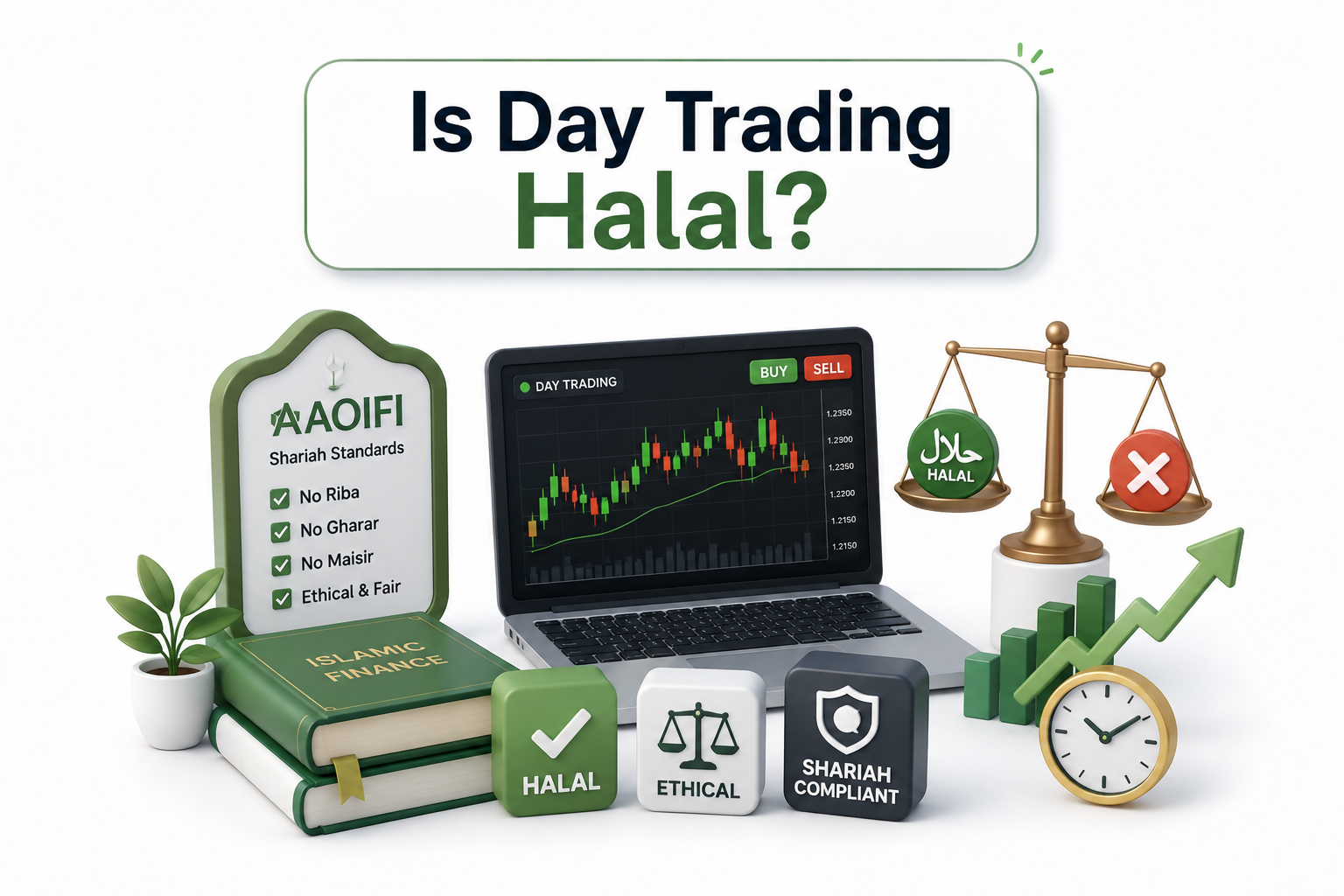
Table of contents:
- Introduction
- What is day trading and how does it work?
- The core Islamic question: do you own what you’re selling?
- The three prohibitions: Riba, Gharar, Maysir
- What scholars and institutions actually say
- AAOIFI Standard 21, Section 3/7 - the key ruling
- Clear halal conditions vs. clear haram practices
- The bottom line: where does day trading stand?
- FAQ - every remaining question answered
Introduction
The short answer: Day trading is not automatically haram - three conditions decide it: whether you genuinely own what you sell, whether interest or leverage is involved, and whether your method is disciplined analysis or reckless speculation. Meet all three, and a group of contemporary scholars permit it; fail any one and it becomes impermissible by consensus.
Scholars are genuinely divided here. AAOIFI Shariah Standard No. 21 permits reselling shares once trade formalities are complete and liability has transferred, even before final settlement - the strongest institutional basis for permissibility. Other scholars discourage day trading entirely, arguing that rapid speculation resembles maysir more than commerce.
This article covers what day trading is, the settlement and ownership question under T+1, how riba, gharar, and maysir apply, what the major scholarly bodies actually rule, and the specific conditions that separate permissible from impermissible practice.
New to the topic? Start with the foundational principles in our beginner's guide to halal trading.
1. What Is Day Trading and How Does It Work?
Day trading means buying and selling a financial asset - such as stocks, currencies, or commodities - within the same trading day, usually closing all positions before the market closes. The goal is to profit from short-term price movements rather than long-term ownership of a business.
A simple example: You buy 100 shares of Apple at $150 at 10 AM. By 2 PM, the price rises to $152. You sell, realize a $200 profit, and end the day holding no shares.
Two things make this Islamically significant:
- Intent: The primary objective is short-term price movement rather than long-term participation in the business itself.
- Speed: Multiple transactions may occur in a single day, raising questions about ownership, settlement, and speculation.
Day trading vs long-term investing
Long-term investing in halal companies resembles participation in a productive business enterprise (similar in spirit to musharakah). Day trading, by contrast, focuses primarily on short-term market movements. These are different activities from an Islamic finance perspective, even if both involve the same stocks.
2. The Core Islamic Question: Do You Own What You’re Selling?
One of the core principles of Islamic commercial law is that a seller should own or possess what they are selling. This is grounded in the hadith:
“Do not sell what you do not possess.”
- Prophet Muhammad ﷺ (Sunan al-Tirmidhi)
This creates an important question in day trading:
When you buy a stock and sell it shortly afterward, do you genuinely own it at the moment of resale?
Understanding Settlement (T+1)
Modern stock markets use a settlement process - the formal transfer of shares to the buyer and cash to the seller.
In the United States:
- markets operated on T+2 settlement until May 2024,
- and now operate on T+1 settlement.
This means ownership is formally finalized one business day after the trade executes.
So if someone buys a stock at 10 AM and sells it at 2 PM the same day, the shares may not yet be formally settled in their account.
This raises a legitimate Shariah question:
Can someone resell an asset before final settlement completes?
The “Constructive Possession” Argument
Many contemporary scholars address this through the concept of qabd hukmi (constructive possession).
Their reasoning:
- once the trade executes,
- the buyer bears market risk,
- cannot freely cancel the transaction,
- and effectively controls the asset economically.
Under this view, meaningful ownership has already transferred even before technical settlement finalizes.
AAOIFI’s important ruling
AAOIFI Shariah Standard No. 21 states that reselling shares may be permissible after trade formalities are completed and liability has transferred to the buyer, even before final settlement occurs.
This is one of the most influential contemporary institutional rulings related to the ownership question in day trading.
However, some scholars maintain a stricter opinion and argue that fully settled ownership is still required before resale.
3. The Three Core Prohibitions: Riba, Gharar, and Maysir
Most scholarly discussions about day trading revolve around three major Islamic prohibitions.
Understanding them carefully matters because the ruling often depends on the structure of the trading activity itself.
Riba (Interest)
The clearest issue arises in margin trading.
Margin trading involves borrowing money from a broker - often with interest - to increase position size. This is widely considered impermissible due to riba.
A more nuanced issue appears when brokers temporarily advance settlement funds between trade execution and settlement completion.
Some scholars, including certain SeekersGuidance rulings within the Shafi’i school, have stated that a genuinely interest-free structure may resemble a cash account.
Other scholars remain cautious because brokers may still derive indirect financial benefit from the arrangement.
For this reason, many scholars consider a fully funded cash account the safest structure.
Gharar (Excessive Uncertainty)
Gharar refers to excessive contractual uncertainty or ambiguity.
The concern in day trading is whether rapid short-term speculation becomes excessively detached from genuine economic activity or informed decision-making.
Some contemporary scholars argue that:
- structured research,
- disciplined strategies,
- and informed analysis differ from purely random speculation.
Others remain concerned that highly speculative trading environments can still involve excessive uncertainty.
Maysir (Gambling)
Maysir refers to gambling-like gain based primarily on chance rather than productive economic activity.
Critics of day trading argue that:
- excessive speculation,
- emotional trading,
- leverage,
- and rapid price betting can structurally resemble gambling behavior.
Other scholars distinguish between reckless speculation, and disciplined analysis-based trading.
This remains one of the key areas of scholarly disagreement.
Important distinction
Unlike riba, which is usually clear and binary, gharar and maysir often depend on degree, structure, and context.
This is why scholars frequently analyze intent, methodology, leverage, ownership, and trading behavior itself.
4. What Scholars and Institutions Actually Say
There is no single universal fatwa that fully settles the issue of day trading.
However, contemporary scholarly discussions generally fall into several recognizable positions.
| Scholar / Institution | Position | Summary |
|---|---|---|
| AAOIFI (Shariah Standard 21) | Conditional Permissibility | Reselling shares before final settlement may be permissible if ownership risk/liability has transferred to the buyer. However, this does not broadly permit all modern leveraged or speculative trading structures. |
| SeekersGuidance (Shafi’i scholars) | Permissible Under Strict Conditions | Trading Shariah-compliant stocks may be permissible when conducted without riba, prohibited leverage, or impermissible derivatives. Certain genuinely interest-free arrangements may be treated similarly to cash accounts. |
| Islamic Fiqh Academy (OIC / MWL) | Generally Cautious | Genuine spot ownership is generally accepted, while leverage, speculative deferred contracts, and many derivative structures are strongly criticized or considered impermissible. |
| Islamic Finance Guru (IFG) | Scholarly Gray Zone | IFG acknowledges that some scholars permit day trading under strict conditions, while also emphasizing concerns around speculation, discipline, and maintaining Shariah compliance consistently. |
| Many Contemporary Conservative Scholars | Often Discouraged or Considered Impermissible | Some scholars criticize day trading due to excessive speculation, resemblance to gambling, emotional volatility, and weak connection to productive economic activity — especially when leverage or derivatives are involved. |
| Malaysia Shariah Advisory Council (SAC) | More Permissive Framework | Malaysian Islamic finance standards are generally more open toward active stock trading if transactions avoid interest, prohibited leverage, and non-compliant instruments. |
| MUIS (Singapore) | Context-Dependent | Trading activities may be permissible if they avoid riba, excessive gharar, and unethical practices while maintaining proper Shariah screening. |
The disagreement is often less about the word “day trading” itself and more about:
- how the trading is structured,
- what instruments are used,
- whether genuine ownership exists,
- and whether prohibited elements are involved.
5. AAOIFI Standard 21, Section 3/7 - The Key Discussion
AAOIFI’s Shariah Standard No. 21 is one of the most frequently cited institutional references in discussions about stock trading and settlement.
The standard states:
“It is permissible to the buyer of a share to undertake transactions in it by way of sale to another after completion of the formalities of the sale and transfer of liability to him, even though final settlement has not yet occurred.”
In practical terms, this means:
- once a trade is executed,
- and liability/risk transfers to the buyer,
- resale may be permissible before formal settlement finalizes.
This forms one of the primary foundations for scholars who permit certain forms of short-term stock trading.
However, stricter scholars still argue that fully settled ownership should occur before resale.
What T+1 Changed
The shift from T+2 to T+1 settlement reduced the ownership-gap concern discussed by stricter scholars.
If same-day settlement (T+0) becomes standard globally in the future, some ownership-related objections may weaken further.
However, even with instant settlement, other issues would still remain relevant:
- leverage,
- riba,
- derivatives,
- speculation,
- and gambling-like behavior.
6. Clear Halal Conditions vs. Clearly Impermissible Practices
Conditions Many Permissive Scholars Require
- ✓ Fully funded cash account
✓ Shariah-compliant stocks only
✓ No interest or interest-equivalent fees
✓ No short selling
✓ No prohibited derivatives
✓ Genuine ownership exposure
✓ Analysis-based decision making rather than reckless speculation
Practices Widely Considered Impermissible
- × Interest-based margin trading
× Conventional leveraged trading
× Short selling borrowed shares
× CFDs (Contracts for Difference)
× Conventional options trading
× Conventional futures contracts
× Leveraged crypto perpetuals
× Interest-equivalent overnight swap structures
The “Islamic account” issue
Some brokers market “Islamic” or “swap-free” accounts. However, scholars have repeatedly warned that certain brokers simply rename interest charges as administrative fees while keeping the same economic structure. Careful verification is important.
7. The Bottom Line: Where Does Day Trading Stand?
The most balanced summary is this:
Some contemporary scholars permit certain forms of day trading under strict conditions, including:
- genuine ownership,
- Shariah-compliant stocks,
- no interest,
- no leverage,
- no prohibited derivatives,
- and avoidance of reckless speculation.
Other scholars discourage or prohibit day trading due to concerns around:
- excessive speculation,
- gambling-like behavior,
- uncertainty,
- and detachment from productive economic activity.
What is broadly agreed upon is that:
- leverage-based trading,
- interest-based margin,
- short selling,
- and derivative-heavy speculation
create major Shariah concerns.
Many scholars also view long-term investing as more closely aligned with the broader Islamic ideals of partnership, productive ownership, and real economic participation.
Practical approach
Anyone considering active trading should:
- use a genuine cash account,
- avoid all interest and leverage,
- trade only AAOIFI-screened stocks (use Akinda to verify)
- avoid derivatives and short selling,
- and consult a qualified scholar regarding their specific setup and circumstances.
8. FAQ - Every Remaining Question Answered
Is day trading halal or haram?
Scholars differ.
Some permit it under strict conditions:
- halal stocks,
- genuine ownership,
- no interest,
- no leverage,
- no short selling,
- and no prohibited derivatives.
Others discourage or prohibit it due to speculation and gambling-related concerns.
What does AAOIFI Standard 21 actually say?
AAOIFI states that shares may be resold after trade formalities are complete and liability transfers to the buyer, even before final settlement occurs.
This is one of the primary institutional foundations for permissibility arguments regarding short-term stock trading.
Did T+1 settlement make day trading “more halal”?
It reduced one ownership-related objection because settlement now occurs faster.
However, it did not eliminate broader debates around leverage, speculation, derivatives, and gambling-like behavior.
Is a zero-interest margin account halal?
Some scholars have viewed certain genuinely interest-free arrangements more leniently.
However, many scholars remain cautious.
A fully funded cash account remains the safest and least controversial structure.
Why is short selling controversial in Islam?
The primary concern is selling something that the trader does not fully own or possess.
Many scholars also criticize its speculative nature and broader economic implications.
Why are conventional options and futures usually considered impermissible?
Major contemporary fiqh bodies - including the OIC Islamic Fiqh Academy - have generally considered conventional options and futures impermissible due to:
- excessive gharar,
- speculative structure,
- and ownership-related concerns.
Are there halal alternatives to day trading?
Yes. Long-term investing in Shariah-screened equities has the broadest scholarly acceptance and aligns more closely with productive ownership and partnership principles.
Some scholars also view swing trading more favorably than high-frequency day trading, particularly when it involves:
- genuine ownership,
- Shariah-compliant stocks,
- no leverage or interest,
- and research-based decision making rather than rapid speculation.
However, the same core Islamic principles - avoiding riba, excessive gharar, and gambling-like behavior - still apply.
How do I check if a stock is Shariah-compliant?
Use shariah screening tools like Akinda. They screen companies based on:
- business activity,
- debt levels,
- non-halal income,
- and other AAOIFI-style screening criteria.
Disclaimer: This article is for educational purposes only and does not constitute a fatwa or financial advice. Scholarly opinions on Islamic finance vary. Consult a qualified Islamic scholar before making trading or investment decisions.