
- Halal investing for beginners
SPUS vs HLAL: Which Halal ETF Is Better?
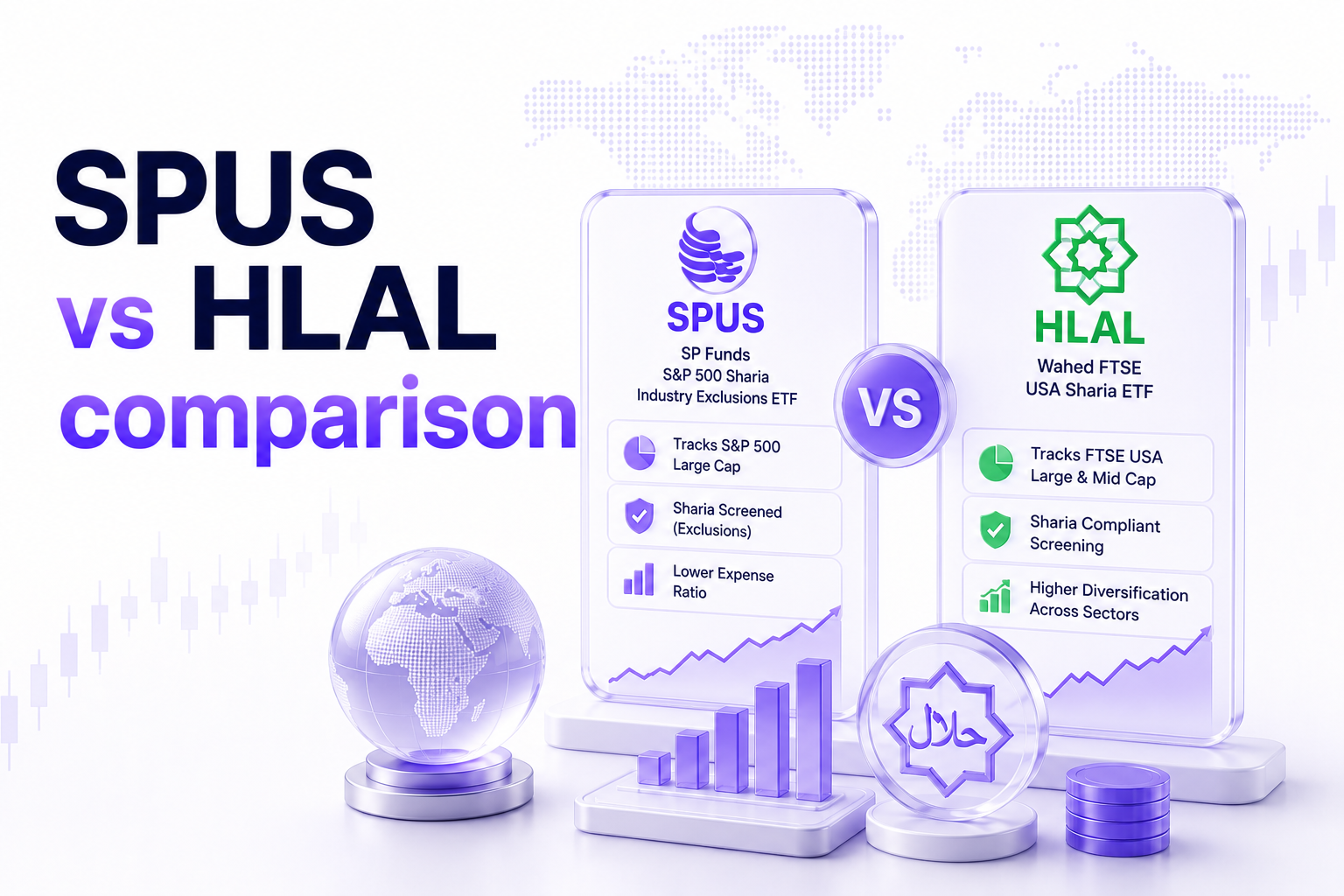
If you're building a halal portfolio in the US, two ETFs dominate the shortlist: SPUS and HLAL. They do the same essential job, giving you a basket of Shariah-screened US companies in a single trade, and their holdings overlap heavily. But they track different indices, come from different providers, and differ on fees and screening methodology. This SPUS vs HLAL comparison breaks down how they stack up on cost, holdings, performance, and Shariah screening, so you can pick the one that fits. Figures are a 2026 snapshot; confirm the latest before investing.
Quick Answer SPUS and HLAL are the two largest US-listed halal ETFs, and they're very similar, moving almost in lockstep. SPUS (by SP Funds) tracks a screened S&P 500 index, charges 0.45%, and has been marginally cheaper and slightly higher-returning over recent years. HLAL (by Wahed) tracks the FTSE USA Shariah index, charges 0.50%, includes some mid-caps, and has shown slightly lower volatility. For most investors either works well; SPUS edges it on cost, while HLAL offers a touch more diversification. Holding both adds little, since they overlap heavily. |
Table of Contents
- SPUS vs HLAL: the quick verdict
- What are SPUS and HLAL?
- How do SPUS and HLAL differ?
- Performance: SPUS vs HLAL
- Which should you choose?
- Alternatives to SPUS and HLAL
SPUS vs HLAL: the quick verdict
Both funds are solid, Shariah-certified ways to own US equities, and they're more alike than different, with a correlation around 0.91. The deciding factors are small: SPUS is slightly cheaper and has posted marginally higher raw returns, while HLAL draws from a wider universe that includes some mid-caps and has shown slightly lower volatility. Neither is clearly “better”; the right pick depends on whether you weight cost, diversification, or risk more heavily.
What are SPUS and HLAL?
Both are exchange-traded funds that hold only Shariah-screened US stocks, so you get a diversified, compliant equity portfolio in one trade. The screening removes prohibited sectors and companies with too much interest-based debt or income, the same AAOIFI-style screening applied to individual stocks.
- SPUS is the SP Funds S&P 500 Sharia Industry Exclusions ETF, launched in December 2019. It tracks a screened version of the S&P 500 and is the larger, more heavily traded of the two.
- HLAL is the Wahed FTSE USA Shariah ETF, launched in July 2019. It tracks the FTSE USA Shariah Index and is managed by Wahed, with quarterly Shariah audits.
How do SPUS and HLAL differ?
The differences are real but modest. Here's how they compare on the factors that matter.
| Feature | SPUS | HLAL |
|---|---|---|
| Provider | SP Funds | Wahed |
| Index | S&P 500 Shariah | FTSE USA Shariah |
| Expense ratio | 0.45% | 0.50% |
| Holdings | ~210, large-cap | ~200, large & mid-cap |
| Tech weight | ~45% | ~43% |
| Launched | December 2019 | July 2019 |
The headline distinction is the index. SPUS screens the S&P 500, so it's purely large-cap. HLAL screens the broader FTSE USA universe, which can include mid-cap companies that pass screening but sit outside the S&P 500. Because S&P and FTSE apply slightly different Shariah thresholds, a company can pass one screen and not the other, which is why the two funds don't hold identical baskets.
Performance: SPUS vs HLAL
Over recent multi-year periods, SPUS has posted marginally higher total returns than HLAL, helped partly by its lower fee, while HLAL has at times shown slightly lower volatility and a competitive risk-adjusted return. Both have broadly kept pace with or beaten the conventional S&P 500 in some stretches, largely because screening tilts them toward technology during tech-led rallies.
The gap between them is small and shifts over time, so it shouldn't be the sole basis for a decision. As always, past performance doesn't guarantee future results, and a fund that leads on raw return in one period can trail in another depending on how tech performs.
Which should you choose?
For most investors, the choice comes down to a few simple leanings:
- Choose SPUS if you want the lowest fee, the deepest liquidity, and pure large-cap S&P 500 exposure.
- Choose HLAL if you'd like a little mid-cap diversification and prefer Wahed's FTSE-based methodology.
- Don't hold both expecting diversification. With a correlation around 0.91 they move almost identically, so owning one is usually more efficient.
Alternatives to SPUS and HLAL
If neither fits, the newer MNZL offers broader US coverage through a screened Russell 1000, and a sukuk ETF like SPSK can add halal fixed income. You'll find the full landscape in “best halal ETFs 2026” article. And if you'd rather own individual names than a fund, both SPUS and HLAL are built from stocks you can screen yourself, familiar holdings like Apple and Microsoft, on Akinda's halal stock screener, where you can also browse the top halal stocks.
Frequently asked questions
Is SPUS or HLAL cheaper?
SPUS is slightly cheaper, with an expense ratio of about 0.45% versus roughly 0.50% for HLAL. The difference is small, around a dollar a year on a $10,000 investment, but it compounds over long holding periods, so cost-focused investors may lean toward SPUS.
Do SPUS and HLAL hold the same stocks?
They overlap heavily but aren't identical. Both are dominated by large-cap US technology and healthcare names, so their top holdings look similar. But SPUS screens the S&P 500 while HLAL screens the broader FTSE USA universe using different thresholds, so each holds some names the other doesn't.
Should I buy both SPUS and HLAL?
Usually not. The two funds have a correlation of about 0.91, meaning they move almost together, so holding both adds very little diversification, you'd essentially double a single position. Picking one is more capital-efficient. If you want to diversify further, add an international or sukuk ETF instead.
Do SPUS and HLAL require purification?
Yes. Like any halal equity fund, both hold companies that earn small amounts of incidental interest, so a little impure income passes through their dividends. Each publishes purification guidance, and you donate that small portion to charity, separate from zakat, to keep the income clean.
Sources
AAOIFI Shari'ah Standard No. 21: Financial Paper (Shares and Bonds) – the screening framework both funds' underlying indices apply.
Fiqh Council of North America – ruling on investing in shares – confirms the permissibility of owning screened US equities.
The Past, Present, and Future of Shari'ah-Compliant Equities (INCEIF journal) – academic context on screening methodologies like those behind SPUS and HLAL.
Download the Akinda app Screen thousands of global stocks and monitor Shariah compliance in real time. 🌐 Website: akinda.io 📱 App: onelink.to/kpqkh6 |
Disclaimer
This article is for educational purposes only and is not financial or religious advice. Fund fees, holdings, and performance change over time, and the figures here are approximate 2026 snapshots. Verify current data and the fund's fatwa before investing, and consult a qualified scholar for your situation.