
- Stock Market & Equities
Top 10 Halal Healthcare Stocks 2026
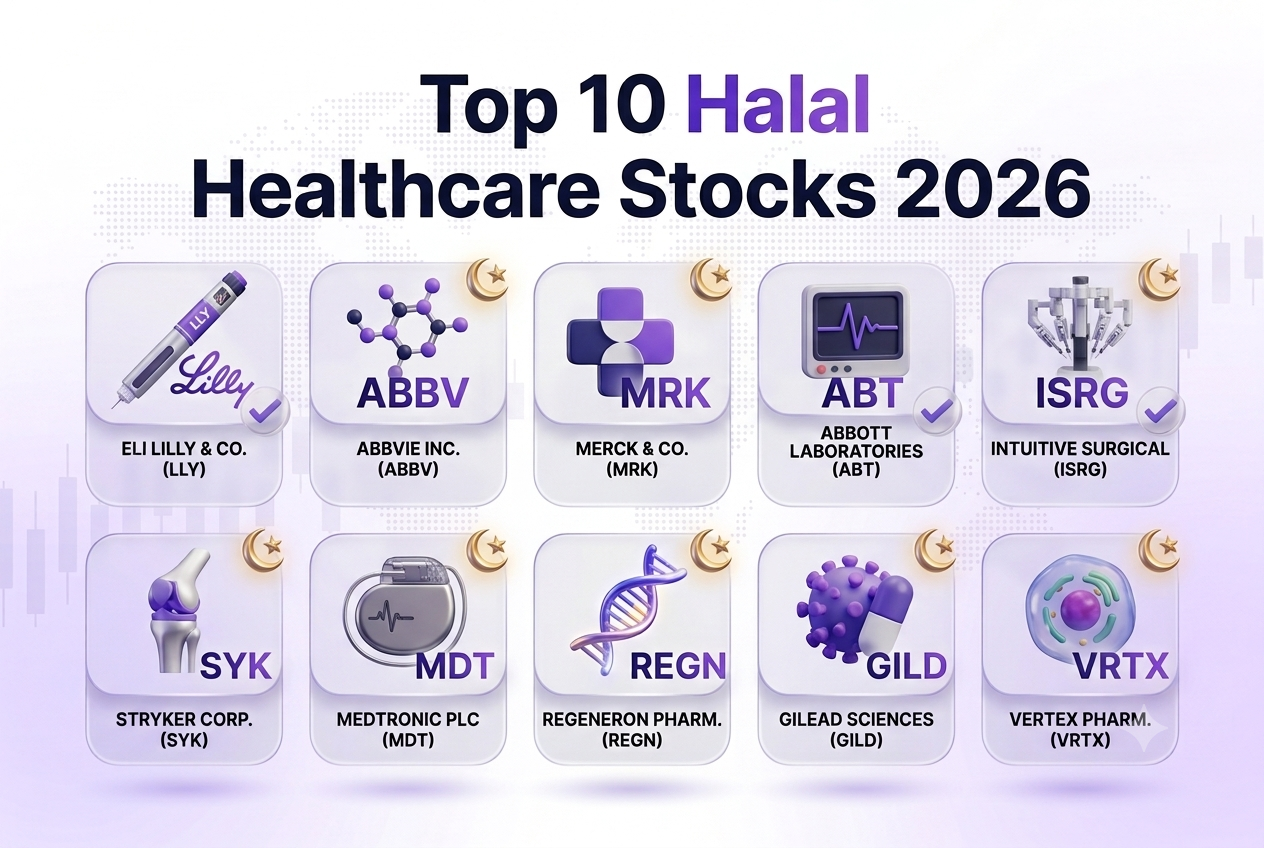
Healthcare is one of the friendliest sectors for Muslim investors, and it is underused. The businesses are permissible almost by definition, treating illness rather than selling anything prohibited, and the large pharmaceutical and medical device companies tend to fund themselves from cash flow rather than heavy borrowing. That combination is exactly what the AAOIFI financial screen rewards. This list covers ten healthcare names that pass Shariah screening in 2026, and explains where the sector still hides a compliance trap.
Quick Answer The top halal healthcare stocks for 2026 include Eli Lilly, AbbVie, Merck, Abbott, Intuitive Surgical, Stryker, Medtronic, Regeneron, Gilead and Vertex, all screened as compliant under AAOIFI Standard 21 in mid-2026. Medical devices and large-cap pharma give the cleanest exposure because they combine permissible activity with low interest-bearing debt relative to market capitalisation. |
Table of Contents
- How these healthcare stocks were selected
- The top 10 halal healthcare stocks for 2026
- A closer look at the sector
- Which healthcare stocks fail the screen?
- How to use this list
How these healthcare stocks were selected
Every name was run through the two-stage AAOIFI screen. The first stage asks whether the core business is permissible. The second measures interest-bearing debt and interest-earning assets against market capitalisation, both capped at 30%, and non-permissible income against revenue, capped at 5%.
We covered pharmaceuticals, medical devices, biotech and animal health, and kept only names returning a HALAL verdict in mid-2026. Hospital operators and health insurers were excluded as a group: insurance is a conventional financial activity that most scholars treat as impermissible, and hospital chains tend to carry debt levels that break the 30% test.
The top 10 halal healthcare stocks for 2026
Ten AAOIFI-screened healthcare companies. Tickers link to their full Shariah report.
| Ticker | Company | What it does and why it fits |
|---|---|---|
| LLY | Eli Lilly | Diabetes and obesity treatments; permissible revenue, strong cash generation. |
| ABBV | AbbVie | Immunology and neuroscience pharma with a broad screened portfolio. |
| MRK | Merck | Oncology and vaccines; long-standing presence on halal equity lists. |
| ABT | Abbott | Diagnostics, devices and nutrition, all permissible activity. |
| ISRG | Intuitive Surgical | Robotic surgery systems; historically net cash with minimal borrowing. |
| SYK | Stryker | Orthopaedic implants and surgical equipment. |
| MDT | Medtronic | Cardiac, diabetes and neuromodulation devices. |
| REGN | Regeneron | Antibody-based biotech with a conservative balance sheet. |
| GILD | Gilead Sciences | Antiviral and oncology therapies. |
| VRTX | Vertex Pharmaceuticals | Cystic fibrosis franchise; low leverage, high margins. |
Two more names worth knowing sit just outside the ten: ZTS (Zoetis, animal health) and BSX (Boston Scientific) both screened as compliant on the same data.
A closer look at the sector
The three sub-sectors behave differently under the screen, and it helps to know why.
- Large-cap pharma (Lilly, Merck, AbbVie, Gilead) passes comfortably because market capitalisations are enormous relative to the debt raised for acquisitions. Watch the debt ratio after any large deal.
- Medical devices (Abbott, Stryker, Medtronic, Intuitive Surgical, Boston Scientific) is the cleanest corner of healthcare. These are manufacturing businesses with predictable cash flows and modest borrowing.
- Biotech (Regeneron, Vertex) is compliant but more volatile. Smaller biotechs frequently fail the screen because they burn cash and fund research with convertible debt, which counts as interest-bearing.
One thing to check before you buy any pharmaceutical name: some scholars raise questions about specific product categories, such as certain vaccine components or pork-derived excipients used in capsules. This does not appear in the financial screen, and it is a matter to take to your own scholar rather than something an automated verdict can settle.
Which healthcare stocks fail the screen?
The sector is not uniformly compliant, and the failures cluster in predictable places.
- Health insurers. Conventional insurance combines gharar with interest earned on float, so these fail at the business stage regardless of financials.
- Hospital and clinic operators. Property-heavy and usually financed with substantial conventional debt, which pushes the debt ratio past 30%.
- Pharmacy retail chains. Many sell alcohol and tobacco alongside medicines, and carry high leverage.
- Small-cap biotech. Convertible notes and credit facilities are the standard funding route before a drug reaches market, and they break the debt test.
This is why sector-level assumptions are dangerous. Healthcare is friendlier than most, but roughly speaking the closer a company sits to finance or to property, the more likely it is to fail.
How to use this list
Healthcare works well as a defensive counterweight in a halal portfolio, since demand for treatment does not disappear in a recession. That makes it a useful pairing with the more cyclical technology and semiconductor names that dominate most Shariah-screened lists.
Treat every name here as a research starting point rather than a buy signal. A stock passing the screen tells you it is permissible to own. It tells you nothing about whether the price is reasonable or whether the company suits your risk tolerance.
The habit that matters most is re-screening. Compliance is recalculated from each new filing, so a verdict from six months ago is history, not information. Check any ticker on the halal stock screener, where each name above links to its full Shariah report, or browse the top halal stocks for the wider compliant universe. For the mechanics behind the three ratios, see how AAOIFI screening works.
Frequently asked questions
Is Eli Lilly halal?
Yes. Eli Lilly screened as HALAL under AAOIFI Standard 21 in mid-2026. Its business, developing and selling pharmaceuticals, is permissible, and its financial ratios sit inside the 30/30/5 limits. Verdicts are recalculated each quarter, so check the current status before buying.
Are health insurance companies halal?
No. Conventional health insurers fail the business activity screen because insurance combines excessive uncertainty with interest earned on invested premiums. Takaful, the cooperative Islamic alternative, is structured differently, but listed conventional insurers do not pass.
Are pharmaceutical companies halal if they make vaccines?
The financial screen does not distinguish between product types, so vaccine makers pass or fail on the same criteria as any pharma company. Concerns about specific ingredients are a separate scholarly question and should be raised with a qualified scholar rather than resolved by a screener.
Why do most biotech stocks fail Shariah screening?
Pre-revenue biotech companies fund years of research with convertible notes and credit facilities. That interest-bearing debt is measured against a small market capitalisation, so the ratio frequently exceeds 30%. Profitable large-cap biotech such as Regeneron and Vertex passes more easily.
How often should I re-screen healthcare stocks?
At least once a quarter, and always after a major acquisition. Pharma companies fund large deals with debt, and a single acquisition can move the debt ratio several percentage points in one filing.
Sources
AAOIFI Shari'ah Standard No. 21: Financial Paper (Shares and Bonds) - the two-stage business and financial screen applied to every name on this list.
Fiqh Council of North America - ruling on investing in stocks - fatwa confirming that shares in permissible, screened companies are halal to own.
The Past, Present, and Future of Shari'ah-Compliant Equities (INCEIF journal) - academic context on Islamic equity screening and index methodologies.
Download the Akinda app Screen thousands of global stocks and monitor Shariah compliance in real time. Website: akinda.io App: onelink.to/kpqkh6 |
Disclaimer
This article is for educational purposes only and is not financial or religious advice, and is not a recommendation to buy any security. Shariah compliance and financial data change over time; the verdicts here are AAOIFI-based snapshots taken in mid-2026. Verify current compliance on the screener and consult a qualified scholar before investing.