
- Stock Market & Equities
Best Halal ETFs 2026: SPUS, HLAL, SPSK, UMMA and More
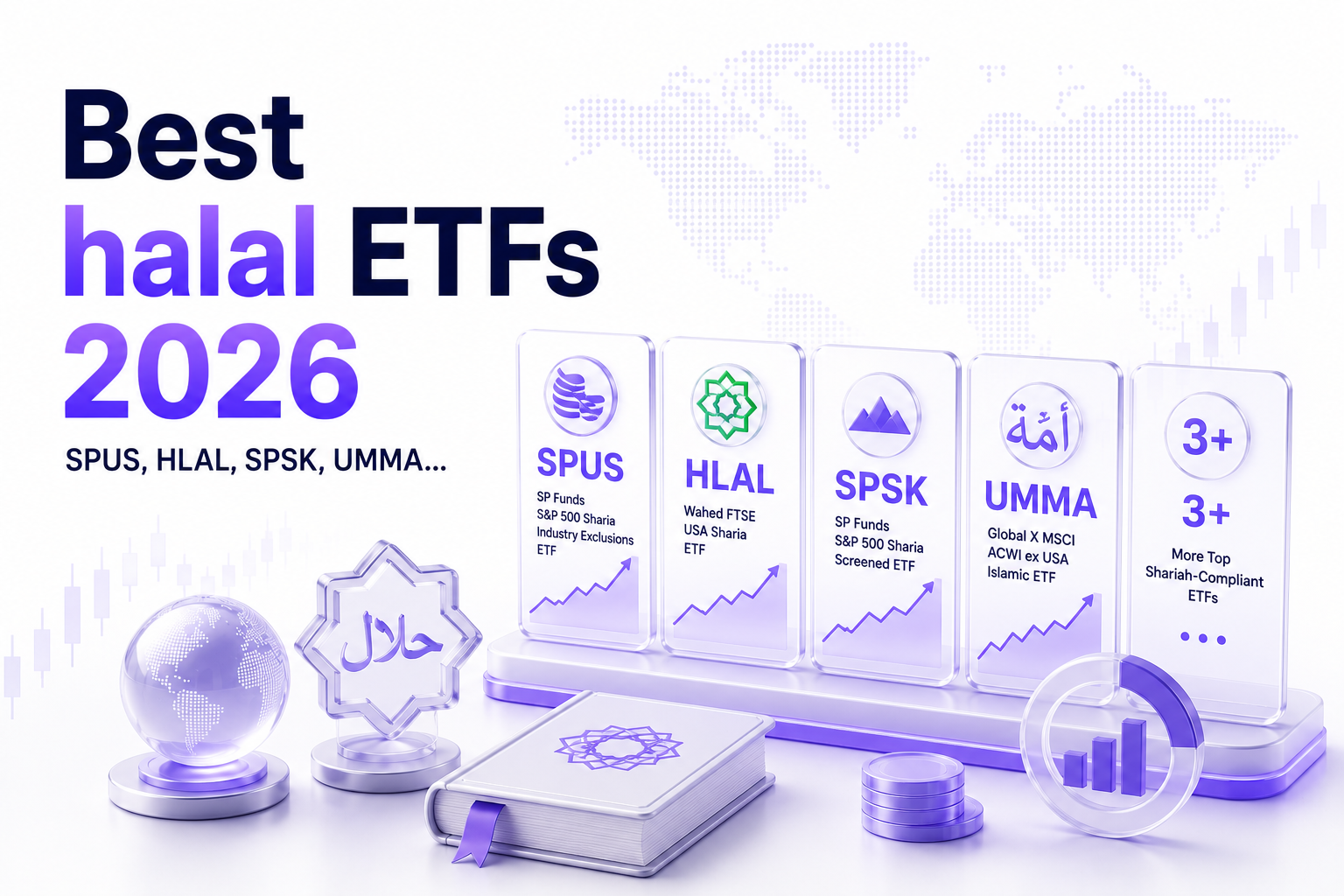
Halal ETFs have gone from a niche idea to a genuine toolkit. As of early 2026 the Shariah-compliant ETF market has passed $8 billion in assets, and there's now a fund for most of the building blocks of a diversified portfolio: US equities, international stocks, sukuk for fixed income, and real estate. This guide rounds up the best halal ETFs for 2026, what each one holds, and how to pick between them. Figures move, so treat the numbers as a snapshot and confirm the latest before you invest.
Quick Answer The most established halal ETFs in 2026 are SPUS and HLAL for US equities, with the newer MNZL offering broader coverage; UMMA and IGDA for international exposure; SPSK for sukuk (the halal fixed-income sleeve); and SPRE for real estate. All screen their holdings against Shariah criteria, exclude interest-based instruments, and are overseen by a Shariah board. They cost more than conventional ETFs (roughly 0.40–0.65%) and lean heavily toward technology, so diversify across a few and purify residual income. |
Table of Contents
- What makes an ETF halal?
- Best US equity halal ETFs
- Best international halal ETFs
- Best sukuk and REIT halal ETFs
- How do you choose a halal ETF?
- Halal ETFs vs individual stocks
What makes an ETF halal?
An ETF is a basket of securities you buy in one trade, and the wrapper itself is permissible. What makes it halal is what's inside: every holding must pass Shariah screening, the fund must avoid conventional bonds and leverage, and a Shariah board must supervise it and re-screen regularly. A regular S&P 500 ETF fails because it holds banks, alcohol, and gambling names. For the full logic, see the “Are ETFs halal” article.
Best US equity halal ETFs
US large-cap equities are the core of most portfolios, and this is the most competitive corner of the halal ETF market.
- SPUS (SP Funds S&P 500 Sharia Industry Exclusions ETF) is the largest and one of the cheapest, at a 0.45% expense ratio. It tracks a Shariah-screened version of the S&P 500, holding roughly 210 large-cap names, and has been the category's flagship since 2019.
- HLAL (Wahed FTSE USA Shariah ETF) tracks the FTSE USA Shariah Index at a 0.50% expense ratio, with around 200 holdings across large and mid caps. It's audited quarterly by an independent Shariah consultancy and managed by Wahed.
- MNZL, launched in late 2025, tracks a screened Russell 1000 universe with roughly 460 holdings, giving broader coverage than the S&P-based funds at a competitive fee.
Best international halal ETFs
For diversification beyond the US, a few funds extend Shariah screening to global and developed markets.
- UMMA (Wahed Dow Jones Islamic World ETF) offers global equity exposure, useful as an international complement to a US core, though its recent performance has trailed US-focused funds.
- IGDA (Invesco Dow Jones Islamic Global Developed Markets) is one of the larger global halal ETFs, spreading exposure across developed markets.
- SPWO (SP Funds ex-US) covers international developed and emerging markets outside the United States.
Best sukuk and REIT halal ETFs
Fixed income and real estate round out a diversified halal portfolio. Conventional bond ETFs are off-limits because bonds pay interest, so the halal fixed-income option is a sukuk ETF. SPSK (SP Funds Dow Jones Global Sukuk ETF) is the main US-listed sukuk fund, holding asset-backed Islamic certificates that share in real cash flows rather than paying interest, governed by AAOIFI's sukuk standard. For real estate, SPRE (SP Funds Global REIT Shariah ETF) holds screened, income-producing property companies.
| Ticker | Focus | Fee (approx.) | What it holds |
|---|---|---|---|
| SPUS | US large-cap equity | 0.45% | ~210 screened S&P 500 companies. |
| HLAL | US large/mid-cap equity | 0.50% | ~200 screened FTSE USA Shariah stocks. |
| MNZL | Broad US equity | ~0.40% | ~460 screened Russell 1000 stocks. |
| UMMA | Global equity | ~0.65% | Screened global developed-market stocks. |
| SPSK | Sukuk (fixed income) | ~0.55% | Global sukuk, not interest-bearing bonds. |
| SPRE | Real estate (REIT) | ~0.55% | Screened, income-producing property companies. |
How do you choose a halal ETF?
With several credible options, a few factors help you decide.
- Certification. Confirm the fund is supervised by a recognised Shariah board and has a current fatwa.
- Fees. Halal ETFs cost more than conventional ones (0.40–0.65% versus as low as 0.03%). Small differences compound over decades.
- Coverage and concentration. Most halal equity ETFs tilt heavily toward technology. Broader funds like MNZL, or combining several, reduce single-sector risk.
- Purification. Check whether the fund purifies impure income at the fund level or publishes a ratio for you to do it, as covered in what is purification.
- Account type. Hold ETFs in a swap-free or Islamic brokerage account so idle cash doesn't earn interest.
Halal ETFs vs individual stocks
Halal ETFs give you instant diversification and a hands-off portfolio, but at a higher fee and with no control over the exact holdings. The alternative is owning individual screened stocks: full control and no fund fee, in exchange for screening and monitoring each name yourself.
Many investors do both, using an ETF as a core and hand-picking a few convictions around it. If you'd like to build your own screened basket, or check what's inside an ETF you're considering, run any ticker through Akinda's halal stock screener, and compare tools in our guide to the top halal investing apps.
Frequently asked questions
What is the best halal ETF for beginners?
For a first US-equity holding, SPUS and HLAL are the two most established choices, with low-ish fees and long track records. SPUS is marginally cheaper and larger; HLAL adds some mid-cap exposure. Either works as a diversified core, and beginners can add a sukuk ETF like SPSK for stability as they grow their portfolio.
Are halal ETFs more expensive than regular ETFs?
Yes. Halal ETFs typically charge 0.40–0.65% versus as little as 0.03% for conventional index funds, because screening and Shariah oversight cost more and the funds are smaller. As assets grow, fees are expected to fall. Over long horizons the difference matters, so it's worth comparing expense ratios between similar funds.
Can I build a full portfolio from halal ETFs?
Yes. A common structure combines a US-equity ETF (SPUS or HLAL), an international one (UMMA or IGDA), a sukuk ETF (SPSK) for fixed income, and optionally a REIT fund (SPRE). Weighted to your risk tolerance, that gives a diversified, multi-asset halal portfolio in a handful of holdings.
Do halal ETFs pay dividends?
Yes, most halal equity ETFs distribute dividends from their underlying holdings, and sukuk ETFs distribute income from the sukuk. Because a small part of that income can be incidental impure income, you should purify it, either relying on the fund's purification or using the ratio it publishes.
Sources
AAOIFI Shari'ah Standard No. 21: Financial Paper (Shares and Bonds) – the screening criteria every holding in a halal equity ETF must meet.
AAOIFI Shari'ah Standard No. 17: Investment Sukuk – the basis for sukuk, the halal fixed-income alternative used by SPSK.
Fiqh Council of North America – ruling on investing in shares – confirms that owning screened, permissible equities is allowed.
Download the Akinda app Screen thousands of global stocks and monitor Shariah compliance in real time. 🌐 Website: akinda.io 📱 App: onelink.to/kpqkh6 |
Disclaimer
This article is for educational purposes only and is not financial or religious advice. Fund fees, assets, holdings, and performance change over time, and the figures here are approximate snapshots. Verify the current fatwa and data for any fund, and consult a qualified scholar for your situation.