
- Halal investing for beginners
Free vs Paid Halal Stock Screeners: Are They Worth It?
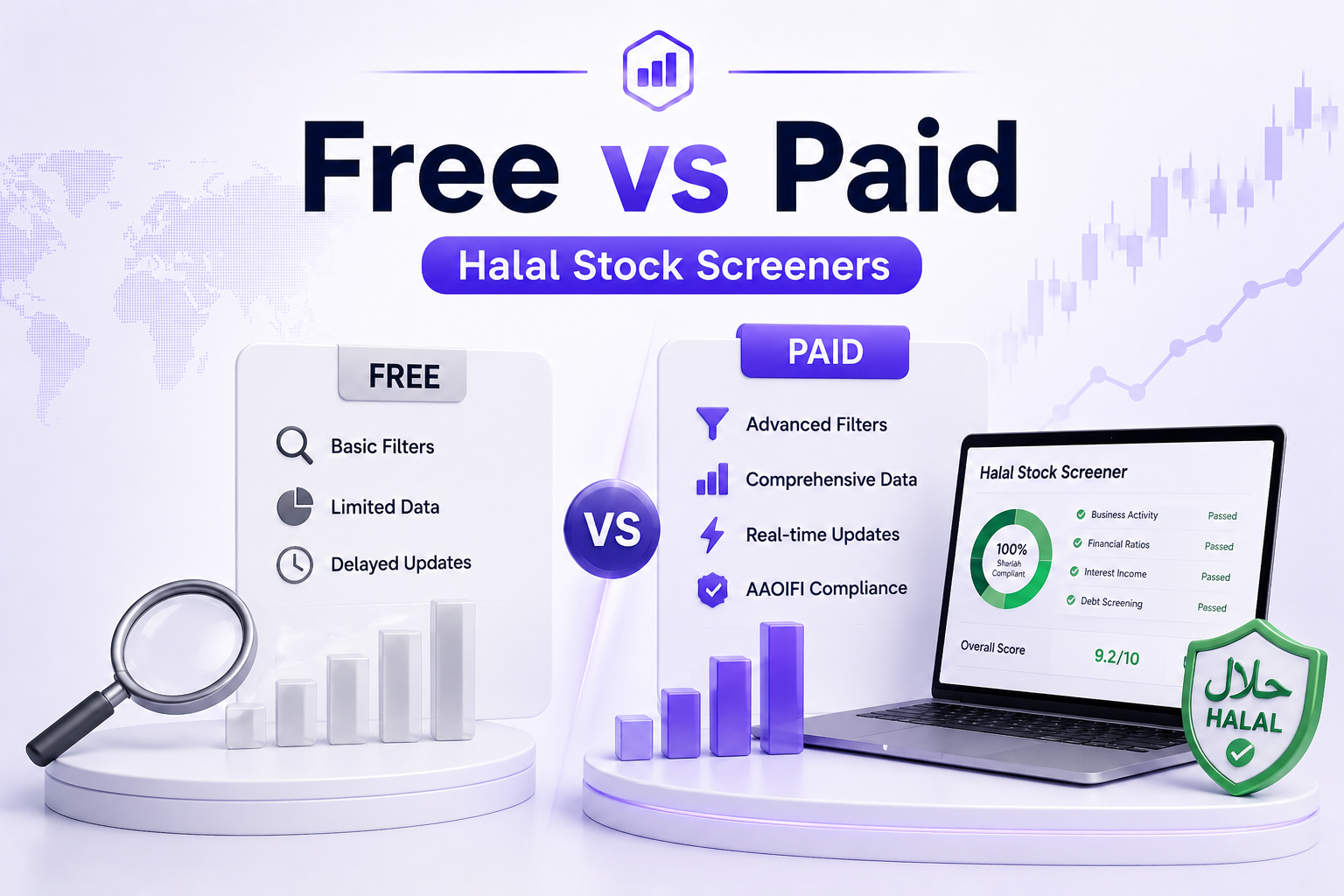
You paste a ticker into a halal stock screener, wait for the verdict, and hit a paywall. It happens more than you'd think. Most halal stock screeners advertise a free plan, then cap your searches, hide the financial ratios, or lock the full compliance breakdown behind a subscription. So the real question isn't free vs paid halal stock screener in the abstract. It's this: what do you actually get for free, where does the paywall land, and is the paid tier worth it for the way you invest? Here's an honest breakdown.
Quick Answer Most halal stock screeners are free to start but limit free users with a set number of monthly searches, hidden financial ratios, or a locked full analysis breakdown. Paid tiers (roughly $6–$15/month) unlock unlimited screening, purification tools, and portfolio alerts. If you only check a few stocks, free is enough. If you actively manage a halal portfolio, paid usually pays for itself. Akinda screens stocks fully free, with no per-search cap. |
Table of Contents
- What's the difference between free and paid halal stock screeners?
- Are free halal stock screeners actually free?
- What do you get with a paid halal stock screener?
- Free vs paid: side-by-side comparison
- Is Zoya free? Is Musaffa free?
- When is a paid halal stock screener worth it?
- Which halal stock screener is completely free?
- How to choose the right plan for you
- Frequently asked questions
What's the difference between free and paid halal stock screeners?
A halal stock screener checks whether a company is Shariah-compliant by running two tests: a business-activity screen and a financial-ratio screen. The core check is the same across free and paid tools. What changes is how much of it you can see and how often you can run it.
Free plans usually give you the headline verdict: halal, not halal, or questionable. Paid plans give you the reasoning behind that verdict, the exact ratios, ongoing compliance alerts, and tools like purification calculators. Think of the free tier as the answer, and the paid tier as the full working.
Under the AAOIFI Shari'ah Standard No. 21, a stock passes only if its core business is permissible and its balance sheet stays within set limits: interest-bearing debt under 30% of market cap, non-compliant investments under 30%, and impermissible income under 5% of revenue. AAOIFI is the Bahrain-based body whose criteria underpin major Islamic indices such as the S&P and Dow Jones Islamic Market Indices. A good screener shows you where a stock sits against each of those thresholds. Many free tiers hide exactly that detail. Want the full methodology?
Are free halal stock screeners actually free?
Yes and no. Almost every screener has a free entry point, but "free" rarely means unlimited. Free tiers usually come with one or more of these catches:
- Search caps. You get a set number of screenings per day or month. Run out, and you wait or upgrade.
- Hidden ratios. You see the pass/fail verdict but not the debt, interest-income, or impermissible-revenue numbers behind it.
- Locked full breakdown. The one-line verdict is free; the detailed analysis, the "why," sits behind a subscription.
- Signup walls. Some tools require an account before showing a single result.
- No monitoring. Compliance changes each quarter as financials shift. Alerts when a stock flips status are almost always a paid feature.
None of this is dishonest, it's just the freemium model. The point is to know where the wall is before you build a workflow around a tool. A screener that's free for your first ten searches is not much use if you're checking forty stocks a month.
What do you get with a paid halal stock screener?
Paid plans generally sit between $6 and $15 a month, and they tend to unlock the same broad set of features across platforms:
- Unlimited screening with no daily or monthly cap.
- Full financial-ratio breakdown so you see exactly why a stock passed or failed against each AAOIFI threshold.
- Purification calculator to work out how much of your dividend income needs to be given away to stay compliant.
- Portfolio tracking and compliance alerts that notify you when a holding changes status.
- Deeper research such as analyst input, watchlists, and expanded market coverage.
The honest way to frame it: paid tiers rarely change the verdict. They give you transparency, convenience, and monitoring. Whether that's worth a monthly fee depends entirely on how active you are, which is exactly what the next sections dig into.
Free vs paid: side-by-side comparison
Here's how the free and paid experience typically compares across the main halal screening tools. Pricing and limits change often, so treat this as a snapshot and verify current details on each platform's official site.
| Feature | Typical free tier | Typical paid tier |
|---|---|---|
| Compliance verdict | Yes | Yes |
| Number of searches | Often capped | Unlimited |
| Full ratio breakdown | Often hidden | Included |
| Purification calculator | Rarely | Usually |
| Portfolio + alerts | No | Yes |
| Typical price | $0 | ~$6–$15/mo |
Where Akinda fits
Akinda takes a different line on the free question. Halal stock screening on Akinda is fully free, with no per-search cap on checking whether a stock is Shariah-compliant. You can screen across 10,000+ global stocks and read the compliance verdict without hitting a paywall on the basic check.
Is Zoya free? Is Musaffa free?
These are two of the most-searched questions in halal investing, so here's the straight answer for each.
Is Zoya free?
Zoya offers a free tier, but it limits how many stocks you can screen. Unlimited screening, full compliance reports, and portfolio tools sit behind Zoya Pro. Per Zoya's own help center, Zoya Pro is priced at $16.79/month and $100.79/year (Zoya Pro) for US users, with pricing that can vary by location. So Zoya is free to try, but active screeners will hit the cap. Zoya vs Akinda
Is Musaffa free?
Musaffa lets you screen the Shariah-compliance status of a large global stock universe for free. What's gated is the depth: detailed Shariah reports, advanced research, alerts, and its Academy content require a paid plan. Per Musaffa's pricing page, the paid plan works out to $2.50/month (Foundation) and $10/month (Invest Plus). So the free tier is genuinely useful for a quick verdict, but the full report is paid. Musaffa vs Akinda
The pattern holds across the category. Free gets you in the door and answers the basic "is this halal?" question. Paid unlocks the why, the monitoring, and the volume.
When is a paid halal stock screener worth it?
A paid plan earns its fee for some investors and is pure overspend for others. Use this rough test.
Paid is probably worth it if you:
- Actively manage your own portfolio and check stocks often.
- Want the full ratio breakdown to understand every verdict, not just accept it.
- Need compliance alerts because a stock's status can flip quarter to quarter.
- Use a purification calculator regularly to cleanse dividend income.
Free is probably enough if you:
- Check just a handful of stocks now and then.
- Mainly want a quick halal / not-halal verdict.
- Are new to halal investing and still learning the basics.
- Cross-check a stock across two free tools rather than paying for one.
One more thing worth saying plainly: paying more does not make a verdict "more halal." Screening quality comes from the standard and the data, not the price. A well-built free screener that publishes its AAOIFI thresholds can be more transparent than a paid black box. Judge the methodology first, the price second.
Which halal stock screener is completely free?
A few tools keep core screening free rather than capped. Akinda is built around that idea: checking whether a stock is Shariah-compliant is free, with no per-search limit on the basic verdict, across 10,000+ global stocks screened to AAOIFI-aligned methodology. That removes the most common friction point, the moment a free user pastes a ticker and hits a paywall instead of an answer.
Akinda pairs the free screener with research features for investors who want to go deeper: an internal ranking score, sector-level halal stock lists, and analysis tools. The screening itself stays free, so you can verify a stock before you ever think about a subscription.
A note on cross-checking
Screening methodologies differ slightly between platforms, so a stock can pass on one and read as questionable on another. Many careful investors run a ticker through two tools before buying. Free screeners make that habit painless, which is a genuine argument for keeping at least one no-cost tool in your kit even if you also pay for another.
How to choose the right plan for you
Instead of asking "free or paid?", work through four questions in order:
- How often do you screen? A few stocks a month leans free. Weekly research leans paid or a fully-free tool.
- Do you need the reasoning? If a pass/fail verdict is enough, free works. If you want every ratio, you need full-breakdown access.
- Do you hold long-term? If yes, compliance alerts matter, and those are usually paid.
- Is the methodology transparent? Whatever you pick, free or paid, confirm it publishes its screening standard. Transparency beats price.
Answer those honestly and the right tier picks itself. Many investors land on a sensible middle path: a free screener for everyday verdicts, plus one paid tool only if their portfolio is active enough to justify it.
Frequently asked questions
Are free halal stock screeners accurate?
A free screener can be just as accurate as a paid one. Accuracy depends on the screening standard and the data quality, not the price. A free tool that applies AAOIFI thresholds and publishes its methodology can be more trustworthy than a paid tool that hides its reasoning. Always check which standard a screener uses before relying on it.
Is Zoya free to use?
Zoya has a free tier with a limited number of screenings. Unlimited screening, full compliance reports, and portfolio tracking require Zoya Pro, priced at $16.79/month and $100.79/year (Zoya Pro) for US users, with pricing that varies by region. It's free to try, but active users will reach the cap and need to upgrade for full access.
Is Musaffa completely free?
Musaffa lets you screen a large universe of global stocks for their compliance status for free, but detailed Shariah reports, advanced research, and alerts require a paid plan that works out to $2.50/month (Foundation) and $10/month (Invest Plus). The free tier answers the basic halal question; the full report and research tools are paid.
Is there a completely free halal stock screener?
Yes. Some platforms keep core screening free rather than capped. Akinda, for example, lets you check whether a stock is Shariah-compliant for free across 10,000+ global stocks, with no per-search limit on the basic verdict. Free screeners are also useful for cross-checking a stock against a second tool before you invest.
Does paying more make a stock "more halal"?
No. A paid subscription buys transparency, monitoring, and convenience, not a different religious verdict. The compliance result comes from the screening standard applied to the company's financials. A free tool and a paid tool using the same AAOIFI criteria should reach the same conclusion on the same stock.
Should I use more than one halal stock screener?
It's a reasonable habit for stocks you're serious about. Because methodologies differ slightly, a company can pass on one screener and read as questionable on another, often due to how each treats cash, interest income, or edge-case revenue. Cross-checking with a free screener alongside your main tool adds confidence at no extra cost.
Download the Akinda app and screen over thousands of global stocks, monitor Shariah compliance in real time
🌐 Website: https://akinda.io
📱 App: https://onelink.to/kpqkh6
Disclaimer: This article is for educational purposes only and is not financial or religious advice. Pricing and plan features change frequently, verify current details on each platform's official site. Automated Shariah screening supports but does not replace guidance from a qualified scholar. Compliance status can change as company financials are updated.