Is the S&P 500 Halal? Why Most Index Funds Fail Shariah Screening
By Akinda · 2026-05-21
Table of Contents
- 1. Introduction
- 2. How halal screening actually works
- 3. Screen 1: The business activity filter
- 4. Screen 2: The three AAOIFI financial ratios
- 5. Where the S&P 500 fails- sector by sector
- 6. Real examples: Apple, Microsoft, Amazon, Netflix
- 7. The dividend purification step
- 8. Halal alternatives to the S&P 500
- 9. Checklist: how to evaluate any index fund
- 10. FAQ
1. Introduction
Every "how to start investing" guide points to the same answer: just buy an S&P 500 index fund. It's the default benchmark of modern investing, the safest entry point for beginners, and the backbone of most retirement accounts in the U.S. So when a Muslim investor sits down to start building wealth, the question shows up almost immediately: is the S&P 500 halal?
The short answer is no - not in its standard form. The index holds hundreds of companies that fail Shariah screening on either their core business or their financial structure. But the more useful question isn't yes or no. It's why it fails, which parts fail, and what a Muslim investor should actually do about it. This guide walks through that, using the AAOIFI screening framework most halal investing platforms rely on today.
2. How halal screening actually works
Halal stock investing follows a structured, two-stage process developed by the Accounting and Auditing Organization for Islamic Financial Institutions (AAOIFI) - the global standard-setter for Islamic finance, headquartered in Bahrain. Their Shariah Standard No. 21 on financial paper is the reference document most halal screening platforms use.
A stock is considered halal only if it passes both screens:
- Business activity screen - what does the company actually do?
- Financial ratio screen - how is the company financed?
Failing either screen makes the stock non-compliant, regardless of how attractive it looks as an investment.
3. Screen 1: The business activity filter
The first screen rules out companies whose primary revenue comes from activities prohibited in Islam. The standard exclusions, as applied by AAOIFI-aligned screeners:
- Conventional banking, insurance, and other interest-based financial services
- Alcohol production and distribution
- Pork and non-halal meat
- Gambling and casinos
- Adult entertainment
- Conventional weapons and defence (interpretations vary among scholars)
- Tobacco
- Music, film, and entertainment with substantial impermissible content
If a company earns its core income from any of these activities, no financial ratio can rescue it. The business itself is the disqualifier.
4. Screen 2: The three AAOIFI financial ratios
This is where most large-cap U.S. stocks struggle. Even a company doing permissible business - selling software, building electric cars, manufacturing chips - can fail if its balance sheet leans too heavily on interest-based debt or interest-earning cash.
AAOIFI Shariah Standard No. 21 sets three financial ratios, each measured against the company's market capitalisation:
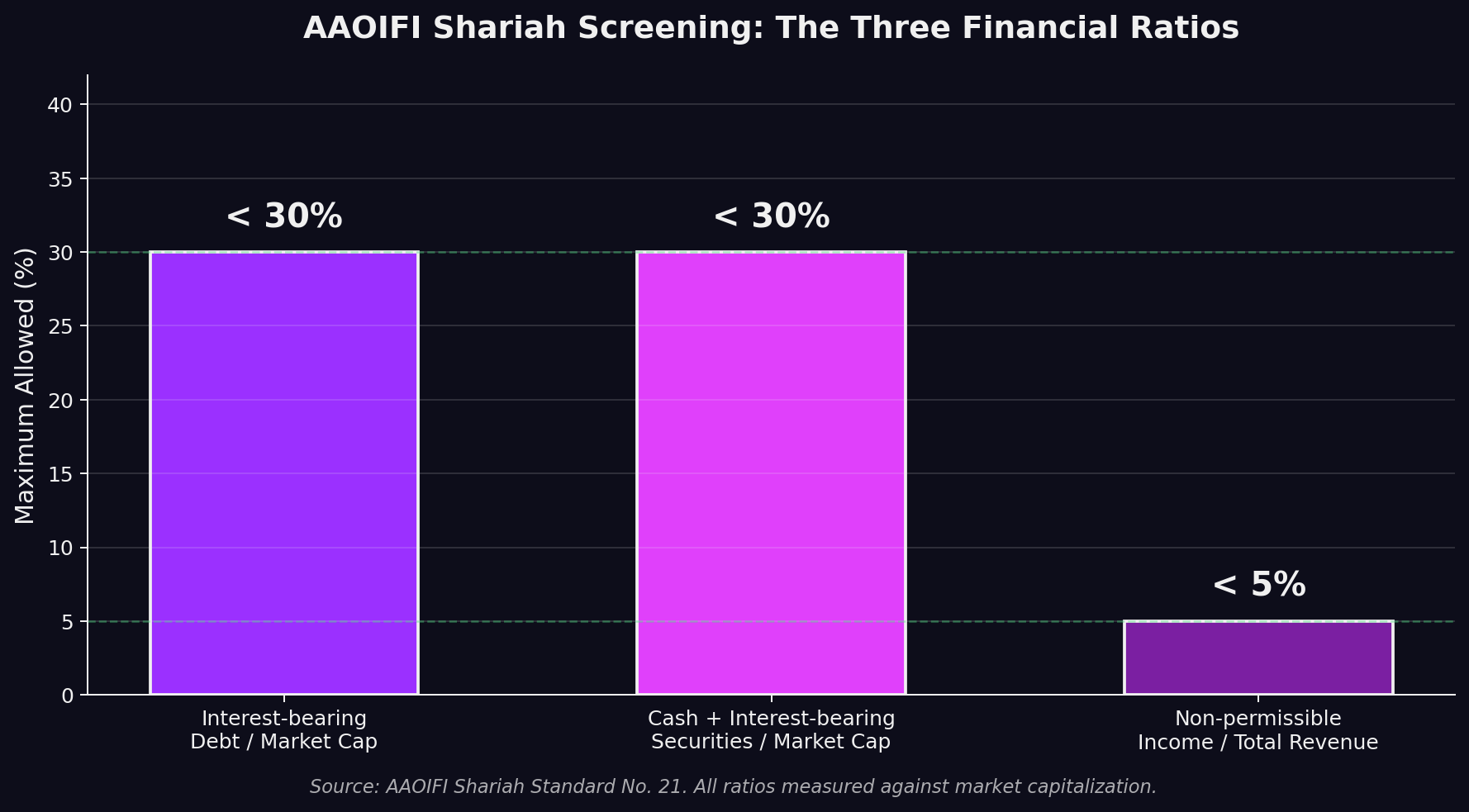
Figure 1. The three AAOIFI ratios. All measured against market capitalization.
| Ratio | AAOIFI Threshold | Denominator |
|---|---|---|
| Interest-bearing debt | < 30% | Market cap |
| Cash + interest-bearing securities | < 30% | Market cap |
| Income from non-permissible activities | < 5% | Total revenue |
A few practical notes
30% vs 33.33%: AAOIFI uses 30%, while some other methodologies (such as MSCI Islamic indices and S&P Dow Jones Shariah) use 33.33% (one-third). Both are widely accepted by qualified scholars. AAOIFI is the stricter mainstream standard.
Market cap as denominator: AAOIFI uses market capitalisation rather than total assets. This matters because asset-light businesses (software platforms, ride-share companies) would otherwise be penalised for having little physical inventory.
Rolling averages: Many screeners use a 24-month average market cap to smooth out short-term volatility. A stock that's halal today can flip non-compliant next quarter if its market cap falls or debt rises - which is why ongoing quarterly monitoring matters.
Purification: Even compliant companies often have small impermissible income (interest on cash reserves, etc.). The corresponding percentage of dividends must be donated to charity - this is called purification, and it's separate from Zakat.
5. Where the S&P 500 fails - sector by sector
The S&P 500 is a market-cap-weighted index of 500 large U.S. companies. It was never designed with Shariah principles in mind, so it fails the halal screen on multiple fronts.
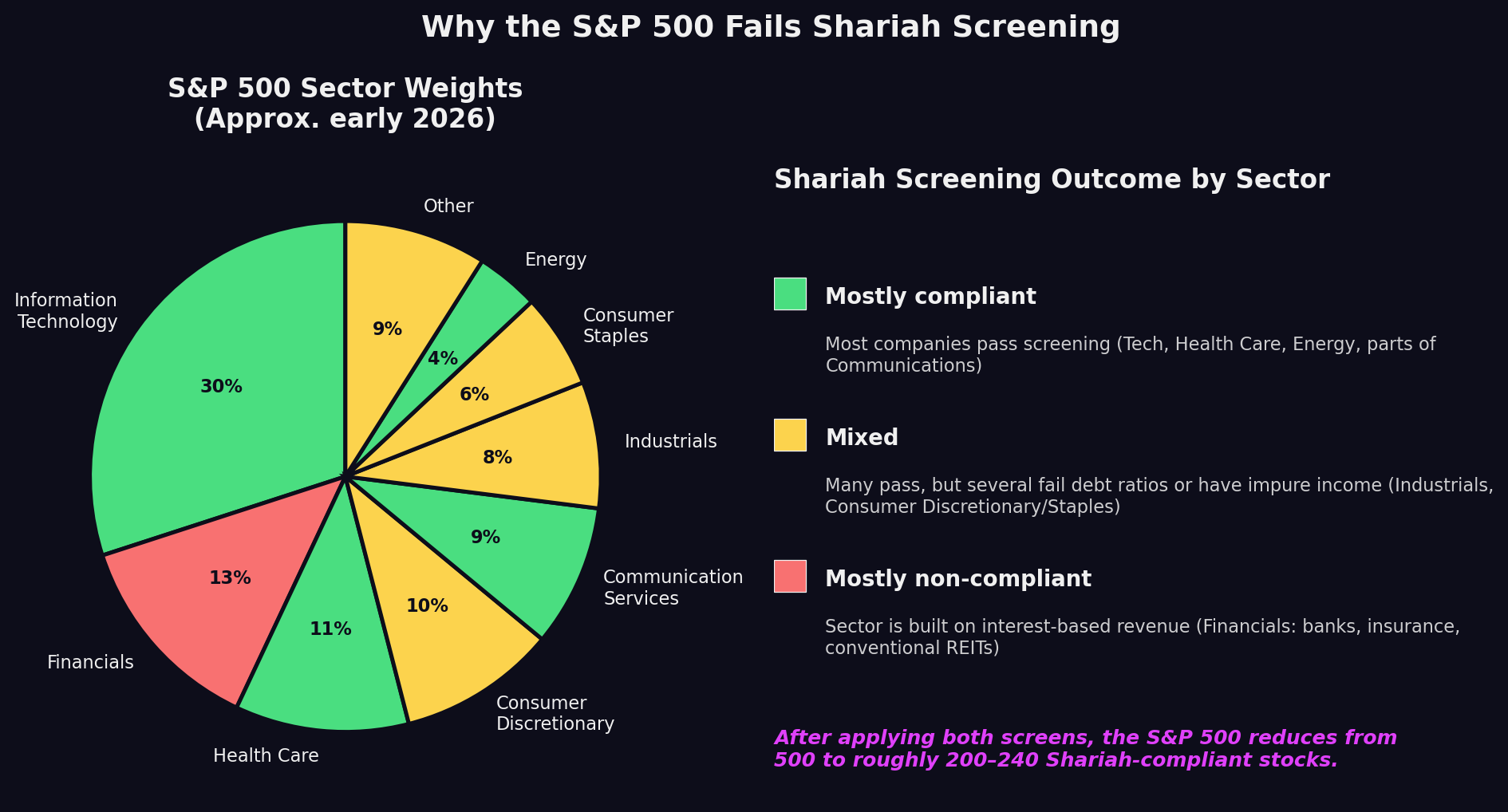
Figure 2. Approximate S&P 500 sector weights and Shariah screening outcomes.
Entire sectors fail the business screen
As of early 2026, the Financials sector represents roughly 13% of the S&P 500 by weight, including names like JPMorgan Chase, Bank of America, Visa, Mastercard, and Berkshire Hathaway's insurance operations. Conventional banks and insurers earn the majority of their income from interest (riba), which is explicitly prohibited. This entire sector is removed before financial ratios are even considered.
Beyond financials, the index also contains:
- Alcohol producers and distributors (Constellation Brands, Brown-Forman)
- Tobacco companies (Philip Morris International, Altria)
- Defence contractors (Lockheed Martin, Northrop Grumman, RTX) - disputed among scholars, but typically excluded by AAOIFI-aligned screeners
- Gaming and casino operators (Las Vegas Sands, Wynn Resorts, MGM Resorts)
- Many conventional REITs that rely heavily on interest-based mortgages
Combined with financials, these activity-based exclusions remove a meaningful portion of the index before any ratio test is applied.
Permissible companies that still fail the debt screen
This is the part most new halal investors miss. Companies in permissible sectors can still fail because of how they're financed. A media or industrial company carrying interest-bearing debt above 30% of its market cap is non-compliant regardless of how clean its core business looks.
Boeing, AT&T, Verizon, and many other industrial and telecom giants have historically carried debt loads at or above the 30% threshold and routinely fail.
After applying both screens, the S&P 500 typically reduces to roughly 200–240 Shariah-compliant stocks. The SPUS ETF, which filters the S&P 500 using S&P's own Shariah methodology, holds approximately 200 stocks at any given time.
6. Real examples: how major S&P 500 stocks score
Compliance status is not static - it shifts as companies report new financials, acquire businesses, or change debt structure. The figures below reflect screening results as reported by major halal screeners in early 2026, and should always be re-checked before investing.
| Company | Status | Debt / Market Cap | Notes |
|---|---|---|---|
| Apple (AAPL) | Halal | ~2.9% | Passes all four screens with significant margins. Small impure income from Apple Card requires dividend purification. |
| Microsoft (MSFT) | Doubtful | Low | Financial ratios pass, but gaming and entertainment revenue streams (Xbox, content) raise concerns about impermissible income near the 5% threshold. |
| NVIDIA (NVDA) | Halal | Very low | Comfortably passes. Massive market cap relative to debt. |
| Alphabet (GOOGL) | Doubtful | Low | Core financial ratios pass, but ad-related revenue streams and certain content on YouTube create scholarly disagreement on full compliance. |
| Amazon (AMZN) | Doubtful | ~6.9% | Debt and cash ratios are within AAOIFI limits, but impermissible income from Prime Video and Amazon Music sits near or above the 5% threshold. |
| Netflix (NFLX) | Not halal | — | Fails business screen - entertainment with substantial explicit content, even if financial ratios would pass. |
| JPMorgan Chase | Not halal | — | Conventional bank - fails business screen. No financial ratio test needed. |
Two takeaways from this table. First, the top of the S&P 500 - the technology giants driving most of the index's returns - is largely halal-compliant. Second, status can change. Amazon's classification varies by methodology and quarter, which is exactly why ongoing screening matters more than a one-time check.
7. The dividend purification step
Even when you hold an individually compliant stock, there's usually a small amount of impermissible income mixed in - typically interest earned on the company's cash reserves. Under AAOIFI methodology, the corresponding proportion of your dividend should be purified by donating it to charity. This is separate from Zakat.
Properly built halal ETFs report a purification percentage to investors each year. If you're holding raw S&P 500 stocks or a regular S&P 500 ETF, you'd need to calculate and donate that portion yourself - which most retail investors never do, and which is one more practical reason direct exposure to a non-screened index fund is problematic.
8. Halal alternatives to the S&P 500
Muslim investors don't have to give up broad U.S. equity exposure. Several Shariah-compliant ETFs aim to deliver something close to the S&P 500 experience.
| Ticker | Fund | Expense Ratio | Holdings | Methodology |
|---|---|---|---|---|
| SPUS | SP Funds S&P 500 Sharia Industry Exclusions ETF | 0.45% | ~200 | S&P 500 Shariah index minus aerospace/defence & financial-data sub-industries |
| HLAL | Wahed FTSE USA Shariah ETF | 0.50% | ~210 | FTSE USA Shariah index - large + mid-cap |
| ISDU | iShares MSCI USA Islamic UCITS ETF | 0.30% | ~100 | MSCI USA Islamic - narrower, lower expense ratio |
Performance context - and the honest caveats
Since its launch in December 2019, SPUS has delivered an average annual return of approximately 17%, and its 5-year average annual return sits around 15%. Over the same period, the S&P 500's historical compound annual return is closer to 10–13%.
This outperformance is real, but it deserves context. SPUS is heavily concentrated in technology (close to half its holdings) and in the so-called Magnificent 7 stocks. Excluding traditional financials and including more tech is what drove the recent gains - and the same concentration that helped SPUS in a tech bull market could hurt it in a sector rotation. Past performance is not a forecast.
Three points worth keeping in mind:
- Halal ETFs charge 10–15× the expense ratio of a conventional S&P 500 ETF like VOO (0.03%). Over decades this compounds, but it is the cost of ongoing screening and Shariah supervision.
- All three funds are concentrated in U.S. large-cap technology and share the same concentration risk as the broader market.
- Methodologies differ. A stock that passes S&P Shariah may fail FTSE Shariah, and vice versa. Neither is more correct - both are overseen by qualified Shariah scholars.
For investors who want more control, building a custom portfolio of individually screened halal stocks is another path. It avoids ETF expense ratios and lets you tailor exposure to specific sectors or values — which is what platforms like Akinda are built to support.
9. Checklist: how to evaluate any index fund
Before putting money into any index fund, ask:
- Is it explicitly Shariah-screened? If the prospectus doesn't mention Shariah, AAOIFI, or a Shariah supervisory board, assume it isn't.
- Which methodology does it use? AAOIFI, FTSE, S&P, MSCI Islamic, and DJIM each have slightly different thresholds. AAOIFI is the strictest mainstream standard.
- How often is it re-screened? Compliance changes quarterly as company financials shift. Quarterly review is the minimum standard.
- Is dividend purification handled by the fund? Good halal ETFs build this into their reporting.
- What's the expense ratio versus the conventional alternative? Higher fees are unavoidable, but anything above 0.60% deserves scrutiny.
10. Frequently asked questions
Is investing in the S&P 500 haram if I purify my dividends?
Most contemporary scholars agree that holding a non-screened index fund is not permissible, because the underlying holdings include companies whose primary business is haram (conventional banking, alcohol, gambling). Purification handles small amounts of mixed income from otherwise compliant companies - it cannot legitimise ownership of fundamentally haram businesses.
Is SPUS exactly the same as the S&P 500 minus haram stocks?
Close, but not identical. SPUS starts with the S&P 500 universe, removes non-compliant companies, and also excludes a few sub-industries (aerospace & defence, financial exchanges, data processing). The result is roughly 200 stocks rather than 500, with heavier weighting toward technology and lighter exposure to financials.
Have halal ETFs really beaten the S&P 500?
Over the past several years, yes - SPUS and HLAL have both outperformed the standard S&P 500 since their 2019 launches. The driver is largely the tech concentration that comes from excluding financials. Past performance does not guarantee future results, and the same concentration that helped recently could hurt in different market conditions.
What's the minimum to start halal investing in U.S. stocks?
You can start with the price of a single ETF share - typically under $100 for SPUS or HLAL. Many platforms also offer fractional shares, lowering the entry point further.
Can I just buy Apple, Microsoft, and NVIDIA and skip the ETFs?
Yes, and many halal investors do exactly that. The trade-off is diversification: holding 5–10 individual stocks concentrates risk much more than holding an ETF with 200 names. A good middle path is using an ETF as a core position and adding individual halal stocks around it.
You may also like
- What Is Halal Investing? The Complete Beginner's Guide (2026)
How to start halal investing from 0 in 2026 - Is Trading Halal? A Beginner's Guide to Halal Trading
Akinda Features Explained: How to Use the Platform for Halal Investing - Halal Stock Screener: How to Check Any Stock in 30 Seconds (Free)
- How to Find Top Halal Stocks on Akinda (Step-by-Step Guide)
Download the Akinda app and screen stocks instantly for free
🌐 Website: https://akinda.io
📱 App: https://onelink.to/kpqkh6