
- Halal investing for beginners
- Investing Principles
Halal Investing vs Conventional Investing: Key Differences
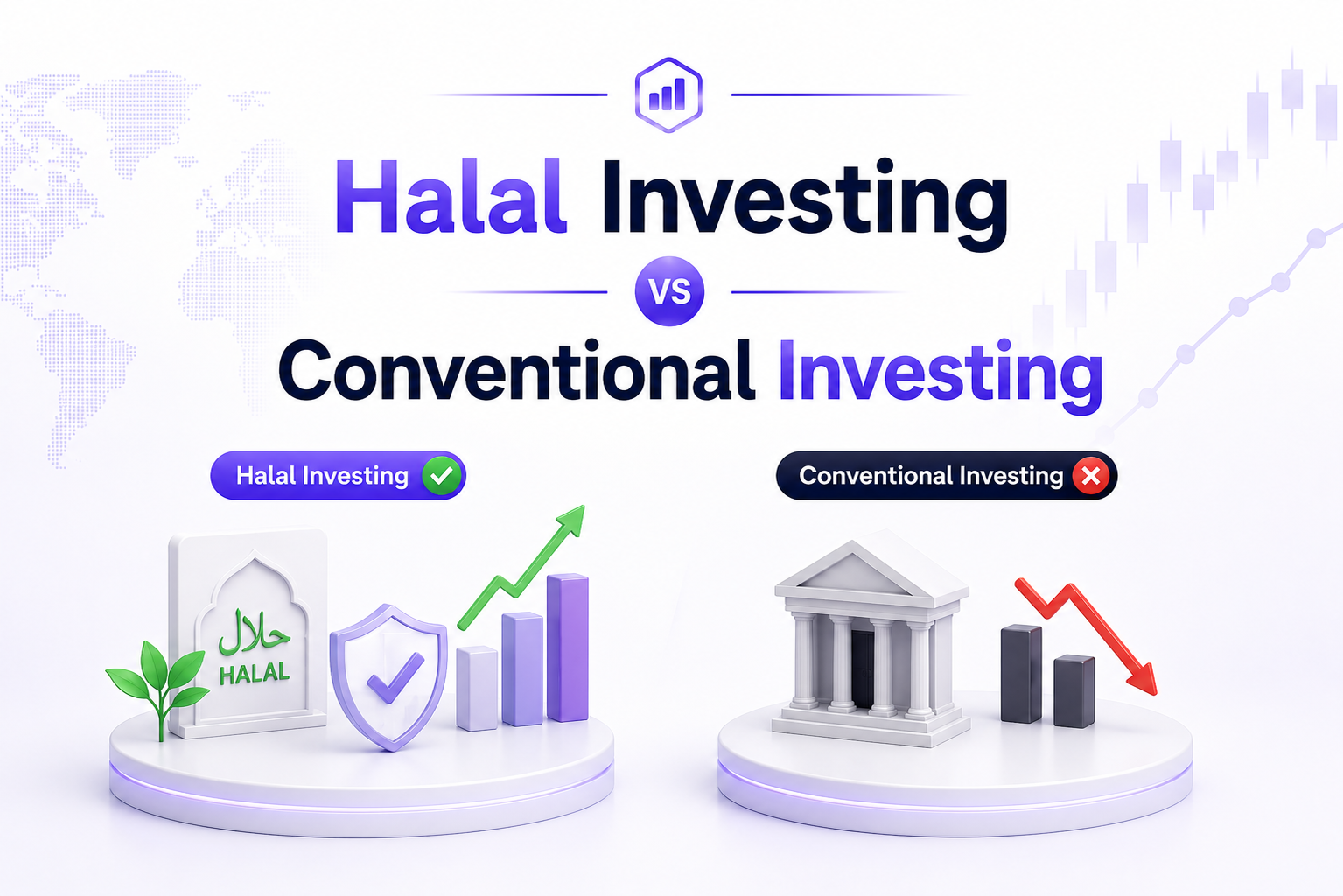
Most people assume halal investing is conventional investing with a few stocks crossed off the list. It is not. The difference starts one layer deeper, at the question of where a return is allowed to come from at all. That single rule reshapes everything downstream: which companies you can own, how much debt they are allowed to carry, whether bonds are on the table, and who signs off on the whole thing. If you are weighing halal investing vs conventional investing, the useful comparison is not "which one wins" but "what am I actually buying, and how is the profit made?" This guide breaks down both, with the exact thresholds.
Quick Answer
Halal investing and conventional investing both aim to grow wealth, but halal investing restricts the source of returns. Profit must come from real ownership and economic activity, not from interest (riba). That rules out conventional bonds, banks, and insurers, and it caps how much interest-bearing debt a company can carry. Conventional investing applies no such filter.
Table of Contents
- What is halal investing?
- What is the main difference between halal and conventional investing?
- How does Shariah screening work?
- Why are conventional bonds not halal, and what replaces them?
- Does halal investing mean lower returns?
- Is the S&P 500 halal?
- How do you actually build a halal portfolio?
- Halal vs conventional: side-by-side
- Frequently asked questions
What is halal investing?
Halal investing is investing that follows Shariah principles: profit comes from ownership of real assets and genuine economic activity, not from lending money at interest. Three prohibitions define it. Riba (interest), gharar (excessive uncertainty in contracts), and maysir (gambling). Everything else in the methodology is downstream of those three.
The practical consequence is that halal investing is equity-first. You own a share of a business and you share in its profits and its losses. Conventional investing is comfortable with either side of that: you can own the business, or you can lend to it and collect interest regardless of how it performs.
What is the main difference between halal and conventional investing?
The main difference is the source of return. Halal investing only permits profit generated through ownership, risk-sharing, trade, or rent on real assets. Conventional investing also permits profit from interest on debt. Everything else, the sector exclusions, the debt limits, the sukuk instead of bonds, follows from that one rule.
A second difference is oversight. Conventional funds answer to financial regulators. Halal funds answer to regulators and to a Shariah board of qualified scholars who review holdings against a published methodology. That is an extra layer of review that has no conventional equivalent.
And a third: risk transfer versus risk sharing. A bondholder gets paid whether or not the business succeeds. A shareholder in a halal portfolio does not have that comfort, by design.
How does Shariah screening work?
Shariah screening is a two-stage filter. First a qualitative screen removes companies whose core business is impermissible. Then a quantitative screen tests the balance sheet, because a clean business with an interest-heavy balance sheet still fails. Akinda screens to AAOIFI Shari’ah Standard No. 21, the benchmark most widely used across Islamic finance.
Stage 1: the business activity screen
Out go companies whose primary activity sits in riba-based finance (conventional banks, insurers), alcohol, pork, gambling, tobacco, adult content, and weapons. This is the part everyone already knows, and it is the part that does the least work.
Stage 2: the financial ratio screen
This is where most of the failures happen. Under AAOIFI Standard 21, commonly summarised as the 30/30/5 rule:
- Interest-bearing debt must not exceed 30% of market capitalisation.
- Interest-earning or non-compliant investments must not exceed 30% of market capitalisation.
- Non-permissible income must not exceed 5% of total revenue.
Breach any one and the stock fails, no matter how clean the product looks on the shelf.
Worth knowing: the thresholds are not universal. AAOIFI sets 30% against market cap, while the Dow Jones Islamic Market indices cap total debt at 33% of a trailing 24-month average market cap, and MSCI’s Islamic Index Series applies a 33.33% cap using total assets as the denominator. Same principle, different arithmetic. The same stock can pass under one standard and fail under another without a single number in its accounts changing.
Stage 3: purification
Where a small slice of income comes from non-permissible sources, the matching portion of your dividend is given away rather than kept. Conventional investing has no equivalent step, because it has nothing to clean.
Why are conventional bonds not halal, and what replaces them?
Conventional bonds are not halal because they pay a fixed return on a loan, which is riba by definition. The Shariah-compliant alternative is sukuk: certificates representing partial ownership of a real asset, where income comes from that asset’s performance rather than from an interest coupon.
A sukuk is an Islamic financial certificate that gives the holder partial ownership of an underlying asset, structured so returns come from the asset itself rather than from interest. That distinction is not cosmetic. A bondholder is a creditor. A sukuk holder is an owner.
The portfolio effect is real. Conventional investors use bonds to damp volatility. Halal investors reach for sukuk to fill that role, and sukuk behave differently from a Treasury ladder. Plan around that rather than assuming a straight swap.
Does halal investing mean lower returns?
No, not structurally. Halal portfolios perform differently rather than worse. Screening out financials and leverage tilts the portfolio toward technology, healthcare and consumer sectors, which has helped over the past decade and would hurt in a decade where those sectors lag. Different exposure, not an automatic penalty.
The mechanism is arithmetic, not miracle. Financials make up roughly 13% of the S&P 500; remove them from a market-cap weighted index and the remaining sectors absorb that weight. That is why halal US equity funds run heavy in tech. The Wahed FTSE USA Shariah ETF (HLAL), for instance, sits around 44% technology and 19% communication services. Concentration is the trade-off you are accepting.
There is an academic angle too. A 2025 study in the Journal of Risk and Financial Management applied five Shariah rulebooks to a fixed S&P 500 universe from Q1 2019 to Q4 2023 and found every Islamic portfolio beat the plain S&P 500 on a risk-adjusted basis, with the advantage coming from smaller drawdowns rather than bigger gains. One universe, one window. Don’t read it as a promise.
The honest summary: neither outperformance nor underperformance should be assumed. Screening removes leverage, and low-leverage companies tend to hold up better when credit tightens. That is the same discipline plenty of conventional value investors apply voluntarily.
Is the S&P 500 halal?
No. The S&P 500 holds conventional banks, insurers, alcohol producers and heavily leveraged companies, so the index as a whole fails Shariah screening. Screened versions exist: the S&P 500 Shariah Index applies the filter to the same 500 companies and keeps only those that pass.
That is the cleanest illustration of the whole comparison. Same starting universe, same 500 companies, and the screen cuts it to roughly 200 to 250 names. S&P Dow Jones publishes the methodology if you want to see exactly what gets removed and why.
How do you actually build a halal portfolio?
The process differs from a conventional build at four points. Not more work, exactly, but different work.
1. Screen before you buy, not after. Check both the business and the ratios. A company can pass on product and fail on debt, and the debt check is the one people skip.
2. Re-check periodically. Compliance is not permanent. A company that raises interest-bearing debt or watches its market cap fall can cross the 30% line without doing anything unusual. Index providers re-screen quarterly for this reason.
3. Diversify inside the compliant universe. The set is smaller, but a portfolio spanning US and international equities, several sectors and multiple market caps can still spread risk properly. Just accept it will not mirror a 60/40.
4. Purify and pay zakat. Cleanse the non-permissible slice of income, and account for zakat at 2.5% of qualifying assets annually. Neither exists in a conventional plan, and both change your net compounding.
Akinda handles the screening layer so you are not reading footnotes in a 10-K to work out a debt ratio. You see the compliance status and the reason for it before you buy, not after.
Halal vs conventional: side-by-side
| Dimension | Halal investing | Conventional investing |
|---|---|---|
| Source of return | Equity ownership, profit-sharing, rent, trade in real assets | Includes interest from bonds, deposits, and lending |
| Screening | Two-stage: business activity + financial ratios, reviewed by scholars | None by default; profitability and risk-return only |
| Fixed income | Sukuk (asset-backed certificates) | Conventional bonds paying coupons |
| Excluded sectors | Conventional banks, insurers, alcohol, tobacco, gambling, pork, adult content, weapons | No sector exclusions unless the fund adds an ESG filter |
| Leverage limit | Interest-bearing debt capped at 30% of market cap (AAOIFI) | No limit; leverage is a strategy choice |
| Derivatives | Restricted; gharar (excessive uncertainty) prohibited | Options, futures, swaps freely used |
| Income cleaning | Purification of non-permissible income | Not applicable |
| Oversight | Shariah board or supervisory scholars in addition to regulators | Financial regulators only |
Frequently asked questions
Can non-Muslims invest in halal funds?
Yes. Halal funds have no religious eligibility requirement. Some non-Muslim investors use them as a low-leverage, exclusion-based strategy, since the screening naturally filters out heavily indebted companies and conventional financials. It functions as an ethical screen with a rules-based debt discipline attached.
Are halal ETFs more expensive than conventional ones?
Generally yes, though the gap has narrowed. Screening, Shariah board oversight and more frequent rebalancing add cost, so expense ratios tend to sit above the cheapest conventional index funds. Compare the specific funds rather than assuming a fixed premium, and weigh the difference against your holding period.
Is a savings account halal?
A conventional interest-bearing savings account is not, because the return is riba. The interest is impermissible regardless of what you do with it afterwards, including donating it. Shariah-compliant alternatives use profit-sharing or asset-backed structures instead of a guaranteed interest rate.
What happens if a stock I own stops being compliant?
Most methodologies expect you to exit within a reasonable window once a holding fails re-screening, and to purify any income earned from the non-compliant period. Index providers usually apply a small buffer before removal to avoid churn on temporary breaches. Check your platform’s specific policy.
Is crypto halal?
Scholars disagree, and there is no single ruling. The debate turns on whether a given token counts as an asset with real utility or is closer to speculation (gharar and maysir). The answer varies by token and by scholar. Treat blanket claims in either direction with suspicion.
Sources
- AAOIFI – Accounting and Auditing Organization for Islamic Financial Institutions — Shari’ah Standard No. 21 (Financial Paper: Shares and Bonds).
- S&P Dow Jones Indices – Dow Jones Islamic Market Indices Methodology
- S&P Dow Jones Indices – S&P 500 Shariah Index
- MSCI – Islamic Index Series Methodology
- Journal of Risk and Financial Management (2025) – Which Islamic Index to Invest?
Disclaimer: This article is educational only and is not financial or religious advice. Automated Shariah screening does not replace guidance from a qualified scholar. Screening thresholds and interpretations differ across scholars, index providers and jurisdictions. All investments carry risk, including loss of capital. Past performance does not indicate future results.
Download the Akinda app and screen over thousands of global stocks, monitor Shariah compliance in real time
🌐 Website: https://akinda.io
📱 App: https://onelink.to/kpqkh6