
- Halal investing for beginners
How to Start an Investment Club with Friends: A Beginner’s Guide
Table of Contents
- Introduction
- What is an investment club?
- Why investing alone is harder than it looks
- 5 real benefits of an investing community
- How to start an investment club with friends: 7 steps
- The halal investing angle: why community matters even more
- Don’t want to start from scratch? Join the Akinda Community
- FAQ
Introduction
Most new investors don’t fail because they pick the wrong stocks. They fail because they’re alone with their doubts - scrolling Twitter at midnight, second-guessing every move, panic-selling at the worst possible moment.
There’s a fix that’s older than the S&P 500 itself, and it has nothing to do with a smarter algorithm: investing with other people.
If you’ve ever thought “I want to start investing, but I don’t know where to begin” - this guide is for you. We’ll cover what an investment club actually is, why a community matters more than your starting capital, exactly how to start an investment club with friends, and how halal investors can build one that aligns with their values.
What is an investment club?
An investment club is a group of people - usually between 5 and 15 members - who meet regularly to learn about investing, research opportunities, and sometimes pool their money to invest together.
Investment clubs come in two flavors:
- Learning-only clubs - members meet to discuss research and ideas, but each person invests through their own brokerage account.
- Pooled clubs - members contribute a fixed amount each month into a shared account and vote on investments as a group.
Both models work. The learning-only model has lower legal complexity and is the better starting point for beginners, especially halal investors who want to keep individual control over their Shariah screening.
Why investing alone is harder than it looks
Here’s what most investors miss: the hardest part of investing isn’t analysis. It’s behavior.
When you invest alone, you face three silent killers:
- Information overload. Every day there are 50 new “must-buy” stocks on YouTube and 50 doomsday predictions on Twitter. Without a filter, you freeze.
- Emotional decisions. Solo investors are statistically more likely to buy at market peaks (FOMO) and sell at market bottoms (panic). The average DIY investor underperforms the market by 2–4% annually, largely because of timing mistakes.
- No accountability. When nobody knows your portfolio, nothing stops you from making a 3 AM trade you’ll regret by breakfast.
A good investing community fixes all three. Suddenly you have a filter, a sanity-check, and a group of people who will ask “why are you doing that?” before you click the button.
5 real benefits of an investing community
1. Research at 10x speed
If 10 members each research one company per month, your group covers 120 companies a year - far more than any solo investor could.
2. Diverse perspectives
A doctor in your club spots strengths in healthcare stocks you’d miss. A software engineer reads tech earnings differently than you do. Diverse expertise equals better decisions.
3. Built-in accountability
Knowing you’ll present your investment thesis to friends next month forces discipline. You stop buying on vibes.
4. A faster learning curve
Beginners watching experienced members work through real decisions learn more in three months than in a year of YouTube.
5. Emotional discipline
Markets crash. Headlines panic. But a group of calm, informed peers reminds you of your long-term plan. That alone can save you thousands.
This is exactly why we built the Akinda Community - a space where halal investors share research, sanity-check decisions, and grow together. More on that below.
How to start an investment club with friends: 7 steps
Step 1: Find 5–12 committed members
Too few and you don’t have enough perspectives. Too many and meetings become chaos. Sweet spot: 6 to 10 people who actually show up. Look for friends who are curious, consistent, and respectful with money - not just enthusiastic.
Step 2: Define your purpose
Are you a learning club or a pooled-investment club? Write it down. Mixing the two without clarity is how friendships break.
Step 3: Set the ground rules
At minimum, agree on:
- Meeting frequency (monthly works for most clubs)
- Contribution amount, if any
- How decisions get made (majority vote, consensus, or individual)
- What happens when someone wants to leave
- Communication channel (Telegram, WhatsApp, Discord)
A one-page written agreement prevents 90% of future disputes.
Step 4: Assign roles
Rotate these every 6–12 months so everyone learns:
- Lead - runs the meetings and keeps the agenda
- Researcher of the month - presents one deep-dive stock or sector
- Note-taker - documents decisions and action items
- Treasurer (if pooled) - tracks contributions and the brokerage account
Step 5: Choose your investment philosophy
This is where most clubs drift. Pick a clear framework before your first investment. Some options:
- Long-term growth (5+ year holds)
- Dividend-focused income
- Halal / Shariah-compliant equities only
- Index-based, with one “active pick” per quarter
For Muslim investors, agreeing on a halal-only mandate from day one removes constant debate later. Use Shariah-screening tools to verify every candidate.
Step 6: Run structured meetings
A 90-minute monthly agenda works well:
- (10 min) Portfolio review - what we own, how it’s performing
- (30 min) Member presents this month’s research
- (20 min) Discussion and vote
- (20 min) Education segment - one concept, one teacher
- (10 min) Action items for next month
Show up on time. End on time. This is the difference between a club that lasts and one that fizzles by month four.
Step 7: Track and review honestly
Every quarter, look back: What worked? What didn’t? Which picks lost money and why? The clubs that compound wealth are the ones that compound learning.
The halal investing angle: why community matters even more
For Muslim investors, going solo isn’t just harder, it’s lonelier. You’re navigating:
- Shariah screening on every position
- Avoiding riba, gambling, and non-compliant sectors
- Confusing scholar opinions on crypto, REITs, and dividend-paying tech
- Family and friends who don’t understand why you can’t just “buy the S&P”
A halal investing community solves the loneliness and the technical confusion in one move. You learn from brothers and sisters who’ve already wrestled with the same questions. You stop second-guessing every purification calculation.
That’s the gap the Akinda Community was built to fill - a community of Muslim investors who screen, share, and build wealth together, on tools designed from day one for Shariah compliance.
Don’t want to start from scratch? Join the Akinda Community.
Building an investment club from zero is rewarding, but it’s also work. Finding members, setting rules, running meetings, keeping people engaged. Not everyone has the bandwidth.
If you’d rather skip the setup and start learning immediately, the Akinda Community is already running.
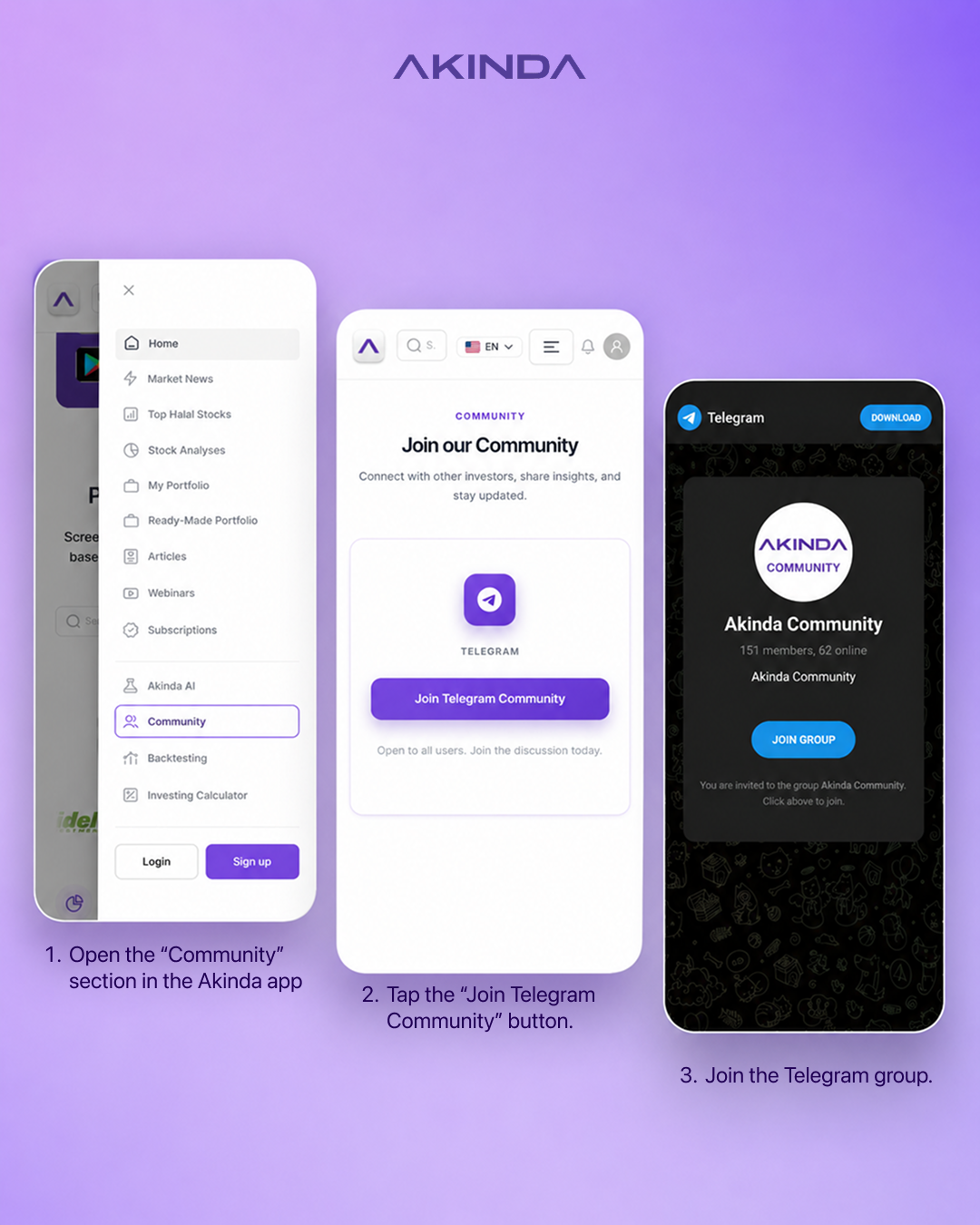
Inside the community, you can:
- Discuss investment ideas
- Stay updated with the latest news and stock analyses
- Share experiences
- Connect with other investors
We also share:
- Swing signals
- Monthly statistics and results
- Competitions and challenges
Whether you start your own club with friends or join ours, the principle is the same: investors who learn together build wealth together.
FAQ
Do you need money to start an investment club?
No. Many successful clubs are learning-only - members invest individually and use the group purely for research and discussion. You can start today with $0.
Are investment clubs legal?
Yes, in nearly every country. If your club pools money, you may need to register as a legal entity (LLC or partnership in the US, similar structures elsewhere). Learning-only clubs typically have no legal requirements.
Can an investment club be halal?
Absolutely. Halal investment clubs follow the same structure but apply Shariah screening to every position - no riba, no haram sectors, with purification of incidental non-compliant income. Communities like Akinda are built specifically for this.
How often should an investment club meet?
Monthly is the most common rhythm. Weekly burns members out; quarterly loses momentum. Monthly meetings give enough time to research between sessions while keeping the club active.
Not financial advice. The information in this article is for educational purposes only. Always consult a qualified financial advisor and a trusted Islamic scholar before making investment decisions.
You may also like
- What Is Halal Investing? The Complete Beginner's Guide (2026)
How to start halal investing from 0 in 2026 - Is Trading Halal? A Beginner's Guide to Halal Trading
Akinda Features Explained: How to Use the Platform for Halal Investing - Halal Stock Screener: How to Check Any Stock in 30 Seconds (Free)
- How to Find Top Halal Stocks on Akinda (Step-by-Step Guide)
Download the Akinda app and screen stocks instantly for free
🌐 Website: https://akinda.io
📱 App: https://onelink.to/kpqkh6