
- Stock Market & Equities
Weekly Market Recap: June 22–26, 2026 (SpaceX Selloff, Micron Earnings, PCE Inflation, GDP)
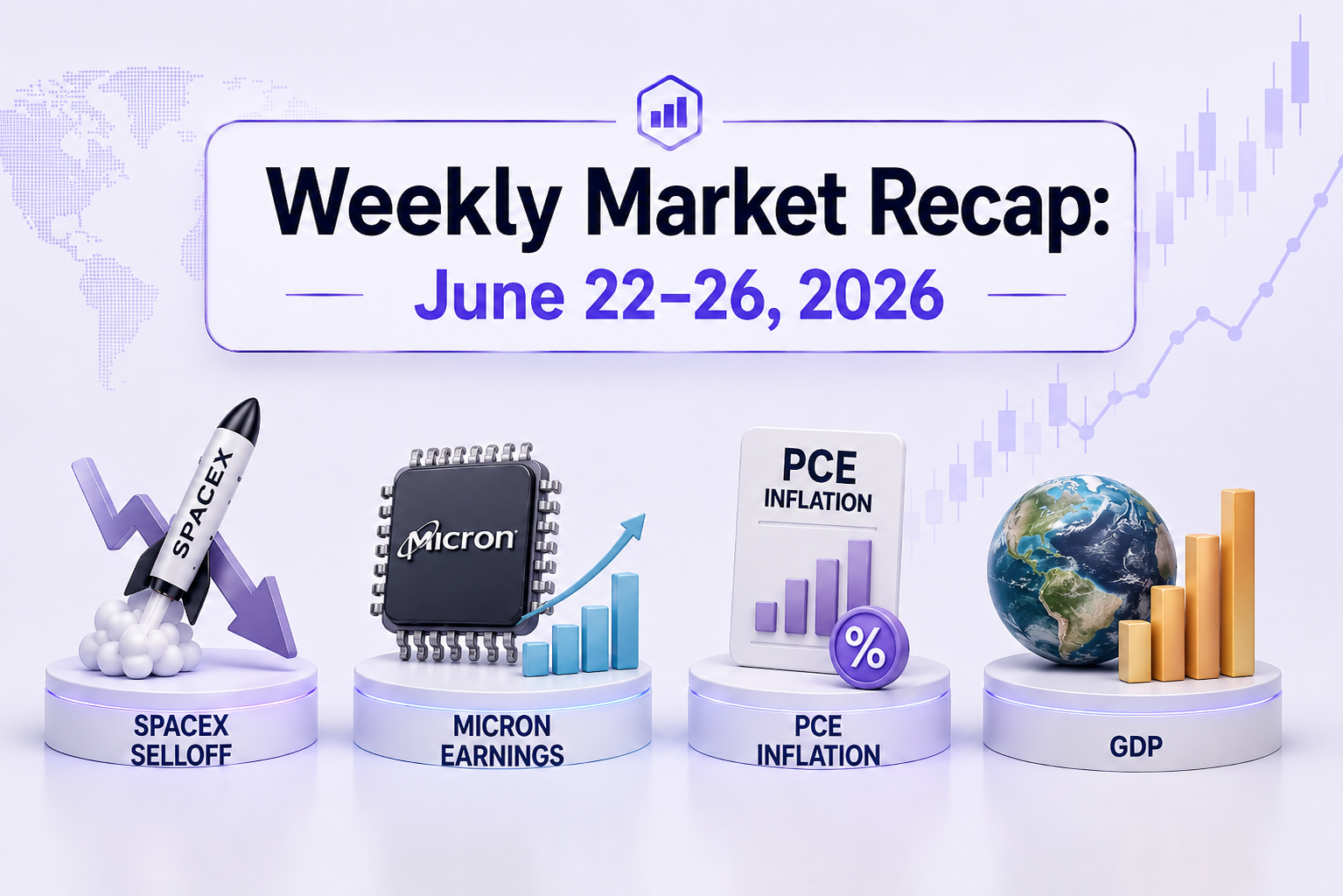
Quick Answer: What Happened in Markets This Week?
In the week of June 22–26, 2026, U.S. markets were defined by a sharp post-IPO selloff in SpaceX and a hot inflation print. SpaceX (SPCX) fell about 31% from its June 16 peak, erasing roughly $620 billion in market value. Micron reported record fiscal Q3 revenue of $41.46 billion, up 346% year-over-year. The Fed’s preferred inflation gauge, the PCE price index, rose 4.1% year-over-year in May - the highest since April 2023 - while Q1 2026 GDP was revised up to 2.1%. Major indexes ended the week mixed, with the Nasdaq lower but market breadth improving as money rotated out of mega-cap tech.
Key Facts at a Glance
- SpaceX (SPCX): Fell ~31% from its June 16 high to a June 22 close of $154.60; ~$620B in market value erased over four sessions.
- Micron (MU): Fiscal Q3 2026 revenue of $41.46 billion (+346% YoY); adjusted EPS $25.11; Q4 guidance $50B midpoint; shares rose ~14.6% after hours.
- PCE inflation (May 2026): Headline 4.1% YoY (highest since April 2023); core PCE 3.4% YoY (highest since October 2023).
- Q1 2026 GDP: Revised up to 2.1% annualized (third estimate), from 1.6% in the second estimate.
- Oil: Brent crude fell to ~$73.40 by Thursday, down more than 35% from its recent peak near $114.
- Market breadth: 63% of S&P 500 stocks traded above their 50-day moving average by late Thursday, up from 50% at the start of June.
Table of Contents
- Why Did SpaceX Stock Fall 16%?
- Did SpaceX Drop Below Its IPO Price?
- How Big Was Micron's Q3 2026 Earnings Beat?
- What Was the May 2026 PCE Inflation Rate?
- How Did the Week End for Stocks?
- What This Week Means for Halal Investors
- FAQ
Why Did SpaceX Stock Fall 16%?
SpaceX (SPCX) stock fell 16% on June 22, 2026, closing at $154.60, after the company announced a $20 billion bond offering just two weeks after its record IPO.
According to CNBC, the drop left SpaceX up only about 14% from its $135 IPO price, down from a June 16 intraday high of roughly $225. NBC News described the 16% drop as the second-largest one-day market-cap wipeout for any stock on record, erasing roughly $400 billion in value. The bond offering, reported by Bloomberg as targeting about $20 billion to repay IPO bridge loans, raised concerns about SpaceX’s capital needs. Credit agencies S&P, Moody’s, and Fitch rated the debt BBB, Baa1, and BBB+ respectively - three notches above junk but short of prime investment grade, per TradingKey.
Alphabet (GOOGL) fell 5% the same day, per CNBC, on two pressures: the departure of AI researchers John Jumper (Google DeepMind) and Noam Shazeer (Gemini co-lead) to rival labs, and the declining value of Alphabet’s roughly 5–7% stake in SpaceX. Amazon and Meta fell 4.8% and 2.3%; Microsoft fell 3%. The Dow rose 148 points as industrials offset tech weakness, led by Caterpillar (+4%).
A $20 billion bond offering two weeks after a $75 billion IPO signals that the AI and space infrastructure buildout requires extraordinary capital. For halal investors, the added interest-bearing debt is another factor to weigh in any future Shariah screening of SPCX, on top of the company’s existing defense-contract and ongoing-loss considerations.
Did SpaceX Drop Below Its IPO Price?
On June 23, 2026, SpaceX shares briefly dipped below their $150 first-day opening price before recovering to close up 1.7%, leaving the stock down about 31% from its June 16 peak.
According to Al Jazeera, the four-session decline erased roughly $600 billion in market capitalization from the peak. A BitMEX analysis noted SpaceX’s float was just 4.2% after the IPO - the lowest for any mega-cap debut in U.S. history - meaning small shifts in buying or selling pressure produce outsized price swings. The same analysis flagged that insider lockup expirations begin in August 2026, which could add further supply pressure around the company’s first earnings report as a public company.
SpaceX’s selloff was driven by market structure (a thin float, high retail ownership, and a stretched valuation) rather than by any change in Starlink’s underlying business. This is a common pattern for newly public companies and reinforces the case for waiting through the post-IPO volatility window before establishing a position.
How Big Was Micron’s Q3 2026 Earnings Beat?
Micron Technology reported fiscal Q3 2026 revenue of $41.46 billion on June 24, 2026, up 346% year-over-year and beating estimates by about 14%, driven by AI memory demand.
Per the official Micron earnings call transcript, adjusted EPS was $25.11 (versus estimates of roughly $19.66–20.49), and the company guided fiscal Q4 revenue to a $50 billion midpoint, about 14.5% above consensus. CEO Sanjay Mehrotra said data center revenue exceeded $25 billion in the quarter - an annualized run rate above $100 billion - and that HBM3E and HBM4 memory products were fully booked through 2027, with demand extending into 2028. The SEC 8-K filing confirmed a quarterly dividend of $0.15 per share. Shares rose roughly 14.6% in after-hours trading to about $1,199, per Investing.com.
Micron’s 346% revenue growth confirms the AI memory (HBM) cycle is still expanding rather than peaking. Micron generally passes Shariah screening on business activity (memory and storage is permissible), though its rising debt load and elevated valuation warrant a check before investing. The result also helped stabilize the broader chip sector after several days of selling.
What Was the May 2026 PCE Inflation Rate?
The PCE price index rose 4.1% year-over-year in May 2026 - the highest since April 2023 - according to the U.S. Bureau of Economic Analysis, while Q1 2026 GDP was revised up to 2.1%.
Headline PCE rose 0.4% on the month and 4.1% year-over-year, while core PCE (excluding food and energy) rose 3.4% year-over-year - its highest since October 2023 - and 0.3% on the month, according to CNBC. Personal income and spending each rose 0.7% on the month, both above forecast. Separately, the BEA’s third estimate of Q1 2026 GDP revised annualized growth up to 2.1% from 1.6%, primarily due to a downward revision to imports. Initial jobless claims fell to 215,000 for the week ended June 20, below the 223,000 estimate. CBS News reported Brent crude touched $73.40 on Thursday and the 10-year Treasury yield fell nearly 0.1 percentage point, as analysts said May’s PCE could mark the peak of the energy-driven inflation spike now that the Strait of Hormuz is reopening.
PCE at 4.1% (and core at 3.4%) keeps a Federal Reserve rate hike on the table for later in 2026, since inflation remains well above the 2% target and is no longer solely energy-driven. Meanwhile, GDP growth of 2.1% with consumer spending revised lower indicates AI-related investment is doing most of the economic lifting - a structurally concentrated source of growth that is exposed if the AI capex cycle slows.
How Did the Week End for Stocks?
Stocks ended the week of June 22–26, 2026 mixed, with technology weak but market breadth improving - 63% of S&P 500 stocks traded above their 50-day moving average by week’s end, up from 50% at the start of June.
Per Charles Schwab’s market update, tech continued to weigh on the major indexes on Friday while advancing shares outnumbered decliners for a sixth consecutive session - a sign of rotation rather than broad de-risking. The University of Michigan Consumer Sentiment final reading for June came in at 48.9, unchanged from the initial estimate but near historic lows. Some of the week’s softness was attributed to quarter-end rebalancing ahead of the June 30 close.
Improving breadth - more stocks advancing even when the index falls - is a structurally healthier setup than a market propelled by a handful of mega-cap names. For halal investors with diversified allocations, this environment tends to reward broad exposure over concentrated bets on the AI trade. Consumer sentiment near historic lows, however, is a metric worth watching into Q3 earnings season.
What This Week Means for Halal Investors
The key takeaway: this week separated business fundamentals from market mechanics. SpaceX’s crash was a structural story; Micron’s surge was a fundamental one; and inflation at 4.1% reset the rate outlook.
- SPCX is a post-IPO volatility story, not a business story. The 31% drop was driven by float mechanics, a bond offering, and lockup concerns - not by Starlink fundamentals. The screening questions (defense, losses, debt) remain, and the volatility adds a reason to wait.
- Micron confirms the AI memory cycle is real and still early. 346% revenue growth with HBM booked through 2027 is not a one-quarter fluke, though the 14.6% after-hours pop means much was already priced in.
- PCE at 4.1% makes a September rate hike a live scenario. Core PCE at 3.4% means inflation isn’t purely energy. Markets price roughly a 50% chance of a hike by September.
- GDP composition is fragile. 2.1% growth led by AI investment while consumer spending fell means the economy leans heavily on one cycle.
- Breadth improvement is the underappreciated headline. A market where 63% of stocks are above their 50-day average is healthier than one led by five names - favoring diversified halal allocations.
Frequently Asked Questions
Why did SpaceX stock crash after its IPO?
SpaceX stock fell about 31% from its peak because of three factors: a $60 billion all-stock Cursor acquisition (announced June 16) that raised dilution concerns, a $20 billion bond offering (announced before June 22) that added debt concerns, and an unusually thin 4.2% float that amplified selling. The company’s underlying Starlink business did not change.
How much did SpaceX lose in market value?
SpaceX lost roughly $620 billion in market capitalization over four trading sessions, falling from a June 16 peak above $225 per share to a June 22 close of $154.60. Its single worst day was June 22, a 16% drop that erased about $400 billion.
What was Micron’s revenue in Q3 2026?
Micron reported fiscal Q3 2026 revenue of $41.46 billion, up 346% year-over-year, with adjusted EPS of $25.11. The company guided fiscal Q4 revenue to a $50 billion midpoint and said its AI memory products were fully booked through 2027.
What is the current US inflation rate (May 2026)?
The PCE price index - the Federal Reserve’s preferred inflation gauge - rose 4.1% year-over-year in May 2026, the highest since April 2023. Core PCE, which excludes food and energy, rose 3.4% year-over-year. (The separate CPI measure for May 2026 was 4.2% year-over-year.)
Will the Fed raise interest rates in 2026?
As of late June 2026, futures markets price roughly a 50% chance of a Federal Reserve rate hike by September. The Fed held its rate at 3.50–3.75% on June 17 but signaled a possible hike via its updated projections, and May’s 4.1% PCE inflation reading keeps that scenario active. A cut appears unlikely in the near term.
Is Micron stock halal?
Micron generally passes Shariah screening on business activity, since semiconductor memory and storage is a permissible business. As with any stock, screening status can change quarterly based on debt ratios and non-permissible income, so it should be verified through your screening platform before investing.
Is SpaceX stock (SPCX) halal?
Akinda’s position is clear and deliberately cautious: under standard Shariah screening, SPCX is best treated as doubtful - not clearly halal. This guide explains exactly what SpaceX is today, what happened with the IPO, how halal screening works, and why caution is the wise default for now.
What economic data comes out next week (June 29 – July 3, 2026)?
The key releases are Conference Board Consumer Confidence (Tuesday, June 30), the June jobs report / nonfarm payrolls (Thursday, July 2, a day early ahead of the July 4 holiday), and FOMC minutes from the June 17 meeting. Early estimates suggest June job growth eased significantly from May’s 172,000.
Disclaimer
This article is for educational purposes only and does not constitute investment, tax, or legal advice. All data points are sourced from publicly available reports linked inline. Shariah compliance status of individual securities can change over time and should be independently verified before any investment decision. Past performance does not guarantee future results.
You may also like
- What Is Halal Investing? The Complete Beginner's Guide (2026)
How to start halal investing from 0 in 2026 - Is Trading Halal? A Beginner's Guide to Halal Trading
- Is Forex Trading Halal or Haram? What Muslim Investors Need to Know (2026)
Akinda Features Explained: How to Use the Platform for Halal Investing - Halal Stock Screener: How to Check Any Stock in 30 Seconds (Free)
- How to Find Top Halal Stocks on Akinda (Step-by-Step Guide)
Download the Akinda app and screen stocks instantly for free
🌐 Website: https://akinda.io
📱 App: https://onelink.to/kpqkh6