
- Halal investing for beginners
Best Halal Stocks for Beginners in 2026 (Start With These)
If you are just starting out and want to grow your money the halal way in 2026, the hardest part is knowing where to begin. The good news: some of the strongest companies in the market right now - especially in AI, semiconductors, and healthcare - are also Shariah-compliant. This guide breaks down the best halal stocks for beginners in 2026, explains how Shariah screening actually works, and shows you a simple, riba-free way to start. No jargon, no interest, just a clear path to building a halal portfolio.
Table of Contents
- What makes a stock halal?
- Why 2026 is a strong year for halal investors
- Best halal stocks for beginners in 2026
- How to start investing in halal stocks
- Common beginner mistakes to avoid
- Frequently asked questions
What Makes a Stock Halal?
A stock is halal when the company passes two screens: a business-activity screen and a financial-ratio screen. Both have to pass - a permissible business with too much interest-based debt still fails.
The business-activity screen
The company's core business must not come from prohibited (haram) sources. That rules out alcohol, gambling, pork, tobacco, weapons, adult content, and conventional interest-based banking. A chip maker, a pharma company, or a software firm passes this screen easily; a conventional bank does not.
The financial-ratio screen (AAOIFI 30/30/5)
Most modern screeners follow the AAOIFI Shariah Standard No. 21, which sets three thresholds measured against market capitalisation:
- Interest-bearing debt must be below 30% of market cap.
- Cash and interest-bearing securities must be below 30% of market cap.
- Non-permissible income (mainly interest income) must be below 5% of total revenue.
Note: some index providers (Dow Jones, S&P, MSCI, FTSE) use a ~33% debt threshold instead of 30%, which is why the same stock can pass under one methodology and fail under another. Always check which standard your screener uses.
One key point beginners often miss: compliance is not permanent. A company can pass this quarter and fail the next if its debt rises or its income mix changes, so ratios must be monitored regularly. You can screen any global stock for free with Akinda's halal stock screener.
Why 2026 Is a Strong Year for Halal Investors
Halal investing used to mean settling for lower returns. That is no longer true. In 2026, many of the market's leading companies happen to sit in exactly the sectors that screen well under Shariah rules.
- Technology and semiconductors tend to pass comfortably because they are asset-light, carry low debt, and earn little interest income - the AI infrastructure buildout has put these names at the centre of market growth.
- Healthcare and pharma offer defensive, permissible businesses with strong pipelines.
- Consumer staples and industrials round out a diversified halal portfolio without touching financials, tobacco, or defence.
In short, staying 100% halal in 2026 does not mean sacrificing performance - some of the best-performing stocks in the market are Shariah-compliant.
Best Halal Stocks for Beginners in 2026
Below is a starting shortlist of large, well-known companies that have screened as Shariah-compliant under AAOIFI standards. These are educational examples, not buy recommendations - always verify current compliance before investing, since ratios change.
| Company | Sector | Why it screens well | Beginner note |
|---|---|---|---|
| NVIDIA (NVDA) | Semiconductors / AI | Very low interest income, hardware-based business | Largest Shariah-compliant company by market cap |
| Apple (AAPL) | Consumer tech | Passes all three ratios; low debt | Familiar brand, huge cash reserves |
| Broadcom (AVGO) | Semiconductors | ~0.5% prohibited income, disciplined balance sheet | AI-silicon exposure beyond NVIDIA |
| Eli Lilly (LLY) | Healthcare / Pharma | Clean business activity, passes screening | Defensive healthcare growth |
| Microsoft* | Software / Cloud | Asset-light, recurring revenue | *Recheck ratios - can shift quarter to quarter |
A quick word on each
NVIDIA (NVDA) is the largest Shariah-compliant company in the world by market cap and the clearest way to get halal AI exposure - its interest income sits well below the 5% line. Apple (AAPL) passes all three ratios and remains a beginner favourite thanks to its scale and cash reserves, though a small slice of impure revenue (from Apple Card interest) means dividends should be purified.
Broadcom (AVGO) is one of the most financially clean names on this list and gives you AI-silicon exposure beyond NVIDIA. Eli Lilly (LLY) offers halal healthcare growth on the back of strong demand for its diabetes and obesity treatments. For each of these, run a fresh screen before you buy - a stock that is halal today can become non-compliant next quarter.
Microsoft (MSFT) is a beginner staple that clears all three AAOIFI ratios, with low debt and interest income comfortably under the 5% line. Its core cloud (Azure) and enterprise software business is squarely permissible, though a small slice of revenue from gaming and advertising means dividends are best purified before you count them as fully clean.
Compliance status noted here reflects recent public screening data and can change. Verify any stock on a dedicated screener before investing.
How to Start Investing in Halal Stocks
You do not need a large amount of money or a finance degree to begin. Here is a simple, beginner-friendly path:
- Screen before you buy. Check any stock against AAOIFI standards using a tool like Akinda so you know it is compliant, not just "probably fine."
- Start small and diversify. Pick a handful of screened companies across different sectors - tech, healthcare, consumer - rather than betting everything on one name.
- Invest for the long term. Halal investing rewards patience. Avoid chasing hype and give your holdings years, not weeks.
- Re-screen every quarter. A company can slip out of compliance if it takes on heavy debt, so recheck your portfolio regularly.
- Purify when needed. If a compliant company earns a small amount of impure income, donate that proportion of your gains to charity to keep your wealth clean.
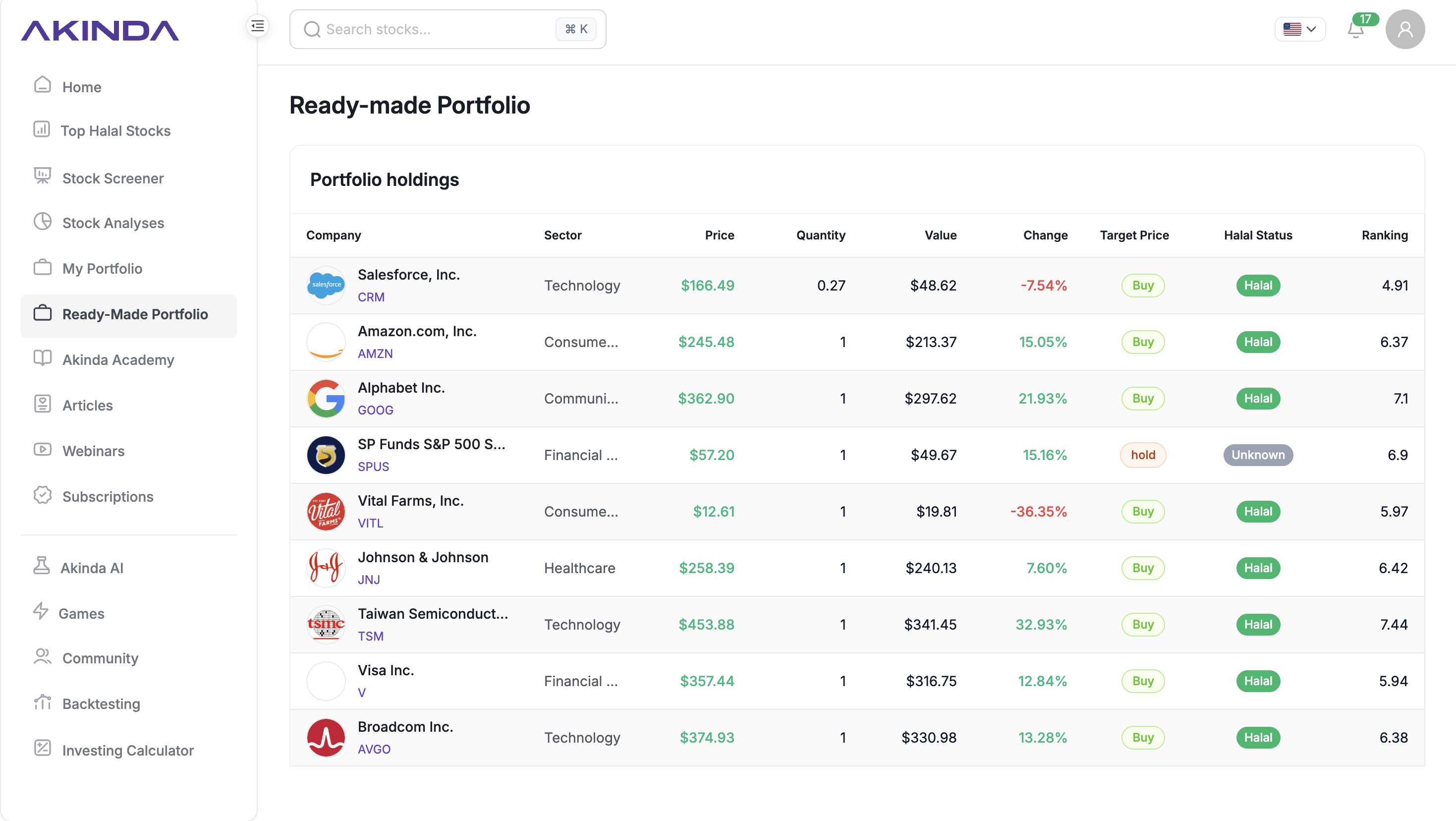
Prefer a done-for-you option? Explore Akinda's top halal stocks and ready-made portfolio to skip the guesswork while you learn.
Common Beginner Mistakes to Avoid
- Assuming halal is permanent. Compliance is dynamic - recheck every few months.
- Confusing "low return" with "halal." You do not have to accept weak performance to stay compliant.
- Skipping the screen. A well-known brand is not automatically Shariah-compliant; a conventional bank fails no matter how big it is.
- Over-paying in fees. Do not spend $20 in commissions to buy $50 of stock - use low-cost or fractional platforms.
- Ignoring purification. Even compliant stocks may carry a tiny impure income that should be cleansed.
Frequently Asked Questions
Is stock investing halal in Islam?
Yes. Owning shares in a company whose core business is permissible and whose finances pass Shariah screening is allowed under Islamic finance. The International Islamic Fiqh Academy permitted investing in compliant common stocks in 1992.
What are the best halal stocks for beginners in 2026?
Large, well-known, low-debt companies in permissible sectors - such as NVIDIA, Apple, Broadcom, and Eli Lilly - have screened as compliant recently. Always verify current status before buying, since ratios change.
How do I know if a stock is halal?
Check two things: the company's core business (no alcohol, gambling, tobacco, weapons, or interest-based banking) and its financial ratios (debt, interest-bearing assets, and impure income within AAOIFI limits). A free screener like Akinda does this instantly.
Do I need to purify my halal stock gains?
If a compliant company earns a small amount of non-permissible income (for example, interest on its cash), you donate that proportion of your dividends or gains to charity. Screeners often calculate the purification amount for you.
Can a halal stock become haram later?
Yes. If a company's debt or interest income rises above the AAOIFI thresholds, it can lose compliance. That is why re-screening your portfolio every quarter matters.
Disclaimer: This article is for educational purposes only and does not constitute financial, legal, or religious advice. Shariah compliance is based on publicly available data and AAOIFI guidelines; individual scholars may differ. Compliance status can change, always verify before investing and consult a qualified advisor or scholar for your circumstances.
You may also like
- What Is Halal Investing? The Complete Beginner's Guide (2026)
How to start halal investing from 0 in 2026 - Is Trading Halal? A Beginner's Guide to Halal Trading
- Is Forex Trading Halal or Haram? What Muslim Investors Need to Know (2026)
- Is Options Trading Halal or Haram?
Akinda Features Explained: How to Use the Platform for Halal Investing - Halal Stock Screener: How to Check Any Stock in 30 Seconds (Free)
- How to Find Top Halal Stocks on Akinda (Step-by-Step Guide)
Download the Akinda app and screen over thousands of global stocks, monitor Shariah compliance in real time
🌐 Website: https://akinda.io
📱 App: https://onelink.to/kpqkh6