
- Stock Market & Equities
June 2026 Stock Market Recap: The Iran War Ends, the Largest IPO in History, and an AI Selloff
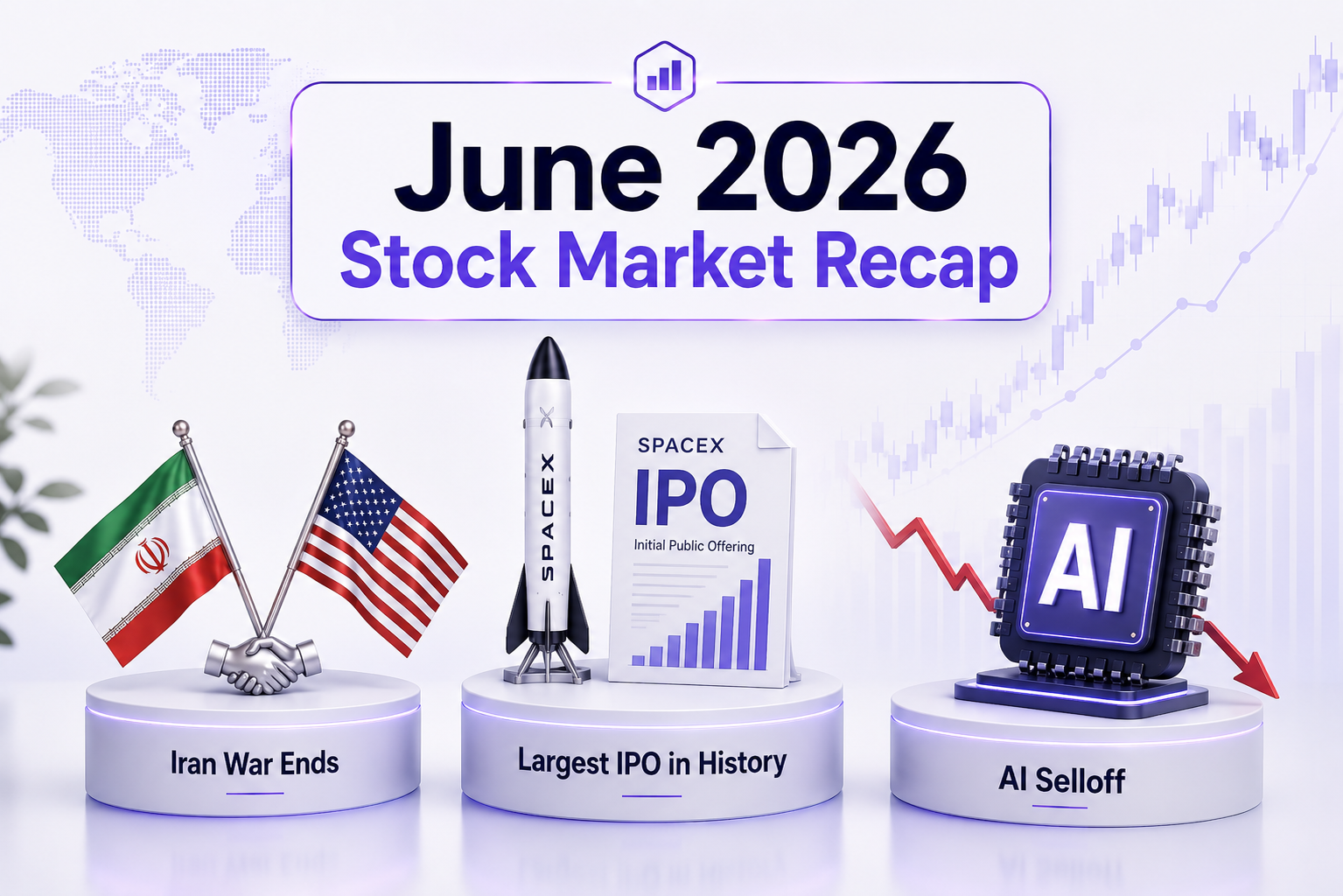
Quick Answer: What Happened in Markets in June 2026?:
June 2026 was one of the most eventful months in recent market history. The U.S.-Iran war that began in February ended with a signed ceasefire framework, sending oil down roughly 35% from its peak. SpaceX held the largest IPO in history, raising about $75 billion at a $1.75 trillion valuation, then fell more than 30% from its first-week high. Inflation rose to a three-year high (CPI 4.2%, PCE 4.1%), and the Federal Reserve - under new Chair Kevin Warsh - held rates but signaled a possible hike. Despite all this, the S&P 500 finished the month down only about 2%, while the broader quarter was its strongest in six years.
June 2026 at a Glance: Key Numbers
- S&P 500 (month): Down roughly 2% in June, but the April–June quarter was its best in six years.
- Oil (Brent): Fell from a peak near $114 to about $73 by late June - down more than 35% - as the Iran war wound down.
- Inflation: May CPI hit 4.2% YoY and May PCE hit 4.1% YoY - both the highest since 2023, driven mostly by energy.
- Federal Reserve: Held rates at 3.50–3.75% on June 17 (Warsh's first meeting) but flipped its projections toward a possible hike.
- SpaceX (SPCX): Largest IPO in history (~$75B raised); debuted June 12 up ~19%, then fell ~31% from its peak by late June.
- Micron (MU): Reported record fiscal Q3 revenue of $41.46 billion, up 346% YoY, on AI memory demand.
- Market breadth: 64% of S&P 500 stocks ended June above their 50-day moving average, up from 50% a month earlier.
Table of Contents
- The Iran War Ended and Oil Collapsed
- SpaceX's Record IPO and the Reality Check That Followed
- Inflation Returned, and the Fed Changed Its Tune
- The AI Trade Wobbled, Then Steadied
- A Down Month Inside a Record Quarter
- Week-by-Week: The Full June Timeline
- FAQ
The Iran War Ended and Oil Collapsed
The single most consequential development of June 2026 was the end of the U.S.-Iran war, which sent oil down more than 35% from its peak and began unwinding the inflation pressure that had built up since February.
The conflict, which began February 28 and closed the Strait of Hormuz in early March, dominated markets for months. On June 15, President Trump announced a deal was “complete,” according to NPR. A 14-point memorandum of understanding - detailed by NBC News - declared an intent to permanently end military operations and reopen the Strait of Hormuz toll-free for 60 days. Iran confirmed the MOU was signed electronically on June 17–18.
The market impact was immediate. CNBC reported Brent crude settled at $73.74 on June 24 - its lowest since before the war began and West Texas Intermediate fell to $70.34. Gold, which had rallied as a safe haven during the war, fell below $4,000 for the first time in seven months as the geopolitical premium drained out. For the deeper week-by-week detail, see our June 15–19 weekly digest, which covered the deal’s signing in full.
Energy prices feed directly into inflation, so the oil collapse is the key to the entire June macro story: it is why analysts began describing May’s inflation spike as a likely peak. For halal investors, who often hold energy and commodity exposure, the unwind is a reminder that geopolitical premiums can disappear as quickly as they appear - though the 60-day negotiating window means the resolution is not yet permanent.
SpaceX's Record IPO and the Reality Check That Followed
SpaceX held the largest IPO in history on June 12, 2026, raising about $75 billion at a $1.75 trillion valuation, then fell more than 30% from its first-week peak as float mechanics and a bond offering caught up with the hype.
SpaceX (ticker SPCX) priced at $135 per share and debuted up about 19%, briefly pushing its market cap above $2 trillion and reportedly making Elon Musk the world’s first paper trillionaire. The raise more than doubled Saudi Aramco’s previous $29 billion record from 2019. Within days, the company announced a $60 billion all-stock acquisition of AI coding startup Cursor, followed by a roughly $20 billion bond offering.
Then came the reversal. Al Jazeera reported the stock fell roughly 31% from its June 16 peak, erasing some $600–620 billion in market value, with a 4.2% float - the lowest for any U.S. mega-cap debut - amplifying the swings. We covered the IPO and the selloff in our June 22–26 weekly digest.
Is SpaceX halal?
As of end-June 2026, major Shariah screening platforms had not yet published a classification for SPCX. The open questions are its significant U.S. defense contracts, ongoing losses, and newly added bond debt. We break this down in our dedicated guide on whether SpaceX is halal, and you can check current rulings with the Akinda halal stock screener. Standard practice is to wait for an explicit screening result before treating any new listing as eligible.
Inflation Returned, and the Fed Changed Its Tune
Inflation hit a three-year high in June 2026 - CPI at 4.2% and PCE at 4.1% year-over-year and the Federal Reserve, under new Chair Kevin Warsh, held rates steady but signaled a possible hike later in the year.
The May CPI report, released June 10, showed headline inflation at 4.2% year-over-year - the highest since 2023 - with energy responsible for over 60% of the increase, per the BLS. Two weeks later, the May PCE print (the Fed’s preferred gauge) came in at 4.1% headline and 3.4% core, according to CNBC.
On June 17, the Fed held its rate at 3.50–3.75% in Warsh’s first meeting as Chair, but CNBC reported the updated projections flipped toward a possible hike, and Warsh stripped the post-meeting statement down to 130 words - removing the forward guidance markets had relied on for over a decade. The full FOMC breakdown is in our June 15–19 weekly digest. This followed the broader inflation re-acceleration we first flagged in our May 2026 monthly recap.
A Fed that removes forward guidance forces markets into pure data-dependency - every inflation and jobs report now carries more weight. For halal investors with rate-sensitive holdings (real estate, long-duration growth names), the takeaway is to watch incoming data closely, since the old crutch of “the Fed told us what’s coming” no longer applies.
The AI Trade Wobbled, Then Steadied
The AI and semiconductor trade that powered markets through early 2026 stumbled badly in late June - with the SMH chip ETF falling 7% in a single session - before recovering into month-end as investors reassessed valuations.
The selloff had several triggers: Broadcom and other chipmakers fell on rate-hike fears after strong-but-not-enough guidance; Alphabet lost two senior AI researchers to rivals; and capital-raising concerns mounted as AI companies leaned on equity and debt to fund expansion. CNBC noted the SMH semiconductor ETF fell 7% on June 23 alone. Yet the fundamentals underneath stayed strong: Micron’s record $41.46 billion quarter (+346% YoY) confirmed AI memory demand was still booked out through 2027.
By the final days of June, the trade steadied. Trading Economics reported that on June 29 the Nasdaq 100 surged 2.3% and the S&P 500 rose 1.2% as investors reassessed AI names, helped by easing Iran tensions. Notably, Alphabet replaced Verizon in the Dow Jones Industrial Average effective June 29, expanding mega-cap tech’s presence in the blue-chip index, and jumped about 5% on its first day as a Dow component.
The June wobble was a valuation reset, not a demand collapse - a useful distinction. For halal investors, who are often overweight tech because financials are screened out, this episode is a reminder that AI-linked names can correct sharply on macro news even when their business fundamentals are intact. Position sizing matters more than conviction when multiples are stretched.
A Down Month Inside a Record Quarter
The S&P 500 fell about 2% in June 2026, yet the April–June quarter was its strongest in six years - a split that captures how much the Iran war’s resolution reshaped markets in a single month.
Per Charles Schwab’s June 30 market update, June was on track for a monthly loss - weighed down by the Magnificent Seven - even as the quarter shaped up as the best for the S&P 500 and Nasdaq in six years, and the Dow’s best quarter since 2022. The same report highlighted that market breadth improved markedly: 64% of S&P 500 stocks ended June above their 50-day moving average, up from 50% a month earlier, suggesting the market grew less dependent on a handful of mega-cap names.
By the close on June 29, the S&P 500 stood near 7,440 and the Dow at a record 52,183, according to Trading Economics, though the index remained down about 2.1% on the month and up nearly 20% year-over-year.
A down month inside a record quarter is a healthy kind of consolidation - the rotation away from concentrated mega-cap tech into a broader set of stocks is structurally constructive. For diversified halal portfolios, improving breadth tends to reward broad exposure over narrow bets on a few AI names.
Week-by-Week: The Full June Timeline
For readers who want the day-by-day detail, here is how June 2026 unfolded across our four weekly digests:
- June 1–5: Alphabet's $80B raise, S&P 500 above 7,600, a Friday jobs-driven selloff
- June 8–12: A 900-point Dow drop, 4.2% CPI, the ECB hike, and SpaceX's record debut
- June 15–19: The US-Iran deal, Warsh's first FOMC, and five central banks in five days
- June 22–26: SpaceX's $620B selloff, Micron's record quarter, and PCE at 4.1%
What June 2026 Means for Halal Investors
The key lesson of June 2026: the biggest risks and the biggest opportunities both came from outside the corporate earnings cycle - from war, peace, monetary policy, and a single historic IPO.
- The energy-inflation link is now the master variable. Oil drove both the inflation spike and its likely peak. Watching energy is watching inflation, which is watching the Fed.
- New listings deserve patience. SpaceX’s 31% post-IPO drop shows why waiting through the volatility window - and for screening clarity - protects capital.
- The Fed’s new style raises the stakes on data. With forward guidance gone, each CPI, PCE, and jobs report matters more. Expect choppier reactions.
- Breadth is quietly improving. A market broadening beyond the Magnificent Seven rewards diversified halal allocations more than concentrated AI bets.
- AI fundamentals are intact; valuations are the risk. Micron’s 346% growth confirms demand. The June wobble was about price, not product.
Frequently Asked Questions
How did the stock market do in June 2026?
The S&P 500 fell about 2% in June 2026, weighed down by a late-month selloff in mega-cap tech, but the April–June quarter was its strongest in six years. The Dow Jones closed June near a record 52,183, and market breadth improved, with 64% of S&P 500 stocks ending the month above their 50-day moving average.
Did the US-Iran war end in June 2026?
Yes. A 14-point memorandum of understanding to end the U.S.-Iran war was announced June 15 and signed electronically on June 17–18, declaring an intent to permanently end military operations and reopen the Strait of Hormuz. It opens a 60-day negotiating window on remaining issues, so it is a major de-escalation rather than a fully finalized peace treaty.
Why did oil prices fall in June 2026?
Oil fell more than 35% from its peak - Brent dropping to about $73 by late June - because the U.S.-Iran war that had disrupted Gulf supply since February wound down. The reopening of the Strait of Hormuz removed the war premium that had been priced into crude.
How big was the SpaceX IPO?
SpaceX held the largest IPO in history in June 2026, raising about $75 billion at a $1.75 trillion valuation - more than double Saudi Aramco’s previous $29 billion record from 2019. The stock debuted up about 19% on June 12, then fell more than 30% from its first-week peak by late June.
What is the current US inflation rate (mid-2026)?
As of the May 2026 data released in June, U.S. CPI inflation was 4.2% year-over-year and PCE inflation (the Fed’s preferred gauge) was 4.1% - both the highest since 2023. Energy was the main driver, accounting for over 60% of the CPI increase.
Did the Fed raise rates in June 2026?
No. The Federal Reserve held its rate at 3.50–3.75% on June 17, 2026, in Chair Kevin Warsh’s first meeting. However, its updated projections flipped toward a possible hike later in 2026, and futures markets priced roughly a 50% chance of a hike by September.
What should halal investors watch in July 2026?
The key items are the June jobs report (due July 2), the start of Q2 earnings season in mid-July, FOMC minutes from the June 17 meeting, and any developments in the 60-day U.S.-Iran negotiating window. Watch whether the AI-trade recovery into month-end holds, and whether falling oil continues to ease inflation.
Disclaimer
This article is for educational purposes only and does not constitute investment, tax, or legal advice. All data points are sourced from publicly available reports linked inline. Shariah compliance status of individual securities can change over time and should be independently verified before any investment decision. Past performance does not guarantee future results.
You may also like
- What Is Halal Investing? The Complete Beginner's Guide (2026)
How to start halal investing from 0 in 2026 - Is Trading Halal? A Beginner's Guide to Halal Trading
- Is Forex Trading Halal or Haram? What Muslim Investors Need to Know (2026)
Akinda Features Explained: How to Use the Platform for Halal Investing - Halal Stock Screener: How to Check Any Stock in 30 Seconds (Free)
- How to Find Top Halal Stocks on Akinda (Step-by-Step Guide)
Download the Akinda app and screen stocks instantly for free
🌐 Website: https://akinda.io
📱 App: https://onelink.to/kpqkh6